If you are wondering how to sell a hair salon or barbershop, here is the short version: buyers do not just buy chairs and a name. They buy a licensed location, a team that may or may not stay, a client base that follows individual stylists, and a lease. Each of those can break a deal if you leave it unresolved.
This post walks through the four issues that surprise salon sellers most: the salon license, booth renter versus employee classification, the stylists and clients you are really handing over, and the lease and build-out. You will get a checklist of what to settle and document before you list, so you can raise problems yourself instead of waiting for a buyer to find them.
Why selling a salon or barbershop is different
Most owners start with a reasonable assumption: I have a licensed salon, a busy book of clients and a full set of chairs, so the buyer gets all of that when they pay me. In a salon, that assumption is shaky on every count.
The license that lets the shop operate is often tied to the owner and the location, not to the business as an asset. The people who generate the revenue are licensed professionals with their own credentials, and many of them may not be your employees at all. The clients often book with a person, not with a brand. And the space itself usually belongs to a landlord who gets a say in who takes over.
That makes a salon sale closer to a handover of relationships and permissions than a handover of equipment. A buyer, and any lender behind the buyer, will ask questions that a retail shop owner would never hear. The good news is that nearly every one of those questions has a practical fix if you start early.
If you are still early in the process, it helps to read a general overview such as our practical step-by-step guide to selling a business alongside this one. Here we stay focused on what is specific to salons and barbershops.
The salon license usually does not transfer to the buyer
Start with the permission that lets you cut hair for a living. In a 2018 Career Outlook article, the U.S. Bureau of Labor Statistics noted that all states require barbers, hairstylists and cosmetologists to be licensed. That article also makes a distinction sellers often miss: individual practitioner licenses are separate from the salon (establishment) license. You and your stylists hold personal licenses. The shop holds its own. Confirm both with your state board.
The establishment license is the one that matters in a sale, and the rule in many states is simple: it does not move from seller to buyer. The buyer applies for their own. The details, deadlines and steps differ a lot from state to state, so here are four examples of how it can look. Treat them as illustrations of the range, not as a description of your state.
Massachusetts: new application and inspection
According to Mass.gov, a salon license is not transferable. Salon owners must immediately notify the board if they plan to sell an operating salon, and the new owners must file a new salon application. After a change in ownership, the salon may remain open for 30 days before the new owners must obtain a new license.
The state regulation goes further. Under 240 CMR 3.01, salon owners must submit an application for a new license at least 30 days in advance of the sale or change in ownership of a salon. The purchaser of a previously licensed salon must file a new application, pay the required fees, and have the premises inspected and approved by the Board.
Read those two sources together and you can see why timing matters. The notice requirement, the advance application and the post-closing window all touch the closing date. If you are in Massachusetts, ask the board how those pieces fit together for your deal before you sign a purchase agreement with a fixed closing date.
Minnesota: new license within a window after the change
The Minnesota Board of Cosmetology salon license application (2024) states that a salon license does not transfer when a salon changes ownership or relocates. If the salon changes ownership, business structure or location, a new salon license is required within 60 days of the change.
Notice the words “business structure.” In that state, even a change to how the business is organized can trigger the requirement, which matters if a buyer plans to operate through a new entity.
Iowa: what counts as a change in ownership
Under Iowa Board of Cosmetology rule 645-61.2, as described in the board’s ownership change FAQ, a salon license is not transferable and a change in ownership requires a new license. The board defines change in ownership as any change of controlling interest in a corporation or any change of name of a sole proprietorship or partnership.
Two further points from that guidance are worth flagging for sellers. A salon cannot be sold if disciplinary actions are pending, so an open complaint or board matter is something to resolve before you list, not after you have a signed offer. And the selling owner must send the license certificate and a report of the sale to the board within 10 days of the date the sale is final. That last item is on you, not the buyer, so put it on your closing checklist.
Ohio: deal structure can change the steps
Ohio Administrative Code 4713-1-11 says salon and barber shop licenses are not transferable from one owner to another. A licensee transferring majority ownership or the physical location must apply for a new license within 30 days of the change. But a legal business with an ownership change that does not transfer majority ownership must report it to the board within 30 days and does not need a new license.
The lesson is bigger than Ohio. How the deal is structured, such as an asset sale versus a sale of majority ownership, can change which licensing steps apply. Before you agree to a structure, ask your state board and your attorney how that structure plays out for the license. You can also read our guide to the asset sale approach to see why structure drives so many other parts of a deal.
What to do about the license before you list
- Call your board. Ask what happens to the salon license on a sale, whether it matters if the deal is an asset sale or a sale of ownership interests, and what deadlines apply to you and to the buyer.
- Check for open issues. Make sure your own license and your establishment license are in good standing, and that no disciplinary matter is pending.
- Build the timeline around it. A buyer who needs a new license and an inspection should not be surprised by it in the final week. Put the licensing steps in the purchase agreement timeline.
- Know who files what. Some states put notice duties on the seller and application duties on the buyer. Write down which is which.
- Check each stylist’s personal license. Buyers will want to know that everyone working in the shop is properly licensed in their own right.
Because rules vary so widely, an attorney who knows your state’s cosmetology or barber board is worth a short conversation here. If the license is not sorted out, the buyer may not be able to operate lawfully on day one, and a careful buyer or lender will notice that.
Booth renters or employees: get the classification right before buyers look
Many salons run on a mix of employees and independent stylists who rent a chair or suite. That model is common in this industry, and the numbers help explain why. According to the U.S. Bureau of Labor Statistics Occupational Outlook Handbook (2024 data), barbers held about 76,000 jobs in 2024, and 76% of them were self-employed. In the same data, hairdressers, hairstylists and cosmetologists held about 575,200 jobs in 2024, and 48% of them were self-employed.
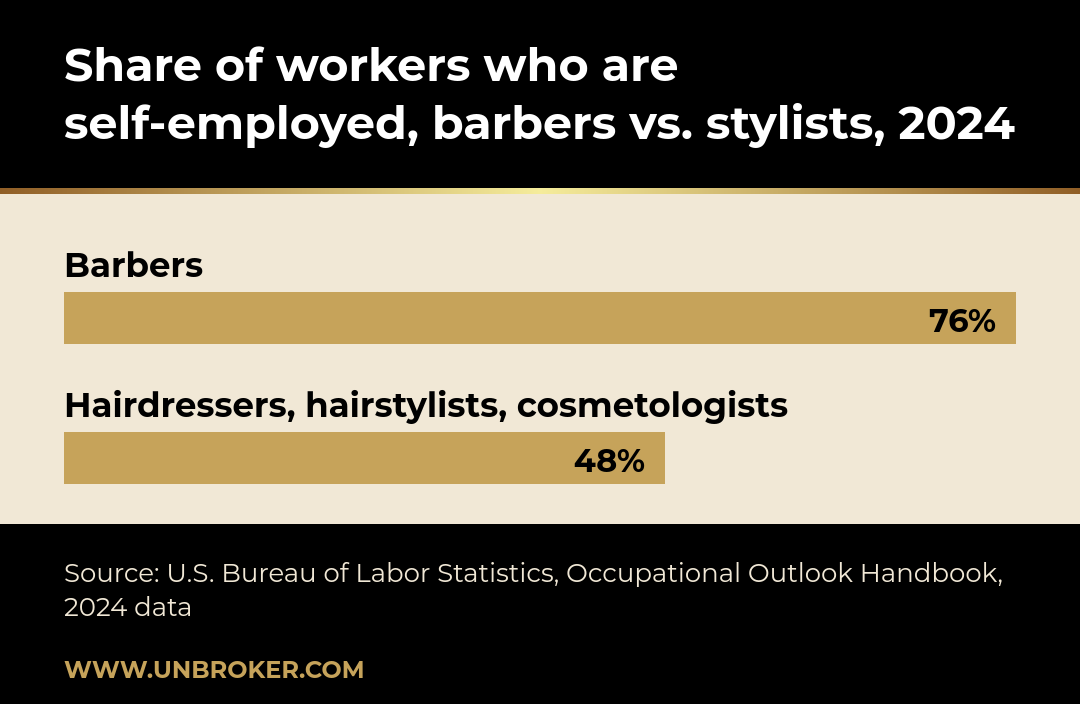
Keep the limits of those figures in mind. They describe workers in those occupations nationwide, not the stylists in your shop, and “self-employed” is not the same thing as “booth renter at your salon.” What the figures do show is that independent work is a normal part of this trade, which means a buyer will expect to see it and will want to know it is set up properly.
Why classification becomes a sale issue
If you call someone an independent contractor but treat them like an employee, a buyer inherits the risk. Back payroll taxes, unpaid withholding, workers’ compensation questions and penalties can attach to a business whatever the paperwork says. Buyers price that risk or walk away from it, and in an asset sale they may ask for a specific protection from you in the contract.
The IRS says that for federal employment tax purposes, the usual common law rules decide whether a worker is an independent contractor or an employee. The evidence falls into three categories: behavioral control, financial control, and the relationship of the parties. On financial control, the IRS looks at things such as:
- the worker’s unreimbursed business expenses
- the worker’s investment in facilities or tools
- whether the business provides employee-type benefits such as insurance, a pension plan, vacation pay or sick pay
Just as important, the IRS guidance on common-law employees says that anyone who performs services for you is your employee if you can control what will be done and how it will be done, even when you give the worker freedom of action. What matters is the right to control the details of how the services are performed, not the label in a contract.
For a salon owner, that is the uncomfortable part. A signed rental agreement that says “independent contractor” does not settle the question on its own. If you set the stylist’s schedule, require specific services or prices, dictate how they work with clients, supply all the tools and products, or pay them in a way that looks like wages, a reviewer could see an employee. On the other hand, a stylist who sets their own hours and prices, buys their own products, carries their own insurance, books their own clients and pays you a fixed chair rental looks more like a true renter. Your state may apply its own tests for wage, unemployment insurance and workers’ compensation purposes, and those tests can differ from the federal one, so confirm with a tax adviser or employment attorney.
If you are unsure, there is a way to ask
The IRS says a business or a worker who wants the IRS to determine whether a specific individual is an independent contractor or an employee can file Form SS-8, Determination of Worker Status for Purposes of Federal Employment Taxes and Income Tax Withholding. Whether that is the right move for you is a question for your tax adviser, since filing has consequences of its own. But it is useful to know the option exists, particularly if you have a long-standing arrangement that you have never had reviewed.
How to clean this up before you list
- Sort every person who works in the shop into a category. Employee, booth or chair renter, or something else. Write the list down.
- Compare reality to paper. For each renter, check the signed agreement against how things actually work day to day: who sets hours, prices and rules, who buys supplies, who books the clients, who carries insurance.
- Fix mismatches. Where a renter is acting like an employee, talk to your adviser about converting the relationship to employment going forward, or about changing the arrangement so it truly fits a rental.
- Collect the paperwork. Signed rental agreements, proof of each renter’s personal license, any insurance certificates, and records showing rent payments.
- Write down how rental income is recorded. Buyers and their advisers will want to see how chair rent and service revenue show up in your books. If you are unsure how that affects the earnings a buyer sees, ask a valuation adviser.
If this sounds familiar from other studio-style businesses, you may find our post on exit planning for tattoo studios with contracted artists useful, because the same classification questions come up there.
Your stylists and your clients: what a buyer is really buying
This is where the assumption that “the stylists and the clients come with the salon” gets tested. Neither is something you can hand over by signing a document.
The stylists are people, not assets
Employees can usually choose to stay or go after a sale. Booth renters hold their own licenses and often have their own agreements with you, and they may not have any obligation to stay once ownership changes. If your top few stylists leave, the shop a buyer thought they were buying can look very different within weeks.
Buyers know this, so they will ask:
- Who are the key stylists and barbers, and how long have they been with the shop?
- What share of the shop’s work comes from a small group of people?
- Are there written agreements, and do they allow assignment to a new owner?
- Do any stylists have non-solicitation or non-compete terms, and are those terms enforceable where you are? Rules on restrictive agreements vary by state, so ask your attorney before you rely on one.
- Are there key people who are close to retiring or planning to leave?
Our guide on what to do when a key employee or manager walks away covers the broader version of this problem. For a salon, the practical step is to talk to your most important people at the right moment. When to tell your team is a judgment call, since confidentiality matters and rumors can hurt a business. Many owners wait until a serious buyer is engaged and a confidentiality agreement is in place. Whatever you choose, plan it rather than letting staff find out from a client.
The clients belong to the chair as much as the shop
In salons and barbershops, loyalty often runs to a person. A client who has seen the same barber for years may follow that barber anywhere. That is a strength if the barber stays, and a risk if they do not.
What helps a buyer get comfortable:
- Client records you own. Booking system data, contact details (handled in line with privacy rules and your client communications policies), visit history and service history for the shop.
- A booking process that belongs to the business. If appointments run through your system and your phone number instead of personal social media accounts, the relationship is more tied to the shop.
- Brand assets. The shop name, website, review profiles and social accounts should be in the business’s name and under your control, with logins documented.
- Retail and product relationships. Supplier accounts, product lines and any distributor terms, including whether they can be assigned.
Confidentiality matters here. You do not want clients, or the shop down the street, hearing that you are selling before you are ready. Our guide on marketing your business for sale without scaring customers explains how to share information in stages so that only serious, qualified buyers see the details.
The lease and the build-out: what to settle before you list
For most salons and barbershops, the location is the business. Clients know where to find you, plumbing and stations are built in, and the lease terms decide whether the shop can keep operating under new ownership. Buyers and their lenders usually treat the lease as one of the first documents to review.
Read your lease like a buyer would
Pull out the lease and every amendment, and look for:
- Assignment and change of control clauses. Does the landlord need to consent when the lease is assigned or when ownership changes? Can consent be withheld, and on what grounds?
- Remaining term and renewal options. A buyer will want enough runway to make the purchase worthwhile. A lease that is close to expiring is a problem to address early.
- Rent changes. Escalation schedules, percentage rent if any, and what happens at renewal.
- Personal guaranty. If you signed one, ask your attorney how you can be released at closing. Buyers often need to provide their own.
- Permitted use. Make sure the lease allows the services you offer, including any chemical services, and that the use is described in a way a new owner can continue.
- Repair, restoration and alteration terms. Who owns the build-out, and what must be restored when the lease ends?
If the lease has a problem, such as a short remaining term, no assignment right or a landlord who is hard to reach, start that conversation before you list. A landlord’s written consent, or an extension negotiated in advance, can turn a risk into a selling point. Similar issues come up in other leased businesses, and our posts on selling a laundromat and selling a leased dog daycare facility go into landlord consent in more depth.
Know what the build-out and equipment are worth to a buyer
Chairs, shampoo bowls, mirrors, color stations, dryers, point of sale hardware and retail displays are part of what you are selling, but their value to a buyer depends on condition and fit. Make an inventory with make, age and condition for the major items. Note what is owned outright, what is leased, and what has a lien against it. If you financed equipment, you will need to know what is owed so it can be paid off or handled at closing.
Also check plumbing, ventilation, electrical and any permits tied to the space. Buyers who plan to open under their own license will often have the premises inspected, and in some states that inspection is part of the licensing process. If you know of repairs the space needs, fixing them or disclosing them early usually goes better than a surprise during review.
If you have an SBA loan or other financing on the business, read selling a business with an SBA loan for how liens and lender consent can affect timing.
What to put in your sale package
Once you have worked through the license, the team and the lease, put everything in one organized package so a serious buyer can see a clear picture quickly. A tidy package signals that the shop is well run. It also shortens the back-and-forth that slows many deals. Our checklist of documents needed to sell is a good general starting point. For a salon or barbershop, add the items below.
- Licensing file. Your salon license, your personal license, each stylist’s license, any inspection records, and a short note on what your state board says about a change of ownership.
- Team summary. A confidential list of roles, tenure and compensation structure, split between employees and renters, with names shared only at the right stage of the process.
- Renter agreements. Signed chair or booth rental agreements, rent history and proof of renters’ insurance and licenses.
- Classification notes. A brief memo from your adviser on how you determined each worker’s status and any steps you have taken to align practice and paperwork.
- Financial statements and tax returns. Profit and loss statements and returns that show how service revenue, retail sales and chair rent are recorded, with any one-time or personal expenses clearly explained.
- Lease package. The full lease, amendments, landlord contact and any consent or estoppel the landlord has agreed to provide.
- Equipment and inventory list. With condition, ownership and any liens noted.
- Client and booking data summary. What the booking system shows about client volume and repeat visits, presented so it does not expose private client details early.
- Supplier and vendor contracts. Product distributors, software, merchant processing and any service agreements, with notes on which can be assigned.
- Brand and online assets. Domain, social accounts, review profiles and phone number, with ownership documented.
- Insurance. Liability, property and workers’ compensation policies and claims history.
For help thinking through how buyers read these materials, see our guides to seller due diligence and packaging your business for sale appeal.
Fix it first, then list
Salon sales tend to go wrong when a buyer discovers something the seller already knew about: a license that has to be reissued, renters who look like employees, a stylist who is about to leave, or a lease that cannot be assigned. None of these problems has to end a sale. Each one is much easier to handle when you bring it up yourself, with a plan, than when it arrives as a surprise in the middle of due diligence.
A simple order of operations helps. First, call your state board and learn the licensing steps for a sale. Second, review your renter and employee arrangements with a tax adviser or employment attorney. Third, read your lease and talk to your landlord. Fourth, gather your records and decide how and when to talk to your team. Then you are ready to put the business in front of buyers on your terms.
Unbroker helps owners sell their businesses through a confidential process, with expert advisors, AI-driven buyer matching and national marketing that can reach qualified buyers for a salon or barbershop. Our Full Service Business Sale charges a 6% success fee, paid when the business sells. To see how it works, visit Unbroker.