If you want to know how to sell a laundromat, start with what a buyer and the buyer’s lender will check first: the lease, the machines, and whether your utility bills and payment records support the revenue you report. Those three items decide more laundromat deals than almost anything in your marketing materials.
This post walks through each of them in order, then covers buyer financing, staff, handover and confidentiality. It ends with a checklist you can work through before you talk to a single buyer.
What Makes a Laundromat Different to Sell
A laundromat looks simple from the outside: people come in, wash clothes, pay, and leave. To a buyer it is a bundle of long-lived, location-dependent assets. You have a lease that controls the site, machines that wear out, plumbing and water heating that cost real money to replace, and revenue that is largely paid by card, app or coin. Each of those can be verified, and a careful buyer will verify them.
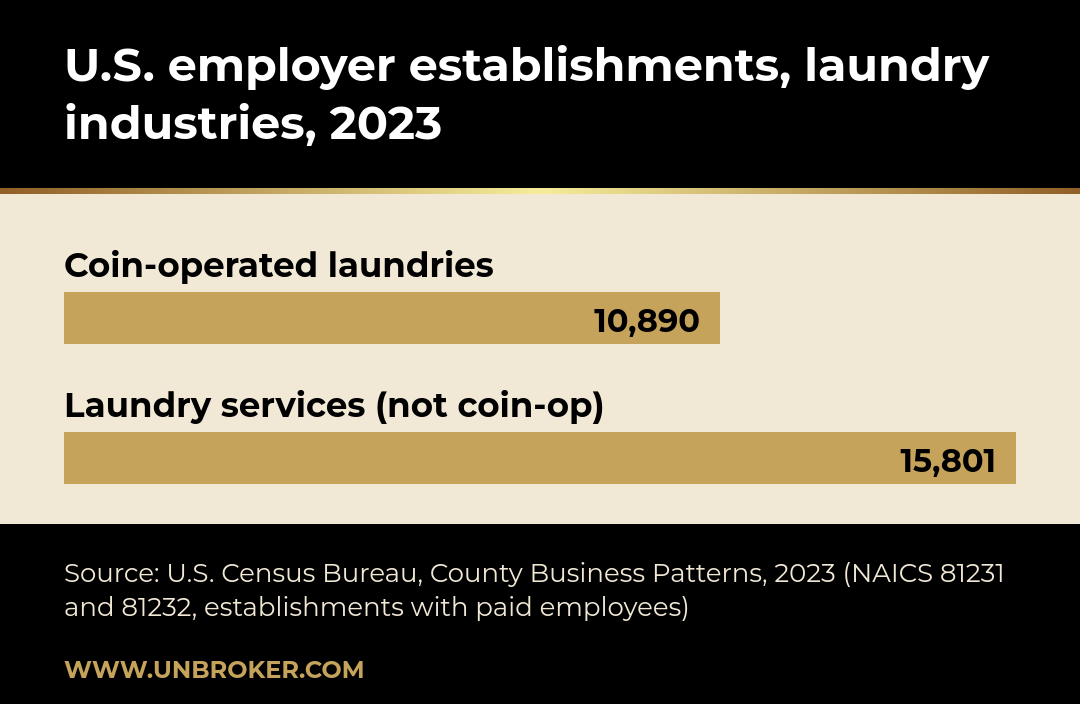
The industry is also bigger than many owners assume. In 2023, County Business Patterns counted 10,890 U.S. establishments with paid employees in NAICS 812310 (Coin-Operated Laundries and Drycleaners), employing 41,351 people. That count covers employer establishments only. Self-employed people and businesses without employees are counted separately by the Census Bureau, so it is not a count of every laundromat in the country. Still, it tells you that buyers have seen these businesses before and know what to ask.
For context, the same 2023 data counted 10,890 employer establishments in coin-operated laundries and drycleaners (NAICS 81231) and 15,801 employer establishments in drycleaning and laundry services except coin-operated (NAICS 81232), both within industry group 8123. Self-service laundromats are a large part of the group, and buyers can compare yours against others they have looked at.
Because buyers compare, the businesses that sell most smoothly are the ones with clean paperwork. The rest of this post is about producing it.
Store, Route or Both: Know What You Are Selling
The industry definition for coin-operated laundries covers two kinds of establishment, according to the NAICS 2022 definition. One is a facility with coin- or card-operated self-service laundry equipment for customers on the premises. The other is an establishment that supplies and services such equipment in places of business operated by others, such as apartments and dormitories. A store and a route share one industry code, but they are different assets.
Decide which one you are selling, because the diligence list changes:
- A store turns on the lease for the premises, the build-out, the walk-in customer base, and the condition of plumbing, venting and water heating.
- A route turns on the placement agreements with property owners, the machines sitting in other people’s buildings, the service vehicles and the technician who knows every location.
- Both means a buyer will want the two operations separated on the financials so each can be judged on its own.
If you run a store plus a route, or a store with extra services such as wash-dry-fold, break out revenue by line. A buyer cannot value what is blended together, and a lender cannot underwrite it. If you want the buyer’s perspective on what they are evaluating, our guide on how to buy a laundromat business shows the other side of the table.
Start With the Lease: Assignment, Term and Landlord Consent
For a store, the lease is often the single biggest issue. A buyer is not really buying a laundromat if they cannot stay in the space. Pull your lease and every amendment now, and read it as a buyer would.
What to check in the lease
- Assignment clause. Does the lease allow assignment to a buyer, and does it require landlord consent? Some leases let the landlord withhold consent or require a fee or new terms.
- Remaining term and renewal options. A short remaining term is a problem even if the business is healthy. Note whether renewal options belong solely to the tenant.
- Rent escalations and extra charges. Buyers model future occupancy cost, so be ready to explain increases, common area charges and anything unusual.
- Personal guaranty. If you guaranteed the lease, ask whether the landlord will release you on assignment. Do not assume it.
- Use and exclusivity. Confirm the lease permits laundromat use, and note any exclusive-use or competing-tenant provisions.
- Utilities and infrastructure. Know who is responsible for water, sewer, venting and any shared systems.
Why term length matters to SBA buyers
Many laundromat buyers use SBA financing, and lease length can limit them. Under SBA SOP 50 10 8 (effective June 1, 2025), for 7(a) loans the lease term, including renewal options exercisable solely by the borrower, should equal or exceed the loan term. If the lender cannot obtain an assignment of lease or a landlord’s waiver, the lease term including those renewal options must equal or exceed the loan term. A short remaining lease can therefore limit a buyer who uses SBA financing.
The practical step: if your remaining term is short, talk to your landlord about an extension or renewal option before you go to market, and ask the buyer’s lender which SOP version and lease terms apply to that buyer’s application. Procedures get updated, so do not rely on a general answer. Have your attorney review any extension or assignment language.
One more point on timing. Landlords often have leverage at the moment of consent, so think about when and how you approach yours. Approach with a plan and a qualified buyer in mind rather than a vague announcement. We cover the confidentiality side of that conversation below.
Equipment: Age, Condition, Liens and Efficiency
Buyers look at the machines as both a revenue engine and a capital expense waiting to happen. A room of old washers and dryers may produce good numbers today, but the buyer will price in replacement. Your job is to make the equipment story clear and documented rather than leaving the buyer to guess.
Build an equipment schedule
Create a single list with every washer, dryer, water heater, boiler, change machine, payment system component, and any other significant item. For each, record:
- Make, model and serial number
- Approximate age or install date
- Capacity and type, such as washer size or dryer stack
- Condition notes and major repairs
- Whether it is owned outright, financed or leased
Pair the schedule with service and repair records. A machine that has been maintained on a schedule is easier to trust than one with no history.
Clear up liens and leased equipment
Equipment financing is common in this business. Before you list, find out what is financed, what is leased, and what a lender has a security interest in. A buyer buying assets needs to know what transfers free and clear and what has to be paid off or assumed at closing. If your business has an SBA loan, read our guide on selling a business with an SBA loan: lien, consent and payoff so you understand how that affects closing.
Also consider how the purchase price will be allocated across equipment, goodwill and other assets in an asset sale. The allocation can affect taxes for both sides, and the rules depend on your entity type and the deal structure. Our Form 8594 seller’s guide explains the basics, and your tax adviser should confirm how it applies to you.
Efficiency and water heating
Buyers pricing a laundromat may weigh machine efficiency against utility costs, because water, sewer, gas and electricity are among the largest operating expenses. ENERGY STAR says commercial clothes washers that have earned the label are on average 9% more efficient and use about 45% less water than standard models. If you have upgraded to efficient machines, that is worth documenting, along with the install dates.
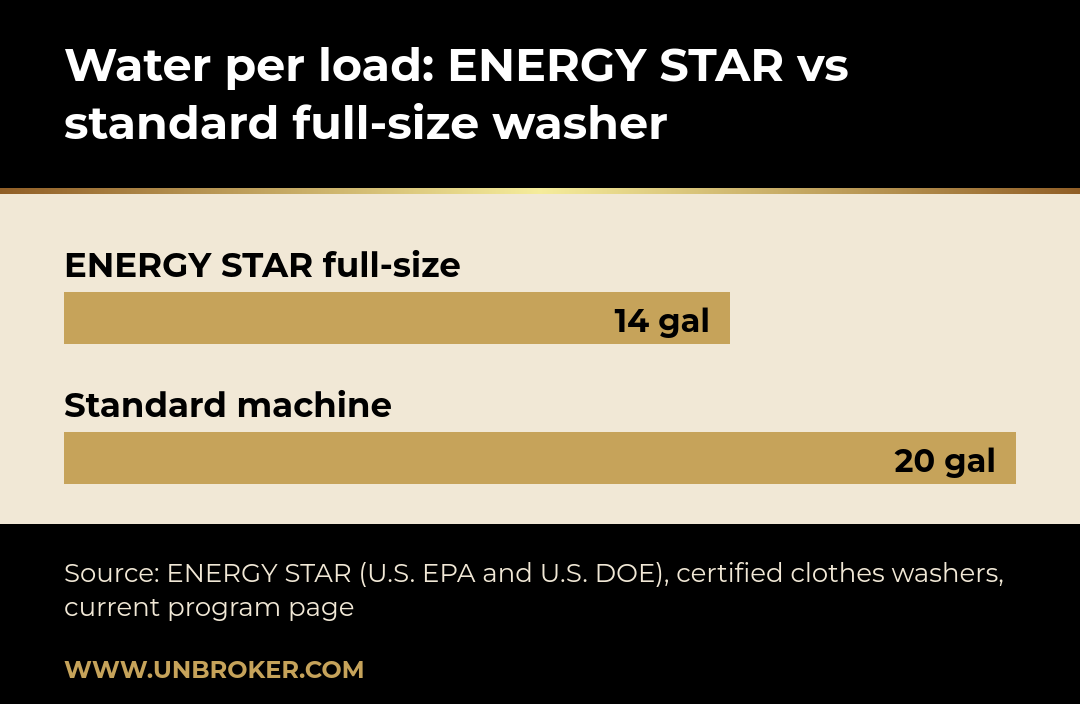
The water numbers show up at the household-size level too. ENERGY STAR states that full-sized clothes washers that have earned the label use 14 gallons of water per load, compared with 20 gallons for a standard machine, per its certified clothes washers page.
Hot water matters even more than the water itself. ENERGY STAR states that water heating consumes about 90% of the energy it takes to operate a clothes washer. That is why hot-water use and heater condition are worth documenting for buyers. Record the type, age and service history of your water heaters or boilers, and note any recent replacements. If they are near the end of their life, expect the buyer to bring it up in negotiation.
Prove Your Revenue With Utility Bills and Payment System Data
Laundromats can be cash-heavy, which makes buyers and lenders cautious. They want to see revenue that ties out across independent sources. If your reported revenue and your utility usage tell different stories, deal confidence drops fast.
Layers of proof buyers look for
- Utility bills. Water, sewer, gas and electric statements over a meaningful period. A buyer can compare usage trends to reported revenue. A business whose water use rises and falls with its reported sales is easier to believe.
- Payment system reports. If you use card readers, app payments or a loyalty system, export the transaction reports. They give the buyer a record that does not depend on your word.
- Coin and cash handling records. Counts, change machine fills, vending sales and deposit records. Deposits should match what you report.
- Tax returns and financial statements. These should reconcile with everything above.
- Other income lines. Wash-dry-fold, vending, route contracts or any other revenue should be tracked separately.
Reconcile before the buyer does
Do this exercise yourself first. Line up monthly revenue, monthly deposits, monthly payment reports and monthly utility costs on one sheet. Look for gaps. Perhaps a month’s deposits are low because of a timing issue, or a large repair spiked gas usage. Write short notes explaining anything odd. Buyers forgive explained anomalies far more readily than unexplained ones.
If part of your cash revenue has not been reported or deposited, that is a serious problem. A lender generally underwrites what is documented, and a buyer will not pay for earnings that cannot be shown. Talk to a tax professional and an attorney before you go to market rather than hoping nobody asks.
When you are ready to adjust the numbers for one-time costs and personal expenses, our guide on how to apply business valuation add-backs is a good starting point. Multiples for laundromats vary by market, location and business type, so ask a valuation adviser what applies to your situation rather than relying on a rule of thumb.
How Buyer Financing Shapes Your Deal (SBA Equity and Seller Notes)
Whether the buyer can get financing often shapes the structure and timeline of your deal. Many small business buyers use SBA 7(a) loans, so it helps to understand the rules that touch you as the seller.
The equity injection
Under SBA SOP 50 10 8 (effective June 1, 2025), a complete change of ownership financed with an SBA 7(a) loan requires an equity injection of at least 10 percent of total project costs, meaning all costs required to complete the change of ownership regardless of the source of funds. A later law firm review in October 2026 of the SOP 50 10 8.1 technical policy updates says that for initial acquisition 7(a) loans, the minimum equity injection requirement cannot be reduced or eliminated. Because SBA procedures are updated, confirm with the buyer’s lender which version governs the application.
Where a seller note fits
Many sellers are asked to carry a note. The SBA rules are strict about when a seller note can count toward the buyer’s equity. Per a client alert on SOP 50 10 8, a seller note counts toward the buyer’s 10 percent equity injection only if it is on full standby, with no principal or interest payments for the entire SBA loan term (typically 10 years), and it may not account for more than 50 percent of the injection.
Think about what that means for you. A standby note means you may not see payments for a long time, so weigh it carefully against a lower price or different terms. The same alert notes that for a partial change of ownership, all equity holders, including a seller who keeps equity, must personally guarantee the SBA loan for at least two years. If you are considering keeping a stake, get legal advice before agreeing.
The takeaway: before you accept an offer, ask what the buyer’s financing structure looks like and which rules the lender is applying. A strong price on paper can fall apart if the financing structure does not fit the lender’s requirements.
Staff, Attendants and the Handover Plan
Some laundromats are largely run by attendants, some by an owner who is on site daily, and some by absentee owners with a manager. Buyers want to know which one they are getting, because it changes what they are buying: a business that runs without you is worth more than one that runs only because you are there.
Document the operation
Write down how the place runs. A simple operations manual can cover:
- Opening and closing routines, cleaning schedules and restocking
- Cash handling, deposits and reconciliation
- How to reset, clear and report problems with machines and payment systems
- Vendor contacts for repair, supplies, detergent vending and equipment service
- Landlord and utility contacts
- Staff roles, schedules and pay arrangements
- For routes, a list of locations, contacts and service schedules
Plan the transition
Agree on a handover period in the purchase agreement. Buyers generally want you to train them, introduce them to vendors and staff, and be reachable for questions. Decide how much time you are willing to give and in what form. Be clear about it up front so it does not become a point of conflict after closing.
Also think about your staff’s future. Good attendants and route technicians are hard to replace, and a buyer will often want them to stay. Do not make promises on the buyer’s behalf, but be ready to describe the team and its tenure. For more on handover planning, see our guide on owner transition planning.
Keeping the Sale Confidential From Customers and Staff
A laundromat depends on a steady stream of regulars, and a sale rumor can unsettle both customers and staff. Staff may worry about their jobs, customers may wonder if the place is closing, and competitors may see an opening. Landlords, vendors and route property owners may also react in ways that complicate a deal.
A few habits help:
- Market the business without naming it. Use a general description of the business and area until a buyer has been screened and has signed a confidentiality agreement.
- Screen buyers before sharing details. Financials, the lease and the equipment schedule should go to qualified buyers only.
- Keep site visits discreet. Have buyers visit as ordinary customers or outside business hours, and decide in advance how you will explain anyone who asks questions.
- Time the landlord conversation. Bring the landlord in when there is a serious buyer and a reason for consent, rather than at the start.
- Plan the staff announcement. Tell employees when it makes sense, with a clear message about what happens next. Our post on whether and when to tell employees you are selling covers the trade-offs.
Keep the paperwork secure too. Share documents through a controlled channel rather than by casual email, and keep a record of who has seen what.
Your Laundromat Sale Checklist
Use this list as a working plan. Check each item off before you list the business.
Lease and site
- Gather the lease and all amendments
- Confirm the assignment clause and landlord consent process
- Check remaining term and renewal options, and ask about an extension if the term is short
- Ask whether the landlord will release any personal guaranty
- Confirm permitted use and any exclusivity terms
Equipment
- Build the equipment schedule with make, model, serial number, age and condition
- Collect service and repair records
- Identify liens, financing and leased equipment, and plan for payoff or assumption
- Document water heater and boiler age, type and service history
- Note any efficient machines and their install dates
Financial proof
- Gather utility bills for water, sewer, gas and electric
- Export payment system and app transaction reports
- Reconcile revenue, deposits, payment reports and utility costs, and explain any gaps
- Separate revenue lines, such as store, route, wash-dry-fold and vending
- Prepare tax returns and financial statements that tie to the rest
Deal and financing
- Ask each buyer how they plan to finance the purchase
- Confirm with the buyer’s lender which SBA SOP version and lease terms apply
- Decide in advance whether you would carry a seller note, and understand the standby rules
- Talk with a tax adviser about asset allocation and with an attorney about the purchase agreement
People and process
- Write the operations manual and vendor contact list
- Decide your handover period and what you will offer
- Plan how and when to tell staff and the landlord
- Set up confidential buyer screening before sharing documents
Unbroker pairs expert advisors with AI-driven buyer matching and national marketing, and runs the sale through a confidential process so you can keep your customers and staff in the dark until the time is right. Our Full Service Business Sale charges a 6% success fee, paid when the business sells. To see how it works for a laundromat, visit Unbroker.