If you own a roofing company and are thinking about selling, this guide covers what a serious buyer checks first: whether your contractor license can follow the sale, how stable your crew is, how your residential and commercial work splits, and how the seasons affect timing.
You will also see why licensing rules differ by state, how deal structure changes the licensing question, and which legal points to confirm with an attorney before you list. A pre-listing checklist at the end pulls it together.
Why roofing companies draw buyer interest, and what buyers test first
Roofing is a skilled trade with steady, visible demand for repair and replacement work. Buyers include other contractors who want more crews and territory, and individuals who want an operating business with a known service. All of them ask the same opening questions: can I legally operate this company on day one, will the people who do the work stay, and where does the revenue come from?
Labor data shows how tied to people this industry is. The U.S. Bureau of Labor Statistics counted 166,900 jobs for roofers in 2025. About 72% of those jobs were at roofing contractors, 20% were self-employed workers, and 3% were in construction of buildings. Those figures describe jobs held by roofers, not the number of roofing companies for sale. Still, they show that most roofing work happens inside contractor firms, and that a meaningful share is done by people working for themselves.
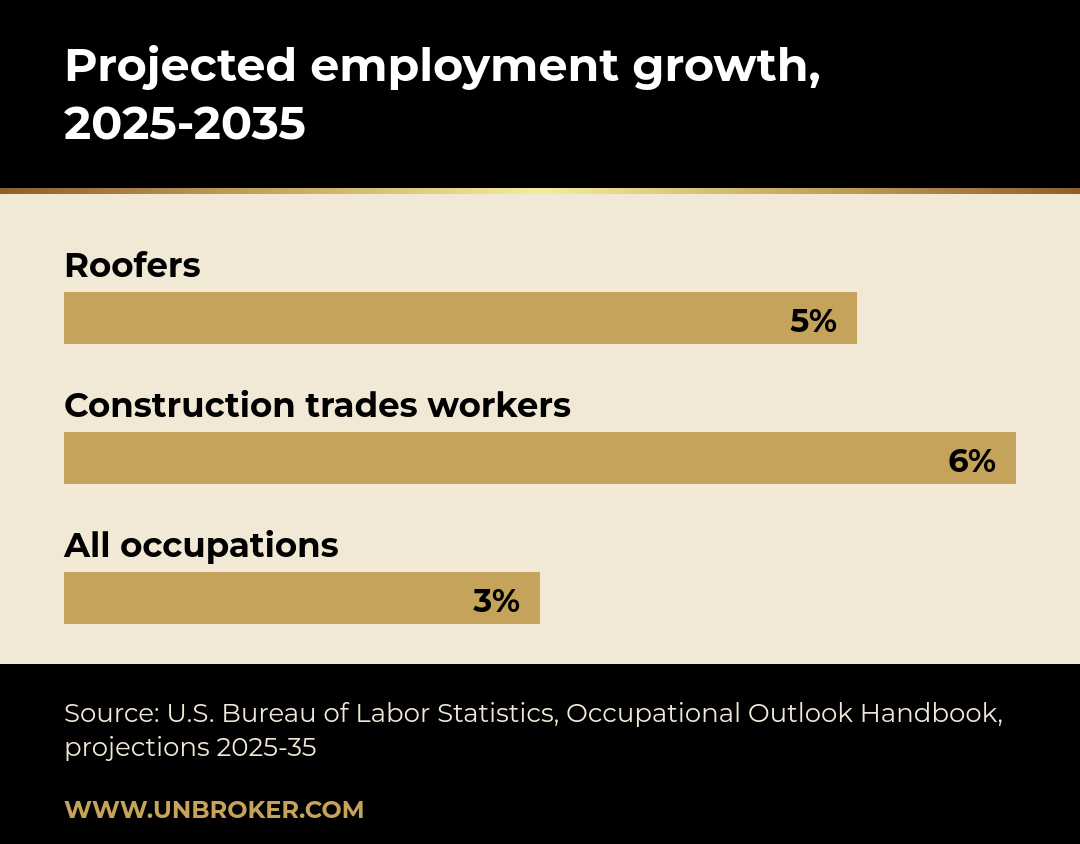
The same source projects employment of roofers to grow 5% from 2025 to 2035, faster than the 3% average for all occupations, with about 12,000 openings a year on average over the decade. Many of those openings are expected to come from workers who move to other occupations or leave the labor force, such as to retire. The projection covers roofer employment, not demand for roofing companies or sale prices, and it is not a promise about your sale. Buyers may read it as a reason to put a high value on a crew that already works well together.
Here is how the projected growth compares with the broader benchmarks, 2025 to 2035: roofers 5%, construction trades workers 6%, and all occupations 3%.
Expect buyers to test four things before they get excited about price: the license, the crew, the job mix, and the seasonal pattern of your cash flow. The sections below take each in turn, starting with the one that can stop a deal outright.
The contractor license: why it usually does not travel with the sale
Many owners assume the license is an asset they can hand over like a truck or a customer list. In many states it is not. Contractor licenses are often issued to a specific business entity, and a change in the entity can mean a new license for the buyer.
Two examples show how this works. In California, the Contractors State License Board states that a new license is required whenever the business entity changes, for example sole owner to corporation or sole owner to partnership. Licenses are not transferable from one business to another, even when the qualifying individual is the same, under Business and Professions Code section 7075.1.
The California board also notes that if a corporation dissolves, merges, or surrenders its right to do business in the state through the Secretary of State, the contractor license must be canceled. A corporate license number is tied to the specific corporate registration number, and a change in that number requires a new license for the new corporation.
Virginia follows a similar pattern. Contractor licenses there are issued to firms and are not transferable. Under 18VAC50-22-210, when the legal entity holding a license is dissolved or altered to form a new entity, the original license becomes void. It must be returned to the Board for Contractors within 30 days of the change, and the firm must apply for a new license on the board’s form within 30 days of the change.
These are two states, not a national rule. Other states differ, and some have their own qualifier, bonding, or notice requirements. Before you tell a buyer anything about the license, check with your own state licensing board and an attorney.
What this means for you in practice:
- Do not market the license as a transferable asset unless your attorney has confirmed it can be in your state.
- Tell buyers early that they may need to obtain their own license, and ask whether they already hold one or have a qualifying individual in place.
- Build the licensing timeline into the deal. A buyer who needs a new license may need a gap period, a transition arrangement, or a closing condition. Your attorney can advise on what is allowed in your state while that happens.
- Keep your own license in good standing through closing, with renewals, bonds, and any required filings current.
Buyers who already hold a license in your state tend to be the simplest fit. A well-organized listing that screens for license status early can save everyone time.
Asset sale or entity sale: how structure changes the licensing question
Structure drives the licensing answer. In an asset sale, the buyer purchases equipment, vehicles, contracts, the brand, and other assets, usually through its own entity. Because the buyer is a different entity from yours, the license issue is front and center: that entity generally needs to be licensed on its own terms. Our guide to the asset sale approach covers why many small-business deals take this form.
In an entity sale, the buyer acquires the ownership interests in your company, so the legal entity stays the same. That can avoid the “new entity” trigger described above, since the registration number does not change. It does not settle everything. Your state may still require notices, a new or updated qualifying individual, or other filings when ownership or control changes. The buyer also inherits the company’s history, including past claims, tax matters, and contract liabilities, so buyers tend to ask for more protection in the purchase agreement.
Neither route is automatically better. The choice affects licensing, liability, taxes, and what the buyer is willing to pay, and the tax side in particular depends on your entity type and facts. In an asset sale, the purchase price is also allocated across asset classes, which you can read about in our Form 8594 guide. Raise structure with your attorney and tax adviser before you list, not after you receive an offer.
Crew, subcontractors and retention: protecting the people who do the work
A roofing company is only as valuable as its ability to keep doing the work after you leave. Buyers will look hard at who actually runs jobs, who sells them, and who holds the customer relationships. If you are the estimator, the closer, and the crew lead, expect questions about what happens when you step back.
BLS wage data gives a useful reference point for what crew labor costs in the market. The median annual wage for roofers was $55,440 in May 2025, compared with $58,150 for construction trades workers and $50,980 for all occupations. The lowest 10 percent of roofers earned less than $37,460 and the highest 10 percent earned more than $81,720. These figures describe employee pay for the roofer occupation, and the BLS data does not cover self-employed workers, so they say nothing about what owners earn.
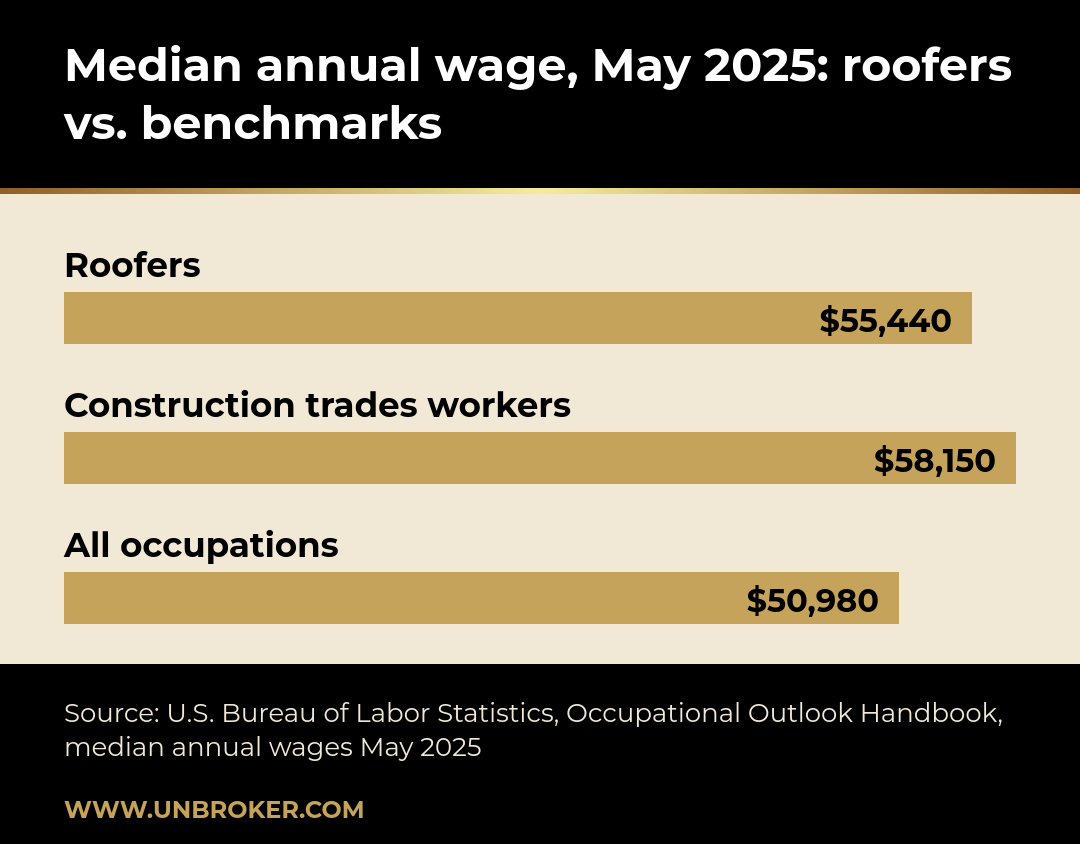
A buyer may compare your payroll with figures like these to judge whether your crew is paid in line with the market, and whether pay will be a retention problem after the sale. If your best installers are paid well below market, a buyer may expect to raise pay to keep them. If you pay well above market, expect a question about why. Either way, have the answer ready.
To protect and present your crew:
- Document roles. Write down who leads installs, who handles estimates, who talks to suppliers, and who deals with insurance adjusters. A clear picture reduces the sense that everything sits in your head.
- Review subcontractor relationships. If you rely on subcontractors or independent installers, confirm that written agreements exist, that their insurance certificates are current, and that the classification of each worker is something your attorney would stand behind. Misclassification is a common diligence concern in the trades.
- Plan retention. Consider stay bonuses or transition incentives for key people, structured with advice from your attorney and tax adviser.
- Decide when to tell your people. Telling the crew too early can unsettle them, and telling them too late can feel like a betrayal. Our post on when to tell employees you are selling is a good place to start thinking about timing.
Buyers also ask what happens if a key foreman leaves mid-process. Our guide to selling when a key employee or manager walks away covers how to keep a deal on track if that happens.
Residential or commercial: how your job mix shapes the buyer pool
Roofing is not one market. BLS notes that low-slope roofs are the most common type and are typical on commercial, industrial and apartment buildings, while steep-slope roofs are typical on single-family homes, where roofers commonly install asphalt shingles. The two segments use different materials and skills, so a roofing company’s mix between them affects who is likely to buy it.
Here is how that may play out for sellers:
- Mostly residential, steep-slope work. Buyers tend to be contractors who already do homes, or newcomers who want a brand with a local reputation. They will look at how you generate leads, your reviews, how much work comes from referrals versus paid advertising, and how storm or insurance work fits in.
- Mostly commercial, low-slope work. Buyers may want proof of repeat accounts, property manager relationships, service agreements, bonding capacity, and the skills in your crew for the systems you install.
- A blended mix. A balanced company can appeal to buyers on both sides, but it can also confuse the story. Be clear about which segment drives the profit and which is a side line.
Whatever your mix, buyers dislike dependence on a handful of customers. If a few accounts make up much of your revenue, say so up front and be ready to explain the contract terms and relationships. Our guide on selling a business with client concentration risk explains how buyers think about this.
Prepare a simple breakdown of revenue by job type: repair versus replacement, residential versus commercial, insured versus self-pay. Clean numbers help a buyer see what they are buying, and help the right buyers find you.
Seasonality and timing: when to list a roofing company
Roofing revenue follows the weather. BLS notes that in northern states roofing work may be limited during the winter months, and that roofers may work overtime during the busy summer months. A company’s books can look very different depending on the month a buyer examines them.
Seasonality affects a sale in three ways:
- Financial presentation. A buyer reviewing results from a slow stretch may misjudge the business unless the seasonal pattern is explained. Show results across full seasonal cycles rather than a single stretch, and be ready to explain unusual weather, storms, or supply problems.
- Buyer attention. In peak season you are busy and distracted, which is when diligence requests pile up. In the slow season you have more time, but buyers see less activity. Neither is automatically better, so pick the timing you can manage.
- Handover. A buyer taking over just before the busy season needs time to meet crews, suppliers, and customers. A buyer taking over mid-season inherits open jobs immediately.
If you are reading this in mid-November and operate in a northern state, the slow season may give you time to gather records, clean up financials, and talk to an attorney before spring. That preparation can let you go to market when your numbers are strongest and your attention is free. A sale can take time, so avoid assuming you can list and close within a particular window. Our business sale timeline explains the stages in order.
Warm-weather markets have less pronounced winters, but weather events, storm cycles, and local demand shifts still shape revenue. Whatever your region, explain your pattern before the buyer asks.
Safety, insurance and warranty records buyers will request
Roofing is physically risky work, and buyers know it. Expect diligence requests in three areas.
Safety
BLS reports that most employers require roofers to complete safety certification that meets OSHA guidelines, either before or after being hired. Buyers will want to see that your training is documented for every crew member, along with your safety program, incident logs, any inspection history, and records of fall protection equipment and its maintenance. Gaps here can raise concerns about liability and insurance cost.
Insurance
Gather your general liability and workers’ compensation policies, certificates for subcontractors, and your claims history. Buyers and their insurers often want loss records, so request them from your carrier or agent. A clean record is a selling point, and a messy one is better disclosed early than discovered late.
Warranties
Roofing work carries long-tail obligations. List the workmanship warranties you have issued, and note which jobs have manufacturer warranties and what their terms say about transfer or the contractor’s status. Ask your attorney who is responsible for warranty claims on jobs completed before closing, and how that should be written into the purchase agreement. Buyers may ask for a reserve or an indemnity for pre-closing work, so know your history of callbacks and claims.
The more of this you can present in an organized form, the smoother diligence goes. Our seller due diligence tips and documents checklist are useful companions here.
Open jobs, backlog and customer deposits at closing
Roofing companies nearly always have work in progress on any given day. That creates some of the trickiest closing questions, and our post on selling a construction business mid-project goes deeper on them. Think through each of these before you list:
- Signed but unstarted jobs. Is this backlog part of what the buyer is purchasing? If customers paid deposits, who holds that money, and who is responsible for completing the work?
- Jobs in progress. Who finishes them, who pays the materials and crew for the unfinished portion, and who receives the final payment? Buyers and sellers often split these by agreement, with a cutoff date and a schedule of open jobs.
- Customer deposits. Treat deposits as obligations. A buyer may expect a price adjustment or a transfer of cash to cover work they will have to perform. Some states have rules on deposits and contract terms, so ask your attorney.
- Contract assignment. Customer contracts may or may not be assignable without consent. Your attorney can check the language and, where needed, plan how to obtain consent.
- Liens and payments. Confirm supplier balances are current, and ask your attorney about lien waivers and releases on completed jobs.
- Working capital. Receivables, payables and inventory at closing can change what you actually receive. See our explainer on working capital adjustments.
Prepare a current schedule of open jobs showing customer, contract value, deposits received, costs incurred, work remaining, and expected completion. A clear schedule builds buyer trust and prevents arguments over small numbers after closing.
Selling confidentially and managing the process
Roofing is a relationship business. If customers, suppliers, or crew members hear you are selling before you are ready, they may worry about warranty support, job continuity, or their own paychecks. A competitor may use the news against you. Confidentiality is not a nicety here, it protects the value you are trying to sell.
Practical steps include:
- Use an anonymous listing. Describe the company by type, region, and general scale without naming it or showing your logo, vehicles, or distinctive details.
- Require a signed confidentiality agreement before sharing identity, customer lists, pricing, or financials.
- Qualify buyers first. Before you reveal anything sensitive, confirm that a buyer has the means, the license position, and the experience to be credible. Our guide to screening serious buyers explains how.
- Stage information. Release high-level facts first, detailed financials later, and customer-specific data only near the end.
- Plan the message. Decide in advance what you will say to employees, key customers, and suppliers, and when.
Whether you manage the process yourself or bring in help, ask how buyers are screened, how documents are shared, and who sees your identity. Selling takes time away from running jobs, and a missed callback or a late crew schedule can hurt both customers and the sale.
Because of the license, structure, and deposit issues above, bring in an attorney who knows your state’s contractor rules before you list. If you are unsure whether you need one, read Do You Need an Attorney for Your Business Exit?
A pre-listing checklist for roofing owners
Use this list as a working checklist. Several items depend on your state and entity type, so confirm the details with your licensing board, attorney, and tax adviser.
- Confirm your license position. Ask your state licensing board and attorney whether a license can transfer in your state, what a buyer needs to obtain their own, and whether a change of ownership or entity triggers a filing and a deadline.
- Decide on likely deal structure. Discuss asset sale versus entity sale with your attorney and tax adviser, including how each affects licensing, liability, and taxes.
- Organize your entity records. Formation documents, good standing, registrations, and any past entity changes.
- Document your crew. Roles, tenure, pay, certifications, and subcontractor agreements with current insurance certificates.
- Plan retention. Decide which people matter most and how you might keep them through a transition.
- Break down revenue. Residential versus commercial, repair versus replacement, insured versus self-pay, and top customers.
- Explain seasonality. Prepare financials across full seasonal cycles and a short note on weather or supply swings.
- Gather safety and insurance files. Training records, safety program, incident logs, policies, and loss runs.
- List warranty obligations. Workmanship warranties, manufacturer warranty terms, and your history of callbacks and claims.
- Build an open-jobs schedule. Contract value, deposits, costs to date, and remaining work for every active job.
- Review vehicles and equipment. Titles, liens, condition, and maintenance records.
- Clean up your financials. Accurate, consistent books make every other conversation easier. For help on how to present earnings, see our plumbing business guide, since many trade-business issues overlap.
- Prepare your confidentiality plan. Anonymous description, confidentiality agreement, and a script for staff and customers.
- Speak with an attorney before listing. Ask them to review licensing, structure, contract assignment, deposits, and warranty exposure.
None of this guarantees a particular price or timeline, but it can reduce surprises and help serious buyers see what you built. Owners who take the license and the crew seriously from the start are usually better positioned when diligence begins.
Unbroker helps owners sell their businesses with expert advisors, AI-driven buyer matching, and national marketing in a confidential process. Our Full Service Business Sale carries a 6% success fee, paid when the business sells. To see how it works for your company, visit Unbroker.