Selling your business is one of the biggest financial decisions you’ll make. Business packaging-organizing your finances, operations, and market position-directly impacts what buyers will pay.
At Unbroker, we’ve seen firsthand how sellers who prepare strategically attract serious buyers and command higher valuations. This guide walks you through the exact steps to position your business for maximum appeal.
Your Financial Foundation for Buyers
Buyers won’t take your valuation seriously without clean, organized financial records. This is where most sellers stumble. According to SCORE, more than 90% of sell-side due diligence involves anticipating what information buyers will request and assembling it upfront. The remaining 10% is researching the potential acquirer.
Organize Your Financial Statements
Your tax returns, profit and loss statements, balance sheets, and cash flow analyses need to tell a consistent story across multiple years. Buyers typically ask for three to five years of profit & loss statements, balance sheets, bank statements, and federal income tax returns. If your accountant prepared them, request them in standardized format. If you’ve handled finances informally, hire a bookkeeper or accountant now to reconstruct clean records. Buyers will compare your claimed profits against your tax filings, and discrepancies kill deals.

Create a data room with digital copies of all financial documents organized by year and category. This speeds up the buyer’s review process and demonstrates professionalism. A well-organized data room signals that you run a tight operation.
Document Assets and Liabilities Thoroughly
Document every asset your business owns-equipment, inventory, intellectual property, customer lists, software licenses. List their current value and condition. Do the same for liabilities: outstanding loans, lease obligations, pending lawsuits, warranty claims. Buyers conduct forensic accounting, so hiding problems only surfaces them later during negotiation, forcing price concessions.
Proactively fix issues before disclosure. For example, if your IT infrastructure is outdated but functional, upgrade it before sale. This shows the buyer the business runs smoothly without requiring capital investment on their end. Removing risk from the buyer’s perspective strengthens your negotiating position.
Prioritize Cash Flow Over Raw Profit
Cash flow analysis matters more than raw profit. A business with strong cash flow demonstrates stability and reduces perceived risk for buyers. Show your working capital trends, seasonal patterns, and cash conversion cycles. These metrics reveal the true health of your operation.
Buyers want to understand how money actually moves through your business. Clean cash flow data demonstrates stability and reduces their perceived risk. The faster your records tell this story, the faster the process moves and the higher your final valuation. With your financial foundation solid, operational systems become your next competitive advantage.
How to Document and Demonstrate Operational Excellence
Buyers scrutinize operations more closely than most sellers expect. They want proof that your business runs without you, that systems exist independent of key personnel, and that the operation can scale under new ownership. Documentation becomes your competitive advantage here. Create written standard operating procedures for every critical function-sales, customer onboarding, inventory management, fulfillment, accounting, customer service. Write these procedures based on what actually happens in your business right now, not theory. Include screenshots of software workflows, templates your team uses, decision trees for common problems, and contact information for vendors and contractors.
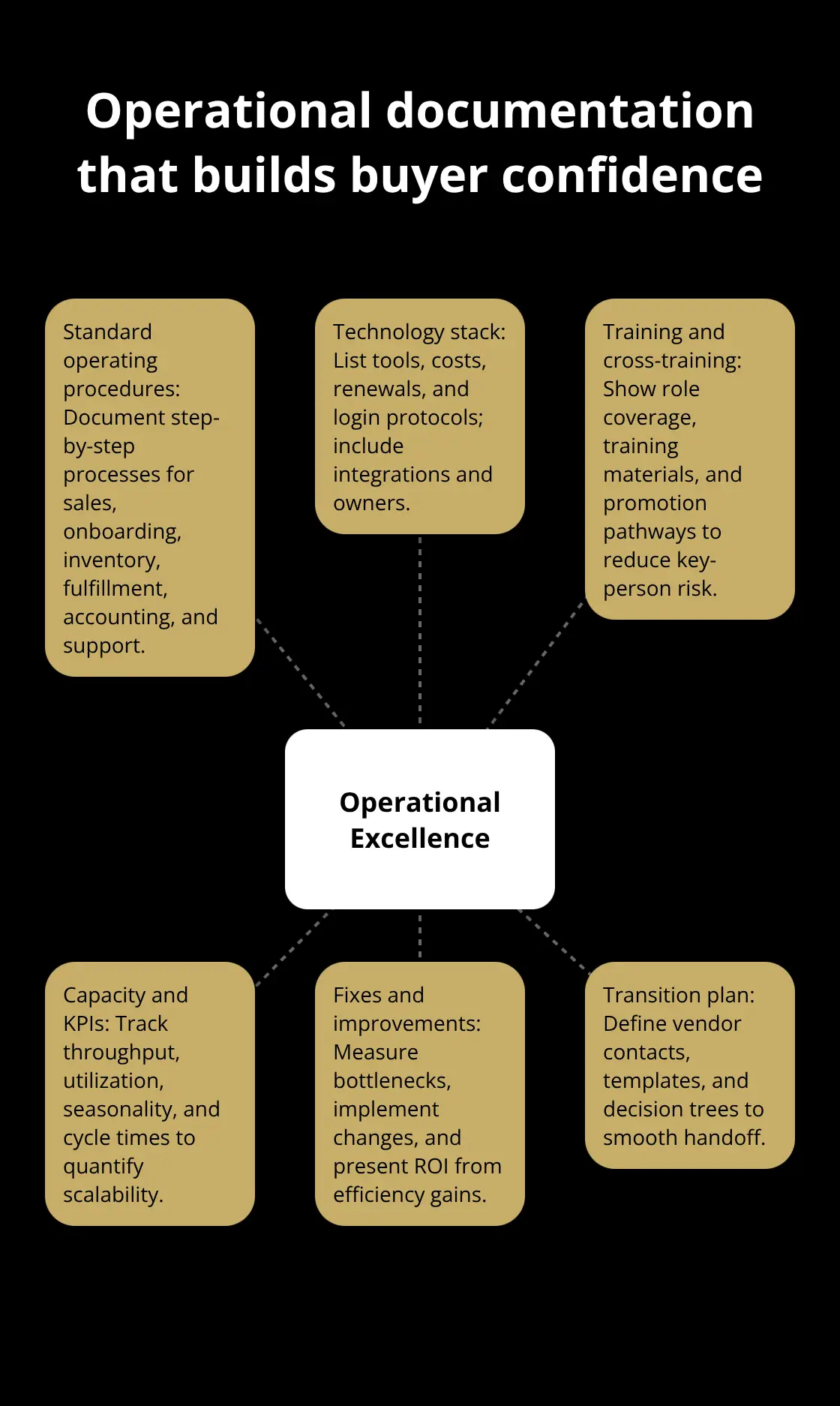
When a buyer reviews these procedures, they mentally calculate how smoothly the transition will go and whether they’ll need to hire new staff. Clean, detailed procedures reduce that anxiety and justify a higher valuation.
Document Your Technology Stack
List the tools and systems you use-your CRM, accounting software, project management platform, communication channels. Record subscription costs, renewal dates, and login protocols. Buyers need to understand the technology stack supporting your revenue, especially if critical functions depend on specific platforms. If your business relies on custom integrations or automations, document how they work and who maintains them. This transparency accelerates the buyer’s confidence in the transition.
Fix Inefficiencies Before Buyers Find Them
Don’t hide operational weaknesses. Find them first and fix them or document the improvement opportunity. If your fulfillment process takes longer than industry standard, measure it, understand why, and either streamline it or show the buyer exactly how they can improve it. For example, if you manually process orders that could be automated, calculate the labor hours saved and present this as a clear value-creation opportunity post-acquisition. Buyers see through surface-level operations. They want to know your actual capacity utilization, how many units or transactions your team handles monthly, and whether you run at 70% or 95% capacity. Running at 70% capacity with existing infrastructure and staff signals massive growth potential to buyers.
Demonstrate Team Strength and Retention
Document your headcount, salaries, skill levels, and retention rates. Buyers worry about losing key employees, so showing strong retention, documented training, and cross-trained staff reduces transition risk. Include organizational charts, job descriptions, and evidence of internal promotion or skill development. Show revenue concentration risk honestly. If 40% of revenue comes from three customers, state it clearly. Buyers will discover this during due diligence anyway. What matters is whether you’ve documented customer satisfaction, contract terms, renewal likelihood, and whether those relationships depend on your personal involvement or are institutionalized within the business.
Show Concrete Growth Metrics and Market Opportunity
Demonstrate scalability with concrete metrics. Show how you’ve grown month-over-month or year-over-year for the past three years. Include data on customer acquisition cost and lifetime value metrics, churn rates, and repeat purchase frequency. These metrics prove the business model works and that growth isn’t accidental. Document your market opportunity. If your addressable market is growing and your market share remains small, buyers see expansion potential. Include third-party market research if available, but be specific-cite actual sources rather than vague claims about market size. Show your backlog or pipeline if you have one. Signed contracts awaiting fulfillment or qualified leads in your sales pipeline prove demand exists beyond what your current operation can handle, a signal for scalability. Operational excellence documentation and demonstrated processes show operational sophistication that buyers reward with higher valuations. Include any proprietary processes, intellectual property, or competitive advantages that create barriers to entry. Patents, trademarks, exclusive partnerships, or unique data sets all increase valuation because competitors find them harder to replicate. With operational excellence documented, your brand and market position become the final piece that attracts premium buyers.
Brand and Market Position: What Makes Your Business Stand Out to Buyers
Buyers evaluate competitive positioning before they examine your numbers closely. They want to know what stops competitors from stealing your customers and why your business matters in its market. Start by documenting your actual competitive advantages, not the ones you wish you had. If you’ve built proprietary technology, own exclusive partnerships, or control scarce resources, document these clearly with evidence. If your advantage stems from customer service or brand loyalty, quantify it through retention metrics and repeat purchase data. Generic claims about being the best at what you do mean nothing. Specific advantages backed by data mean everything.
Measure Your Market Position Accurately
Measure your brand positioning within your addressable market, not just total industry size. If your market is worth $50 million and you own $5 million in revenue, you control 10% of an accessible market. That matters to buyers because it shows growth runway without requiring market expansion. Document this with third-party research sources when possible. Show your customer retention rate over the past three years.
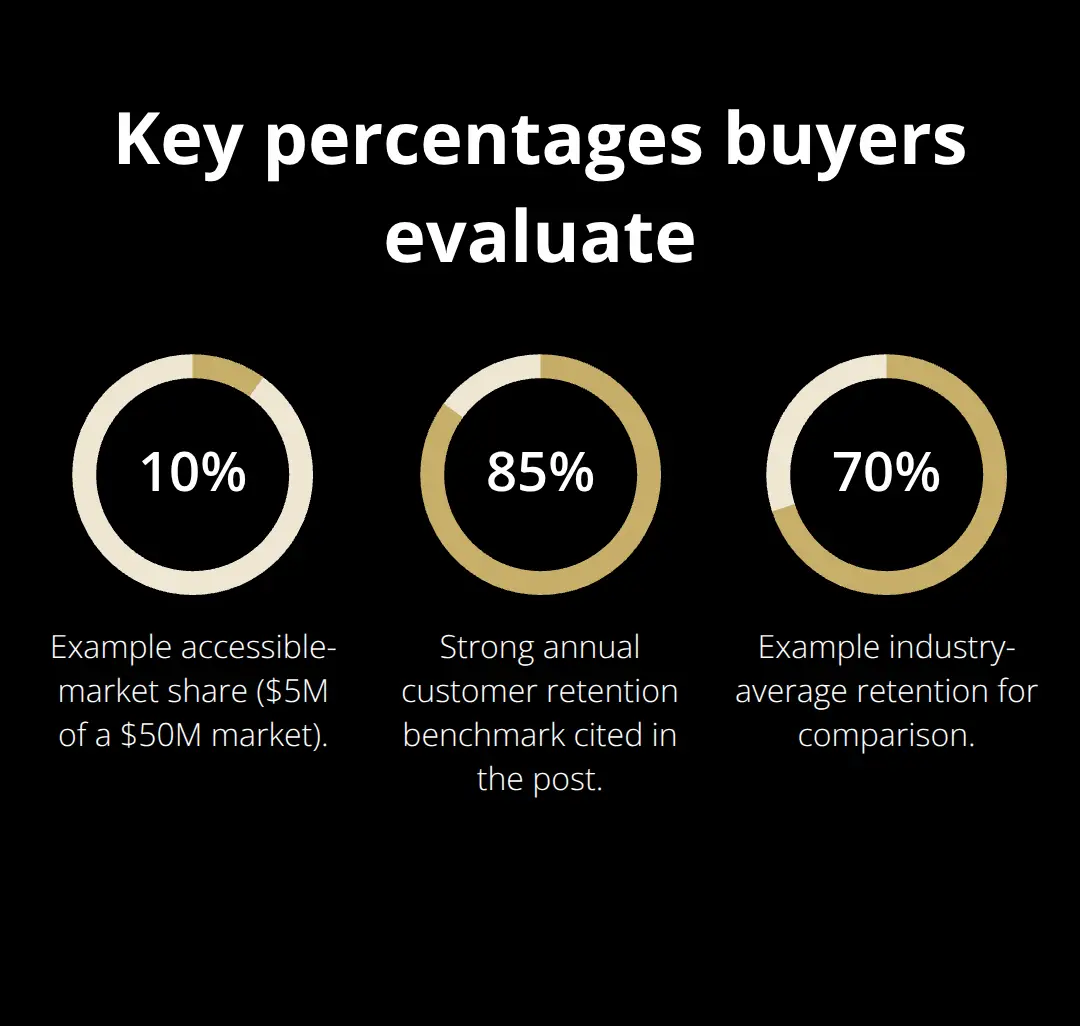
Industry benchmarks vary widely, but if you retain 85% of customers annually while your industry average sits at 70%, that’s a defensible competitive edge. Calculate your customer lifetime value against acquisition cost. If you spend $500 to acquire a customer who generates $3,000 in total revenue over their relationship, you’ve built an efficient, scalable model. Buyers see this math and understand whether your business model actually works or just appears profitable on the surface.
Demonstrate Revenue Quality and Stability
Revenue stability matters far more than revenue size. A $2 million business with three customers generating 80% of revenue carries significantly more risk than a $2 million business with 300 customers evenly distributed. Document your customer concentration honestly. If 40% of revenue comes from your top five customers, state it. Buyers will uncover this during due diligence regardless. What impresses them is transparency and documented mitigation. Show contract terms for major customers, renewal likelihood based on historical patterns, and whether those relationships depend on your personal involvement or have been institutionalized within your team. Include customer satisfaction metrics if you have them. Net Promoter Score, customer feedback, or case studies demonstrating strong relationships reduce perceived risk. Document your recurring revenue percentage and subscription model valuation. Recurring revenue models typically contribute to a stronger valuation by offering a clearer picture of future earnings. If a significant portion of your revenue comes from subscriptions or contracts with defined renewal cycles, highlight this aggressively.
Build Authority Through Online Credibility
Your online presence directly influences buyer perception before they even contact you. A strong website, active social media, and third-party credibility signals tell buyers your business operates professionally and stays market-aware. Ensure your website clearly explains what your business does, who you serve, and what problems you solve. Vague positioning costs you valuation. Document your content marketing efforts if you maintain a blog, podcast, or educational resources. This proves you’ve invested in building authority and customer education. Buyers see this as evidence of sustainable customer acquisition beyond paid advertising. Gather testimonials, case studies, and reviews from actual customers. Platforms like Google, Trustpilot, or industry-specific review sites carry weight because they’re third-party validation. A business with 50 five-star reviews carries more credibility than one with none, even if both have identical operational metrics. Track your search engine visibility for key terms related to your business. If you rank in the top three for relevant keywords, document this. It proves organic customer discovery works. Include any media mentions, speaking engagements, awards, or industry recognition. These third-party endorsements signal market leadership and reduce buyer risk perception.
Final Thoughts
You’ve now walked through the three pillars of business packaging: financial records that tell a consistent story, operational systems that prove scalability, and market positioning that demonstrates competitive strength. Sellers who prepare strategically attract serious buyers and command higher valuations. Those who skip preparation face lower offers, longer negotiations, and deals that fall apart during due diligence.
Start now, even if you’re not selling immediately. Clean financial records take months to reconstruct properly, and operational documentation requires time to write and refine. Market positioning builds gradually through consistent effort, so the earlier you begin, the less pressure you’ll face when you decide to sell.
We at Unbroker built a platform specifically designed to help sellers navigate this journey without the high fees traditional brokers charge. Visit Unbroker to explore our Full Service Business Sale or Assisted Business Sale options, which provide access to our buyer network, marketing tools, legal templates, and negotiation support.