An open SBA loan does not automatically stop you from selling, and it does not automatically move to the buyer either. What happens depends on which loan you have, what your documents say, and what the lender or SBA agrees to in writing. This guide gives you a clear sequence to follow.
You will learn how to identify your loan, why a COVID EIDL needs special attention, how payoff and assumption differ, and how to plan the payoff into your price and closing. We also cover what changed for buyers who finance with SBA loans under the rules effective October 1, 2026, since those rules can affect your price and terms.
Can you sell a business that still has an SBA loan?
Yes, you can sell a business with an SBA loan outstanding. Most owners who do so pay the loan off from the sale proceeds at closing, and the lender releases its liens once it is paid. The loan is a closing item to manage, not a wall in front of the deal.
Two assumptions cause most of the trouble. The first is that the loan makes the business unsellable. The second is that the loan simply goes with the business to the new owner. Neither is a safe default. Your loan documents and the lender’s (and sometimes SBA’s) approvals decide what is allowed.
The practical lesson is to find out early. Buyers, their lenders and their attorneys will ask about your debt in the first round of diligence. If you already know your loan type, what is pledged as collateral, whether consent is needed and what a payoff would look like, you can answer calmly and keep the deal moving. If you find out mid-negotiation that you need written consent from SBA, you may lose weeks you did not plan for.
A helpful way to think about it is as three questions to answer before you list:
- What exactly do I owe, and to whom?
- What did I pledge, and who has to sign off if I sell it?
- Will the loan be paid off at closing, or can a buyer take it over?
Know which loan you have: 7(a), 504 or COVID EIDL
Start by pulling your loan authorization, promissory note, security agreements and any guarantee documents. Then identify the program. The three you are most likely to see are the 7(a) loan, the 504 loan and the COVID-19 EIDL.
7(a) loans
A 7(a) loan is made by a participating lender and partly guaranteed by SBA. Whether a buyer can assume it or you must pay it off is decided by your loan authorization and note, and by the lender’s and SBA’s servicing approval, not by a general rule. Texas Exit Advisors, in 2026 guidance on selling a business with debt, recommends that sellers ask the lender in writing and early which applies. That is good advice for any program.
504 loans
A 504 loan is a different structure, delivered through a lender and a development company, and it is commonly tied to real estate or major equipment. The details of transfer or payoff sit in your specific documents. If you have one, ask the servicer in writing what is required to sell the financed assets or the business, and have an attorney read the answer.
COVID-19 EIDL
The COVID EIDL is a direct SBA loan, with no bank in the middle. That means SBA itself is the party you deal with, and its consent requirements work differently from a bank loan. We cover those in the next section.
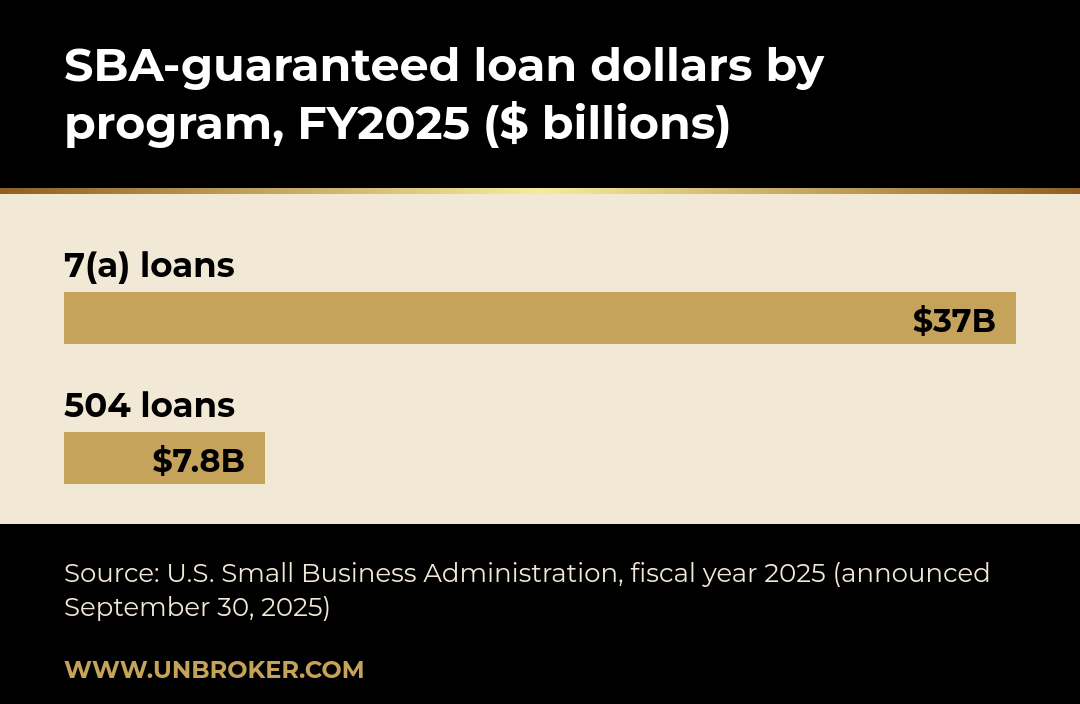
These programs are not small. In fiscal year 2025, SBA guaranteed 84,400 7(a) and 504 small business loans totaling $44.8 billion, including 77,600 7(a) loans for $37 billion and 6,750 504 loans for $7.8 billion, according to SBA’s September 30, 2025 announcement. In dollar terms, 7(a) loans were $37 billion and 504 loans were $7.8 billion for FY2025.
Whatever program you have, write down the lender or servicer, the loan number, the current balance, the collateral listed, and whether anyone besides the company signed as guarantor. That one page becomes the backbone of your sale preparation.
COVID EIDL: the blanket lien and SBA’s written consent
Owners with a COVID EIDL should slow down here, because this is where sales get snagged.
In an SBA FAQ for agricultural businesses and farming operations dated August 18, 2020, SBA stated that collateral is required for all COVID-19 EIDL loans over $25,000, and that SBA files a UCC-1 general security interest against non-real estate business assets. You can read the guidance in the FAQ hosted by the U.S. Senate. In plain terms, that means a blanket lien on things like equipment, inventory, receivables and other personal property of the business. A buyer’s attorney will find that lien in a UCC search almost immediately.
The same FAQ said SBA’s consent is required before selling or transferring collateral securing these loans, including equipment. It also said borrowers must notify SBA of net proceeds from the sale of collateral equipment, with proceeds remitted to SBA unless alternative conditions are agreed before the sale. The key phrase is “before the sale.” Agreeing on conditions afterward is much harder.
The loan paperwork points the same way. A COVID-19 EIDL Loan Authorization and Agreement filed with the SEC in 2020 states the borrower will not sell or transfer any collateral, other than normal inventory turnover in the ordinary course of business, without SBA’s prior written consent. That is one example, and each borrower’s own loan documents control, so read your own authorization and note.
Ownership changes matter too. A Williams Mullen law-firm analysis of mergers and acquisitions with PPP or EIDL borrowers says the EIDL promissory note treats it as a default if the borrower changes ownership or business structure without SBA’s prior written consent. The firm says that language is broad enough to cover most transfers of ownership interests. So this is not only an asset-sale issue. A stock or membership-interest sale may trigger the same problem.
What to do about it:
- Read the authorization and note for the collateral, transfer and ownership-change clauses.
- Run a UCC search on your own business so you know exactly what is on file.
- Contact SBA early, in writing, about consent or a payoff, and keep the correspondence.
- Have an attorney review the consent or payoff approach before you accept an offer.
Payoff at closing vs. buyer assumption: what your documents decide
There are two basic paths for an SBA loan in a sale. One is payoff, where the loan is repaid at closing from the sale proceeds. The other is assumption, where the buyer takes over the loan with approval.
Payoff at closing
Payoff is the cleaner and more common route, and the easier one for a buyer and the buyer’s lender to underwrite. Here is how it usually works:
- You request a payoff letter from the lender or SBA showing the amount needed on the closing date, including any interest accrued through that date.
- The closing agent or attorney sends the payoff amount directly to the lender from the sale proceeds.
- The lender releases its liens, typically by filing a UCC termination statement and releasing any other recorded security.
- You receive written confirmation that the loan is satisfied, and you keep it with your records.
Because payoff comes out of your proceeds, a buyer is not inheriting your debt, and a buyer’s lender can take a clean first position on the assets.
Buyer assumption
Assumption may be possible on some loans, but it is not a right. As noted above, for 7(a) loans it is decided by the authorization and note and by servicing approval from the lender and SBA. Buyers financing their purchase with a new loan generally cannot also leave your old lien sitting in front of the new lender. Expect that a buyer who wants to assume needs approval, and expect the process to add documentation and time.
If you are considering assumption because the existing loan has attractive terms, ask the lender in writing whether it is allowed, what the buyer must submit, and what happens to you if it goes through. The next section explains why that last question matters.
Why you stay on the hook if the loan is assumed
Many sellers assume that once a new owner takes over the loan, they are done. That is not what SBA’s process provides. Frost Law, summarizing SBA’s assumption request requirements in a piece on SBA EIDL loans and hidden asset liens, reports that SBA approval of a new owner taking over a loan does not release the original borrower or any guarantor from liability.
In practice, that means if you signed a personal guarantee, you may remain responsible if the buyer stops paying, even after you have sold and moved on. You could be exposed for years on a business you no longer control.
If assumption is on the table, protect yourself:
- Ask the lender or SBA in writing whether a release of the original borrower and guarantors is possible, and under what conditions.
- If no release is available, think hard about whether the price benefit is worth the continuing exposure.
- Have the purchase agreement require the buyer to keep the loan current, give you notice of any default, and indemnify you, and ask your attorney how to back that up with real security.
- Consider whether you would be more comfortable simply paying the loan off at closing.
For many sellers, a full payoff is worth it for the clean break alone.
Plan the payoff into your price and closing timeline
The payoff is a use of proceeds, not a reduction in what the business is worth. A buyer is paying for the business, and the debt is your obligation. Still, it affects what you take home, so build it into your math from day one.
Set up a simple proceeds estimate before you list:
- Start with a realistic target price from a valuation, not a hope.
- Subtract the SBA payoff amount, including accrued interest to the expected closing date.
- Subtract other debts and liens that must be cleared, plus transaction costs and any adviser fees.
- Set aside an estimate for taxes, and confirm it with your tax adviser.
The result is your net, and it tells you your floor. If the net is thin, you will want to know that before you entertain offers, not after.
Timeline matters just as much. If SBA consent or a payoff letter is needed, start those requests while you prepare the listing, not after you have a signed letter of intent. Lining up the paperwork early may help avoid a gap between a buyer’s closing date and your lender’s response. Do not promise a buyer a closing date until you know how long the lender or SBA needs to turn around the payoff and lien releases.
Also be ready for what a buyer’s attorney will ask for:
- Copies of the loan authorization, note and security agreements.
- A UCC search showing every lien on file.
- A payoff letter, or a plan to get one, with a lien release commitment.
- Any written consent from SBA or the lender.
Organized records here also support the rest of diligence. Our guide to preparing your records for a faster close covers the wider document set buyers expect.
What buyers using SBA loans now face under SOP 50 10 8.1 (effective October 1, 2026)
Even if your own loan is paid off at closing, your buyer may be using an SBA loan of their own. The rulebook for those loans changed this fall, and since it is already in effect, it should shape how you negotiate.
SBA published Notice 5000-880695 on August 14, 2026, announcing SOP 50 10 8.1, the standard operating procedure for lender and development company loan programs covering 7(a) and 504 loans. It is effective October 1, 2026 and applies to applications issued an SBA loan number on or after that date. Applications submitted through September 30, 2026 stay under the prior SOP 50 10 8. You can see the announcement in SBA’s information notice.
That split matters. A buyer whose loan application went in before the cutoff may be under the older rules, while a buyer whose loan receives an SBA loan number on or after October 1, 2026 is under the new ones. Ask any buyer who plans to use SBA financing which set of rules applies to their application, and ask their lender to confirm.
Two changes stand out, based on law-firm summaries:
- Independent valuation. The Cantrell Law Firm’s summary of SOP 50 10 8.1 says every SBA-financed change of ownership requires an independent valuation from a qualified source, commissioned by and prepared for the lender, covering the full purchase price. This applies to loans receiving an SBA loan number on or after October 1, 2026.
- Equity and earnouts. A law-firm analysis in The Chicagoland Lawyer (August 26, 2026) says the SOP prohibits seller earnouts in SBA change-of-ownership deals, so if the buyer uses a 7(a) loan the price must be fixed at closing. It also says the buyer must inject at least 10% equity for initial acquisitions.
What this means for you: a lender-ordered valuation puts a third-party opinion in the middle of your deal. If the valuation covers the full purchase price and comes back below the agreed price, the deal may need to be renegotiated or restructured, or the buyer may need to bring more cash. Clean, well-supported financials and a defensible price can help here. Our guides on how buyers use an SBA loan to buy a business show the buyer side of the same process.
Because these rules are new and detailed, confirm specifics with the buyer’s lender and your attorney rather than relying on a summary alone.
Seller notes, earnouts and valuation: what to expect from SBA-financed buyers
If your buyer is using an SBA 7(a) loan, the structure of your deal has less flexibility than in a conventional sale. Plan for that before you negotiate.
Earnouts
Under the law-firm analysis above, SOP 50 10 8.1 prohibits seller earnouts in SBA change-of-ownership deals, so the price must be fixed at closing when the buyer uses a 7(a) loan. If you were hoping to bridge a valuation gap with a contingent payment tied to future performance, that tool may be off the table with an SBA-financed buyer. If you are weighing the pros and cons of contingent pricing in general, see should you accept an earnout when selling your business.
Seller notes
Seller financing is also constrained. Under SOP 50 10 8 (effective June 1, 2025), per Promise Legal’s 2026 change-of-ownership playbook, a seller note could count toward the buyer’s 10% minimum equity injection only if it was on full standby, meaning no principal or interest for the life of the 7(a) loan, and it could cover no more than half of the required equity. Confirm with the buyer’s lender how the current SOP treats seller notes before you build a deal around one.
A standby note means you may wait a long time to be paid on that portion, and it typically sits behind the lender. If you are considering one, read are seller financing notes worth the risk first.
What it adds up to
Expect SBA-financed buyers to bring a fixed price, real cash at closing, and a lender-driven valuation. That structure can be attractive to a seller who wants most of the value at closing and a clean exit, especially if you plan to pay off your own SBA loan from the proceeds. It can be less attractive if your price depends on creative terms. Talk to prospective buyers about their financing early, ask how far along their lender is, and decide which structures you will and will not accept.
A pre-listing checklist for sellers with SBA debt
Use this list to get ahead of the issues buyers will raise. Do as much as you can before you go to market.
- Gather the documents. Loan authorization, note, security agreements, guarantees, amendments and recent statements.
- Identify the program. 7(a), 504 or COVID EIDL, and the lender or servicer.
- Run a lien search. Pull UCC filings and confirm what is recorded against the business, and check any real estate records tied to your loan.
- Read the transfer clauses. Look for collateral sale restrictions, ownership-change defaults and notice requirements.
- Ask in writing. Ask the lender or SBA whether payoff or assumption is available, what consent is required, and what releases will be provided.
- Request a sample payoff letter. Know the balance and how interest accrues so you can model your net proceeds.
- Check your guarantees. List every personal guarantor and ask whether a release is possible if the loan is assumed.
- Decide your deal structure. Asset sale or equity sale, since an ownership change can itself be a default under some EIDL notes.
- Plan for SBA-financed buyers. Expect a lender-ordered valuation, a fixed price and limited seller-note treatment, and confirm which SOP applies to each buyer.
- Bring in advisers. An attorney should review consents and the purchase agreement, and a tax adviser should review proceeds and structure.
- Keep it confidential. Share loan details with buyers only after an NDA and only as needed, and avoid telling lenders more than the process requires.
This is also a good moment to organize your wider sale file. Our checklist of documents needed to sell pairs well with the list above.
How Unbroker helps you prepare a confidential, organized sale
Unbroker is a modern platform for selling businesses, combining expert advisors, AI-driven buyer matching and national marketing, with a confidential process from start to finish. Our Full Service Business Sale charges a 6% success fee, paid when the business sells, and includes legal document templates and negotiation assistance. If you have an SBA loan to resolve, you can bring your questions about timing, buyer financing and deal structure to an advisor early, and keep your attorney and tax adviser in the loop on the lien, consent and payoff details. To start, visit Unbroker.