Selling an independent insurance agency has a lot in common with selling any small business, but a few issues can stall or reshape a deal if you find them late. This guide covers who owns the renewal rights to your book, how carrier agreements and appointments affect a transfer, what your agency license and designated responsible producer mean for a buyer, and which tax questions to raise early.
You also get a practical list of records to pull together and a sensible order of operations, so you can talk to your attorney, tax adviser and carriers from a position of knowledge. None of this replaces professional advice, and the rules vary by state and by contract. The goal is to help you ask better questions before you go to market.
Why an insurance agency sale is different from other small business sales
Most small businesses sell their equipment, inventory, brand, lease and customer relationships. An insurance agency has little of the first three. What a buyer pays for is the right to service and renew a book of business, plus the people and systems that keep clients in place. That right does not sit entirely in your hands. It runs through your agreements with the carriers you represent, and it depends on licensing rules set by each state.
That is why four questions come up in nearly every agency sale:
- Who owns the expirations? These are the renewal rights in your policies.
- Do your carrier agreements allow a transfer? Some may require notice or consent, and a buyer needs its own appointments.
- Who holds the license, and who is the designated responsible producer? The entity and the individual both matter.
- How will the purchase price be allocated? The allocation affects taxes for you and the buyer.
The market is also worth understanding. Liberty Mutual’s November 2023 report said agency mergers and acquisitions reached an all-time high in 2021 and that activity had since slowed amid economic uncertainty. It added that owners of small property and casualty focused agencies in particular may have fewer offers and options to sell (Liberty Mutual Agent for the Future). A clean, well-documented agency is easier to present to the buyers who are active, so preparation matters more when options are thinner.
Agency sale or book of business sale: what you are actually selling
Before you talk to a single buyer, decide what you are offering. There are two common shapes, and they carry different consequences.
Selling the agency
In an agency sale, the buyer acquires the business itself: the book, the employees, the office, the systems and the brand. Depending on how the deal is structured, the buyer may take over the entity or buy its assets. This path suits an owner who wants to hand off the whole operation, and it usually involves more diligence on employment, leases, contracts and any liabilities that come with the entity.
Selling a book of business
In a book sale, you sell some or all of your policies and the right to renew them, and you keep the company. Owners choose this when they want to keep part of the operation, wind down gradually, or sell a line they no longer want to service. The buyer gets less to diligence, but the carrier questions can come into sharper focus because the transfer of each carrier’s business is the whole deal.
Why the choice matters
The structure shapes your tax outcome, which carrier approvals are needed, whether staff move to the buyer, and who is responsible for errors and omissions claims on past work. Your attorney should advise on the structure, and you should settle on a working preference before you list. Buyers respond better to a seller who can say clearly what is for sale.
Many owners also overlook how they came to own the agency themselves. In the 2023 Agency Growth Study (an online survey conducted in late 2022), independent agency owners and principals were asked how they came to own their agency, and could give more than one answer. Of those owners and principals, 53% started from scratch, 22% left a captive agency, 19% became owner as a producer after a set time, 17% took over from family, 10% bought an agency or book, and 7% became owner as a producer once their book reached a certain size (Liberty Mutual Agent for the Future).
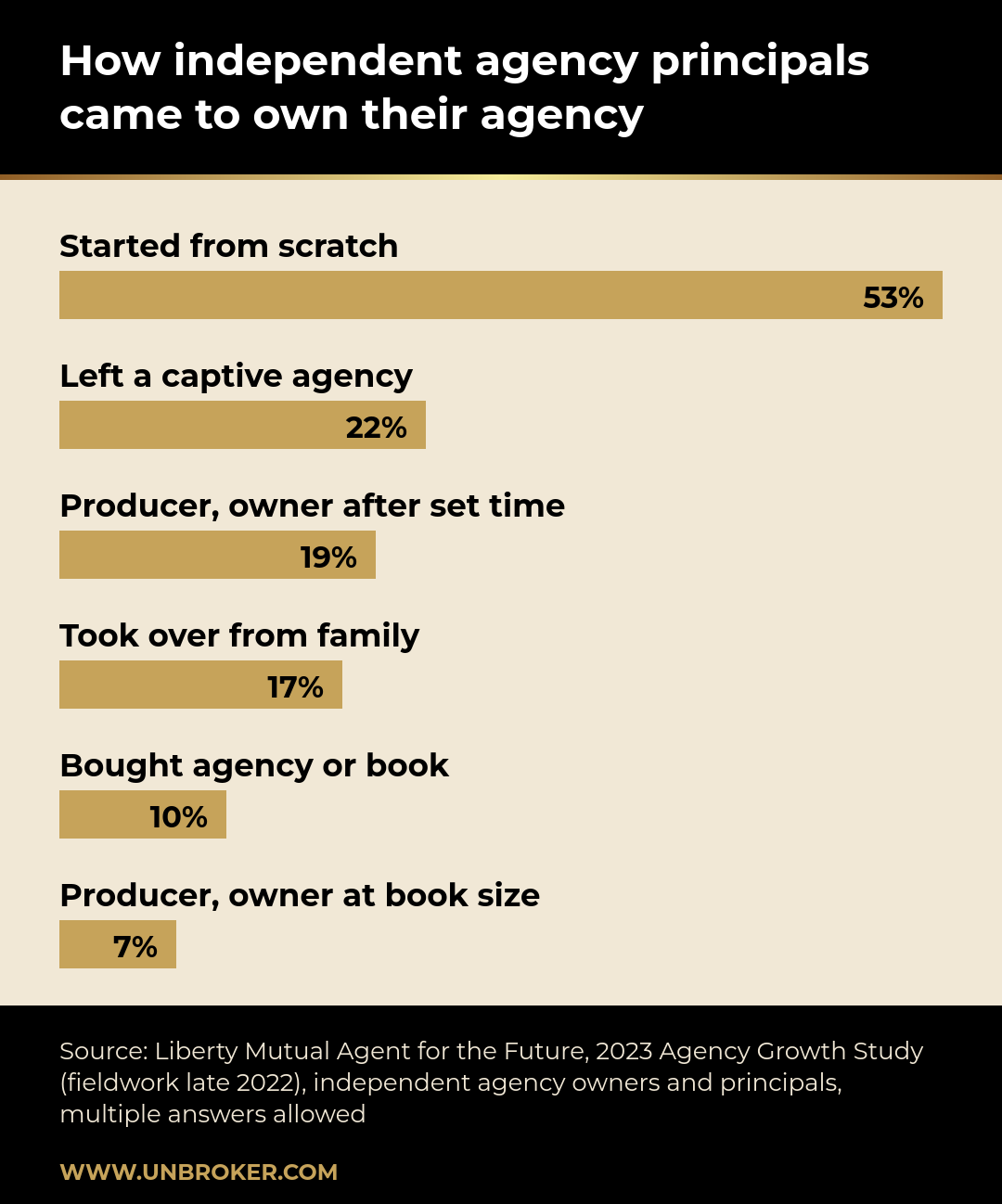
The takeaway is practical. Only 10% of those owners and principals bought an agency or book, so many have never been through a purchase agreement from either side. If that describes you, it is worth getting an attorney and a tax adviser involved early rather than learning the vocabulary during negotiations.
Who owns the expirations? Check this before you list
Expirations are the renewal rights in a book of business: the ability to approach a client at renewal and place the coverage. In an agency sale, the buyer is paying largely for those rights, so a buyer’s attorney is going to ask who holds them. You should know the answer first.
As described in a May 2025 Insurance Journal article on agency agreements, producers typically own their expirations during the term of the agreement and after termination, except where they owe the carrier money after termination. The article also notes it is not uncommon for a carrier agreement to include other grounds on which a book of business would be transferred to the carrier (Insurance Journal). That “typically” and “not uncommon” language is the point: your own contract controls, and it may differ from the usual pattern.
What to read in your own agreements
- Ownership language. Does the agreement say who owns the expirations during the term and after termination?
- Debts to the carrier. Do you owe the carrier anything, such as unearned commission or balances, that could affect your rights?
- Transfer triggers. Are there circumstances in which the book would be transferred to the carrier, and could the sale itself or a change in ownership trigger one?
- Restrictions on assignment. Does the agreement limit who you can sell to, or require notice or approval?
- Producer and employee agreements. If a producer on your team brought in a portion of the book, what do their agreements say about ownership of those accounts?
Have an attorney who knows insurance agency contracts review the documents and confirm what you actually own. If you find a problem, it is far better to learn it before you set an asking price than after a buyer’s diligence team does. Some issues can be fixed with a payoff, an amendment or a written consent. Others may change what you can offer.
Carrier agreements and appointments: confirm consent early
A buyer does not just need your clients. It needs the ability to place business with the carriers behind those clients. That depends on two separate things that owners often blur together: your carrier agreements and the buyer’s appointments.
A license is not an appointment
Under the NAIC Producer Licensing Model Act (Model #218) and the Uniform Licensing Standards, a producer can hold a license without holding an active appointment, and an appointment is filed by the insurer. A license and a carrier appointment are separate things, so you should not assume a buyer’s license also gives it the right to place business with each carrier (NAIC State Licensing Handbook, Chapter 1).
In practice, that means a buyer who is fully licensed may still need appointments with some or all of your carriers before it can service your policies there. Some carriers may already appoint the buyer. Others may not, and a carrier may have its own view on whether to appoint a buyer or consent to a transfer.
Sequence the carrier conversations
Carrier consent is easy to put off because it feels risky to tell a carrier you are selling. But the carriers may be central to the deal, so plan how and when to approach them:
- Read each carrier agreement first, so you know what it says about assignment, notice and transfer.
- Group your carriers by importance to the book. Your largest relationships are the ones most worth understanding early.
- Ask your attorney when in the process each carrier should be told, and under what confidentiality terms.
- Ask each prospective buyer which carriers it is already appointed with, and which appointments it would need.
- Build consent or appointment as a condition in the purchase agreement, so you and the buyer share a clear picture of what must happen before closing.
A buyer will usually ask these questions anyway. Walking in with the answers signals that your agency is organized and that the transfer risk has been thought through.
Agency licenses and the designated responsible producer
An insurance agency is generally a licensed business entity, and the individuals who sell and service coverage are licensed too. A sale can touch both layers.
Under the NAIC Producer Licensing Model Act (Model #218), a business entity acting as an insurance producer must obtain a producer license where the state adopts that requirement. Before approving a resident business entity, the state must find that the entity has designated a licensed producer responsible for its compliance with state insurance laws, commonly called the designated responsible producer. Model #218 is a model law, so each state’s rules and deadlines for reporting ownership changes can differ and should be confirmed with the state insurance department or an attorney (NAIC State Licensing Handbook, 2020).
Questions to answer before you list
- Who is your designated responsible producer today? If that person is you and you are leaving, the buyer needs a plan to name a replacement.
- Which states are involved? If your agency holds licenses in more than one state, ask your attorney what each state requires when ownership changes.
- What are the reporting deadlines? Because deadlines for reporting ownership changes can differ by state, confirm them with the state insurance department or your attorney, and build them into the closing timeline.
- Will the buyer keep your entity or use its own? The answer affects which licenses transfer, which must be applied for, and what has to be filed.
- Are your own licenses and continuing education current? A buyer’s diligence may include a check of the agency’s and producers’ license status.
If you plan to retire
Owners who intend to step away often want to keep receiving renewal commissions for a time. Section 13(C) of NAIC Model #218 says a producer should not be required to maintain an active license solely to continue receiving renewal or deferred commissions. This is a model provision and each state decides its own rules, so a retiring owner should confirm the treatment of renewal commissions in the state and in the purchase agreement (NAIC State Licensing Handbook). If part of your price is meant to be paid over time out of renewal commissions, make sure your attorney reviews how that works in your state before you agree to the structure.
Who buys agencies, and what owners are planning
Understanding who else is thinking about a transition helps you see your options. In Liberty Mutual’s 2023 Agency Growth Study, an online survey conducted in late 2022 of 1,141 U.S.-based independent agency principals, producers and CSRs (including 467 agency owners and principals), 40% of the principals surveyed were older than 60 and 20% were older than 65 (Liberty Mutual Agent for the Future).
In the same survey, just over half of agency principals anticipated a major change in agency ownership within the next 10 years, slightly less than a third expected ownership to stay the same for more than 10 years, and 16% were unsure (Liberty Mutual Agent for the Future).
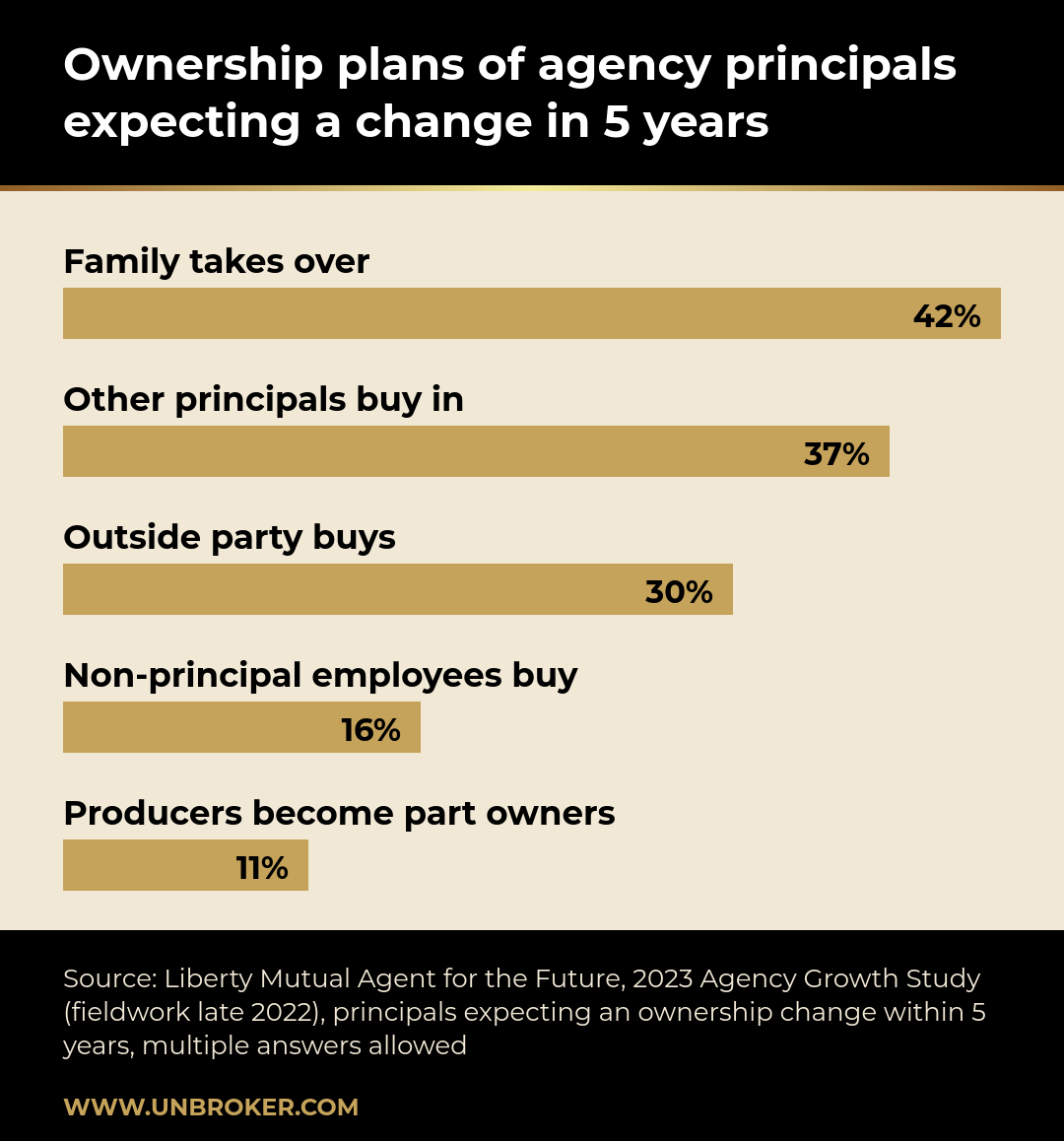
The plans differ widely. Among principals who expected an ownership change within five years, 42% planned for children or other family members to take over, 37% for other principals to buy their interest, 30% for an outside party to buy their interest, 16% for non-principal employees to buy, and 11% for producers to become part owners once their book reaches a certain size. The percentages add up to more than 100 because respondents could name more than one plan (Liberty Mutual Agent for the Future).
Size seems to shape the choice. In the same study, agencies with fewer than seven employees were more likely to consider selling to an outside party, while agencies with more than seven employees were most likely to plan for other principals to buy out a departing owner’s interest (Liberty Mutual Agent for the Future). If you run a smaller agency with no internal successor, an outside sale may be the most realistic route, which makes reaching a wide pool of qualified buyers more important.
Matching the buyer to your goals
Different buyers want different things, and your priorities should guide who you approach:
- Internal buyers such as a partner, a producer or an employee may know the book and the clients, but may need seller financing or time to pay.
- Outside buyers such as another agency may bring appointments, capital and scale, but may want changes to staffing, systems or branding.
- Family may offer continuity, but the same documentation and consent issues apply, and the relationship adds its own pressure.
If a team member is a possible buyer, our guide on selling to employees versus an outside buyer lays out the tradeoffs.
Asset sale tax basics: what to ask your tax adviser
Many agency deals are structured as asset sales, where the buyer purchases the book and related assets rather than the entity itself. Whether yours is one depends on your entity type, your goals and negotiation, so this is a conversation for your tax adviser and attorney. What follows is the buyer’s side of the picture, which is useful because it shapes what buyers ask for.
Under Internal Revenue Code section 197, a buyer amortizes the adjusted basis of an amortizable section 197 intangible ratably over 15 years, beginning with the month it was acquired. The statute defines section 197 intangibles to include customer-based intangibles, meaning composition of market, market share and other value from future customer relationships. How purchase price is allocated across asset classes affects both parties, so sellers should confirm treatment with a tax adviser (Internal Revenue Code section 197, 2024 edition).
For a seller, the practical point is that the allocation in the purchase agreement is not a formality. An agency’s value sits mostly in customer relationships, but the agreement may also allocate amounts to other items, such as equipment, a non-compete or a consulting arrangement, and each can be treated differently for you.
Questions to bring to your tax adviser
- How does my entity type affect the tax result of an asset sale compared with selling the entity?
- How should the purchase price be allocated, and how does that allocation affect me?
- How would payments over time, such as seller financing or amounts tied to retained renewals, be treated?
- How are payments for a non-compete or a transition consulting agreement treated?
- Which tax forms and filing deadlines apply to the transaction?
Our guide to Form 8594 and purchase price allocation explains how the allocation is reported, and our overview of the asset sale approach covers when the structure makes sense. Neither replaces your own adviser, because the answers depend on facts only they can review.
Keeping a sale confidential from carriers, staff and clients until the right moment
In an agency, confidentiality has an unusual edge. Your clients may associate the relationship with you personally. Your producers and CSRs may worry about their jobs. Your carriers have a stake in who services their business. A rumor reaching any of these groups too early can cause real damage, such as a producer who leaves with accounts before closing or a client who shops the policy.
A practical disclosure order
- Your advisers first. Your attorney, tax adviser and accountant should know before anyone else, and they are bound by professional duties of confidentiality.
- Buyers under a non-disclosure agreement. Share identifying details only with buyers who have signed an NDA and been screened for fit and financial capacity. Early marketing should describe the agency without naming it, for example by size, lines of business and region.
- Carriers when the process requires it. Ask your attorney when to approach each carrier, based on what each agreement says.
- Key staff at a planned moment. Consider whether retention arrangements for key people should be in place before they hear the news.
- Clients after terms are set. Plan the message with the buyer, so clients hear a consistent story about service continuity.
Restrict who can see policy-level data too. Share client lists and loss runs in a redacted or summarized form until a buyer is serious, and then move to fuller disclosure under the NDA. For more on handling this, see our guides to a confidential business sale and when to tell employees you are selling.
Records to gather before you go to market
A well-organized file shortens diligence and lets a buyer price with fewer unknowns. Start collecting these items while you review contracts:
Contracts and ownership
- Every carrier agreement and any amendments, plus a list of your current appointments
- Producer, employee and non-compete agreements
- Any prior agreements that touch the ownership of accounts, such as earlier purchases of books
- Entity documents, including operating or shareholder agreements
Licensing and compliance
- Agency and individual license details for each state, including the designated responsible producer
- Continuing education and renewal status
- Records of any regulatory inquiries or complaints, and your errors and omissions coverage history
The book and the financials
- A policy-level report from your management system, showing carrier, line of business, premium, commission and renewal date
- Commission statements and revenue by carrier and by line
- Recent tax returns and profit and loss statements, with personal and one-time expenses identified so a buyer can understand the real operating picture
- A summary of contingent or bonus income, if you receive any, and the carrier terms behind it
Operations
- An organization chart, with roles, tenure and who owns key client relationships
- Your management system, agency software and vendor contracts
- Your lease and any equipment or technology obligations
Our checklist of documents needed to sell covers the general items any buyer expects, and you can layer the agency-specific records above on top of it.
Your next steps
Put these steps in order and you can approach the market with fewer surprises:
- Decide whether you are selling the agency or a book of business, and which parts of your operation, if any, you want to keep.
- Have an attorney review your carrier agreements for ownership of expirations, transfer triggers and assignment limits.
- Confirm licensing details, including your designated responsible producer and state reporting deadlines.
- Talk to your tax adviser about structure and price allocation before you accept any offer.
- Gather the records above and clean up your book data.
- Plan your confidentiality and disclosure sequence, then go to qualified buyers.
A sale of this kind can involve many moving parts, but most of them can be identified in advance. Owners who take the time to understand their contracts, their licenses and their tax picture are in a stronger position to negotiate, whatever the market is doing.
Unbroker helps owners sell a business with expert advisors, AI-driven buyer matching and national marketing, all within a confidential process. Our Full Service Business Sale charges a 6% success fee, paid when the business sells. To see how it works, visit unbroker.com.