A car wash is a hybrid asset. Buyers are purchasing a piece of real estate, a line of heavy equipment and a stream of customer cash flow, and each one gets its own scrutiny. This guide covers the four areas that most often shape a car wash deal: whether the land and building are sold or leased, how equipment depreciation may be taxed, how membership revenue is documented, and whether your wastewater compliance is clean.
You will also get a plan for staffing and handover, a look at how wash format shapes your buyer pool, ways to keep the sale quiet, and a checklist to work through before you list. Treat it as a map of what to organize first, not as tax or legal advice.
What buyers are really buying: the site, the equipment and the cash flow
When a buyer looks at your car wash, they underwrite three things at once. The first is the site: its location, traffic, zoning, and whether the buyer gets the land or only a lease. The second is the equipment: tunnel conveyors, in-bay machines, dryers, pumps, water reclaim systems, vacuums and payment hardware. The third is cash flow: what the wash earns per car and how much of that revenue repeats every month.
The industry is large and spread thin. The International Carwash Association estimated there were about 62,750 car washes in the United States in 2020, and the trade publication Auto Laundry News attributed a decline in store count over the preceding period to the Great Recession and to a pullback in convenience store and gas sites that have car washes. You can read that analysis in Auto Laundry News. That 2020 figure is an older estimate, so treat it as a snapshot of the market’s scale and not a current count.
For car wash businesses classified under NAICS 811192, VerticalIQ reports about 15,675 firms operating 19,463 establishments. The gap between those two numbers shows that some operators run more than one site.
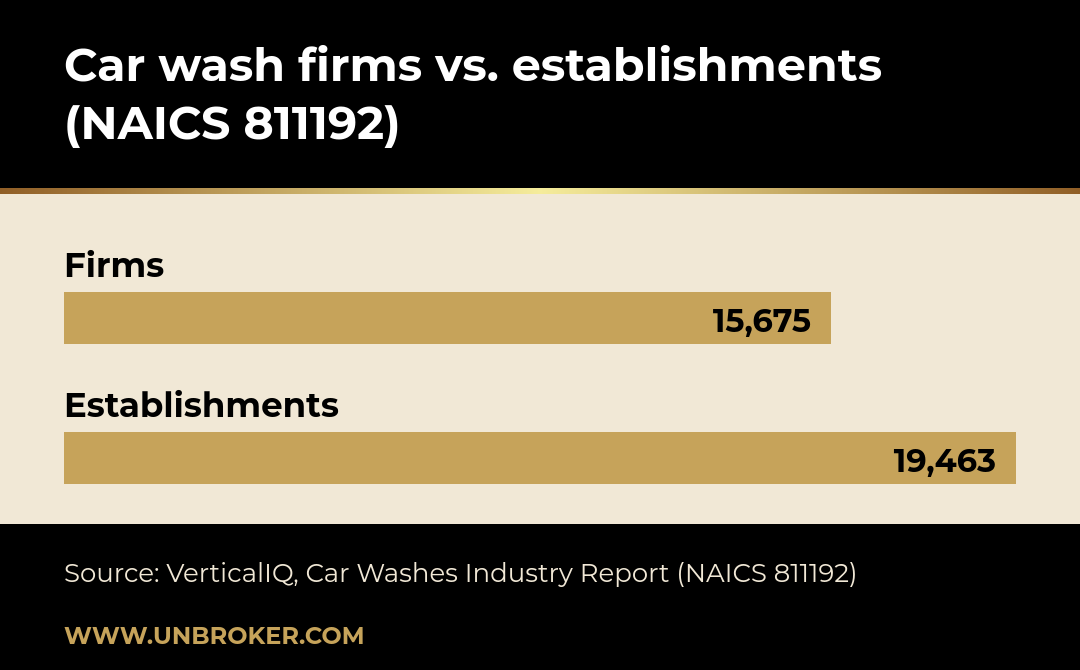
VerticalIQ describes the industry as extremely fragmented, with the top 50 companies accounting for 20% of industry revenue, and it describes the average car wash in its NAICS 811192 data as a single-location operation that employs 12 workers and generates about $1 million annually (see the VerticalIQ industry report). That is an industry average and not a benchmark for your site. Its practical meaning is that most car washes are owner-operated, so many buyers are used to reviewing a business with a thin management layer. They will still expect clean records.
The same VerticalIQ report, citing the International Carwash Association’s Q2 2026 Pulse Report, says the U.S. car wash industry showed signs of strengthening in Q2 2026 while operators face growing customer-retention challenges. For a seller, that second point matters. Buyers will probe how sticky your customers are, which brings us back to membership records later in this guide.
Owned land vs. leased land: how the real estate decision shapes the deal
The first structural question in almost every car wash sale is whether the land and building go with the business. The answer changes who your buyers are, how they finance the purchase and how your paperwork is organized.
If you own the land and building
You have a choice: sell the real estate together with the operating business, or sell the business and lease the site to the buyer. Each path has trade-offs.
- Selling both together. This can appeal to buyers who want full control of the site and who plan to finance the real estate and the business in one package. It also simplifies the question of what happens when the lease ends, because there is no lease.
- Selling the business and leasing the site. This can widen the buyer pool to people who cannot fund the land, and it can give you ongoing rental income. It also makes you a landlord to your buyer, so the lease terms (length, renewals, rent adjustments, maintenance duties, what happens on default) need careful drafting by an attorney.
Real estate and business assets are often valued and taxed differently, and the split in the purchase price matters. Ask a tax adviser how your entity type and deal structure affect the allocation, and see our guide to Form 8594 purchase price allocation for how that allocation is reported in an asset sale.
If you lease the land
A leased site puts the lease itself on the due diligence list. Buyers and their lenders will read it closely, and they may care as much about the lease as about the equipment. Pull the full document with every amendment and check:
- How much term remains, and whether renewal options exist and who controls them.
- Whether the lease can be assigned to a buyer, and whether the landlord must consent.
- How rent changes over time and what other charges the lease passes through.
- Who owns the improvements and equipment at the end of the term, and who pays for removal or restoration.
- Any environmental clauses, which matter for a site that handles wash water, chemicals and reclaim sludge.
If the remaining term is short, talk to the landlord early about an extension or a new lease that a buyer can rely on. Do this before you list, since a buyer who sees only a short runway may reprice the deal or walk. Our guide to selling a laundromat covers a similar equipment-heavy, lease-dependent situation and may give you more ideas for approaching a landlord.
Equipment age, condition and depreciation: what to organize and what may be taxed as ordinary income
A car wash is a capital-intensive business, so equipment is often a large part of the value and a large part of the tax conversation. There are two jobs here: show buyers the physical condition of what they are buying, and understand how depreciation may affect your after-tax proceeds.
Build an equipment file
Buyers and lenders want to see an itemized list of equipment, not a lump sum. For each major item, gather:
- Make, model, serial number and approximate install date.
- Maintenance and repair records, including major rebuilds and replacements.
- Warranty status and any open service agreements.
- Whether the item is owned outright, financed or leased, with payoff or lease terms and lender contact information.
- Any items you plan to exclude from the sale.
Equipment that is financed or leased creates liens and consents that need handling before closing. Surface these early so they do not surprise a buyer in diligence. Our seller due diligence tips can help you organize the rest of the file.
Depreciation recapture: the tax issue to understand before you set a price
Under IRS rules, a gain on the sale of section 1245 property, meaning depreciable personal property such as equipment and machinery, is treated as ordinary income to the extent of the depreciation allowed or allowable on the property. This is called depreciation recapture, and the remainder of a gain may be taxed differently. The IRS explains it in Publication 544 (2025), Sales and Other Dispositions of Assets.
How this plays out for you depends on your entity type, the deal structure and the asset allocation. That is why the allocation of the purchase price among equipment, real estate, goodwill and other assets deserves attention before you sign a letter of intent, and why you should confirm the details with a tax adviser.
If you carry a note and report the sale under the installment method, the same publication says any depreciation recapture under section 1245 or 1250 is taxable as ordinary income in the year of sale, even if the purchase price is paid over several years, for example through seller financing. A seller who accepts a note can therefore owe tax on recapture before most of the cash has arrived. Plan for that cash flow with your adviser before agreeing to seller financing.
Recent bonus depreciation changes may make your history unusual
The One Big Beautiful Bill Act (Public Law 119-21) reinstated a 100% special (bonus) depreciation allowance for certain qualified property acquired and placed in service after January 19, 2025, according to the IRS Instructions for Form 4562 (2025). Equipment bought and placed in service under that rule may carry a large amount of prior depreciation that can be recaptured on a later sale.
Qualifying property acquired before January 20, 2025 remains subject to the earlier (TCJA) bonus depreciation rules under IRS Notice 2026-11, as BDO’s summary of the interim guidance explains. So if you bought a new tunnel component this year and an older dryer system years ago, the two may have different depreciation histories.
Not every purchase qualifies as “qualified property,” and the conditions matter. Ask your tax adviser to pull a depreciation schedule, identify which assets were placed in service on which dates, and estimate what recapture might look like under different price allocations. Do this before you negotiate, not after.
Membership plans and recurring revenue: the records buyers ask for
Recurring revenue is a major value story in modern car washes. Auto Laundry News attributes the increase in average car wash store sales to widespread adoption of monthly wash plans and a continued increase in average per-car revenue. If you run a membership program, buyers will treat it as a core part of what they are paying for. They will also try to verify it.
Because the Q2 2026 Pulse Report summarized by VerticalIQ points to customer-retention challenges across the industry, expect buyers to ask how durable your members are, not just how many you have. Be ready to document:
- Active member count over time. Show the trend by month, including new sign-ups and cancellations.
- Plan tiers and pricing. List each plan, its price, what it includes and when prices last changed.
- Churn and retention. Show how long members typically stay and how many cancel. If you do not track this today, start now.
- Billing records. Reconcile membership billing to deposits and to your books. Buyers want to see that reported recurring revenue matches cash received.
- Failed payments and refunds. Show how you handle declined cards, chargebacks, freezes and cancellations.
- Usage patterns. If your system reports how often members wash, share it. It helps a buyer judge both demand and capacity.
- Terms and conditions. Provide the member agreement or sign-up terms, so a buyer can see what customers actually agreed to.
Also look at who holds the data. The member database, payment processor relationship and point-of-sale system are all part of the handover. Check your vendor agreements for transfer and assignment terms, and find out whether the buyer can take over billing without asking members to re-enroll. A messy switch can cost members, and a buyer who suspects that will price the risk in.
Keep the reporting clean and consistent. A buyer who can trace membership revenue from the sign-up system to the bank statement tends to trust the rest of the file.
Water, wastewater and discharge compliance: clean this up before you list
Wash water is regulated, and a buyer’s lender or attorney may ask pointed questions about it. A compliance gap can slow a deal, trigger a price renegotiation or shift liability into the contract. It is much better to find problems on your schedule than in a buyer’s diligence window.
EPA guidance states that washing activity for commercial purposes must control, contain and capture wash water before it leaves the site or enters a storm drain (see the EPA car washing fact sheet). So the basic question for your site is where your wash water goes: to a sanitary sewer, to a treatment or reclaim system, or somewhere it should not.
TERC’s guidance on wastewater from vehicle washing adds two points. Direct discharge to a stream, or to ditches or culverts that lead to streams, requires an NPDES permit or a state equivalent. And the most common form of non-compliance is discharging wash water into a storm sewer or onto a street that drains to a storm water inlet. Requirements vary by state and locality, so check with your state environmental agency and your local sewer authority.
Local differences can be real. In Maryland, for example, the Department of the Environment states that discharge of wastewater from vehicle washing is not eligible for coverage under its NPDES General Industrial Stormwater Permit, as its stormwater hotspot guidance notes. That is one state’s example, and it shows why a permit that works in one place may not cover you in another.
A pre-listing compliance review
- Collect every permit, discharge authorization and sewer connection agreement tied to the site, and confirm each is current and in the right name.
- Walk the property after a wash cycle and after rain. Look at where water goes, including drains, curb lines and any inlets near the bays or the vacuum area.
- Gather inspection reports, notices of violation and your responses, along with proof that issues were corrected.
- Document how you handle sludge, oil and chemical waste, including hauler agreements and disposal records.
- Check that reclaim and separator equipment is maintained and that service records exist.
- Confirm which permits transfer to a new owner and which must be reissued. This varies by agency, so ask the agency directly.
If you find a problem, fix it or at least have a documented plan to fix it, and consider speaking with an environmental attorney about disclosure. Hiding a known issue is never a good strategy. A clear paper trail also makes a stronger case to a buyer than silence does.
Staffing, vendor contracts and handover for a site that runs without you
Buyers pay more comfortably for a wash that does not depend on you personally. Since the typical operation in the VerticalIQ data is a single-location business with a small crew, an owner who is deeply involved in daily work is common. That is fine, but it means you should show how the site operates when you are not on it.
- Write down the routines. Opening and closing procedures, chemical mixing and ordering, equipment checks, cash handling, customer complaint handling and weather-day decisions should live in a manual and not only in your head.
- Introduce a second-in-command. A reliable manager or lead attendant helps a buyer see continuity. If you have one, document their role and what they handle.
- Organize employment records. Keep a current roster with roles and pay, plus handbooks and any agreements. Make sure employee classification and payroll filings are in order.
- List your vendor relationships. Chemical suppliers, equipment service providers, point-of-sale and membership software, waste haulers, utility accounts, insurance and security systems should all be on one sheet with contact details, terms and renewal dates.
- Check assignability. Some contracts transfer cleanly and some need consent. Know which is which before a buyer asks.
- Plan the transition. Offer a defined training period and be clear about what you will and will not do. Put it in the purchase agreement and not just in a handshake.
See our guide on what to do when a key employee or manager walks away if your team depends on one person you cannot afford to lose mid-sale.
Choosing a car wash format and buyer pool: express tunnel, in-bay automatic, self-service
Your wash format affects who tends to be interested, what they ask for and what they worry about. The categories below are general, so use them as a prompt for conversation with an advisor and not as a rule.
- Express tunnel. These sites are often built around throughput and memberships, so buyers may focus on member counts, churn, equipment condition and site traffic. They may also be attractive to operators who want to add a location to an existing group.
- In-bay automatic. These are often smaller operations and are sometimes attached to a fuel or convenience site. Buyers may look closely at equipment age, the relationship with any host business, and the lease or real estate arrangement.
- Self-service. These may appeal to buyers who want a simpler, more hands-off operation. Buyers may care about bay condition, payment systems, water usage and local compliance.
- Mixed formats. A site with several formats may draw a wider mix of buyers, but each part will be judged on its own merits.
Buyer types can include individual owner-operators, regional operators adding a site, and investors who prefer the real estate. Each has different financing and different expectations about your involvement afterward. A buyer who plans to run the wash needs more training. A multi-site operator may want records that fit into their existing systems. A real estate investor may care most about the site and the lease.
Because the industry is fragmented, there is no single “typical” buyer, and what a buyer will pay depends on your market and your numbers. Ask a valuation adviser how comparable sites in your area have been priced instead of relying on a general rule. Our small business valuation guide is a good starting point for the questions to bring.
Keeping the sale confidential from customers and employees
A car wash is a visible, public-facing business, and word travels quickly. Members may worry about their plan, employees may worry about their jobs, and vendors may ask questions. A confidential process protects the business while you look for the right buyer.
- Market the business anonymously. Share a teaser with general information, and reveal the name and location only after a buyer signs a nondisclosure agreement and passes basic screening.
- Screen before you share. Ask for proof of funds or financing readiness before sharing permits, financials, member data or the lease.
- Control site visits. Schedule visits outside peak hours or present the buyer as a vendor or consultant if that is appropriate and honest. Think carefully about what you say to staff.
- Limit who knows. Share the news with your attorney, your tax adviser and perhaps a trusted manager, and no one else until it is needed.
- Plan your announcement. Decide when and how to tell employees and members once there is a signed agreement. Our post on when to tell employees you are selling can help you think through timing.
Confidentiality is a process and not a single document. Read more in our guide on keeping your business sale secret while attracting buyers.
Seller checklist before you list a car wash
Use this list to find gaps while you still have time to fix them. Work through it with your accountant, attorney and advisor.
- Real estate. Decide whether you will sell or lease the land and building, and gather the deed, survey, title documents or the full lease with all amendments.
- Landlord conversation. If you lease, learn whether the landlord will consent to an assignment and whether an extension is possible.
- Equipment list. Build an itemized schedule with install dates, service records, warranties and any liens or leases.
- Depreciation review. Ask your tax adviser for a depreciation schedule and a view on recapture, entity type and asset allocation, including how bonus depreciation affects equipment bought before and after January 20, 2025.
- Seller financing plan. If you may carry a note, ask your adviser how installment reporting interacts with recapture in the year of sale.
- Membership records. Prepare member counts, plan pricing, churn, billing reconciliations and your member terms.
- Data and systems. Confirm who owns the member database and payment processor relationship, and what a transfer would require.
- Water and discharge. Gather permits, sewer agreements, inspection reports and waste disposal records, and confirm with your state environmental agency and local sewer authority what applies to your site.
- Site walk. Check where wash water actually flows, after use and after rain, and fix any issues you find.
- Staff and vendors. Prepare a roster, written procedures and a vendor sheet with assignment terms.
- Format and buyer pool. Decide which kinds of buyers fit your wash and what financing they might need.
- Confidentiality plan. Prepare a nondisclosure agreement, a screening step and a script for staff questions.
- Financial records. Clean up the books so that revenue, membership billing and deposits reconcile.
- Professional team. Line up a tax adviser and an attorney who understand asset sales and real estate.
The owners who do best are usually the ones who treat these items as a project and not a scramble. A well-organized file gives a buyer fewer reasons to hesitate. It also gives you a clearer view of what your car wash is really worth.
If you want help taking a car wash to market, Unbroker pairs expert advisors with AI-driven buyer matching and national marketing, all within a confidential process. Our Full Service Business Sale carries a 6% success fee, paid when the business sells.