Selling an accounting or tax practice is not like selling a shop or a route. Your most valuable asset is a set of client relationships, and the records behind them are protected by federal tax rules and professional ethics standards. Move them the wrong way and you can create problems for yourself, your buyer and your clients.
This guide is for CPA, enrolled agent and tax preparer owners. It walks through what you are actually selling, when a client list can transfer, how to get client consent for file transfers, how to handle due diligence without leaking client data, and how to structure the deal when part of your price depends on clients staying. It ends with a pre-listing checklist and a list of questions for your attorney, tax adviser and state board of accountancy.
Why selling a practice is different from selling other service businesses
In most small businesses, a buyer can walk through the customer list during diligence and call the top accounts. In a tax or accounting practice, that same list is tied to taxpayer information. Federal regulations limit when it can be shared and who can use it afterward. If you are a CPA, the AICPA Code of Professional Conduct adds its own rules on transferring client files.
Three features set these sales apart:
- Clients choose the preparer, not the business. Many clients are loyal to you personally, so the price often depends on how many stay after you leave.
- Client records are not yours to hand over freely. You hold them in trust, and some of them may not belong in the sale at all.
- Timing is built in. A consent window, a filing season and a handover period all have to fit into one calendar.
The good news is that the rules are workable if you plan around them. Most of the pain comes from owners who treat the file transfer as an afterthought.
Start early: the succession gaps owners report
Many practice owners are closer to the exit than their planning suggests. In the 2020 CPA Firm Succession Planning Survey from the AICPA Private Companies Practice Section and the Succession Institute, 44% of solo practitioners and sole proprietors planned to retire within five years and 31% within six to 10 years. Fewer than 10% of those respondents had practice continuation agreements.
Larger firms show similar gaps. In the AICPA PCPS 2020 CPA Firm Succession Planning Survey of multi-owner CPA firms (226 firms responded), 57% had no written and approved succession plan, 40% had not addressed client transition and 70% had not addressed referral source transition.
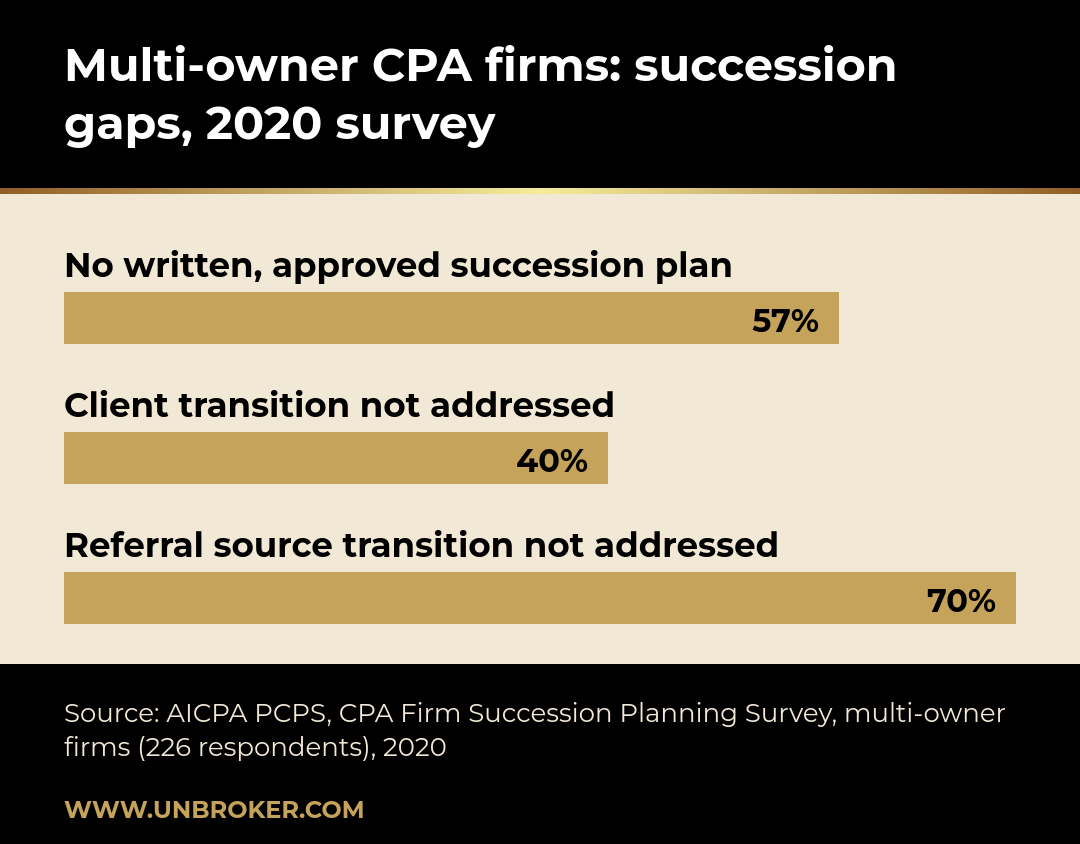
These surveys cover CPA firm owners in 2020, so do not read them as a snapshot of every tax preparer or enrolled agent today. They do show a pattern worth acting on: plenty of owners expect to leave, and few have written down how clients and referral sources will move to someone else.
That is why a 12 to 24 month runway makes sense. Time lets you clean up your files, document your workflow, introduce a successor or buyer to key clients, and run the consent process without rushing it. If you are earlier in the process, our guide to selling a recurring revenue bookkeeping business covers many of the same preparation steps for a neighboring service line.
What exactly you are selling
Before you talk to a buyer, decide what is in the package. Practice sales usually combine several pieces, and each one is treated differently:
- The client list. Names and contact details of the people you serve. For a tax return preparation business, this list is subject to specific federal rules, covered in the next section.
- Client files and working papers. These hold sensitive information. For CPAs who are AICPA members, moving them is governed by the file-transfer consent process described below.
- Workflow and systems. Your engagement letters, checklists, templates, software setup, pricing schedule and staff roles. A buyer who can see how work gets done is more likely to trust that it can continue without you.
- Goodwill. The expectation that clients and referral sources will keep coming. This is the hardest piece to price, and it is where retention-based terms usually come in.
- Equipment, leases and staff. Handle these like any other business sale, with your attorney’s help on assignments and employment questions.
Write the scope down early. A one-page description of what is included, what is excluded and which client records will be returned keeps negotiations clear and helps your attorney draft the agreement.
Section 7216 and the client list: when a tax practice list can transfer
If you prepare tax returns, Treasury Regulation 301.7216-2(n) is the rule to know. Under it, a tax return preparer may keep a separate list of taxpayer names, mailing and email addresses, phone numbers, entity type and return form number. The preparer may not transfer that list to anyone unless the transfer takes place in conjunction with the sale or other disposition of the preparer’s tax return preparation business.
Read that carefully. It does not say any list can go to any buyer at any time. The conditions are:
- The list is the separate list described above: those specific data points, not the underlying return information.
- The transfer happens in conjunction with the sale or other disposition of your tax return preparation business, not as a standalone list sale.
- Paragraph (n) applies to disclosures or uses occurring on or after December 28, 2012.
The buyer inherits limits too. Under the same regulation, a person who acquires a taxpayer list in conjunction with the sale of a tax return preparation business is bound by the same rules. The list may be used only to contact taxpayers with tax or educational information or to solicit tax return preparation services, not other services or products. So a buyer cannot use the list to market unrelated products, and your agreement should say so.
This rule speaks to the list. It does not by itself settle how to move complete return files or working papers. For those, talk to your attorney, and if you are a CPA, follow the AICPA consent steps below along with any state requirements.
Due diligence without breaking confidentiality
A serious buyer will want to see more than a summary: client counts, fee schedules, service mix, return types and how long clients have stayed. Some of that touches taxpayer information, so the sequence matters.
The regulation addresses this. Due diligence before a proposed sale of a tax return preparation business is not treated as a transfer of the client list if it is done under a written agreement that requires confidentiality of the tax return information and expressly bars its use for any purpose other than the purchase of the business. The IRS makes a similar point on its section 7216 information center: due diligence done in contemplation of a sale is treated as connected with the sale, and tax return information made available for due diligence is a disclosure of that information, not a transfer of it.
In practice, that means:
- Sign a written confidentiality agreement first. It should require confidentiality of tax return information and expressly limit use to evaluating the purchase.
- Start with anonymized data. Share client counts by service type, fee bands and tenure without names. Many buyers can make a first decision on that alone.
- Release identifiable detail late and narrowly. Share it only with a qualified buyer who has signed the agreement, and only what is needed for the next decision.
- Log what you share. Keep a record of who saw what and when.
Our guide to protecting your privacy during a confidential business sale covers the general mechanics of screening buyers before they see sensitive material.
AICPA file-transfer consent: the written request and the 90-day window
If you are an AICPA member, the Code of Professional Conduct has a specific section for this. ET 1.400.205, Transfer of Files and Return of Client Records in Sale, Transfer, Discontinuance or Acquisition of a Practice, took effect June 30, 2017. It is meant to protect clients’ sensitive information when a member’s practice is sold, transferred, discontinued or acquired.
Here is how it works when a CPA practice is sold or transferred and the seller will not keep an ownership interest in the successor practice. According to the Virginia Society of CPAs, each client should receive a written request to consent to transfer its files. The notice may say consent is presumed if the client does not respond within 90 days, and files should not move until consent is given or the 90 days pass.
Some important caveats:
- Presumed consent is not universal. The 90-day approach applies unless prohibited by law or by the rules of the applicable state board of accountancy.
- Explicit consent is safer. CPA Insurance Agency notes that a client’s explicit written consent is the preferred route from a risk-management standpoint, and that state laws and regulations may also apply, so confirm local rules.
- Keep proof. Members are encouraged to keep evidence of consent, whether it was obtained from the client or presumed after 90 days.
If you are an enrolled agent or an unaffiliated tax preparer, the AICPA code is not your rulebook. Section 7216 still applies to you as a return preparer, and your state may have its own rules. The AICPA approach is still a sensible model for a clear, documented client notice. Ask your attorney what applies to you.
Build the 90 days into your calendar
Because files should not move until consent arrives or the window closes, the notice date affects your closing and handover plan. Work backward from the date you want the buyer to start serving clients, and keep busy season in mind. A notice that lands in the middle of filing season may get slower responses and more questions than one sent in a quieter month. Your attorney can help you decide whether files move at closing or after the window, and what the buyer may access in the meantime.
What a good consent notice contains
- Plain-language description of the sale or transfer and the name of the successor practice
- What files are covered and what the client’s options are, including asking for records back
- How and by when the client can respond, and what happens if there is no response, if presumed consent applies in your state and for your credentials
- Contact details for you and the buyer
- Disclosure of any retention-based payment terms, covered below
Returning client records that are not part of the sale
Not every file goes to the buyer. Clients who decline, clients you are not transferring and records outside the agreed scope need a plan. Under ET 1.400.205, a firm being sold, transferred or discontinued should make arrangements to return any client records that are not subject to the sale or transfer.
Make this a defined workstream:
- Sort clients into three groups: transferring with consent, declined or unresponsive where presumed consent does not apply, and not part of the deal.
- Decide how records are returned and in what format, and confirm that nothing a client is entitled to is held back.
- Agree with the buyer who handles requests that arrive after closing.
- Document each return, along with the consent evidence for each transferred file.
Also check your professional liability coverage and your state’s record retention requirements before you close. Your insurer or attorney can tell you whether you need tail coverage or a plan for access to old working papers.
Deal structure and client retention
This is where price is won or lost. Because clients are free to leave, buyers often tie part of the price to how many stay. Terms vary a great deal from deal to deal, so treat the following as a framework for your conversations, not a norm.
The three common building blocks
- Upfront payment. Cash paid at closing. It gives you certainty, and buyers usually weigh it against the risk they are taking on.
- Deferred payment. Part of the price paid over time, often as a note. You become a creditor of the buyer, so security, default terms and what happens if the buyer sells or closes the practice matter.
- Retention-based payment. Part of the price depends on clients staying for a defined period. Our guide on whether to accept an earnout explains the trade-offs of contingent pricing in general.
Protect yourself in a retention clause
If part of your price depends on clients staying, define every moving part in writing:
- Which clients count. A named list or a defined category, so there is no later argument about who was in the base.
- How retention is measured. By client count, by fees billed or by some other measure, and over what period.
- What happens when a client leaves. Does a client who leaves because of a buyer fee increase, a staffing change or a service problem count against you? Many sellers push to exclude departures that are within the buyer’s control.
- Buyer covenants. Commitments on service levels, staffing and pricing during the measurement period, so the buyer cannot undermine retention.
- Reporting and access. How you verify the numbers, and whether you can see billing records for the measurement period.
- Restrictive covenants. What you may and may not do after closing, including contacting clients. Your attorney should draft these and check enforceability in your state.
Disclosure to clients matters too. A 2016 Journal of Accountancy article advises that if any sale proceeds are contingent on client retention, the buyer and seller should disclose that to clients. Clients should not be left to discover that the person recommending a successor has a financial stake in whether they stay.
Tax treatment of the price, including how it is allocated and when you report it, depends on your facts. Our seller’s guide to Form 8594 is a good primer, and your tax adviser should model the structure before you accept terms.
Telling clients and staff
The best retention tool is a calm, well-timed announcement. Plan it with the buyer so both of you say the same thing.
- Staff first, but not too early. Your team needs to hear about the sale before clients do, and they usually have questions about jobs and pay. Sequence the conversation with your attorney.
- Joint announcements. A letter or call signed by both you and the buyer, introducing the successor, explaining why you chose them and describing what stays the same.
- Personal calls for your top relationships. Do not let your most important clients learn about the sale from a mass email.
- Combine the notice with the consent request. If you are a CPA using the AICPA process, the announcement and the written consent request can work together, as long as the consent language is clear.
Plan the handover
The same Journal of Accountancy article advises sellers to be ready to help the buyer for at least the first few weeks or months of the transition and be available for occasional calls afterward. Put that in the agreement so both sides know what to expect, including any compensation for your time. Useful handover tools include client-by-client notes on preferences and quirks, a calendar of deadlines and extensions, a list of referral sources with introductions, and a schedule of joint meetings during the first filing season.
For more on preparing a smooth handoff, see our guide to buying a tax business, which shows the process from the buyer’s side. Understanding what buyers worry about helps you answer their questions before they ask.
Keeping the sale confidential while you find the right buyer
If clients, staff or referral sources hear about a sale too soon, you can lose relationships before a buyer is even identified. A few habits help:
- Market the practice without your name, location details or client specifics.
- Require a signed confidentiality agreement before sharing identifying information.
- Qualify buyers on credentials, experience, financing and fit with your clients before they see anything sensitive.
- Limit who inside your firm knows, and tell them why discretion matters.
- Keep sharing client-level data to the last possible stage, under the written agreement described above.
Buyer fit matters more here than in most sales. A buyer who cannot serve your client mix, or whose fees and style differ sharply from yours, may put your retention-based payments at risk.
Pre-listing checklist for practice owners
- Decide what is in the sale: list, files, workflow, equipment, staff and goodwill.
- Confirm which rules apply to you: section 7216 as a return preparer, the AICPA code if you are a member, and your state board’s rules.
- Build a separate client list with only the data fields the regulation describes, kept apart from return information.
- Draft a confidentiality agreement that requires confidentiality of tax return information and bars use for anything other than evaluating the purchase.
- Prepare anonymized client data: counts by service type, fee bands, tenure and return types.
- Draft the client consent notice and decide whether you will seek explicit written consent, rely on the 90-day approach where allowed, or both.
- Set up a log for consent evidence and for records returned to clients.
- Write up your workflow: checklists, templates, software, deadlines and staff roles.
- List referral sources and decide how to introduce them to a successor.
- Confirm professional liability and records retention arrangements with your insurer and attorney.
- Get a valuation opinion before setting expectations, and ask the adviser how retention risk affects price in your market.
- Plan your post-closing availability and what you are willing to offer in transition support.
Questions for your attorney, tax adviser and state board
Attorney
- Does my client list qualify for transfer under Treasury Regulation 301.7216-2(n) in this deal structure?
- How should the confidentiality agreement be worded for buyer diligence?
- What do I need to put in the purchase agreement about buyer use limits on the list?
- How should retention-based terms, security for deferred payments and restrictive covenants be drafted?
- What notice language should clients receive, and how should retention terms be disclosed?
Tax adviser
- How will each part of the price be taxed, and does the timing of payments change when I report it?
- How should the price be allocated among assets, and how does that affect me?
- What happens to my tax position if retention payments come in lower than expected?
State board of accountancy
- Is presumed consent after 90 days permitted in my state, or is explicit written consent required?
- Are there rules on record retention, client notice or ownership of the practice that affect who can buy?
- Do my credentials, whether CPA, enrolled agent or unlicensed preparer, change which rules apply?
If you want help getting a practice sale in front of qualified buyers, Unbroker combines expert advisors, AI-driven buyer matching and national marketing in a confidential process. Our Full Service Business Sale charges a 6% success fee, paid when the business sells. Your attorney and tax adviser still handle the legal and tax questions above, and we help you run the sale around them.