Selling a restaurant business is one of the most complex transactions you’ll face as an owner. The process demands careful planning, solid financial records, and a clear understanding of what buyers actually want.
At Unbroker, we’ve guided restaurant owners through countless exits. This guide walks you through the essential strategies that lead to successful sales and fair valuations.
What Restaurant Buyers Actually Want Right Now
The restaurant market in 2026 has shifted dramatically from what it was five years ago. Buyers no longer want businesses that rely on owner-dependent operations or inconsistent cash flows.
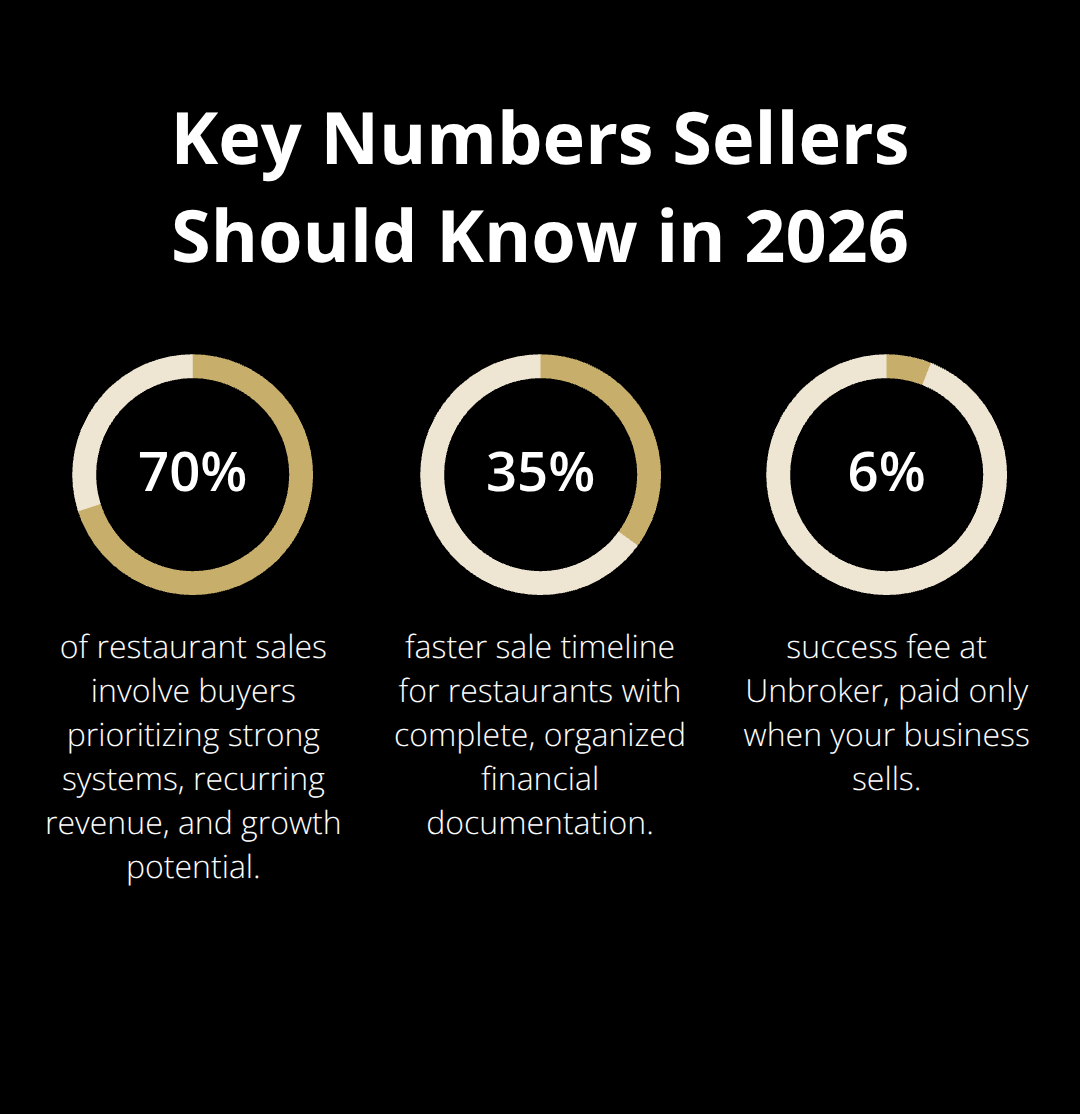
According to data from the National Restaurant Association, roughly 70% of restaurant sales today involve buyers who specifically seek businesses with strong management systems, documented recurring revenue, and clear growth potential. This means your restaurant’s value depends far less on its reputation or location than it did in the past, and far more on whether it can operate profitably without you.
Buyers scrutinize cash flow statements with intensity because restaurant margins remain notoriously thin (3-9% net profit). They want to see clean financials, consistent customer bases, and revenue that doesn’t vanish if you leave. If your restaurant depends on your personal relationships with customers or your presence in the kitchen, you start behind.
The Real Numbers Behind Restaurant Valuations
Restaurant businesses typically sell for 3-4 times EBITDA, though this varies significantly based on brand strength and location stability. If your restaurant generates $150,000 in EBITDA annually, expect buyer offers in the $450,000-$600,000 range. However, restaurants with documented systems, multi-year customer contracts, or catering operations with predictable revenue command 5-6 times EBITDA. The difference between selling at 3x versus 5x means $300,000 in additional proceeds.
Buyers also factor in working capital requirements, lease terms, and equipment age. A restaurant with five years remaining on a favorable lease is worth significantly more than one with 18 months left, because the buyer faces lease renegotiation risk. This is why timing matters enormously.
When to Sell for Maximum Returns
Selling a restaurant during peak operational performance sounds obvious, but most owners delay sales during their best years. The worst time to sell is when you’re exhausted and revenue has declined. The best time is when your business shows upward trajectory, consistent profitability, and documented systems that prove it can survive without you.
Q4 typically sees higher buyer activity because investors allocate capital before year-end, though this varies by region. If your restaurant has seasonal patterns, selling at the end of a strong season gives buyers confidence that your historical performance will continue. Conversely, selling after a weak quarter signals trouble, even if that quarter was an anomaly.
Market Conditions Favor Certain Locations
Current market conditions favor sellers with restaurants in secondary markets more than those in major metropolitan areas. Primary markets like New York, Los Angeles, and Chicago see intense competition among sellers, which depresses valuations. Secondary markets with growing populations and limited quality restaurant options often see buyers competing for acquisitions, which drives prices upward.
Understanding where your restaurant sits in this landscape helps you position it correctly. The next step involves preparing your actual business for sale-and that preparation starts with your financial records.
Preparing Your Restaurant for Sale
Financial Records That Buyers Actually Trust
Buyers will scrutinize three areas before making an offer: your financial records, how your business operates without you, and what physical assets come with the sale. Most restaurant owners fail at this stage because they underestimate how thoroughly buyers investigate each one.
Your financial records need to show three years of clean tax returns, profit and loss statements, and bank deposits that match your reported revenue. Inconsistencies between what you report to the IRS and what you claim to buyers instantly kill deals. If you’ve run cash operations or minimized reported income, you must align those records now. This doesn’t mean changing your tax returns, but rather ensuring that your documented revenue reflects your business’s true earning capacity.
Buyers also want itemized expense breakdowns by category, lease agreements, vendor contracts, and customer concentration data. If 40% of your revenue comes from three catering contracts, that information affects valuation directly. Restaurants with complete, organized financial documentation sell 35% faster than those without, and often at higher valuations because buyers face less uncertainty.
Building Systems That Work Without You
Your operational systems matter far more than your personal skill in the kitchen. You must document everything that currently lives in your head: supplier relationships, staff schedules, recipes or prep procedures, customer preferences, and vendor pricing agreements. Create standard operating procedures for each critical function, from inventory management to table assignments.
Buyers want proof that your restaurant generates revenue through repeatable systems, not through your daily presence. If your head chef is irreplaceable, your business value drops significantly because the buyer assumes that person will leave after the sale. Staff retention in restaurants becomes essential here. Showing that you have stable, trained staff with documented responsibilities makes your business far more attractive to potential buyers.
Evaluating Your Property and Equipment
Property and equipment need honest assessment. You should obtain a third-party valuation of your kitchen equipment, furniture, and POS system. Equipment age matters enormously because buyers factor replacement costs into their offers. A 10-year-old HVAC system represents a future expense that reduces what they’ll pay today.
Lease terms affect valuation directly. A lease with five years remaining at favorable rates increases your sale price substantially compared to one expiring in months. If your lease terms are unfavorable, you should negotiate an extension or renewal option before marketing the business. This single step can add tens of thousands of dollars to your final sale price.
Moving Forward With Confidence
Once your financial records are organized, your systems are documented, and your assets are properly valued, you’re ready to position your restaurant in front of qualified buyers. The next phase involves marketing your business strategically to reach the right people who will pay what your restaurant is actually worth.
Marketing Your Restaurant to Qualified Buyers
Target the Right Buyers, Not the Largest Audience
Most restaurant owners make a critical mistake when marketing their business: they cast the widest net possible, assuming more exposure equals more offers. This strategy wastes time and attracts tire-kickers who have no real purchasing power. What you actually need is targeted exposure to serious buyers with capital ready to deploy. Target the right 50 qualified buyers generate better offers than those reaching 500 unqualified prospects. The difference lies in precision marketing rather than volume.
Syndication partners that specialize in restaurant acquisitions should be your primary channel because these platforms aggregate serious buyers actively searching for restaurant investments. General business marketplaces dilute your visibility among unqualified browsers. When you list through specialized syndication partners focused on food service acquisitions, your restaurant appears alongside comparable sales data that helps buyers understand fair market value. This context matters enormously because it prevents lowball offers based on incomplete information.
Highlight What Makes Your Business Valuable
You should prepare a one-page executive summary highlighting your EBITDA, customer base stability, and any unique revenue streams like catering or delivery contracts. Buyers reviewing dozens of opportunities need immediate clarity about why your restaurant justifies the asking price.
Your unique revenue streams deserve specific emphasis because they directly impact valuation. A restaurant generating 30% of revenue from corporate catering contracts shows recurring, predictable income that buyers value far higher than walk-in traffic. Document these revenue sources separately in your marketing materials with contract terms, client names, and renewal rates. If you operate a ghost kitchen operation alongside your physical location, that deserves prominent mention because it demonstrates operational sophistication and revenue diversification.
Build Credibility Through Transparency
Building trust happens through transparency about what makes your business work. Disclose your customer concentration honestly-if three clients represent significant revenue, state it clearly rather than hoping buyers won’t notice during due diligence. Buyers who discover hidden dependencies later will either withdraw or demand steep discounts. Conversely, owners who proactively address potential concerns build credibility that translates to higher offers.
Share your documented systems, staff retention rates, and supplier relationships as proof that your business operates independently of your personal involvement. Provide references from long-term customers or key staff members willing to speak with potential buyers about the business’s stability. These conversations matter more than any marketing copy because they confirm that your documented operations reflect reality.
Final Thoughts
Clean financial records, documented systems, and strategic positioning in front of qualified buyers form the foundation of a successful restaurant sale. Most owners who sell a restaurant business at fair value follow this path: they prepare their operations thoroughly, present their financials honestly, and connect with serious buyers through specialized channels. The owners who skip these steps face prolonged negotiations, lowball offers, and frustration that could have been prevented.
Professional guidance transforms the entire process because experienced advisors understand restaurant economics and what buyers actually scrutinize. We at Unbroker match restaurant owners with serious buyers, handle the marketing strategy, and manage negotiations so you can focus on running your business. You pay only a 6% success fee when your business sells, with no hidden costs or upfront charges.
Unbroker can guide you through selling your restaurant business with a team that knows exactly what buyers expect and how to position your operation for maximum value.