Selling a small business requires knowing what it’s actually worth. At Unbroker, we’ve seen countless owners struggle with small business valuation methods because they don’t understand which approach fits their situation.
This guide walks you through three proven valuation approaches: asset-based, income-based, and market-based methods. You’ll learn which one works best for your business and how to prepare for a professional valuation.
Asset-Based Valuation Methods
Understanding the Foundation of Asset-Based Valuation
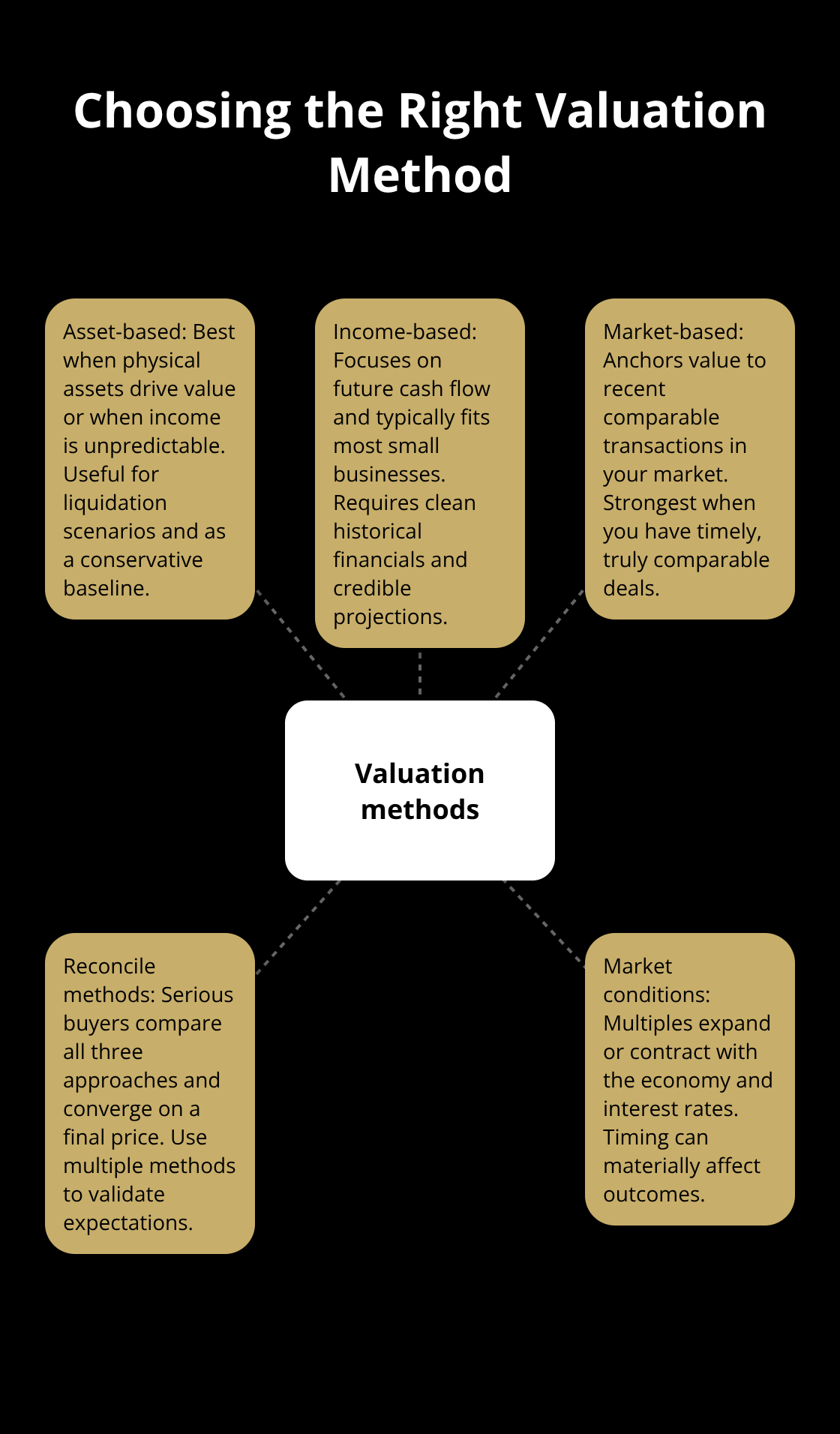
Asset-based valuation strips your business down to its financial bones. This method works best for service businesses, manufacturers, or companies with significant physical assets. You add up everything your business owns-equipment, inventory, real estate, accounts receivable-then subtract what it owes. The result is your net asset value. The simplicity appeals to many owners, but here’s the reality: most small businesses are worth more than their assets alone because of the income they generate. That said, asset-based valuation serves an important function when income is unpredictable or when a buyer plans to liquidate your assets rather than continue operations.
Tangible Assets and Liabilities Assessment
Start by getting an accurate inventory of tangible assets. This means more than checking your balance sheet. Physical assets depreciate, and your accounting records may not reflect current market value. Asset depreciation and current market value require professional assessment. Get professional appraisals for major assets-machinery, vehicles, real estate-especially if they’re central to your sale. Real estate appraisals typically cost $300 to $500 but prevent massive valuation errors. For inventory, count it physically rather than relying on records; shrinkage and obsolescence are real problems that affect valuations constantly. Then calculate your liabilities accurately. Many owners forget about deferred tax obligations, pending lawsuits, or warranty obligations that reduce the actual value buyers will pay.
Intangible Assets and Brand Value
Intangible assets like brand reputation and customer relationships create real value but don’t appear on balance sheets. A plumbing business with loyal customers willing to pay premium rates has intangible asset value that pure asset counting misses. Some valuators assign percentages to intangible value-perhaps 20 to 40 percent of total value for established businesses-but this becomes speculative fast. The key is grounding these estimates in concrete factors: how long customers stay, repeat business rates, switching costs, and competitive advantages.
Adjusted Book Value Approach
The adjusted book value approach tries to bridge the gap between tangible and intangible assets. You start with net asset value, then add reasonable estimates for intangible assets based on industry standards. For a staffing agency, customer contracts might represent 30 to 50 percent of value. For a retail operation, brand and location matter enormously. This method works well when you need a conservative baseline valuation or when your business has substantial physical assets but modest earnings.
Once you’ve established your asset-based value, you’re ready to test it against what the market actually pays for similar businesses.
Income-Based Valuation Methods
Income-based valuation flips the asset approach on its head. Instead of counting what your business owns, you measure what it earns. This method works better for most small businesses because it captures the real reason buyers pay money: future cash flow. The challenge is that income-based valuation requires accurate financial records and honest projections. Many owners overstate earnings or understate expenses, which inflates valuations and kills deals when buyers conduct due diligence. You need clean financials for the past three years minimum, ideally five years, showing consistent or growing income.
EBITDA multiples and Earnings Analysis
The most practical approach uses EBITDA multiples, which stands for earnings before interest, taxes, depreciation, and amortization. EBITDA strips away accounting quirks to show what a business actually generates in cash. The EBITDA multiple will depend on the size of the subject company, its profitability, its growth prospects, and the industry in which it works. A digital marketing agency with $500,000 in EBITDA might sell for $1 million to $3 million. The specific multiple depends on growth rate, customer concentration, market conditions, and competitive position.
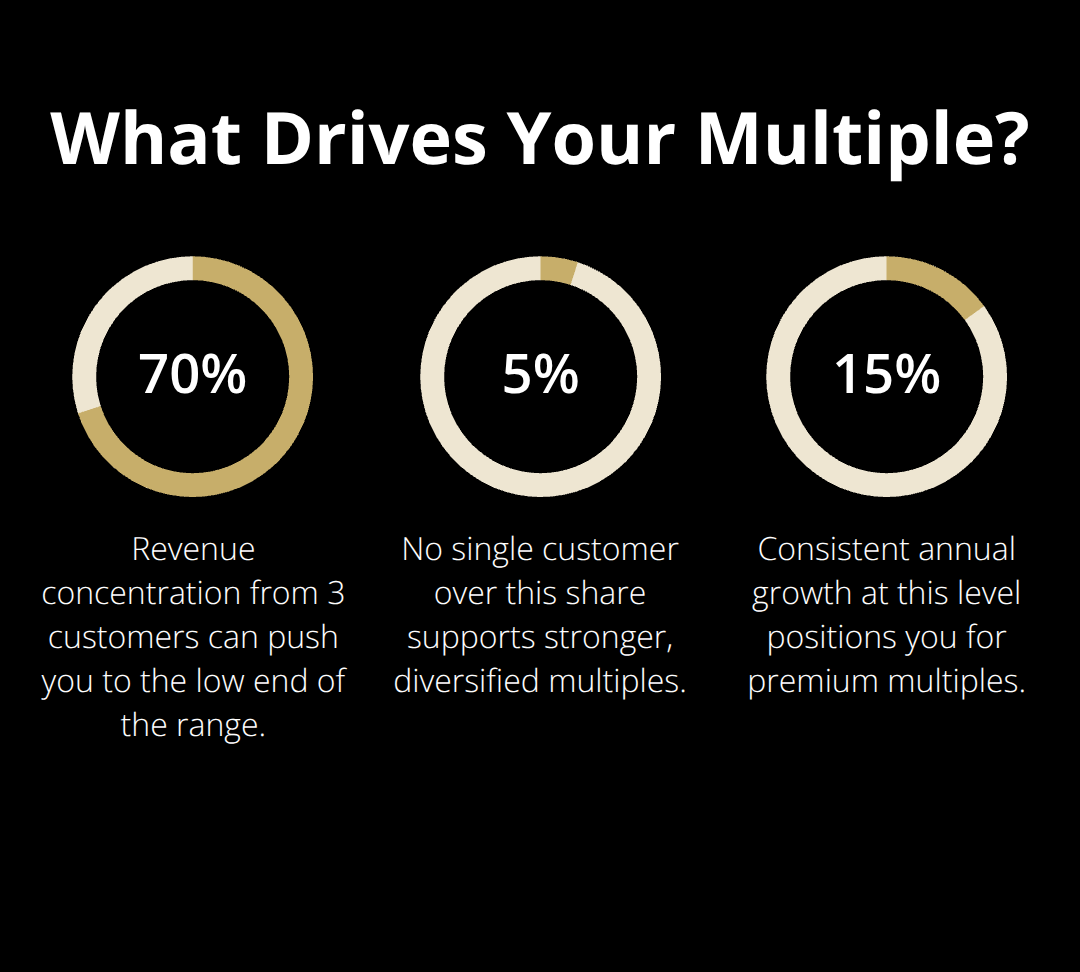
Stable businesses with recurring revenue command higher multiples than declining ones. If your business grew 30 percent last year but relied on three customers for 70 percent of revenue, expect the lower end of the multiple range. If you have 200 customers with no single customer representing more than 5 percent of revenue and consistent 15 percent annual growth, you’re looking at premium multiples.
Discounted cash flow Projections
Discounted cash flow projections offer a more sophisticated approach but require realistic assumptions. You forecast future cash flows for five to ten years, then discount them back to present value using a discount rate that reflects your business’s risk. A 10 percent discount rate is typical for established small businesses with moderate risk. If your plumbing business generates $300,000 in annual cash flow and you assume 3 percent annual growth with a 10 percent discount rate, your DCF valuation reaches roughly $3 million.
Small changes in assumptions massively shift valuations. Increase the discount rate to 12 percent and the same business drops to $2.4 million. Most buyers and valuators view DCF as a secondary check rather than the primary valuation method because the projections become unreliable beyond five years for small businesses facing market uncertainty.
Revenue-Based Valuation for Early-Stage Businesses
Revenue-based valuation serves early-stage or pre-revenue businesses where EBITDA doesn’t exist yet. SaaS companies often use EV/ARR or EV/Revenue multiples to benchmark growth assets. A bootstrapped software company with $1 million in annual recurring revenue could command $5 million to $10 million even with minimal profits. This method assumes the buyer can improve margins or scale the business.
However, revenue-based valuation is riskiest because it ignores profitability entirely. A company with $2 million in revenue but $1.8 million in expenses looks impressive on revenue but represents a terrible investment. Try revenue-based valuation only when your business has strong unit economics and clear paths to profitability within twelve to twenty-four months.
Reconciling Multiple Valuation Methods
Established businesses with consistent earnings use EBITDA multiples as the primary valuation driver. Mature businesses with predictable cash flows add DCF analysis to stress-test the valuation. Early-stage companies rely on revenue multiples with caveats about future profitability. Most serious buyers request all three methods and reconcile them to a final offer price. Once you’ve calculated your income-based valuation, you’re ready to test these numbers against what comparable businesses actually sold for in your market.
Market-Based Valuation Methods
What Comparable Sales Actually Tell You
Market-based valuation grounds your business value in real transactions. Instead of relying on spreadsheet calculations or asset counts, you’re looking at what actual buyers paid for actual businesses similar to yours. This approach works best when you have solid comparable data in your market and your business operates in an established industry where transactions happen regularly.
The problem most owners face is finding reliable comparable data. Public company valuations don’t apply to small businesses. M&A databases like Pitchbook and Mergermarket focus on larger deals. What you really need are comparable transactions in your specific market and industry that happened within the past twelve to eighteen months.
Start by identifying businesses that sold recently in your market and industry. Talk to business brokers, accountants, and other business owners about recent sales. If you’re selling a dental practice in Portland, you need to know what other dental practices in the Portland area sold for in the past year, not national averages. A dental practice generating $800,000 in revenue with strong patient retention might sell for $600,000 to $800,000 depending on location and patient composition.
These transactions become your benchmarks. Document the sale price, revenue, EBITDA, and business age for each comparable. Calculate valuation multiples from each transaction: what revenue multiple did it sell for, what EBITDA multiple, what net income multiple. If three similar businesses in your market sold for 1.2x to 1.5x revenue in the past year, and your business generates $1 million in revenue, your market-based valuation falls within $1.2 million to $1.5 million.
This approach works because it reflects what real buyers in your market actually value, not theoretical calculations. The challenge is that small business transactions are private and not widely reported. Brokers often guard this data. Industry associations sometimes publish anonymized transaction data for their members. Asking your accountant or attorney about recent comparable sales in your area often yields better results than searching databases.
Why Timing Matters More Than You Think
Market conditions shift valuation multiples dramatically. During economic downturns, buyers demand lower multiples because they’re nervous about future cash flow. During growth periods, multiples expand. A staffing agency that sold for 4x EBITDA in 2022 might only command 2.8x EBITDA in a slower economy.
Interest rate changes affect multiples too. Federal Reserve interest rate increases between 2022 and 2023 elevated rates that often dampen buyer enthusiasm, recalibrate business valuation metrics, and alter financing structures. Buyers could now earn higher returns from risk-free investments, so they demanded higher returns from business acquisitions to justify the risk.
Track when comparable transactions occurred. A sale from two years ago tells you less about current value than a sale from three months ago. If you’re selling your business in a rising rate environment, expect lower multiples than you’d have received eighteen months earlier. This is why timing your sale matters strategically. Some owners wait for economic conditions to improve before selling. Others sell when conditions are mediocre because they know multiples could compress further. The point is that market-based valuation forces you to acknowledge external forces beyond your control.
Building Your Own Comparable Dataset
The most actionable approach is building your own comparable transaction database over time. Professional appraisers access databases like DealStats and PitchBook to identify truly comparable transactions within your industry sector. When you talk to peers, ask about recent transactions. When your accountant mentions a client sold their business, ask for details. When industry publications report deals, clip them.
After a year, you’ll have ten to twenty comparables. After two years, you’ll have thirty to fifty. This dataset becomes your strongest negotiation tool because it’s based on your specific market and industry. When a buyer offers a valuation that seems low, you can point to three comparable transactions from the past six months that support a higher price. When you’re negotiating with multiple buyers, comparable data prevents you from leaving money on the table.
A landscaping business owner who tracked five comparable sales in their market knew that similar businesses had sold for 3.2x to 3.8x EBITDA. When one buyer offered 2.8x EBITDA, the owner confidently asked for 3.4x based on comparable data. The buyer revised their offer upward. Without that comparable data, the owner might have accepted the lower offer thinking it was fair.
Final Thoughts
You’ve now seen three distinct approaches to small business valuation methods. Asset-based approaches work when physical assets matter, income-based approaches apply when your business generates predictable cash flow, and market-based approaches ground your valuation in real transactions from your specific market. Most serious buyers calculate all three methods, then reconcile the results to a final offer price-which means you should do the same before listing your business.
Professional valuations support your sale in concrete ways. A certified business appraiser costs $2,000 to $5,000 but provides documentation that buyers trust, and when you have a professional valuation in hand, you negotiate from strength rather than guessing. Preparing your business for sale starts now, regardless of your timeline-clean up your financial records for the past three to five years, document your customer base and revenue sources, get appraisals on major assets, and build your own comparable transaction database by tracking what similar businesses sold for in your market.

Unbroker offers a modern platform for selling businesses with expert advisors, AI-driven buyer matching, and national marketing. You pay only a 6% success fee when your business sells, with no hidden fees, and the combination of professional guidance and technology removes the guesswork from valuing your business and connects you with qualified buyers who understand your actual value.