Selling a business shouldn’t mean handing over 10% or more of your sale price to a broker who controls access to buyers. Yet that’s exactly what happens when a broker monopoly dominates the market, leaving sellers with limited options and inflated costs.
At Unbroker, we’ve seen firsthand how traditional brokers use gatekeeping and information asymmetry to maintain their grip on business sales. The result is a system where sellers lose money and have little transparency into how their deal is being handled.
What You’re Actually Pay When You Hire a Traditional Broker
Commission Fees That Drain Your Sale Price
Traditional brokers charge between 8% and 12% of your sale price as commission, and that’s just the headline number. A business selling for $500,000 with a 10% fee means you lose $50,000 before any other costs appear. But the real damage goes deeper. Most traditional brokers also demand upfront retainer fees ranging from $5,000 to $25,000, money you hand over regardless of whether they sell your business or not. These retainers sit in their accounts while they work at their own pace, often taking 10 to 12 months to close a deal. You pay for their time and resources from day one, with zero guarantee of results.
When you calculate the total cost of a traditional broker relationship, sellers typically give up 12% to 15% of their final sale price when combining commissions, retainers, and miscellaneous charges. That $500,000 business now nets you $425,000 or less. Platforms like Unbroker offer a stark contrast, charging a transparent 6% success fee that’s only paid when your business actually sells. On that same $500,000 sale, you’d pay just $30,000-keeping $30,000 to $45,000 more than you would with a traditional broker.
Hidden Charges That Appear After You Sign
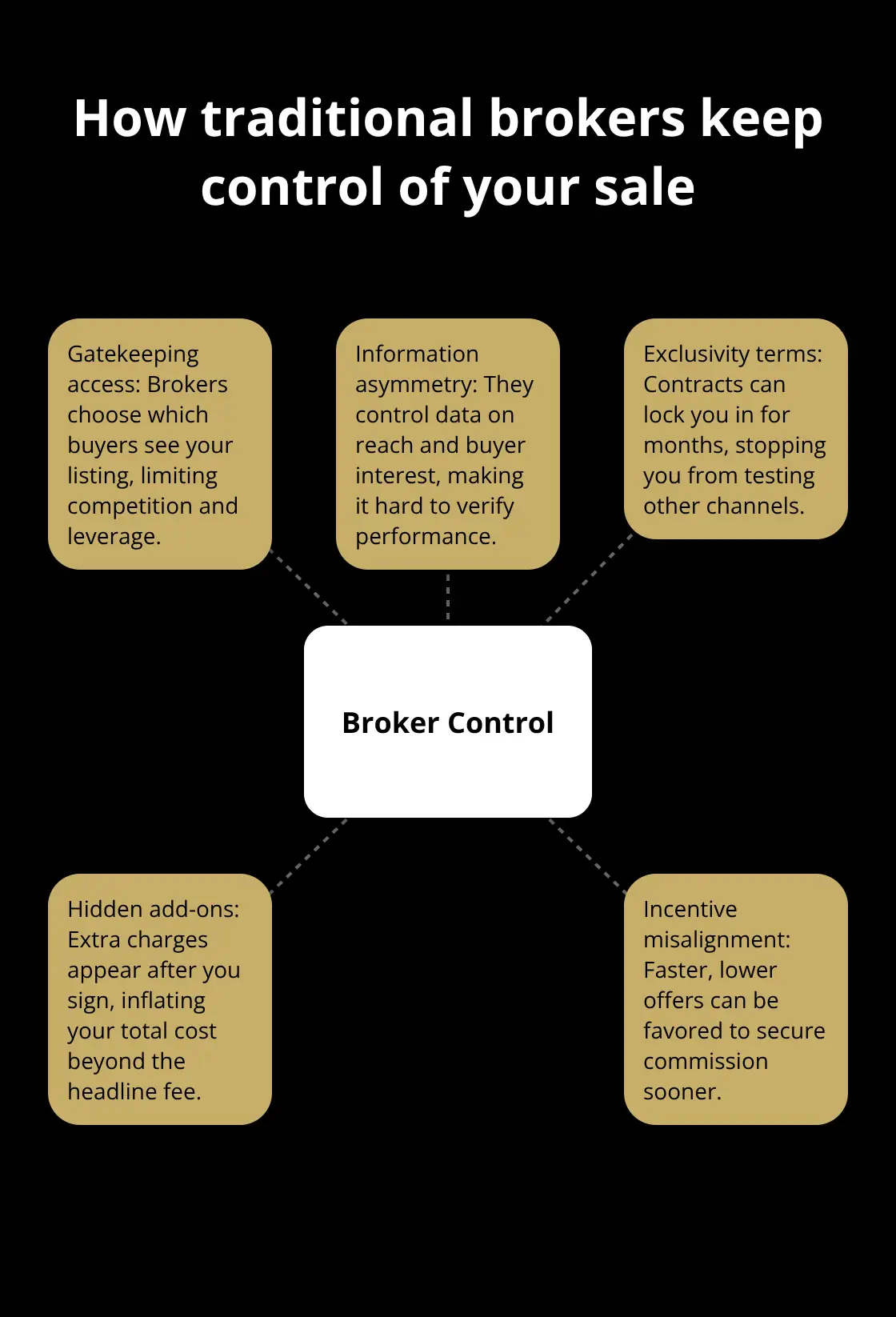
Traditional brokers frequently add costs for marketing materials, photography, legal document preparation, and transaction coordination that they don’t mention upfront. You discover these line items only after signing an agreement, at which point negotiating feels awkward. Some brokers also take a percentage of earnest money or hold funds in escrow accounts where they earn interest without sharing it with you.
These hidden charges compound the problem because brokers control when and how you learn about them. They bury fees in lengthy contracts, knowing most sellers won’t read every page. The practice creates a system where your actual cost far exceeds what you initially agreed to pay.
The Broker’s Incentive Conflicts With Your Goals
Traditional brokers profit when they close deals, but they don’t profit equally from all deals. A broker handling multiple listings has incentive to move the quickest sale, not the best sale for you. If two buyers appear, one offering $480,000 quickly and another potentially offering $520,000 with a longer negotiation, the broker often pushes the faster option because it means commission sooner. You never see this dynamic because it happens behind closed doors.
Information Asymmetry Keeps You Dependent
Transparency vanishes because brokers control the information flow. They decide which buyers see your listing, what details get emphasized, and how offers get presented. Without access to the buyer network or marketing data yourself, you cannot verify whether your broker actually reached qualified purchasers or simply showed your business to a handful of contacts. This information asymmetry lets brokers justify their fees while keeping you dependent on their judgment and connections.
The real problem isn’t just what brokers charge-it’s that you have no way to know if you’re getting fair treatment. This lack of visibility into the sales process creates the perfect conditions for brokers to prioritize their own interests over yours. When you move to a platform that exposes you directly to buyer networks and shows you exactly how your business is being marketed, the difference becomes impossible to ignore.
Who Really Controls Your Buyer Network
Traditional brokers maintain market dominance by controlling access to buyers, and this isn’t accidental-it’s fundamental to their business model. When a broker lists your business, they decide which buyers see it and which don’t. Most traditional brokers work from a closed network of repeat contacts, past clients, and referrals. A business listed with a traditional broker typically reaches over 100,000 potential buyers compared to the limited networks traditional brokers access. Meanwhile, digital platforms expose listings to 100,000 or more qualified buyers within 24 hours through multiple channels simultaneously. The broker’s gatekeeping creates artificial scarcity around your business, limiting competition among buyers and suppresses final sale prices. You never learn how many potential buyers actually saw your listing or whether the broker exhausted all available networks.
The Data Your Broker Won’t Share
Brokers rarely provide sellers with detailed marketing performance metrics. You won’t receive reports on how many people viewed your listing, where they came from, which marketing channels drove inquiries, or why certain leads didn’t convert. Empire Flippers, a digital business marketplace, maintains 100,000 registered buyers-a network most traditional brokers couldn’t build in a decade. When you work with a traditional broker, you get vague updates like “we’re shopping your business around” or “several interested parties are looking.” What you don’t get is concrete data about marketing reach, buyer qualification, or competitive positioning. This absence of transparency lets brokers control the narrative and justify their fees without accountability. Digital platforms provide real-time dashboards that show exactly how many qualified buyers viewed your listing, which marketing channels performed best, and how your business ranks against comparable sales in your industry.
Exclusivity Agreements That Lock You In
Traditional brokers often require exclusivity agreements during which you cannot work with other brokers or sell independently. This contract locks you into their limited network and slow process with no exit clause if they underperform. You cannot test whether a different broker would reach more buyers or negotiate better terms. The exclusivity clause protects the broker’s investment in listing your business, but it protects their interests, not yours. If your broker moves slowly or fails to generate serious buyer interest after two months, you remain bound to them for four more months. This structural advantage lets brokers take their time without competitive pressure to perform. Modern platforms don’t require exclusivity and often allow you to list on multiple marketplaces simultaneously, multiplying your exposure and creating real competition for your buyer’s attention.
Why This Control Matters to Your Bottom Line
Information asymmetry gives brokers the power to claim they worked hard while keeping you ignorant of the true market interest in your business. The broker decides which buyers see your listing, what details get emphasized, and how offers get presented. Without access to the buyer network or marketing data yourself, you cannot verify whether your broker actually reached qualified purchasers or simply showed your business to a handful of contacts. This lack of visibility into the sales process creates the perfect conditions for brokers to prioritize their own interests over yours. When you move to a platform that exposes you directly to buyer networks and shows you exactly how your business is marketed, the difference becomes impossible to ignore. The next section reveals how this control extends beyond buyer access into the very structure of how deals get priced and negotiated.
How Digital Platforms Beat Traditional Brokers on Cost and Speed
The Real Price Difference
A $500,000 business sale costs you traditional broker commissions with rates between 8% and 10% of the sales price, often on top of upfront retainers. Platforms like Unbroker charge a 6% success fee, paid only when the business sells, which comes to roughly $30,000 on that same sale-still leaving you significantly more in your pocket. This cost structure removes the perverse incentive that traditional brokers have to rush deals. When a broker earns commission only after closing, they have every reason to accept the first reasonable offer rather than negotiate harder for top dollar. You never see this happening because it occurs in private conversations with buyers. Because a success-fee model like Unbroker’s scales with your sale price, the platform has a built-in incentive to push for the highest possible offer, unlike flat-fee arrangements that pay the same no matter the outcome.
Why Speed Matters More Than You Think
Every month your business sits unsold costs you money in lost revenue and opportunity costs. Traditional brokers average 10 to 12 months to close a deal, partly because they control the process and face no competitive pressure to accelerate. Digital platforms close most deals in 60 to 90 days. They expose your business to 100,000 or more qualified buyers simultaneously across multiple channels instead of a broker’s limited network. Empire Flippers demonstrates this at scale, processing over $100 million in annual business sales with a registered buyer base of 100,000 people ready to act. When multiple qualified buyers see your listing at once, competition drives offers up and negotiation timelines down.
Technology Removes Months of Delays
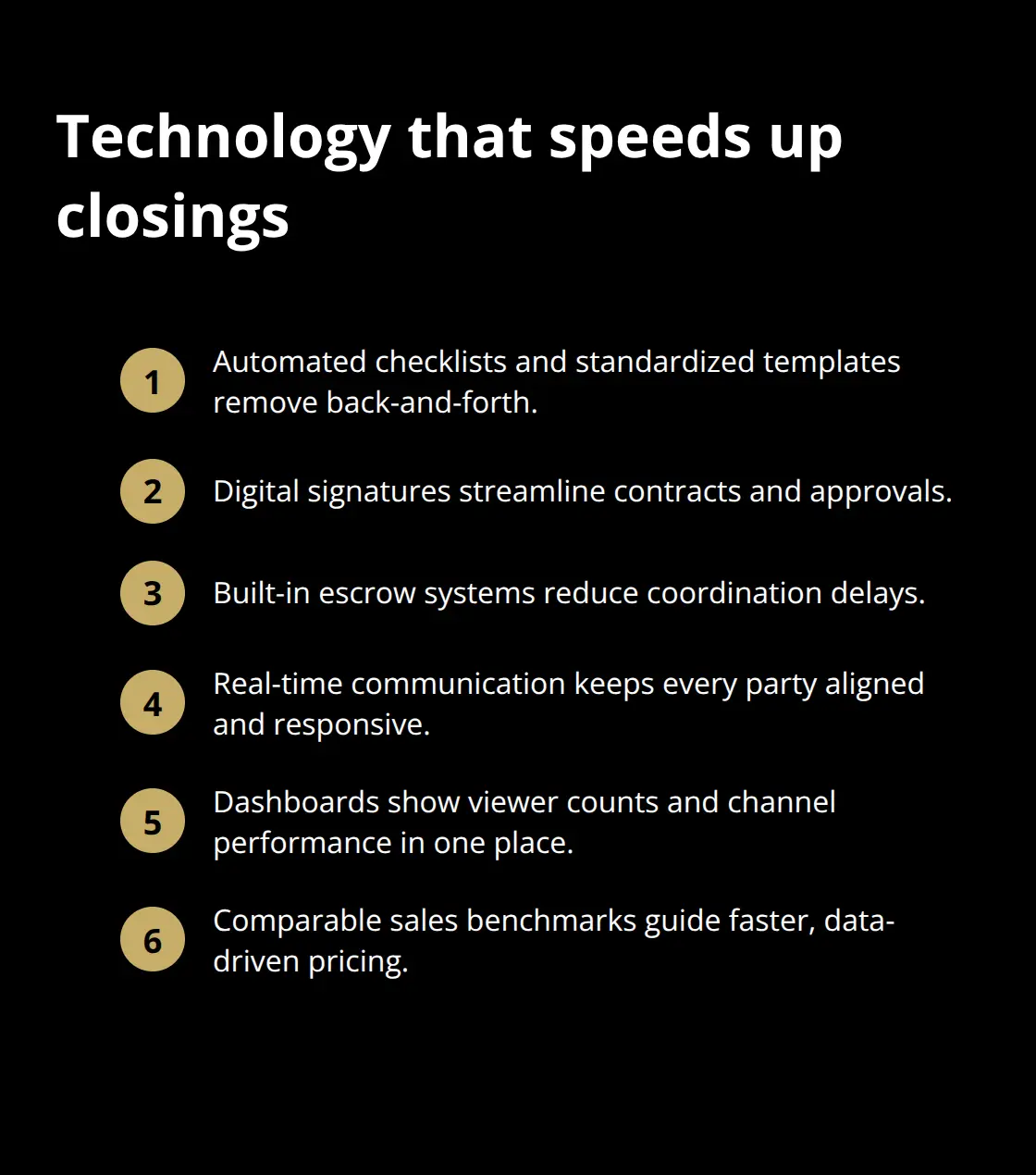
Automated due diligence checklists, digital signatures, standardized legal templates, and built-in escrow systems remove the back-and-forth delays that plague traditional sales. Real-time communication features and secure messaging keep all parties connected without waiting for broker availability. You receive concrete data on marketing performance instead of vague assurances, including exact viewer counts, which marketing channels generated inquiries, and how your business ranks against comparable sales in your industry. This transparency lets you make informed decisions about pricing and strategy rather than trusting a broker’s judgment.
Control Over Your Exit Timeline
The shift from broker-controlled processes to technology-enabled marketplaces gives sellers genuine control over their exit timeline and financial outcome. You no longer depend on a single broker’s network or pace. Multiple platforms can list your business simultaneously, multiplying exposure and creating real competition for buyer attention. This competitive pressure forces platforms to perform faster and more efficiently than traditional brokers ever could.
Final Thoughts
The broker monopoly that dominated business sales for decades is crumbling as sellers reject opaque fee structures, limited buyer networks, and months-long sales processes. Digital platforms now expose your business to thousands of qualified buyers simultaneously, eliminate information asymmetry through real-time data dashboards, and compress timelines from months to weeks through automated systems. Transparent success-fee pricing, like Unbroker’s 6% fee paid only when your business sells, aligns platform interests with yours-the more your business sells for, the more they earn, giving them every reason to fight for your best offer instead of rushing you into a lesser deal.
Sellers who demand transparency and control now access the same market data that brokers once hoarded, making gatekeeping obsolete. Automated due diligence checklists, digital signatures, and standardized legal templates remove delays that traditional brokers built into their processes. Real-time communication platforms keep all parties connected without waiting for broker availability, and you make informed pricing decisions based on concrete feedback rather than trusting a broker’s judgment.
We at Unbroker operate on the principle that your interests and ours should align perfectly. Our transparent pricing model eliminates hidden charges and backs our commitment with a satisfaction guarantee. The future of business sales belongs to sellers who refuse to accept the broker monopoly’s terms-and that future is already here.