Selling an independent pharmacy is not like selling a gift shop or a hardware store. Your DEA registration does not simply pass to the buyer, your prescription files are protected health records, and your state board has its own say about who may operate the license. This guide walks you through each of those pieces in plain language.
You will get a map of the controlled-substance inventory on transfer day, the HIPAA rules that govern handing over patient records, the state notices to plan for, and a list of what to gather before you go to market. It works whether you want an expert team to run the process or you plan to stay hands-on and manage it yourself.
Why selling a pharmacy is different from selling other retail stores
In most retail sales, the buyer takes the keys, the inventory and the lease, and opens the next morning. A pharmacy has three extra layers that can slow or reshape that handover.
- Federal controlled-substance rules. Controlled medications are tracked by the DEA, and the registration to handle them is tied to the registrant, not to the store as a transferable asset.
- Patient health records. Your prescription files are protected health information. They are a major part of what a buyer is paying for, but you can only hand them over under the right legal framework.
- State pharmacy licensing. Each state board sets its own change-of-ownership process, notice periods and inspection steps.
None of this makes a pharmacy unsellable. It means the sequence matters. A buyer who cannot legally handle controlled substances on day one has a gap in revenue, and a seller who plans late can watch a deal stall over paperwork rather than price. If you start the regulatory planning before you list, you can walk into buyer conversations with answers instead of open questions.
What the independent pharmacy market looks like today
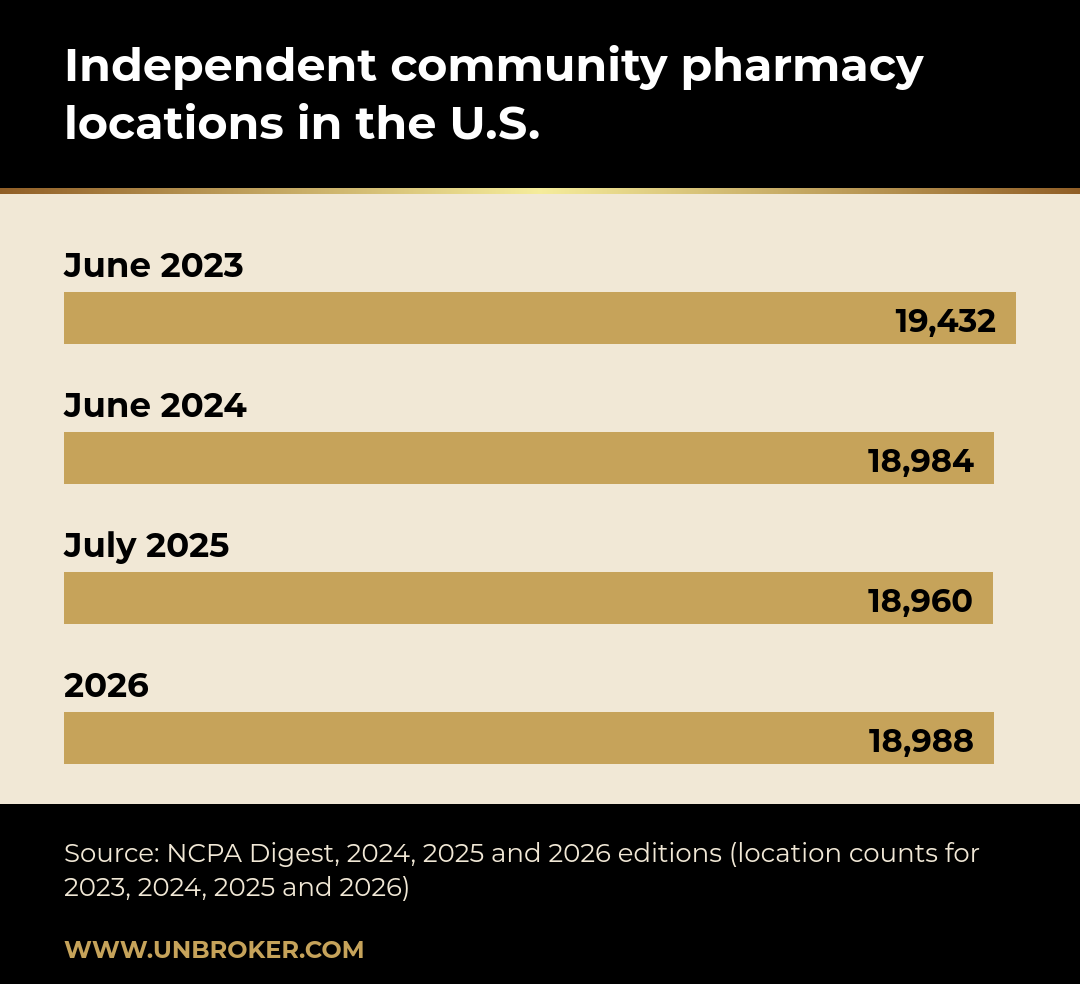
Buyers are looking at a stable, concentrated market. The National Community Pharmacists Association (NCPA) estimated the number of independent community pharmacies in 2026 at 18,988, essentially unchanged from the 18,960 locations reported in 2025, according to its 2026 Digest release. NCPA says independents make up nearly 37 percent of all retail pharmacies in the United States. The count had fallen earlier: the 2024 NCPA Digest counted 18,984 independent community pharmacies as of June 2024, down from 19,432 in the 2023 Digest.
Put together, NCPA counted 19,432 independent community pharmacies in June 2023, 18,984 in June 2024, 18,960 in July 2025 and an estimated 18,988 in 2026.
The same NCPA release says independent pharmacy was a $103 billion marketplace in 2025, with over 96 percent of sales for independents coming from the prescription department. That second number matters for a seller. If your revenue is overwhelmingly prescriptions, then your prescription files, your third-party payer contracts and your controlled-substance compliance history are the heart of what a buyer is evaluating, not your front-end shelves.
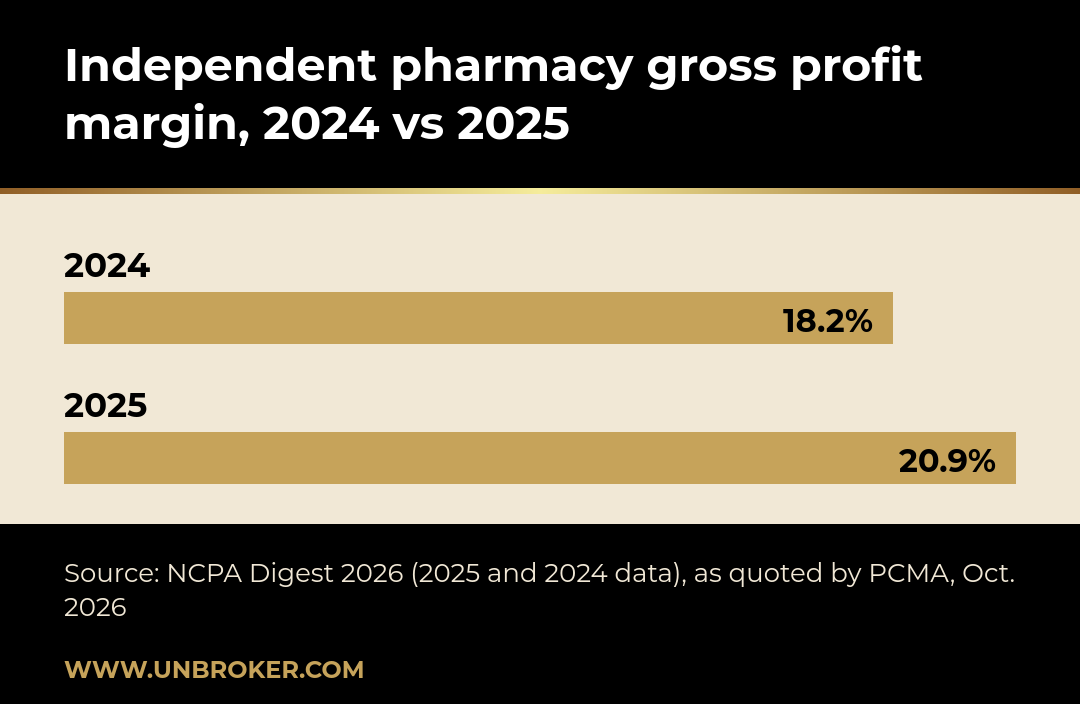
On profitability, the Pharmaceutical Care Management Association (PCMA), quoting the 2026 NCPA Digest, reports that gross profit margin for independent pharmacies rose to 20.9 percent in 2025 from 18.2 percent in 2024, as described in its October 2026 post.
Independent pharmacy gross profit margin was 18.2% in 2024 and 20.9% in 2025.
Gross margin is not take-home profit, and your own numbers may look different from the industry picture. Treat these figures as context for a conversation with a valuation adviser, not as a price tag. Multiples and buyer appetite vary by market, location and payer mix, so ask an adviser who knows pharmacy deals.
One more data point shapes who is likely to buy. The 2024 NCPA Digest reported average sales per location of $4,997,000 in 2023, and said nearly 30 percent of independent pharmacy owners had ownership in two or more pharmacies. Multi-store owners are a natural buyer group, and as the next section shows, they can have a regulatory head start.
DEA registration: why it does not simply pass to the buyer
This is the point that surprises many owners. According to a health law firm’s analysis of 21 CFR 1301.13 and 1304.11, a pharmacy sale does not carry the seller’s DEA registration to the buyer. A buyer who is not already registered must apply for a new registration and may not handle controlled substances until DEA grants it. The firm advises sellers to confirm timing with a pharmacy attorney, and so do we.
There is one situation that can make this smoother. The DEA Pharmacist’s Manual says that a buyer who already owns at least one other pharmacy licensed in the same state as the pharmacy being acquired may apply for a new DEA registration before the transfer date. DEA may issue a registration that allows the buyer to obtain controlled substances at the time of transfer. Even then, the buyer may not dispense them until the pharmacy has a valid state pharmacy license. You can read the details in the DEA Pharmacist’s Manual.
What this means for you in practice:
- Ask every buyer about their registration status early. A buyer with an existing pharmacy in your state may have a different timeline than a first-time owner or an out-of-state operator.
- Do not assume a closing date equals an opening date. A buyer may be able to own the business on a certain day and still be unable to dispense controlled substances until the state license and DEA steps are in place.
- Build the gap into your deal terms. Your attorney can help you draft how the parties handle the controlled-substance portion of the business if approvals lag.
If you want a sense of how other regulated, license-driven businesses handle a handover, our posts on selling a dental practice and selling a convenience store cover similar ground, though neither involves DEA rules.
Controlled substance inventory on transfer day: what to count and who signs
Under federal DEA rules (21 CFR 1301.52), when controlled substances are transferred, a complete inventory must be taken on the date of transfer. That inventory serves as the final inventory of the seller (the transferor) and the initial inventory of the buyer (the transferee), and a copy goes in each party’s records.
A few related points from the same rule and the DEA manual:
- Transfers of Schedule I or II substances require order forms under part 1305, so plan that paperwork with your attorney and the buyer before the day arrives.
- The seller must also transfer the related controlled-substance records on the transfer date.
- The acquiring pharmacy must keep the transfer records for two years.
State rules can add detail. Wyoming’s retail pharmacy change-of-ownership rule is one example: a controlled-substance inventory of Schedules II through V is taken at close of business on the last day under the prior owner, dated and signed by the pharmacists-in-charge of the prior and new ownership, and the Board inspects after the change. You can see the text in the Wyoming Board of Pharmacy rules. Other states set their own rules, so check yours rather than assuming it works the same way.
How to prepare for the count
- Clean up your records first. Reconcile your perpetual inventory against what is on the shelf and in the safe well before transfer day. Surprises during the final count are a deal risk.
- Decide who attends. Agree in writing which pharmacists will conduct and sign the count, and make sure the people who need to sign are available on the date.
- Settle the cutoff time. Agree on when the count happens relative to closing time, and when the last dispensing under your registration occurs.
- Agree on how disputes get resolved. If a count does not match the records, the parties need a process decided in advance, not on the day.
- Keep your own copy. Your final inventory and the transferred records belong in your files, as the rule requires.
Prescription files and HIPAA: when you can hand over patient records
Prescription files are what most buyers are really purchasing, so the question of when and how you can hand them over deserves care. Under the HIPAA Privacy Rule definition of health care operations in 45 CFR 164.501, the sale, transfer, merger or consolidation of all or part of a covered entity is included when it is with another covered entity, or with an entity that will become a covered entity after the transaction. Related due diligence is also included.
In plain terms: a pharmacy is generally a covered entity, and a sale to another covered entity, or to a buyer who will become one through the purchase, falls within the category of health care operations. That is the framework that allows the records to move as part of the deal. Three cautions apply:
- It does not erase other duties. The commentary on the rule notes that this does not remove any other legal or ethical duty to notify individuals of a sale. State law or professional standards may require patient notice, so ask your attorney what your state expects.
- The buyer’s status matters. The rule language is about a buyer who is, or will become, a covered entity. A buyer who is not on that path is a different conversation, and you should not hand over files until your attorney confirms the footing.
- State record-keeping rules still apply. States may have their own requirements for how prescription records are kept, transferred and made accessible. Confirm these with your attorney and your pharmacy board.
Practical handling during due diligence
Early in the process, buyers need to understand your business, not individual patients. A sensible approach is to share summaries first: prescription counts by month, payer mix, top drug categories and similar aggregate views. Hold back patient-level detail until a buyer is serious, has signed a confidentiality agreement and your attorney has confirmed what can be shared and when. Our seller due diligence tips go deeper on organizing records so you are ready when buyers start asking.
State board permits, public notices and change-of-ownership timing
State boards of pharmacy decide who may operate a pharmacy in their state, and change of ownership usually triggers an application, a notice process or both. Because rules differ so much from state to state, treat the following as examples of what to look for, not as a description of your state.
- Notice to DEA. Florida’s Board of Pharmacy instructions tell the seller to send notice to DEA at least 14 days before the proposed date of transfer of controlled drugs. The notice includes the names, addresses and registration numbers of the parties and the planned transfer date. See the Florida change-of-ownership information sheet. This is one state’s instructions, so other states’ timing and forms may differ.
- Public notice. In Wyoming, when a change of ownership requires a new DEA registration number, the pharmacy must plan how it will tell the public about the ownership change no later than 14 days before it happens.
- Post-change inspection. Wyoming’s Board inspects after the change. Expect that some boards review the pharmacy once the new owner is in place.
Notice that two different 14-day clocks show up in just these two examples: one to DEA and one to the public. They have different triggers and different audiences. That is the kind of detail that makes a calendar essential.
Build a regulatory calendar
Work backward from your target transfer date and list every step with an owner and a deadline: buyer’s state license application, buyer’s DEA registration application (or the early application route if the buyer qualifies), any DEA notice your state requires, public notice, inventory count, records transfer and board inspection. Share the calendar with the buyer’s attorney. When both sides can see the same schedule, fewer surprises show up late.
Also check your own contracts. Wholesaler agreements, third-party payer contracts, lease terms and any software or vendor agreements may have their own assignment or consent requirements. These are separate from the licensing steps above, and your attorney should review them early.
What to gather before you list: records, contracts, inventory and financials
Buyers of pharmacies ask for a lot of documents, and they ask for them in a regulated context. Having them ready signals that you run a clean operation.
Regulatory and compliance records
- Current state pharmacy license and your DEA registration
- Controlled-substance records, inventories and any past inspection reports
- Any corrective actions or board correspondence
- Policies and procedures, including your HIPAA privacy documentation
Contracts and relationships
- Third-party payer and network agreements, with notes on assignment or change-of-control terms
- Wholesaler and supplier agreements
- Lease, or deed if you own the real estate
- Employee roster, roles and licenses, plus any employment agreements
- Service contracts for systems, packaging, delivery or compounding equipment
Inventory and operations
- Current inventory reports separating controlled and non-controlled stock
- Fixed asset list: shelving, safes, robotics, delivery vehicles, compounding equipment
- Pharmacy software details and how your records can be exported
Financials
- Several years of tax returns and financial statements
- Prescription volume and revenue trends, with the prescription department separated from front-end sales
- Gross margin and payer mix by period
Since the prescription department drives the lion’s share of sales for independents, buyers will want to see it broken out clearly. A seller’s document checklist can help you make sure nothing general is missing alongside the pharmacy-specific items. If you plan to hand a buyer a number, make sure your valuation method is sound and that you understand what drives it. Multiples vary by market, so ask a valuation adviser who works with pharmacies.
Keeping the sale confidential from staff, patients and competitors
A pharmacy runs on trust and routine. If staff hear rumors, key pharmacists may start looking elsewhere. If patients hear, some may wonder whether their prescriptions are safe. If a competing pharmacy hears, it may try to recruit your patients or staff. Confidentiality is not a courtesy here, it protects the value of what you are selling.
- Use a blind description. Market the business without your name, address or distinctive details. Share identifying information only after a buyer signs a confidentiality agreement and you have a sense of who they are and whether they can actually close.
- Qualify buyers before you reveal anything. Ask about their financing, their experience and, for a pharmacy, their DEA and state license position. A buyer who cannot explain how they would get licensed is a risk to your timeline.
- Limit the circle. Tell only the people who need to know: your attorney, your accountant and any adviser. Hold off on telling employees until it is necessary. Our post on when to tell employees you are selling covers the timing question.
- Control site visits. Schedule walkthroughs outside busy hours and introduce buyers in a way that does not raise questions among staff or patients.
- Protect the data. Use secure channels for documents, and keep patient-level information out of early-stage sharing as described above.
Patients are a special case. Because other legal or ethical duties to notify individuals of a sale may exist beyond HIPAA, plan the timing and wording of any patient communication with your attorney, and coordinate it with the public-notice requirements in your state, so patients hear about the change from you rather than from the grapevine.
Choosing how to run the sale: managed or hands-on
Some pharmacy owners want a team to handle buyer outreach, screening, negotiation and the many moving parts, so they can keep filling prescriptions. Others are comfortable running the process themselves and want to control costs. Both are workable paths for a pharmacy, as long as the regulatory steps are handled by your attorney and checked against your state board’s instructions.
If you stay hands-on, the parts that most reward careful work are the buyer screening, the confidentiality discipline and the regulatory calendar. If you hire help, ask how they handle each of those, and whether they will work alongside your pharmacy attorney. In either case, remember that a good adviser or tool can organize the process, but the licensing and records rules are legal questions for your attorney. For a broader view of when a lawyer should be in the room, see our post on whether you need an attorney for your business exit.
A pre-listing checklist to confirm with your attorney and pharmacy board
Use this list as a starting agenda for a conversation with your pharmacy attorney and your state board of pharmacy. Check off each item or write down who is responsible for it.
- Deal structure. Confirm how the sale will be structured and how that affects your license, your DEA registration and your contracts.
- Buyer’s DEA position. Find out whether each serious buyer already owns a pharmacy licensed in your state, and whether they can apply for a DEA registration before the transfer date.
- State license steps. Get the board’s current change-of-ownership application, fees, timing and inspection process in writing.
- DEA notice. Ask whether your state or your attorney expects advance notice to DEA, and how many days ahead.
- Public notice. Ask whether your state requires a public notice of the ownership change, the required lead time and the format.
- Inventory plan. Decide the date, time, attendees and signers for the transfer-day controlled-substance inventory, and plan any order forms for Schedule I or II transfers.
- Records transfer. Plan how controlled-substance records move on the transfer date, and how both sides keep their required copies and retention periods.
- Prescription files. Confirm the HIPAA footing for the buyer and any state rules on patient notice and record custody.
- Contract consents. List the payer, wholesaler, lease and vendor agreements that need consent or assignment.
- Confidentiality plan. Decide what gets shared, with whom, and when, including staff and patient communication timing.
- Financial package. Prepare financial statements with the prescription department separated, and talk to a valuation adviser about how buyers are likely to look at your numbers.
- Calendar. Put every step on one shared timeline, and revisit it as the buyer’s approvals progress.
Pharmacy sales are manageable when the regulatory work starts early and runs in parallel with marketing and negotiation. The owners who tend to have the smoothest experience are the ones who know the steps before the first buyer calls.
If you are ready to explore a sale, Unbroker combines expert advisors, AI-driven buyer matching and national marketing in a confidential process. Our Full Service Business Sale charges a 6% success fee, paid when the business sells, and sellers who prefer to stay hands-on can use our legal document templates and negotiation assistance. Your pharmacy attorney and state board remain your guides on the licensing and records rules.