If you own a dental practice and you are starting to ask what it is worth and who would buy it, this guide is for you. You will learn how buyers commonly price a practice, how the buyer pool is changing, and what to prepare before the first buyer asks for anything.
You will also see why your role in the chair shapes both price and structure, how to keep a sale quiet from patients and staff, and how to decide between a professionally managed sale and a hands-on one. At the end there is a list of questions to take to your CPA, attorney and valuation adviser.
Why dental practice owners are thinking about selling now
Ownership is still the norm in dentistry, but it is slipping. The ADA Health Policy Institute reports that 73% of U.S. dentists were practice owners in 2023, compared with 85% in 2005. Fewer dentists own, so the group of people who might buy your practice looks different than it did when you started.
Several pressures sit behind the timing question for many owners. The same ADA report says inflation-adjusted average annual income for general practice dentists fell from $267,168 in 2010 to $207,980 in 2024 (in 2024 dollars). Comparing pooled 2015-19 with pooled 2020-24 medians for general practitioners (also inflation-adjusted), revenue per dentist went from $706,966 to $698,436, while expenses per dentist rose from $468,459 to $482,343. Those are national figures for general practitioners. Your own numbers may look quite different, which is one more reason to review them closely before you decide.
Time and energy matter too. In 2024, owner dentists worked an average of 37.0 hours a week and employee (associate) dentists 31.8 hours, a gap of 5.2 hours. The report also finds that average weekly office hours not spent treating patients rose from 3.6 in 2010 to 5.5 in 2024. If you feel the administrative load of ownership growing, the data suggest you are not imagining it.
Retirement timing is shifting as well. The average retirement age of dentists who retired in 2024 was 68.7 years, about 4 years later than in 2001. The same report says a considerable share of dentists aged 60 and older have left the workforce since 2017, and that by the late 2020s most baby boomer dentists will have aged out of it. As more owners reach the exit at roughly the same time, preparing early is a sensible way to stand out.
None of this tells you whether now is your moment. It does say that the market for practices is moving, and that owners who plan ahead have more choices than owners who react to a health scare or a burnout day. If you want a broader framework for timing, the post on exit timing clues is a useful companion.
How buyers price a dental practice: collections, earnings and goodwill
The collections rule of thumb
Dentistry has its own shorthand for value, and it starts with collections, meaning the money the practice actually collects from patients and payers. The ADA says it is typical for dental practices to sell for 65-85% of the average of the last 3 years of collections. As a very rough estimate, it suggests averaging your last 3 years of collections and multiplying by .65 for the low end and .85 for the top end.
Treat that as a starting range, not a valuation. The base here is collections, not earnings, and it describes dental practices specifically. It does not tell you where your practice lands inside the range or whether it falls outside it. Payer mix, overhead, facility condition, patient base, the strength of your team and how dependent the practice is on you all push a real number up or down.
Earnings, goodwill and what you leave on the table
Buyers who finance a purchase, and especially group and DSO buyers, also look at what the practice earns after normal expenses. Goodwill, the value of your patient relationships, reputation and location, is generally what a buyer is paying for beyond equipment and supplies. Goodwill is also the part of the price most exposed to patient attrition after you leave, which is why the handover matters so much.
When you or an adviser normalize earnings, the measure you use changes how your pay is treated, so name it before you compare numbers:
- Seller’s discretionary earnings (SDE): personal expenses and one-time costs are added back, and one owner-operator’s full pay is added back, whatever its level. SDE is the usual lens for a small practice where one owner-dentist does the clinical work.
- Adjusted EBITDA: personal expenses and one-time costs are added back, but owner pay is reset to a market rate. Pay above market is added back. Pay below market is a deduction that lowers EBITDA, because a buyer has to pay a replacement dentist the going rate.
This matters in dentistry because you are probably both the owner and the main producer. If you have been paying yourself less than a buyer would need to pay an associate to do your clinical work, an EBITDA-based buyer will adjust for that. A buyer using SDE will see the full picture differently. Ask your valuation adviser which measure applies to the buyers you expect, and ask for the multiple’s base (collections, SDE or EBITDA) and the type of practice it was drawn from. Multiples vary by market and practice type, so do not anchor on a number you heard at a conference. For a deeper look at the mechanics, see the business valuation checklist.
The ADA also recommends a practice valuation every year, whether or not a transition is planned. That habit gives you a trend line, shows you what a buyer will see, and lets you fix problems while you still have time.
Who buys: associate dentists, group practices and DSOs
Associates and younger dentists
The classic buyer is a dentist, often an associate who has worked in your office or a nearby one. The pipeline of owner-ready dentists is thinner at the younger end, though. In 2023, 8.8% of dentists under 30, 32.5% of those aged 30 to 34 and 70.9% of those aged 35 to 44 owned their practices, versus 88.6% of those aged 45 to 54, 89.7% of those aged 55 to 64 and 83.5% of those aged 65 and older.
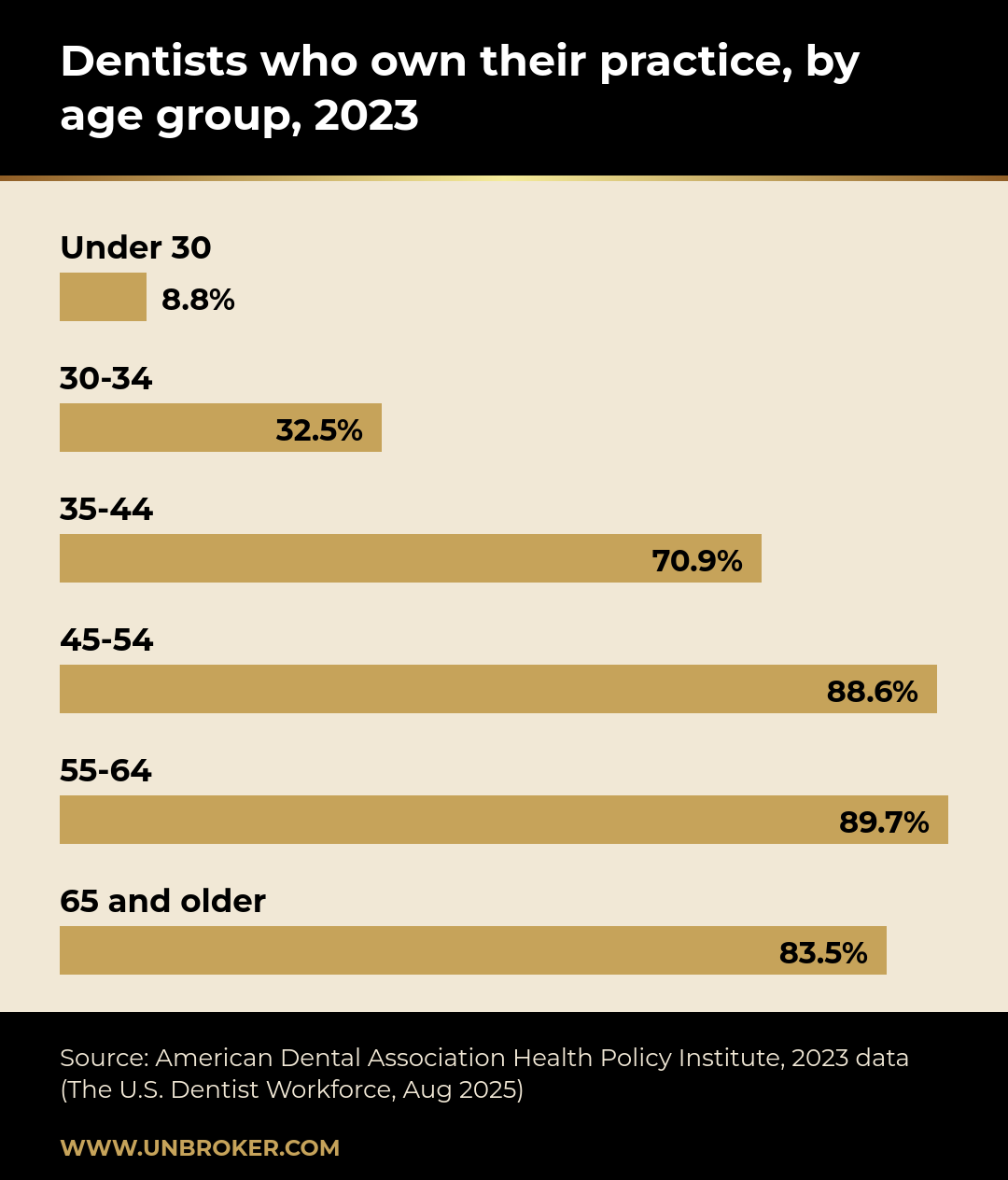
That does not mean younger dentists will never buy. The ADA Health Policy Institute describes ownership among newer generations as delayed rather than abandoned. For dentists who graduated in 2016 to 2020, about 21% owned a practice 5 to 9 years after graduation, while the graduating classes of 1991 to 1995 reached about 90% ownership by 25 or more years after graduation. In practice, a younger buyer may be ready later, may need more help with financing, and may want a longer runway with you in the practice.
Group practices and DSOs
The second major buyer type is organized dentistry: multi-doctor group practices and dental support organizations (DSOs). The ADA Health Policy Institute found that the share of U.S. dentists affiliated with a DSO more than doubled from 7.2% in 2015 to 16.1% in 2024. Affiliation is much higher among newer dentists: in 2024, 26.5% of dentists up to 10 years out of dental school were DSO-affiliated, versus 14.4% of those 11 to 25 years out and 9.1% of those more than 25 years out.
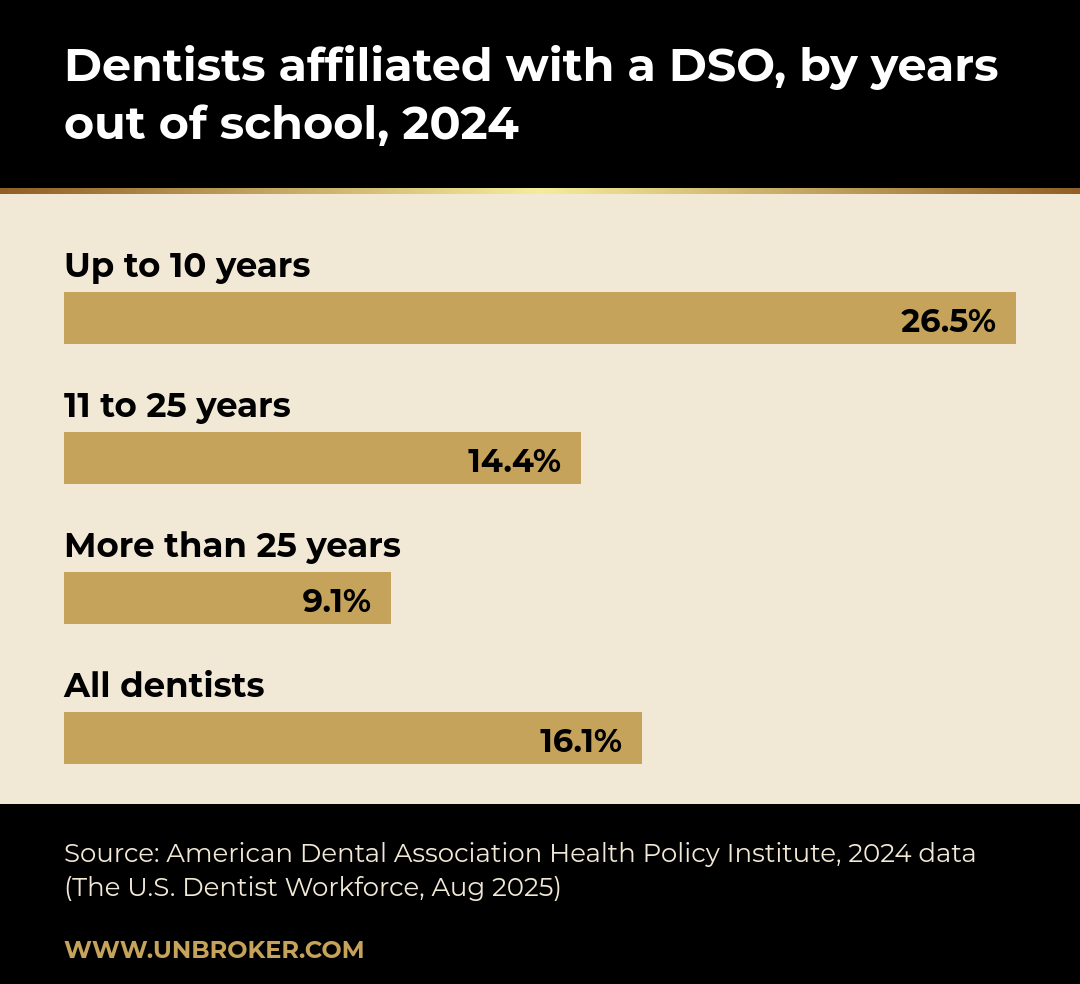
Practice setting is shifting in a similar direction. In 2024, about 34% of U.S. dentists practiced in a single location with no other dentist (solo practice), 39% worked in a single-location practice with at least one other dentist, and 11% were in practices with 100 or more locations. Among dentists up to 10 years out of dental school, 14.9% were in solo practice, versus 47.6% of those 26 or more years out. If you run a solo practice, the dentists coming up behind you are less likely to be solo practitioners themselves, which affects who is shopping.
Your market may look different
Geography matters a great deal. Share of dentists affiliated with a DSO in 2024 ranged from 27% in Nevada and 27% in Colorado, 25% in Texas, down to 3% in North Dakota and 2% in Hawaii. Buyer demand from group and DSO buyers may therefore look very different from one market to another. In a high-affiliation state you may have several organized buyers competing. In a low-affiliation state your best buyer may be an associate, a nearby dentist expanding, or a buyer from outside your area.
The practical lesson is to avoid assuming that one buyer type fits you. A broad, well-qualified buyer pool, including buyers who are not in your zip code, can give you options on price and on terms such as how long you stay.
Why the owner’s chair matters: transition and patient retention
In most practices, patients come for the dentist as much as for the building. A buyer knows that if patients leave after the sale, the goodwill they paid for leaves with them. So buyers care about three things: how well you can introduce the new dentist, how long you will stay, and how much of the practice’s production depends on you personally.
A few steps tend to help:
- Plan a defined handover period. Decide how long you are willing to keep treating patients alongside the buyer, and what your schedule looks like. Be ready to put that in writing.
- Build the team’s role. Hygienists, long-tenured assistants and front-desk staff hold patient relationships too. A buyer will want to know who is staying and on what terms.
- Introduce patients deliberately. Warm introductions from you to the new dentist carry more weight than a letter. Your attorney can advise on when and how you can tell patients.
- Know your dependence. If most production runs through your hands, say so honestly. Buyers will find out in diligence, and surprises tend to cost you in negotiation.
Think about your own plans, too. Some owners want to hand over the keys and be gone. Others want to keep working part-time as an associate, which can make a sale more attractive to a buyer who is nervous about patient retention. For a broader view of handover design, see this guide to owner transition planning.
Prepare your records before buyers ask
The ADA advises dentists to have practice financial documentation ready regardless of how value is determined, because the purchaser will need it to secure financing. That is worth taking literally. Even a cash-rich buyer’s lender or investors will want clean records, and a buyer who sees disorganized files may lower the offer or walk.
Start assembling these items now:
- Financial statements and tax returns for the periods your adviser recommends, with a clear reconciliation between them.
- Collections reports and production reports, so the collections-based range can be tested against your real numbers.
- A list of one-time and personal expenses that run through the practice, with documentation, so they can be added back consistently.
- Payer and fee-schedule information, including participation agreements and how your payer mix has moved over time.
- Patient and schedule metrics such as active patient counts and new patient flow, defined the same way every year.
- Staff information: roles, tenure, pay, benefits, and any written agreements.
- Licenses, permits and compliance records for the practice and its clinicians, along with your policies for records and infection control.
- Equipment list with age, condition, maintenance records and any leases or liens.
- Lease or property documents for the premises.
The more consistent your reporting, the easier it is for a buyer to trust your numbers. For a deeper checklist, see these seller due diligence tips. Rules about patient record transfer, retention and notice vary by state, so confirm the requirements with your attorney well before any records change hands.
Real estate, leases and equipment in a practice sale
Dental practices often involve a property question that a typical service business does not. Every case is different, but the common setups are these:
- You lease your space. The buyer will want to know the remaining term, renewal options, rent escalations, and whether the landlord must consent to an assignment or a new lease. Talk to your attorney early, since landlord consent can become a gating item for closing.
- You own the building through a separate entity. You can sell the practice and keep the property as landlord, sell both, or sell the practice with a purchase option. Each choice has tax and financing consequences, and a lender may want the lease terms to look like an arm’s length deal.
- You own the building personally or in the practice entity. Your attorney and CPA should help sort out how the real estate is valued, separate from the practice.
Equipment is the other piece. Operatories, imaging, sterilization equipment, software and instruments all carry age and maintenance histories. A buyer will look at whether major equipment is nearing replacement, because that is a cost they inherit. Updating or documenting equipment before a sale can help you defend your number. Also check technology contracts, such as practice management software and imaging licenses, to see whether they transfer.
How the deal is structured, whether as a sale of assets or a sale of an entity, affects taxes, liability and what the buyer takes on. Tax treatment depends on your entity type, how long you have held the assets, and the rules in effect when the deal closes. Confirm all of this with a tax adviser or attorney before you agree to terms. If you want background on structures, read about the asset sale approach.
Keeping the sale confidential from patients and staff
A practice runs on trust. If patients hear you are selling before you are ready to tell them, some may start looking elsewhere. If staff hear it, key people may begin interviewing. Confidentiality is therefore a core part of the plan, not a nicety.
Good habits include:
- Market the practice anonymously. Early marketing should describe the practice in general terms, such as region, setting and general size, without the name or exact address.
- Use confidentiality agreements before sharing details. Have your attorney prepare an NDA, and release the practice name and sensitive records only to buyers you have screened.
- Screen for fit and financing. A buyer who cannot show the ability to close should not be touring your office.
- Control site visits. Schedule visits outside patient hours or present the buyer in a low-key role, and agree on what is said to staff.
- Decide in advance when to tell your team. Staff will ask what happens to their jobs. Have an answer, ideally agreed with the buyer, before you tell them.
Digital tools can help, since a secure online data room limits who sees what and when. For a broader look, read about running a confidential business sale.
Managed sale or hands-on sale: choosing how much help you want
There is no single correct way to sell. The right model depends on your time, your comfort with negotiation and how complex your practice is.
A professionally managed sale
If you would rather keep seeing patients and let someone else run the process, a managed sale puts an advisor in charge of positioning the practice, finding and screening buyers, handling inquiries, and coordinating negotiation and paperwork. This tends to suit owners with busy schedules, multi-location or multi-doctor practices, or practices with several likely buyer types, where a structured process can help you compare offers on more than price. You pay for that help, so understand how the advisor is compensated and what is included before you sign.
A hands-on sale
If you are cost-conscious and willing to put in the time, you can run more of the process yourself using templates, valuation tools and online marketing. You keep control of the conversation with buyers and you decide who sees what. The tradeoff is that you take on the work: preparing a summary of the practice, screening buyers, keeping the process confidential, and negotiating terms while you are still running a clinic. A hands-on approach can work well when you already have a likely buyer, such as an associate, and need help structuring and documenting the deal. Bring in your CPA and attorney either way.
A useful way to decide is to list the tasks and ask which ones you would do well, which you would do reluctantly, and which you would likely skip. Whichever route you choose, you should still expect clear terms about cost and a plan for keeping patients and staff in the dark until you are ready to tell them. The guides on selling a veterinary practice also show how another owner-operated healthcare business weighs these same choices.
Questions to take to your CPA, attorney and valuation adviser
Bring these to your first conversations. Good advisers will welcome them.
For your valuation adviser
- Which earnings measure fits my practice and likely buyers: SDE or adjusted EBITDA?
- How is my own pay treated, and would a buyer need to pay a replacement dentist more or less than I pay myself?
- How do my last 3 years of collections compare with my earnings, and where might I fall in the collections-based range?
- What multiples apply to practices like mine, in my market, and what is each multiple’s base?
- What would a buyer see as risks, such as patient concentration in my own schedule?
For your CPA
- How should my financials be cleaned up and presented, including add-backs for personal and one-time expenses?
- What are the tax implications of an asset sale compared with an entity sale for my entity type and holding periods?
- How will the allocation of the price among goodwill, equipment and other items be treated?
- Are there any deadlines, thresholds or recent law changes that affect my timing?
For your attorney
- What do I need to do about patient notification and record transfer in my state?
- What are my lease and landlord consent obligations?
- What non-compete, non-solicit and transition terms are reasonable for me, and enforceable where I practice?
- How should staff agreements, payer contracts and technology contracts be handled in the deal?
- What representations and warranties will I be asked to give, and what protects me after closing?
Selling a dental practice goes better when you give yourself time to prepare, know how buyers think, and decide up front how involved you want to be. Start with your numbers, then your handover plan, then the buyer pool.
Unbroker pairs expert advisors with AI-driven buyer matching and national marketing, and its Full Service Business Sale carries a 6% success fee, paid when the business sells. Sellers get a confidential process, legal document templates and negotiation assistance, and Unbroker supports non-profit programs along the way. To see whether a managed or more hands-on route suits your practice, visit Unbroker.