Selling your business is a major milestone, but the work doesn’t stop at closing. The months following your exit determine whether the transition strengthens or damages what you’ve built.
A solid post-sale support plan protects your legacy while giving the buyer confidence in the handover. At Unbroker, we’ve seen firsthand how sellers who plan ahead avoid costly disruptions and preserve their reputation.
The First 90 Days After Closing
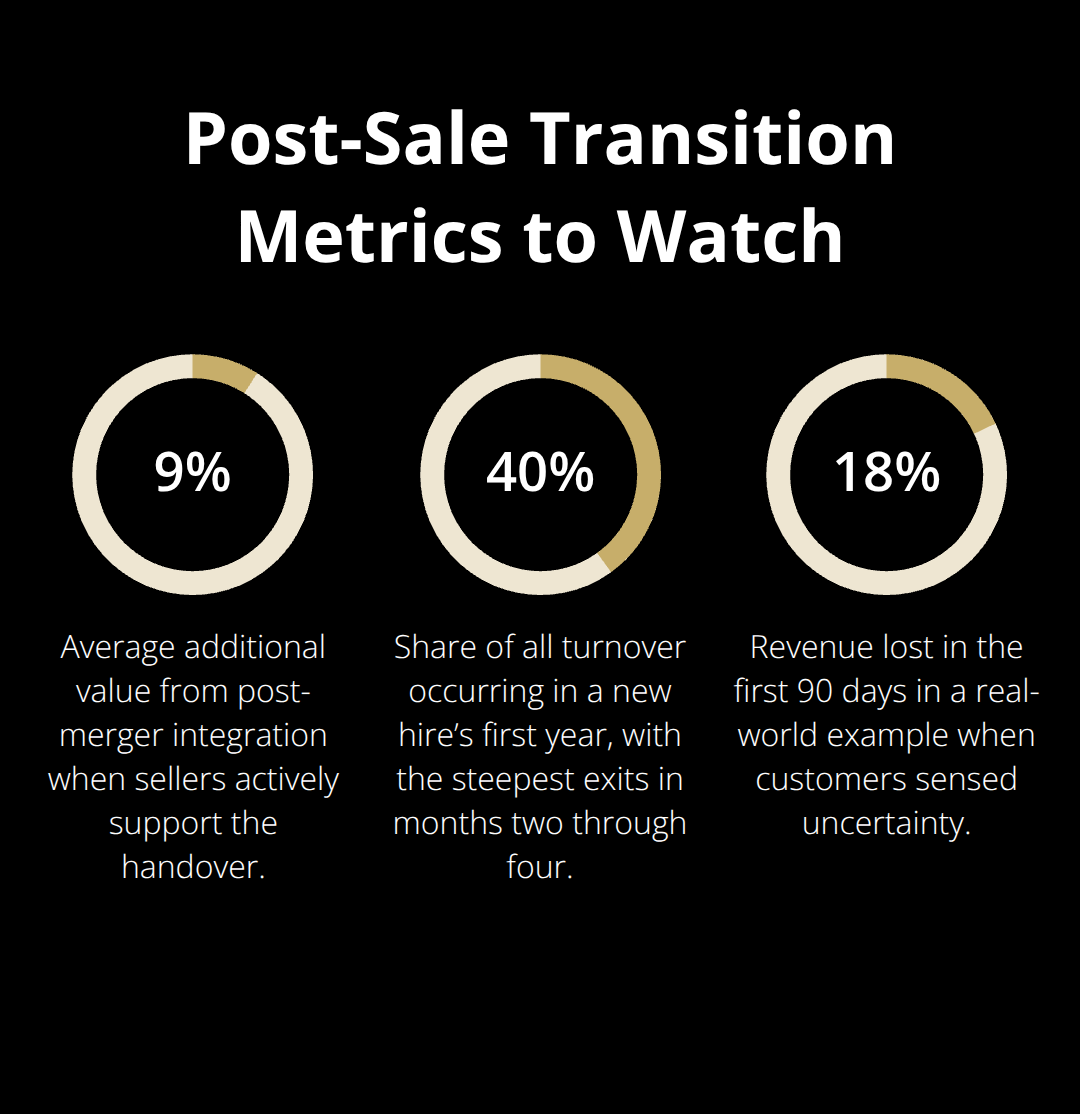
The closing happens on a Friday afternoon. Monday morning arrives, and the new owner expects to walk into a functioning business. This is where most sellers stumble. The transition isn’t automatic, and the 90 days following your exit will determine whether the buyer feels confident about their purchase or regrets it immediately. BCG research shows that post-merger integration work delivers approximately 9% more value on average than typical deals, but only when sellers actively support the handover rather than disappearing. Your involvement during this window protects both the business you built and your own interests under the purchase agreement.
Control the First Week’s Chaos
The moment closing papers are signed, three things must happen simultaneously. First, update all critical systems with new access credentials and ownership information. This includes bank accounts, payroll platforms, accounting software, and vendor portals. A single missed login or outdated contact person creates operational friction that compounds daily. Second, schedule joint meetings with your top 10 customers and suppliers within 48 hours of closing. These aren’t optional. The Content Marketing Institute notes that personal introductions preserve relationships and revenue stability during transitions, and research confirms that customer churn spikes when new ownership feels uncertain. Position these as brief, reassuring conversations where you introduce the buyer personally and confirm that service quality remains unchanged. Third, hold an all-hands meeting with your team. Employees need to hear from you that the transition is planned, their roles are secure, and leadership has continuity. Studies show that employee turnover accelerates when communication gaps exist, so transparency here directly impacts operational stability. Provide an organizational chart showing who reports to whom under the new owner and clarify how compensation, benefits, and job responsibilities change, if at all.
Document What Exists Before It Disappears
Create a detailed operations manual covering your most critical workflows. This manual should document how you manage inventory, process customer orders, handle supplier relationships, and manage cash flow. Include login credentials for all systems, step-by-step process maps, and the names and contact information for key relationships. Don’t assume the buyer has this information. Many sellers believe their business is self-explanatory; it rarely is. Spend 10 to 15 hours over the first two weeks creating this documentation. Pair this with scheduled shadowing sessions where you walk the buyer and their team through actual daily operations. Show them how you negotiate with suppliers, handle customer complaints, and manage seasonal fluctuations. This isn’t mentoring; it’s protecting your deal. The purchase agreement likely contains representations about how the business operates, and poor handoff documentation creates disputes later. Similarly, transfer all financial records, tax filings, and administrative accounts to the buyer’s accountant. Coordinate with your accountant to ensure the buyer’s accounting team has access to historical data and understands your financial reporting practices. Regulatory compliance often shifts during ownership changes, and gaps here create liability that can pull you back into legal proceedings months after you’ve exited.
Announce the Change Without Triggering Panic
Your communication strategy during the first 30 days shapes stakeholder confidence for months. Draft separate announcements for employees, customers, and suppliers, each addressing what changes and what stays the same. For employees, emphasize job security and explain how the new owner’s vision aligns with the company’s values. For customers, focus on continuity of service and introduce the new owner as a partner who strengthens the business. For suppliers, confirm that payment terms and order processes remain consistent. Send these announcements within 24 hours of closing, not weeks later. Delayed communication creates rumors and erodes trust. Follow up with email and SMS updates at 30, 60, and 90 days, reinforcing stability and sharing early wins under new ownership. This cadence prevents customers from seeking alternatives and keeps employees engaged. The buyer should lead some of these communications to establish their credibility, but your presence alongside them signals continuity and reduces anxiety.
The first 90 days set the tone for everything that follows. How you handle these immediate priorities determines whether the buyer views you as a trusted partner during the transition or as someone who checked out too early.
What Goes Wrong When Leadership Changes Hands
The moment the buyer takes control, three predictable crises emerge simultaneously, and most sellers aren’t prepared for them. Employee turnover within the first 60 days spikes as staff worry about job security and cultural shifts under new ownership. Customers disappear quietly, testing competitors because they sense uncertainty and fear service quality will decline. Operations stall because critical processes live only in people’s heads, not in documented systems. Research from the Society for Human Resource Management shows that attrition during a new hire’s first year accounts for roughly 40% of all turnover, with the steepest departures happening in months two through four when initial reassurance wears off. Your job during this window isn’t to micromanage the buyer; it’s to actively prevent these three crises from compounding into permanent damage.
Why Your Employees Leave Before You Do
The staff member who built your customer relationships, the operations manager who knows every supplier, the developer who maintains your core systems-they all evaluate job offers within weeks of the announcement. They don’t necessarily leave because the new owner is bad; they leave because uncertainty feels worse than a concrete change elsewhere. Within the first two weeks, identify your top 10 employees whose departure would genuinely damage the business. Meet with each one individually, not in a group. Explain exactly how their role changes, what new opportunities the buyer brings, and what compensation or title improvements they’ll receive. If retention is critical, structure a retention bonus that vests over 12 months, tied to staying through specific milestones. This acknowledges that their institutional knowledge has real value and that continuity costs less than replacement. Involve the buyer in these conversations so employees hear directly that their role matters under new leadership. Schedule monthly team meetings throughout the first 90 days where the buyer shares concrete business wins and growth plans. Employees need to see that the new owner isn’t stripping the company for parts; they’re investing in it. One founder lost three key team members within eight weeks because the buyer never explained how the acquisition funded new software and hiring. The employees assumed the opposite and left preemptively.
How Customers Quietly Switch
Customer churn during business transitions is silent and devastating. Your best customers don’t complain or give notice; they simply respond more slowly to emails, delay renewal decisions, and start conversations with competitors. This happens because customers equate you with reliability, and your absence signals risk. For your top 20 customers (the ones generating 60 to 80% of revenue), schedule a three-way call with you, the buyer, and the customer within 30 days of closing. You should lead this call, not the buyer. Explain why you sold, introduce the buyer as someone who strengthens the business, and commit to being available for questions during the transition. Then step back and let the buyer discuss their vision. Customers accept change when they hear it from you first and see the buyer as an enhancement, not a replacement. For mid-tier customers, the buyer should conduct quarterly check-ins during the first year, asking specifically what’s working and what needs improvement. Track renewal rates and average order values monthly. If either metric dips below historical averages by month two, you have a customer retention problem that demands immediate attention. Assign the buyer’s team to contact dormant accounts before they formally churn. One business lost 18% of annual revenue in the first 90 days because the new owner assumed customers were sticky; they weren’t. The founder’s absence signaled that the business was no longer their priority, so customers found alternatives.
Operational Gaps That Compound Daily
Your processes work because you understand the context and exceptions that don’t appear in any manual. The buyer’s team follows the documented steps, misses the context, and creates errors that pile up. Inventory management fails because no one explained the seasonal ordering rhythm. Customer onboarding slows because the unwritten relationship-building steps got skipped. Cash flow tightens because payment follow-up happens differently now. Spend the first three weeks creating a detailed operations playbook that covers your top 10 revenue-generating processes. For each process, document the standard steps, the common exceptions, the seasonal variations, and the names of people who handle edge cases. Include screenshots, decision trees, and actual examples from recent transactions. Pair this documentation with knowledge transfer where you work alongside the buyer’s team on real operations for two to four weeks. Show them what good looks like, explain why certain steps matter, and answer questions when they get stuck. After 60 days, step back and observe from a distance, intervening only if you see critical errors repeating. This protects the business’s operational integrity while the buyer learns your context. Without this, small inefficiencies compound into lost revenue and customer complaints that damage the business’s value and your reputation as the seller.
These three crises-employee departures, customer churn, and operational breakdowns-don’t happen in isolation. They feed each other. Employees who sense instability leave, which causes customers to lose confidence, which creates operational chaos that makes the buyer question their purchase. The next section shows how to structure your post-sale support agreement so you remain available to prevent these cascading failures without becoming trapped in the business indefinitely.
Your Post-Sale Support Agreement Structure
The purchase agreement defines what you sold, but it rarely defines what happens after closing. This gap creates conflict. The buyer expects you available 24/7 to answer questions about why customer X stopped ordering or why the accounting system behaves unexpectedly. You expect to hand over the keys and move forward with your life. Neither assumption is realistic, which is why you need a separate post-sale support agreement that clarifies exactly what you will and won’t do after closing. This document isn’t optional-it’s the difference between a smooth transition and months of frustrating phone calls that feel like you never actually left.
Define Duration, Functions, and Compensation
Your post-sale agreement must specify three concrete elements: the exact duration of your availability (typically 90 days for immediate intensive support, then 6 to 12 months for advisory availability on an as-needed basis), the specific functions you’ll support (usually knowledge transfer, customer introductions, and operational troubleshooting, but not day-to-day management), and the compensation structure (typically a consulting fee, retention bonus tied to your involvement, or both). Be explicit about response time expectations. If the buyer can reach you at midnight on a Sunday with operational questions, that’s your fault for not setting boundaries. Define that you’ll respond to urgent operational issues within 24 business hours and non-urgent questions within 5 business days. This protects your time while reassuring the buyer that critical problems won’t languish unresolved.
Specify which systems you’ll support directly (accounting software, customer relationship management, inventory management) and which you’ll only explain conceptually. Don’t agree to manage systems yourself; instead, commit to training the buyer’s team to manage them independently. This distinction matters because the buyer needs to build internal capability, not develop dependency on you.
Structure Knowledge Transfer in Measurable Terms
Commit to knowledge transfer in measurable terms by conducting formal training sessions for the buyer’s leadership team on your top 10 revenue-producing processes, with each session documented and scheduled in advance. Specify that you’ll participate in quarterly business reviews for the first year, reviewing financial performance, customer metrics, and operational changes. Include a clause requiring the buyer to document your guidance during these sessions so they have written records if questions arise later about how something should work.
Address customer and supplier relationships explicitly. Commit to making personal introductions to your top 20 customers and top 10 suppliers within 30 days of closing, but clarify that you won’t manage these relationships after introductions are made. State that you’ll answer customer questions about historical decisions or relationship context, but that the buyer owns all ongoing customer management. This prevents customers from treating you as the de facto owner after the sale, which undermines the buyer’s authority.
Protect Both Parties with Clear Boundaries
Include a non-disparagement clause that protects both parties. You won’t criticize the buyer’s management decisions to employees or customers, and the buyer won’t blame you for operational problems that existed before closing. This sounds obvious, but it’s essential when stress emerges. Specify that either party can terminate the support agreement early if the other party acts in bad faith, but that termination requires 30 days written notice. This gives you an exit if the buyer refuses to listen to guidance or treats you disrespectfully, while giving the buyer time to plan if they want to end your involvement.
Align Compensation with Success
Structure compensation in a way that incentivizes your involvement without creating financial dependency. A flat monthly consulting fee of $2,000 to $5,000 for 90 days of intensive support is standard for small businesses, declining to $500 to $1,500 monthly for the following 6 to 12 months as your involvement naturally decreases. Alternatively, tie part of your compensation to hitting retention milestones-for example, if customer churn stays below 10% in the first 90 days, you receive a bonus. This aligns your interests with the buyer’s success and gives you concrete motivation to stay engaged during the critical transition window.
Final Thoughts
Selling your business marks an ending and a beginning. The post-sale support plan you structure today determines whether the transition strengthens what you’ve built or erodes it over the following months. Founders who disappear after closing often watch their legacy deteriorate as employees leave, customers drift, and operations falter under new leadership, while those who stay engaged through a formal support agreement protect both their reputation and the buyer’s confidence in the purchase.
Your business legacy extends beyond financial returns to the relationships you’ve built with customers, the team you’ve developed, and the operational systems that generate consistent revenue. A structured post-sale support plan preserves these assets while giving the new owner the guidance they need to succeed. This isn’t about micromanaging or refusing to let go-it’s about being present during the 90 days when the business is most vulnerable, then gradually stepping back as the buyer gains confidence and capability.
Moving forward with confidence after your exit means knowing you’ve done everything possible to protect the business you built. You’ve transferred knowledge systematically, introduced the buyer to critical relationships, and remained available during the transition period while setting clear boundaries so you can actually move forward with your life. Explore how Unbroker supports your business sale and transition planning to ensure you have the resources and clarity needed for a successful exit.