Most business owners spend years building value but never plan how to exit. Without clear exit planning steps, you risk leaving money on the table and facing unnecessary complications when the time comes to sell.
At Unbroker, we’ve seen owners who prepared early capture significantly higher valuations than those who scrambled at the last minute. This guide walks you through the concrete actions that transform a business from unsellable to attractive to serious buyers.
Why Exit Planning Matters
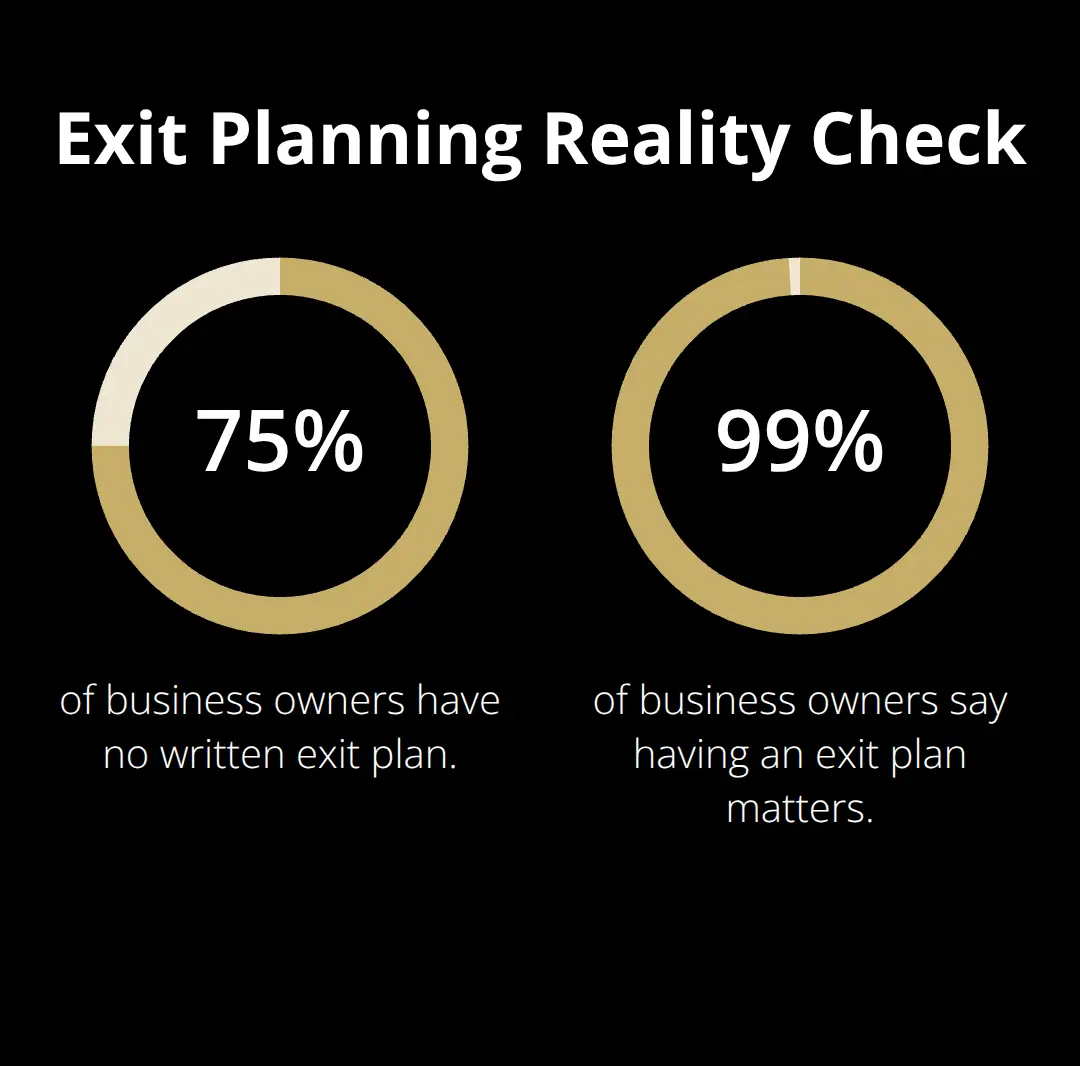
Most business owners operate without a formal exit strategy, and the numbers prove this is a critical mistake. According to the Exit Planning Institute, 75% of business owners have no written exit plan despite 99% acknowledging that having one matters. This gap between intention and action costs owners real money. A business that sells in a crisis or rushed situation typically fetches 40-50% less than one with proper planning.
A $10 million business might sell for $6-8 million under pressure versus $12-15 million when positioned correctly. The difference isn’t luck-it’s preparation.
The valuation impact of early planning
Planning ahead directly increases what your business is worth. Owners who adopt a structured value-creation timeline over 5-7 years typically increase enterprise value by 30-50% through operational improvements and risk reduction. This happens because buyers don’t just evaluate revenue; they assess sustainability. They want to see strong management depth, diversified customers, documented processes, and stable cash flow. When you build these elements intentionally, adjusted EBITDA improvements can multiply your sale price since buyers apply valuation multiples to earnings. An owner who spends two years strengthening these areas can realistically add millions to the final sale price. The Exit Planning Institute data shows that owners with formal exit plans rarely regret their exits, while 76% of those without planning deeply regret selling within a year.
Planning transforms stress into control
The moment you have a concrete exit plan, uncertainty disappears. You know your target valuation, understand what buyers want, and have a timeline to build toward it. This removes the reactive scrambling that happens when life forces a sudden exit-whether from health issues, family circumstances, or market shifts. Owners with written plans report significantly lower stress during transitions because they’ve already addressed legal compliance, tax optimization, and succession details. You’re not making decisions under pressure; you’re executing a plan built during calmer times. That sense of control matters more than most owners realize until they experience it.
What comes next in your exit journey
The foundation is clear: exit planning works. Now you need to understand the specific steps that transform your business into something buyers actively pursue. The next section walks you through the concrete actions that move you from where you are today toward a successful exit.
What Your Business Is Actually Worth
Start with a number. Before you can plan anything meaningful, you need to know what your business is actually worth in today’s market. Most owners guess. They assume their business is worth some multiple of revenue or base it on what a friend’s similar business sold for five years ago. This guesswork creates massive problems later. When you sit down with a serious buyer, they’ll have a professional valuation. If yours doesn’t match, you either walk away from a deal or accept far less than you should. 80% of business owners have the majority of their wealth tied up in their business, which means a flawed valuation doesn’t just affect your sale price-it wrecks your entire retirement plan. Get a credible baseline valuation now, not when you’re desperate to sell. This number becomes your anchor for everything that follows: your exit timeline, your financial goals, and your value-building priorities.
Understanding what buyers actually focus on
Buyers don’t pay for revenue. They pay for sustainable cash flow, which is why adjusted EBITDA matters far more than your top line. Remove the one-time expenses, the owner-specific costs, and the bloated line items that won’t exist under new ownership. A business that reports $2 million in profit but generates $2.8 million in adjusted EBITDA looks dramatically different to a buyer because that higher number reflects true earning power. The valuation multiple buyers apply multiplies against that adjusted EBITDA, so improving it by even 10-15% can add hundreds of thousands to your sale price. Spend the next 30 days auditing your last three years of financials. Identify every non-recurring expense, every owner benefit that a new owner won’t need, and every cost that inflates your true operating expenses. Document these adjustments clearly because buyers will scrutinize them, and transparent, well-supported adjustments strengthen your credibility.
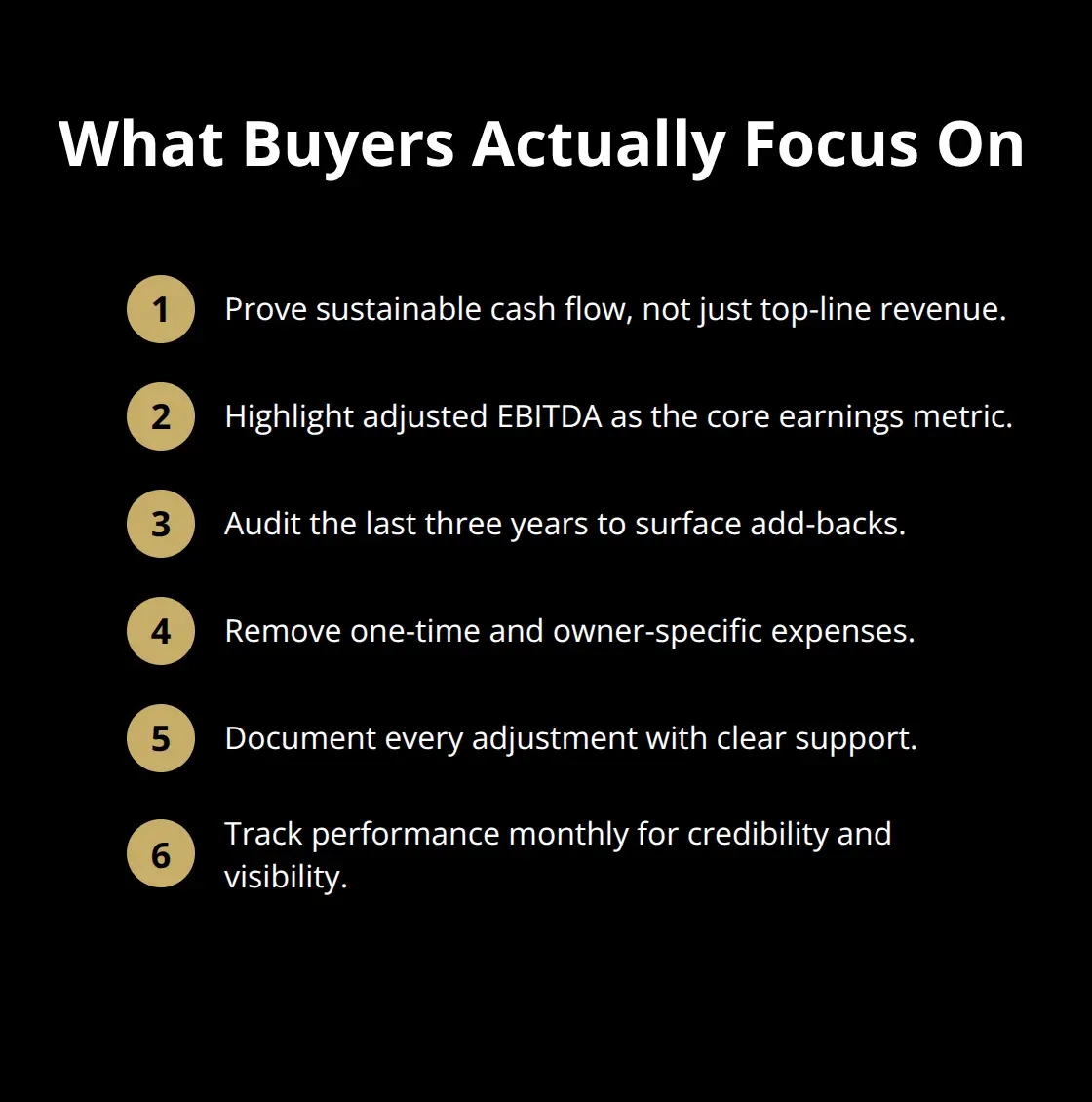
Track your financial performance monthly from this point forward, not just quarterly or annually. Monthly data reveals seasonal patterns, growth trends, and early warning signs that annual snapshots miss. This granular visibility also impresses buyers during due diligence because it shows operational discipline.
Building your timeline around market reality
Decide when you actually want to exit, then work backward. Owners who plan over 5-7 years increase enterprise value by 30-50%. That’s not arbitrary. It takes time to build the management depth, document the processes, diversify the customer base, and strengthen the financial metrics that command premium valuations. If you’re thinking three years out, that’s still viable, but you’ll need to prioritize ruthlessly. If you’re thinking one year out, you’re already behind. Market conditions matter too. Certain industries and business types command higher multiples during specific economic cycles. If you operate in a sector where valuations are currently elevated, that’s valuable information for your timeline. Conversely, if your industry faces headwinds, moving faster might make sense. Research recent sales in your space-not hypothetical benchmarks, but actual transactions. This gives you real data on what similar businesses sold for and how long their sales took. Strategic sales often take 6-18 months from serious buyer contact to closing, so factor that into your timeline.
Defining success beyond the sale price
Define what success looks like beyond just the sale price. Do you want to stay on for a transition period? Do you need a specific amount of cash at close, or are you comfortable with seller financing? Are you exiting to retire completely or to pursue something different? These goals shape which exit strategy makes sense and influence how you prepare your business. The answers to these questions determine whether you should pursue a strategic buyer, private equity firm, or internal successor. They also affect your negotiation priorities and the deal structure that works best for your situation. Once you understand your true business value and establish a realistic timeline, you’re ready to identify which exit path aligns with your goals and circumstances.
Getting Your Business Ready to Sell
Buyers do not purchase businesses as they exist today. They purchase what those businesses can become under new ownership. The difference between a business that sells quickly at premium valuation and one that languishes on the market comes down to preparation. Most owners underestimate how much work this takes, which is exactly why so many sales stall or close at disappointing prices. The next 6-12 months determine whether a buyer sees a professionally run operation or a collection of owner dependencies and operational chaos.
Remove Yourself from Daily Operations
Start by removing yourself from the daily operations. If the business cannot function without you making decisions, no serious buyer will pay full price. This means you must document every process, every decision-making framework, and every client relationship that currently lives only in your head. Reducing key person risk directly improves valuation multiples because buyers fear that revenue walks out the door when you do.
Audit your top 20 customers and identify which relationships depend entirely on you versus which are genuinely account-based. For the ones tied to you personally, start systematically transferring those relationships to other team members. Introduce your team members to these clients. Have them lead meetings. Handle the transition now while you control the timeline, not during due diligence when a buyer is evaluating whether the business is actually sellable.
Organize Financial Records for Buyer Scrutiny
Your financial records need to be audit-ready right now, not three months from now when you are in active negotiations. Gather three years of tax returns, monthly profit and loss statements, balance sheets, accounts receivable aging reports, and accounts payable aging reports. Organize them chronologically and verify consistency across documents. Buyers will scrutinize these numbers for red flags like sudden revenue drops, expense spikes, or accounting inconsistencies.
Any discrepancy between what you reported to the IRS and what you present to a buyer creates immediate credibility problems. If your financial records are messy, hire a bookkeeper or accountant to clean them up before you approach potential buyers. This investment pays for itself through faster due diligence and better sale terms. Track your financial performance monthly from this point forward, not just quarterly or annually. Monthly data reveals seasonal patterns, growth trends, and early warning signs that annual snapshots miss.
Address Legal and Compliance Gaps
Legal and compliance gaps can kill deals. Conduct a comprehensive audit: Do you have all required licenses and permits? Are contracts with major customers current and enforceable? Do you have proper intellectual property documentation for any proprietary processes, software, or branding? Are employment agreements documented? Do you have non-compete agreements where they matter? Are there pending lawsuits, regulatory complaints, or compliance violations in your files?
Buyers will discover these issues anyway during due diligence, so find them first and address them proactively. Unresolved compliance issues do not just reduce valuation; they can kill a deal entirely if a buyer’s legal team determines the risk is too high. Resolve these problems now while you control the process and timeline.
Strengthen Your Management Team
Your management team becomes the face of continuity for any buyer. If you are the only person who understands operations, pricing, or customer strategy, that is a massive red flag. Strengthen your leadership bench by identifying 2-3 key people who could step into critical roles if you disappeared tomorrow. Invest in their development now. Give them expanded responsibilities. Send them to relevant training. Document the decisions they make and the reasoning behind them.
When a buyer evaluates your management team, they assess whether the business can scale without you. A strong second layer of management commands premium valuations because it reduces execution risk. This depth of talent signals that your business runs on systems and people, not on you alone.
Market Your Business to Qualified Buyers
Market your business to the right audience using channels that actually reach serious buyers. Generic business listing sites attract tire-kickers and low-ball offers. Instead, target strategic buyers and private equity firms who operate in your space and have capital ready to deploy. Industry publications, trade shows, and professional networks often connect you with qualified buyers faster than broad-market approaches.
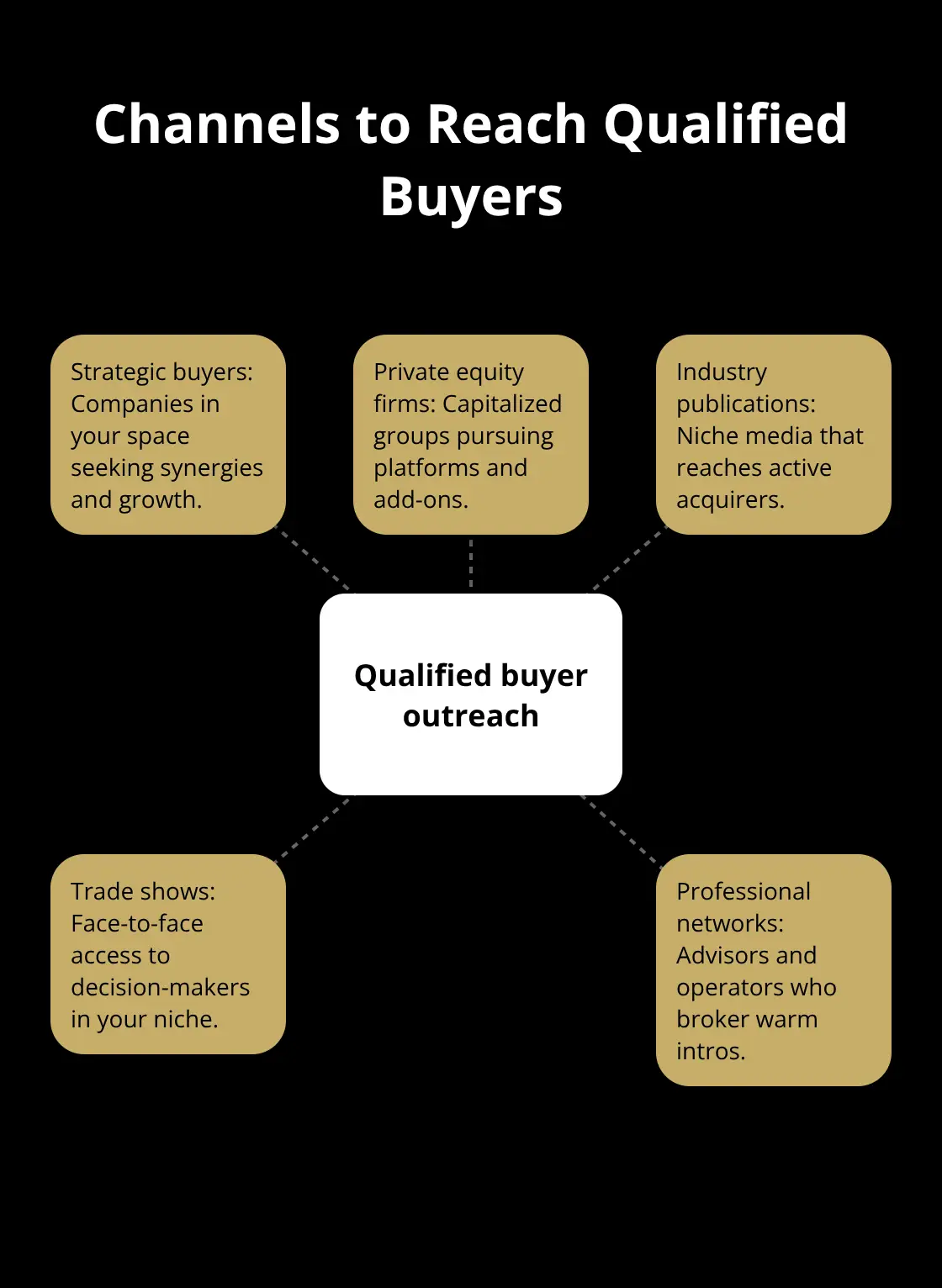
If you sell a professional services firm, your market is other firms seeking to expand their service offerings or geographic reach. If you sell a manufacturing business, your market is competitors seeking capacity, private equity firms seeking platform acquisitions, or strategic buyers in adjacent industries. Tailor your marketing message to what each buyer type actually cares about: operational efficiency, customer retention, growth potential, or market position.
Final Thoughts
Exit planning steps don’t end when you understand your business value or prepare your operations for sale. They continue through execution, adjustment, and professional guidance. The owners who succeed aren’t those with perfect plans-they’re the ones who start now, measure progress regularly, and adapt as circumstances change. Your immediate priority is getting a credible baseline valuation and establishing a realistic timeline, then focus on the operational improvements that compound over time: removing yourself from daily decisions, strengthening your management team, and organizing your financial records.
Choosing your exit strategy early shapes every decision that follows. Whether you target a strategic buyer, private equity firm, or internal successor determines what matters most during preparation, and understanding your target buyer lets you prioritize your efforts effectively. Different buyers value different things, so clarity on your exit path prevents wasted work on the wrong priorities.
Don’t navigate this alone-exit planning involves tax strategy, legal structure, valuation methodology, and negotiation tactics that require professional expertise. We at Unbroker built a platform specifically designed to support business owners through this process with transparent pricing and expert guidance, offering flexible options based on how hands-on you want to be, with access to a vast buyer network and premium marketing tools. Explore how Unbroker can support your exit without the high fees that traditional brokers charge.