Most business owners think they’re ready to sell when revenue looks good. But true exit readiness involves far more than healthy financials.
We at Unbroker see countless entrepreneurs rush to market without proper preparation, only to face disappointing valuations or failed deals. The difference between a successful exit and a costly mistake often comes down to systematic preparation across three critical areas.
What Makes Your Financials Buyer-Ready?
Your financial records serve as the foundation for any serious buyer evaluation, and subpar documentation kills deals before they start. Business succession faces significant challenges, with inadequate planning being a primary cause of failure. Buyers demand three years of reviewed or audited financial statements, not basic records that your cousin’s firm compiles.
Professional Financial Documentation Standards
Smart sellers engage CPAs to restate their financials according to GAAP compliance at least 18 months before they list. This process typically costs $15,000 to $30,000 but prevents last-minute buyer objections that can torpedo negotiations. Your financial statements must clearly separate owner compensation, personal expenses, and one-time costs to show true business profitability. Buyers scrutinize every line item during quality of earnings analysis, so eliminate any questionable entries now rather than explain them later under pressure.
Revenue Consistency Drives Valuation Multiples
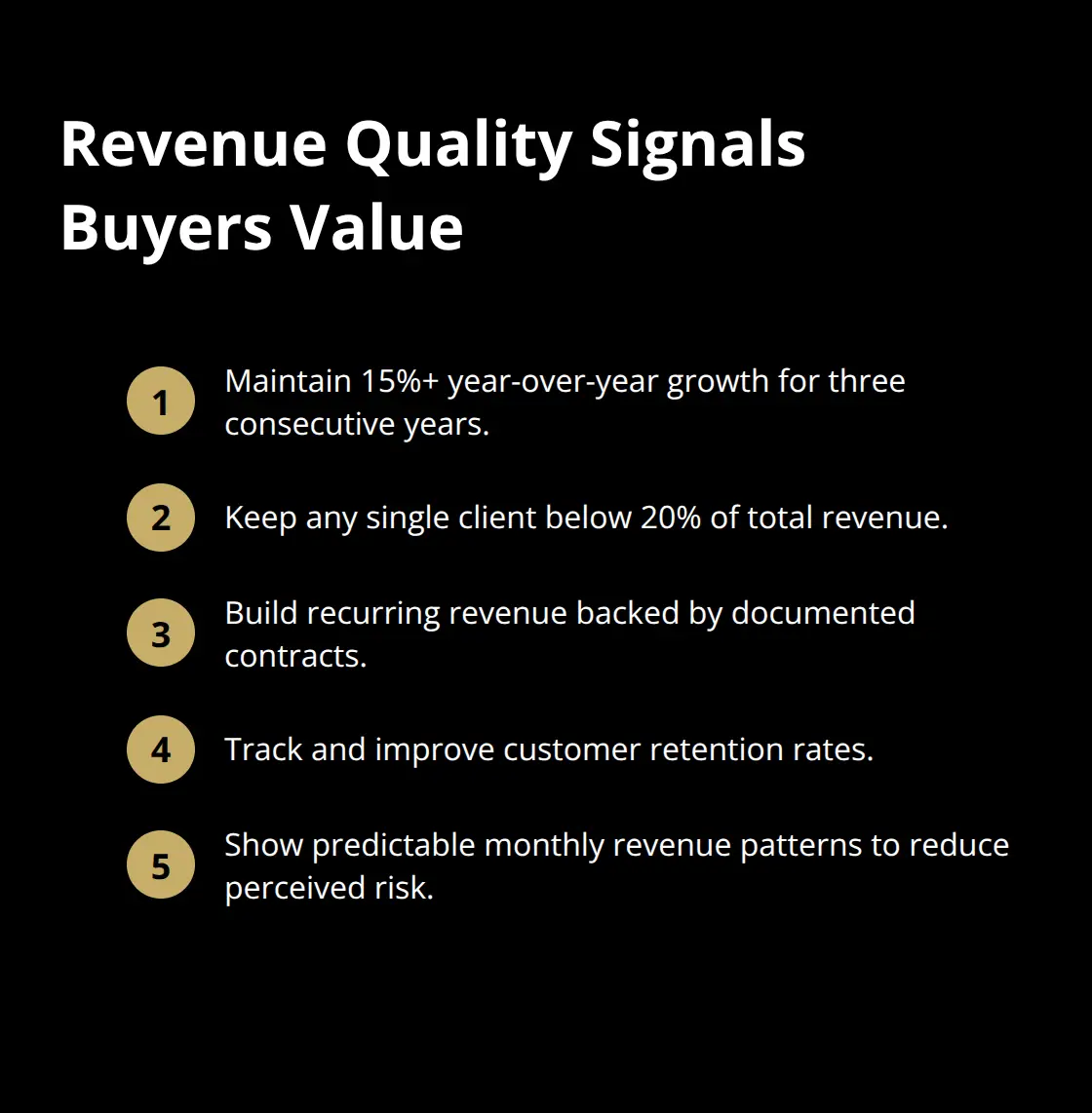
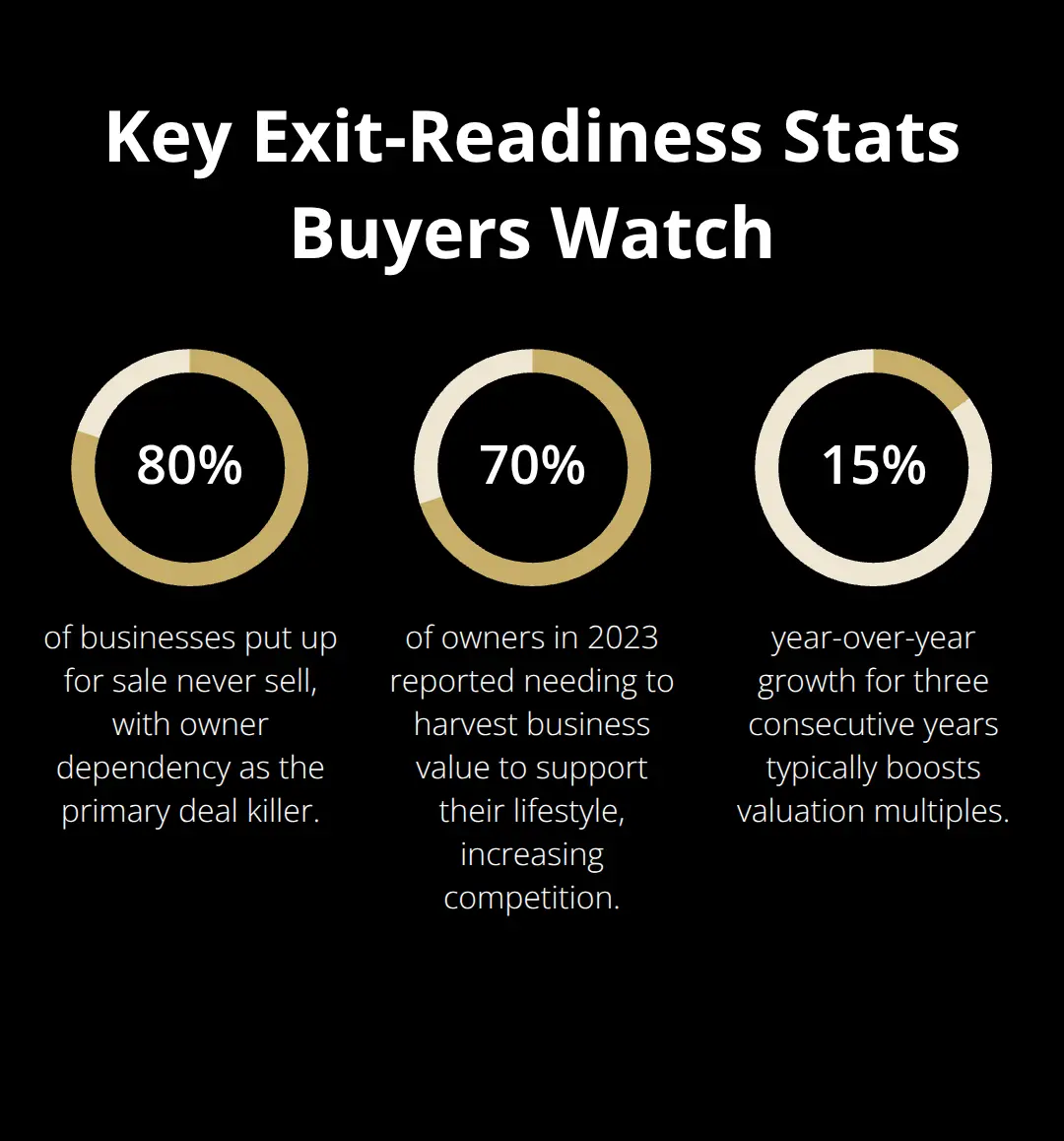
Consistent monthly revenue streams command premium valuations compared to volatile income patterns. Businesses that show 15% or greater year-over-year growth for three consecutive years typically receive higher EBITDA multiples from strategic buyers. Track your customer concentration risk carefully – if any single client represents more than 20% of revenue, buyers will demand significant purchase price reductions to account for this dependency (which can reduce your final sale price by 10-30%). Document revenue sources that recur, contract terms, and customer retention rates to demonstrate predictable cash flow that survives ownership transition.
Cash Flow Analysis Reveals True Business Health
Positive cash flow from operations for 36 consecutive months proves your business creates real money, not just paper profits. Buyers focus intensely on capital requirements, inventory turnover rates, and seasonal cash flow patterns during due diligence. Calculate your cash conversion cycle and compare it to industry benchmarks – shorter cycles indicate efficient operations that require less buyer capital investment post-acquisition.
Strong financial foundations set the stage for operational readiness, but buyers also evaluate how well your business functions without your constant presence.
Can Your Business Run Without You?
Your business must operate seamlessly without your daily involvement to attract serious buyers. The Exit Planning Institute reports that 80% of businesses put up for sale never sell, with owner dependency as the primary deal killer. Buyers pay premium prices for businesses that demonstrate management independence and systematic operations. Companies that require constant owner oversight receive valuation discounts of 20% to 40% because buyers recognize the operational risk. Document every process from customer onboarding to inventory management in detailed standard operating procedures. Your operations manual should enable a new manager to run daily activities within 30 days without your guidance.
Management Team Strength Determines Sale Success
Strong second-in-command leadership directly correlates with higher sale prices and faster transaction timelines. Businesses with experienced management teams that have operated independently command higher EBITDA multiples from strategic acquirers. Create a succession plan by promoting or hiring a general manager two years before your planned exit date, then step back from day-to-day decisions to test their capabilities. Track key performance indicators under their leadership to demonstrate consistent results without owner involvement. Companies that lack management depth face extended sale periods and reduced buyer interest because transition risk increases substantially.
Systems Documentation Reduces Buyer Risk
Comprehensive process documentation eliminates buyer concerns about operational continuity after ownership transfer. Create detailed workflows for every department, from sales processes to quality control procedures. Include vendor relationships, supplier contracts, and customer service protocols in your documentation package.
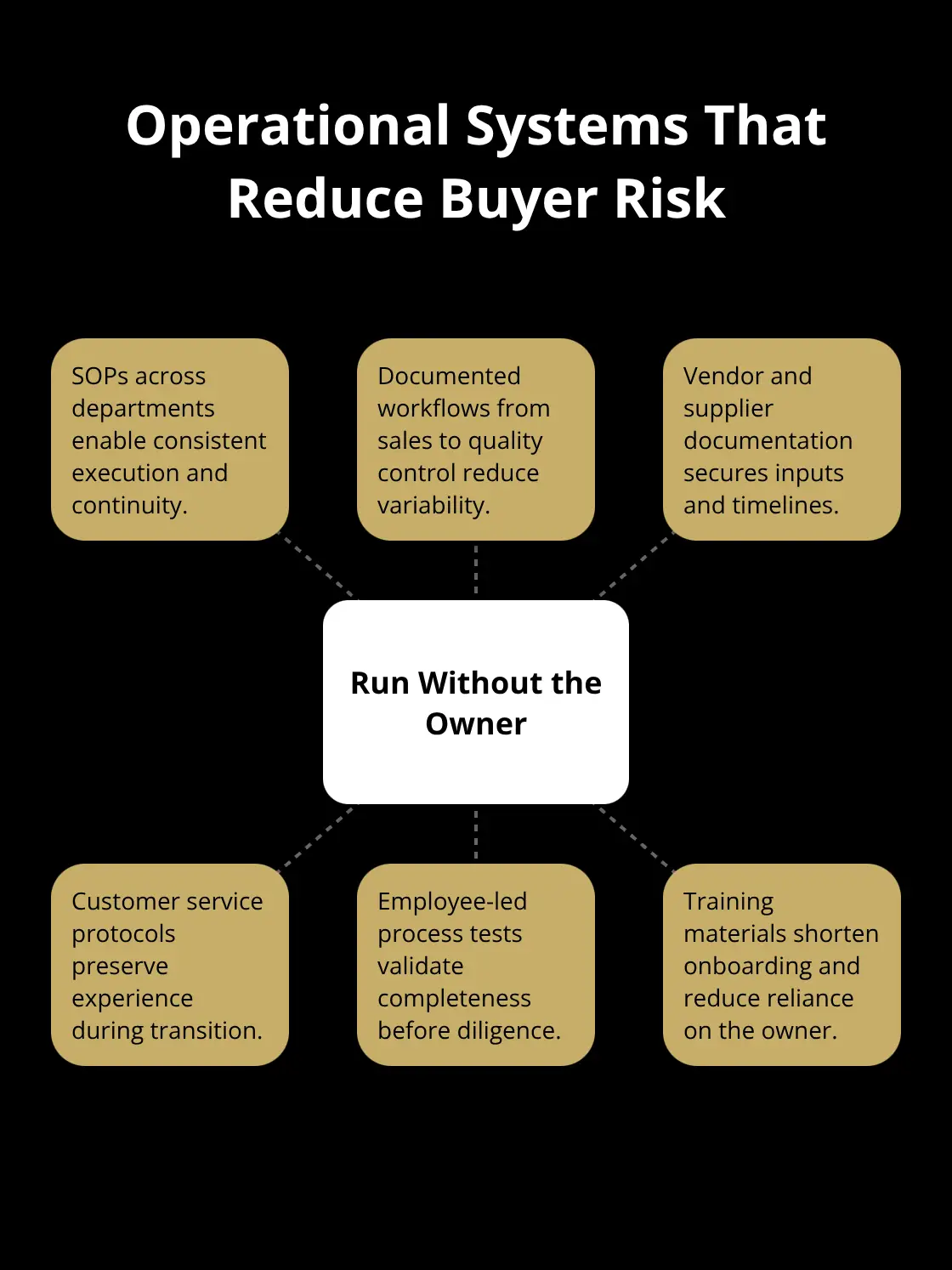
Buyers want a business that can run smoothly without the current owner’s involvement. Test your documented processes by having employees follow written procedures without additional verbal instruction to identify gaps before buyers discover them.
Legal Compliance Creates Buyer Confidence
Comprehensive legal compliance audits prevent deal-breaking discoveries during buyer due diligence processes. Environmental laws and regulations significantly impact business transactions, from due diligence to valuation to long-term operational costs. Retain specialized attorneys to review contracts, licensing agreements, and regulatory compliance status at least 18 months before you list your business. Address any outstanding litigation, resolve permit issues, and update employment agreements to current standards. Clean legal standing reduces buyer concerns and accelerates closing timelines while protecting your negotiated purchase price from last-minute reductions.
Your operational independence sets the foundation for the next critical evaluation: how market conditions and industry trends affect your sale timing and valuation potential.
Is Market Timing Working Against Your Sale?
Market conditions directly impact your sale price and transaction speed, which makes timing analysis essential for exit value maximization. The Exit Planning Institute found that 70% of owners in 2023 indicated they needed to harvest the value of their business to support their lifestyle, which creates unprecedented market competition for buyer attention. Industries that experience consolidation trends typically see higher EBITDA multiples as strategic buyers compete for market share, while fragmented sectors often result in lower valuations due to limited buyer interest. Software and technology businesses currently command 8-12x EBITDA multiples, compared to traditional manufacturing at 3-5x multiples, according to recent market data. Track your industry’s merger and acquisition activity for the past 18 months to identify peak periods when buyer demand drives premium prices.
Competitive Position Determines Strategic Value
Your competitive advantages directly translate into higher purchase prices when you position them correctly against market alternatives. Businesses with proprietary technology, exclusive supplier relationships, or regulatory moats receive strategic premiums above financial buyer offers. Document your competitive differentiators with concrete metrics like customer acquisition costs that run 30% below industry averages or patent portfolios that create market barriers. Strategic buyers pay premium prices for businesses that strengthen their market position or eliminate competitive threats. Analyze recent acquisitions in your sector to understand what strategic value buyers prioritize, then highlight how your business delivers those specific advantages.
Growth Trajectory Validates Future Potential
Consistent growth patterns over 36 months prove your business model scales effectively beyond current performance levels. Forward-looking financial projections based on contracted revenue, pipeline analysis, and market expansion opportunities convince buyers of continued value creation post-acquisition. Companies that show consistent annual growth rates typically receive higher multiples because buyers anticipate accelerated returns through their additional resources and market access (which often includes expanded distribution channels and operational expertise). Calculate your total addressable market size and demonstrate how your business captures market share through documented competitive wins and customer expansion. Strong growth trajectories reduce buyer risk perception and justify premium valuations that reflect future potential rather than historical performance alone.
Industry Trends Shape Buyer Appetite
Current industry dynamics determine which business models attract premium valuations and which face buyer skepticism. Healthcare technology and cybersecurity sectors see intense buyer competition due to regulatory tailwinds and market expansion opportunities. Traditional retail and hospitality businesses face valuation pressure as buyers worry about digital disruption and consumer behavior shifts.
Monitor industry publications and acquisition announcements to understand which business characteristics buyers value most in your sector. Position your company’s strengths to align with these buyer priorities rather than generic business metrics that fail to resonate with sector-specific acquirers.
Final Thoughts
Your business achieves true exit readiness when financial documentation meets professional standards, operations function independently, and market conditions align with buyer demand. Three years of GAAP-compliant financials, management teams that operate without owner involvement, and documented systems create the foundation for premium valuations. Red flags that derail sales include owner dependency that exceeds 40% of daily operations, customer concentration above 20% of revenue, and financial records that require extensive explanations during due diligence.
Legal compliance issues and undocumented processes trigger buyer concerns that reduce offers or extend transaction timelines significantly. Start preparation 24 months before your intended sale date through CPA engagement for financial restatement, second-in-command leadership promotion, and operational procedure documentation. Professional business valuations every 18 months track your progress and identify improvement opportunities that maximize sale price.
We at Unbroker understand that traditional brokerage fees consume substantial portions of your sale proceeds (often 6-10% of the total transaction value). Our modern platform eliminates high commission structures through transparent pricing that preserves more of your exit value while providing professional support throughout the entire process. This approach allows business owners to retain maximum proceeds from their most important financial transaction.