Selling your business is one of the biggest financial decisions you’ll make. At Unbroker, we’ve helped countless business owners navigate this process and walk away with real profits.
Understanding exit strategy basics means knowing your options before you sit down at the negotiating table. This guide walks you through planning, evaluating your choices, and maximizing what your business is actually worth.
Getting Your Exit Plan Right From Day One
The biggest mistake we see is owners waiting until they’re ready to sell before thinking about their exit. That’s backwards. Your exit strategy shapes decisions you make today-how you structure your finances, build your team, and position your business for growth. Getting Your Exit Plan Right From Day One suggests starting three to five years before you want to leave. This timeframe lets you clean up financial records, develop leadership depth, and position your company in ways that matter to buyers. According to the Exit Planning Institute, only about 30 percent of family successions succeed, and a primary reason is lack of preparation time.

The owners who walk away with the highest payouts aren’t the ones who rush; they’re the ones who planned ahead.
Know Your Numbers Before Anyone Else Does
Get an external valuation done early-ideally more than one. Don’t rely on gut feel or what you think your business is worth. Buyers will bring their own valuations, and if you haven’t done your homework, you’ll negotiate from a weak position. Valuations typically cost between $2,000 and $10,000 depending on business complexity, but this investment pays for itself many times over. When you understand your actual valuation, you can set realistic financial targets for the exit. Ask yourself: What’s the minimum you need to walk away? What would make this worth your time and effort? What happens to your post-exit lifestyle if you get 20 percent less than your target? These questions force clarity. Your business valuation depends on profitability, cash flow, growth trajectory, customer concentration, and operational efficiency. If your business depends heavily on you-meaning it can’t run without your day-to-day involvement-buyers will discount the price significantly. That’s why you should build a leadership team years before you exit, not months before.
Identify Who Actually Wants to Buy
Different buyers have different priorities, and this shapes your entire strategy. A strategic buyer (a competitor or company in your industry) typically pays the highest headline price because they see synergies and cost savings. A financial buyer like a private equity firm focuses on cash flow and growth potential and may pay less upfront but structure deals with earn-outs that let you benefit from future performance. An internal buyer like your management team or a key employee offers cultural continuity but likely has less buying power and may need seller financing to make the deal work. Start mapping potential buyers now. Who operates in adjacent markets? Who has mentioned acquisition interest? Which competitors are actively buying? Which private equity firms focus on your industry? Build relationships before you need to sell. When you’re ready, you’ll have warm contacts instead of cold calls. The market for your business exists whether you’re looking or not-smart owners start conversations early to understand buyer appetite and pricing expectations.
Position Your Business for Maximum Appeal
Buyers evaluate far more than just revenue numbers. They assess whether your business can operate without you at the helm. A company that depends entirely on the founder’s relationships or expertise becomes riskier and less valuable in a buyer’s eyes. Develop systems, document processes, and empower your team to make decisions independently. Clean financial records matter enormously during due diligence. Buyers scrutinize tax returns, profit-and-loss statements, and cash flow documentation going back several years. If your records are messy or inconsistent, you’ll face delays, skepticism, and lower offers. Organize everything now. Customer concentration also affects valuation significantly. If one or two customers represent 50 percent of your revenue, buyers see vulnerability. Work to diversify your customer base and reduce dependency on any single account. The stronger your operational foundation, the higher the price buyers will offer and the faster the sale will close.
Your Exit Options and Which One Fits Your Business
Strategic Buyers Pay Top Dollar-With Trade-Offs
Strategic buyers and competitors typically offer the highest headline prices because they see immediate synergies in your customer base, operations, or market position. A competitor acquiring your business can eliminate redundant departments, cross-sell to your customers, or expand into your geographic territory. These deals often close at multiples 20 to 40 percent higher than financial buyers offer, according to research on M&A outcomes. The downside is cultural disruption. Your team faces restructuring, your brand might disappear into theirs, and the process takes six to nine months of intensive due diligence. If you care about legacy or your employees’ futures, a strategic buyer may not align with your values.
Financial Buyers Offer Flexibility Through Earn-Outs
Financial buyers like private equity firms take a different approach. They care about cash flow, growth runway, and operational efficiency. They typically pay less upfront but structure deals with earn-outs, meaning you stay involved post-sale and earn additional money if the business hits performance targets over two to three years. This keeps you financially invested but also ties you to the business longer than you might want. Private equity buyers often replace leadership quickly and focus on profit margins over culture, so expect operational changes.
Management Buyouts and ESOPs Preserve Your Company’s Identity
Management buyouts and employee stock ownership plans offer a middle path that preserves your company’s identity while transferring ownership to people who already understand the business. A management buyout happens when your existing leadership team purchases the company, usually with seller financing where you accept payments over time instead of a lump sum. This works well if you trust your management team and want to stay involved as an advisor. The risk is that your management team may lack the upfront capital to close the deal, so you carry financing risk.
Employee stock ownership plans, or ESOPs, let your entire workforce own a stake in the company. According to the National Center for Employee Ownership, ESOP companies were 3 to 4 times more likely to retain staff and less likely to make pay cuts. An ESOP also offers potential tax advantages if certain conditions are met, including possible capital gains tax deferral for qualifying shareholders. The complexity here is administrative and legal. Setting up an ESOP requires specialized attorneys and valuators, costing $15,000 to $50,000 depending on company size.
Formal M&A Processes Drive Competitive Bidding
Mergers and acquisitions as a formal process differ from a simple sale. An M&A process involves hiring an investment banker or advisor to run an auction where multiple buyers submit offers simultaneously. This competitive dynamic typically drives prices higher because buyers know they’re competing. A professional M&A process also handles all the negotiation complexity, legal documentation, and due diligence coordination for you. The cost runs 5 to 10 percent of the deal value, which is substantial but often worth it if you’re selling a company worth $5 million or more. For smaller businesses under $2 million in revenue, the M&A overhead eats too much of the proceeds. At that size, a direct sale to a strategic buyer or management team makes more sense financially.
Match Your Exit Path to Your Priorities
The real decision comes down to timing, control, and your post-exit involvement. Want maximum cash now and no ongoing role? A strategic buyer or formal M&A auction works. Want to stay involved and earn ongoing income? A management buyout with seller financing or an earn-out structure fits better.
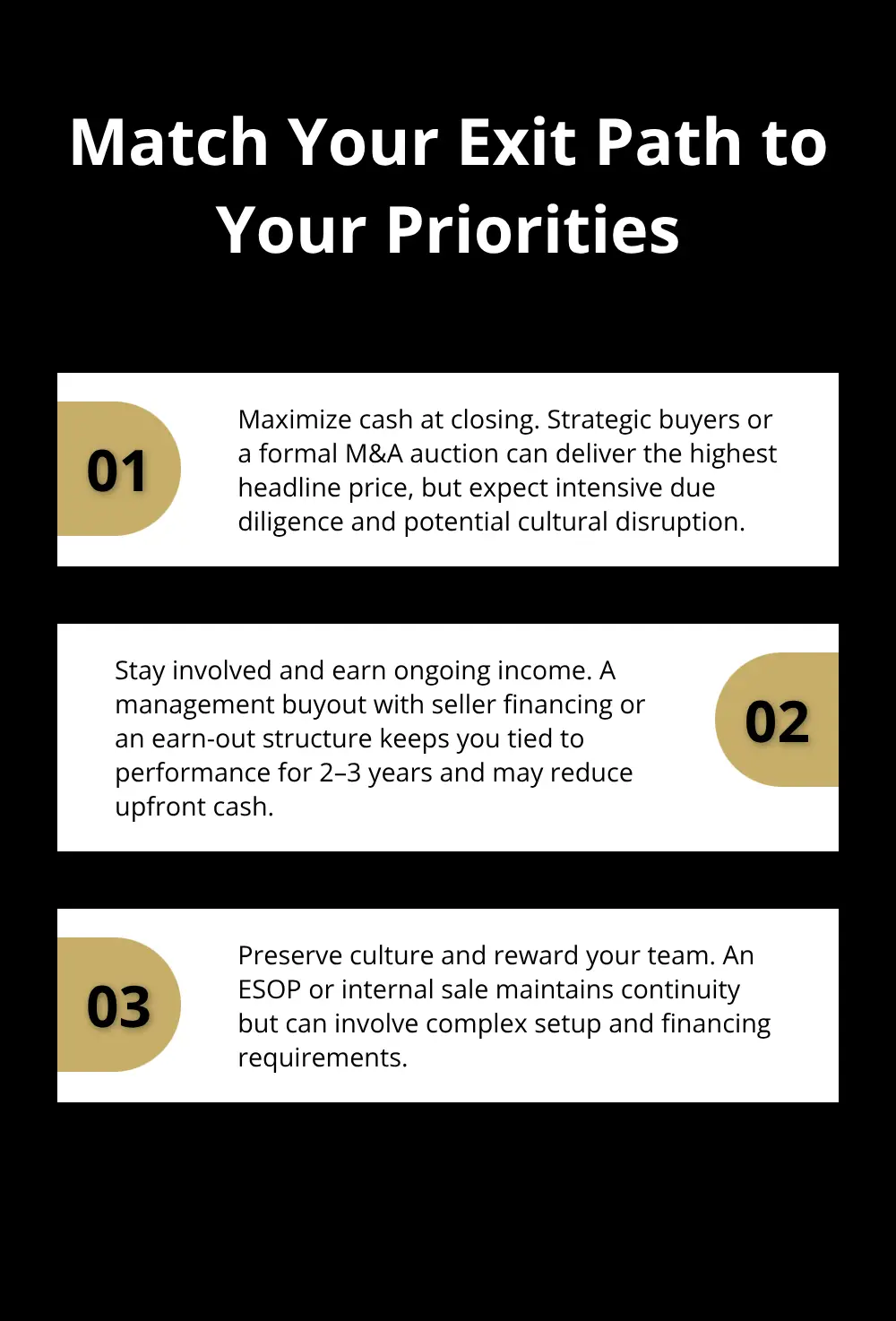
Want to reward your team and preserve culture? An ESOP or internal sale aligns with that priority. Your choice depends on what matters most to you after the sale closes-and understanding these trade-offs helps you move forward with confidence as you prepare your business for the market.
Turning Buyer Interest Into Maximum Proceeds
Organize Your Records Before Buyers Ask
Due diligence accelerates or stalls based on how well you’ve prepared your documentation. Buyers request financial statements, tax returns, customer contracts, employee records, and operational documentation spanning three to five years. Most owners underestimate the volume and specificity of what buyers demand.
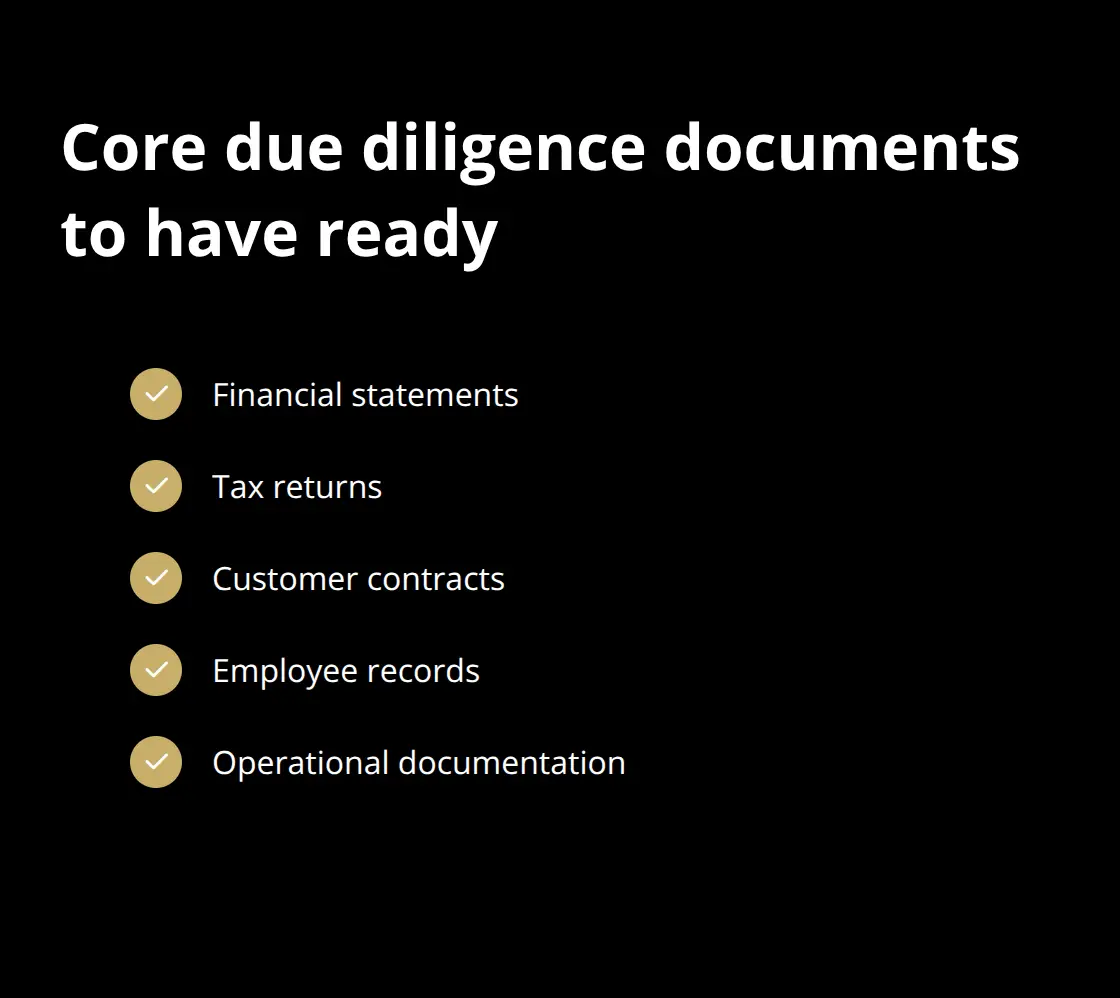
Start organizing this material now, not when an offer arrives.
Create a data room-a secure, organized digital space where all documents live in logical folders. Buyers expect to access information quickly and find what they need without asking repeatedly. If your records scatter across email, filing cabinets, and someone’s personal hard drive, you signal disorganization and hide risk. During due diligence, buyers scrutinize your revenue recognition practices, customer acquisition costs, and customer lifetime value. They examine employee agreements, non-competes, and any pending litigation. They verify that your intellectual property is properly documented and that you own everything you claim to own.
Eliminate Red Flags in Your Documentation
Gaps or inconsistencies in your records become negotiation leverage against you. One common mistake is overstating customer relationships. If a customer agreement says they can leave with 30 days notice, that’s what buyers count on-not your assumption that they’ll stay forever. Clean up these details before the sale process begins.
Document your processes and systems so buyers understand that your business doesn’t depend entirely on you personally. Documented procedures, standardized operations, and scalable systems demonstrate business maturity to potential acquirers. Prepare a detailed operations manual covering sales processes, customer onboarding, financial controls, and key vendor relationships. This directly impacts what buyers will pay.
Leverage Multiple Offers to Strengthen Your Position
Once you have multiple offers, your negotiating position strengthens dramatically. Never accept the first offer or negotiate with a single buyer. In an M&A sale, competitive bidding means presenting your business to a curated list of qualified buyers and asking them to submit offers. If you’re selling a company worth $3 million and multiple buyers compete, that difference represents $450,000 to $750,000 in additional proceeds.
Compare not just headline price but deal structure. A $5 million all-cash offer at closing differs fundamentally from a $5 million offer with $2 million in earn-outs spread over three years. Earn-outs depend on future performance you may not control after you leave. Calculate the present value of deferred payments and understand the earn-out conditions carefully-what metrics trigger payment? What happens if the buyer misses targets or changes strategy?
Watch Purchase Price Adjustments Closely
Buyers often negotiate working capital targets, inventory adjustments, and debt assumptions that reduce your final payout. Every dollar of working capital they claim reduces what hits your bank account. Get your accountant to model these adjustments before negotiations start so you know what bottom-line proceeds you’ll actually receive.
Transparent pricing models work in your favor. If you clearly document your cost structure and profit margins, you eliminate buyer uncertainty and reduce their discount for unknown risks. Vague or complicated pricing creates doubt, and doubt costs money. The clearer your financial story, the higher the valuation buyers will offer.
Final Thoughts
Exit strategy basics come down to three core principles: plan years ahead, understand your options, and execute with precision. The owners who walk away with the highest proceeds aren’t the ones who rush into a sale-they’re the ones who spent time building operational strength, organizing their finances, and mapping potential buyers before the process began. Some owners combine strategies over time, taking multiple bites of the apple to increase optionality and value, whether through a recapitalization that brings growth capital while they stay involved, or a partial sale that retains a minority stake generating ongoing income.
After your business sale closes, your focus shifts to integration and transition. If you’ve structured an earn-out or seller financing arrangement, you remain connected to the business through performance metrics or payment schedules; if you’ve sold completely, your role becomes advisory at most. Communicate clearly with your team about what comes next, because uncertainty breeds anxiety, and anxiety costs you in employee retention and operational continuity during the handoff period.
Professional advisors including accountants, M&A attorneys, and investment bankers guide you through tax implications, legal documentation, and negotiation strategy. At Unbroker, we’ve built a platform specifically designed to simplify the selling process with transparent pricing, access to a vast buyer network, and expert support whether you want hands-off assistance or DIY guidance-our modern approach eliminates high brokerage fees and gives you control over your exit timeline and terms.