Business valuation isn’t one-size-fits-all. The method you choose depends on your business type, stage, and what you’re trying to accomplish.
At Unbroker, we’ve seen founders and business owners struggle with common business valuation methods because they don’t understand which approach fits their situation. This guide breaks down the three main strategies-asset-based, income-based, and market-based-so you can pick the right one for your needs.
Asset-Based Valuation Methods
Tangible Assets and Their Role in Business Value
Asset-based valuation starts with a straightforward principle: add up what the business owns, subtract what it owes, and you’ve got a baseline value. The problem is that most founders stop there and think they’re done. Tangible assets like equipment, inventory, furniture, and real estate form the foundation of this calculation, but their actual value depends entirely on market conditions and what a buyer would realistically pay for them. A piece of manufacturing equipment might be worth far less on the resale market than its original purchase price suggests.
According to BizBuySell’s data covering private business sales from Q1 2021 through Q4 2025, median sale prices across all industries hit $337,750, with the largest segment of deals falling between $50,000 and $2,000,000. This range shows that most small businesses selling today rely heavily on what they actually earn rather than just their physical assets. When you’re valuing a business with owned real estate, separate the operating business value from the property value using an income approach for the real estate portion. If you own a supermarket with rental spaces for other tenants, calculate the cash flow from the core business independently from the rental income those spaces generate. This separation matters because buyers often finance the property and the business differently, and it gives you much clearer negotiating power.
Intangible Assets and Brand Equity
Intangible assets and brand equity represent where most small-business owners leave money on the table. Your customer list, brand reputation, software systems, licenses, and supplier relationships often represent 70 to 80 percent of what makes your business valuable, yet they rarely appear on a balance sheet. If your business has recurring revenue, strong customer retention, or a recognizable brand in your market, that’s worth real money in a sale.
The challenge is quantifying it without making up numbers. Start with normalizing your earnings first-remove owner-specific expenses, non-recurring costs, and discretionary spending that a new owner wouldn’t maintain. This adjusted earnings figure, often called Seller’s Discretionary Earnings (SDE), is what actually matters to buyers and what you should use to calculate value. Across sectors, average earnings multiples hover around 2.5x, but they vary dramatically by industry. Assisted Living facilities command multiples around 4.30, while restaurants typically sit at 2.15 to 3.34 depending on the sub-sector. Tech-related businesses like Software & Apps reach 3.28, and Websites & Ecommerce hit 3.43. These higher multiples reflect market expectations about recurring revenue and scalability.
Adjustments for Liabilities and Market Conditions
Interest rate environments affect asset valuation, along with local economic trends and supply chain stability. Don’t just subtract outstanding debt from your asset total-liabilities interact with market conditions in complex ways. A business with favorable lease terms or long-term customer contracts has lower risk and commands higher multiples. Gather three to five years of financial statements to identify revenue trends, margin stability, and cash flow consistency. This historical data lets you project forward with credibility and shows buyers you understand your own business performance.
The next step moves beyond what your business owns and owes. Income-based valuation methods focus on what your business actually generates in cash flow and earnings-the metrics that drive most purchase decisions in today’s market.
Income-Based Valuation Methods
Income-based valuation flips the asset conversation entirely. Instead of asking what the business owns, it asks what the business generates in cash. This is where most buyers actually focus their attention, and it remains the most reliable way to price a small business. The core principle is straightforward: earnings drive value, not square footage or inventory counts. When you normalize earnings by removing owner-specific expenses and one-time costs, you uncover a true picture of what a buyer would actually take home.
Earnings Multiples and What They Reveal
Seller’s Discretionary Earnings (SDE) forms the foundation for every serious valuation conversation. Earnings multiples across industries average around 2.57x, though this varies significantly by sector. Assisted Living facilities trade at 4.30x earnings, while Websites & Ecommerce hit 3.43x. Car Washes command 4.99x, and Tech-related Software & Apps reach 3.28x. These numbers reflect what actual buyers paid for actual businesses in recent years.
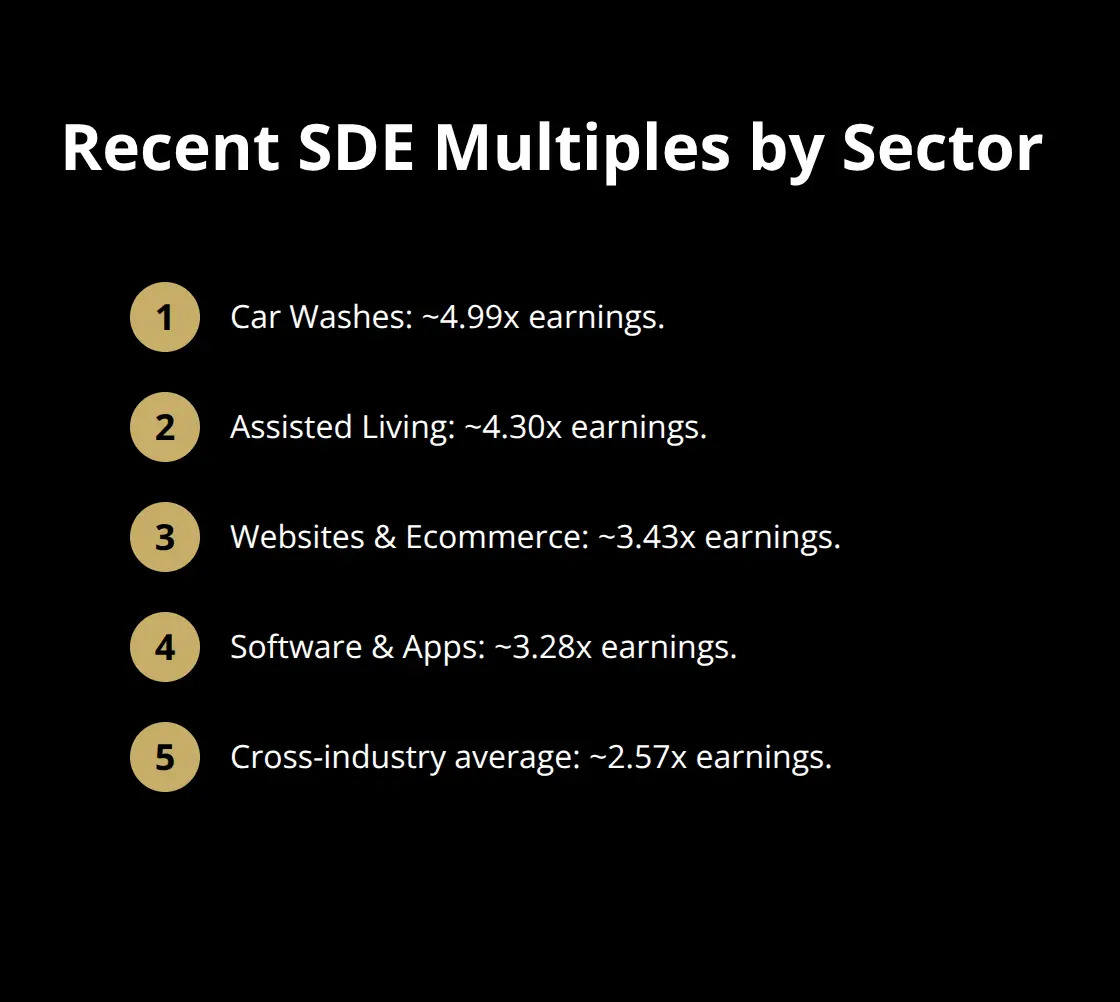
The market speaks clearly: recurring revenue, scalability, and low customer acquisition costs justify higher multiples. If your business has strong cash flow predictability and recurring customers, you sit at the upper end of your industry range. If you depend on one-time sales or volatile margins, expect lower multiples. The difference between a 2.0x multiple and a 3.5x multiple on $200,000 in earnings equals $300,000 in valuation-a gap that matters enormously when you’re selling.
Discounted Cash Flow Analysis
Discounted Cash Flow analysis takes earnings projections several steps further by calculating what future cash flows are worth in today’s dollars. Project your earnings forward three to five years based on realistic growth assumptions, then discount those future amounts back using a discount rate that reflects your cost of capital and risk profile. Higher-risk businesses need higher discount rates, which lowers present value. This method works particularly well for businesses with clear growth trajectories or those undergoing strategic improvements.
The discount rate itself carries enormous weight in the calculation. A business with stable, predictable cash flows might warrant a 10% discount rate, while a volatile startup could require 25% or higher. That difference alone can swing your valuation by millions. The formula treats future earnings as a stream of value that compounds backward to today, accounting for the time value of money and the risk you take by waiting for those future dollars.
Revenue-Based Valuation for Early-Stage Businesses
For early-stage businesses without significant earnings history, revenue-based valuation offers a practical alternative, though it remains less reliable than earnings-based methods. Revenue multiples range from 0.42 to 1.2 across industries, but this masks huge variation. Restaurants hover near 0.39x to 0.57x while tech platforms can hit 1.2x or higher. The truth is that revenue multiples work best when you compare genuinely similar businesses.
A SaaS company with 80% gross margins and 90% customer retention deserves a revenue multiple five times higher than a service business with 40% margins and constant churn. Revenue alone tells you nothing about profitability or sustainability. Gather three to five years of audited or reviewed financial statements, normalize earnings consistently across all years, and apply multiples based on businesses that actually sold in your sector. This data-driven approach beats guesswork every time.
The final piece of the valuation puzzle looks outward rather than inward-to what comparable businesses actually sold for in your market and industry.
Market-Based Valuation Methods
Comparable Company Analysis
Market-based valuation cuts through theory by anchoring your price to what real buyers paid for real businesses recently. This method works best when you find genuinely comparable sales in your industry and geography, then adjust for meaningful differences between those deals and yours. The BizBuySell dataset covering Q1 2021 through Q4 2025 shows that 80 percent of private business sales fall between $50,000 and $2,000,000, with median prices climbing from $337,750 to $375,000 by late 2025. These aren’t hypothetical numbers-they represent thousands of actual transactions where buyers and sellers agreed on price.
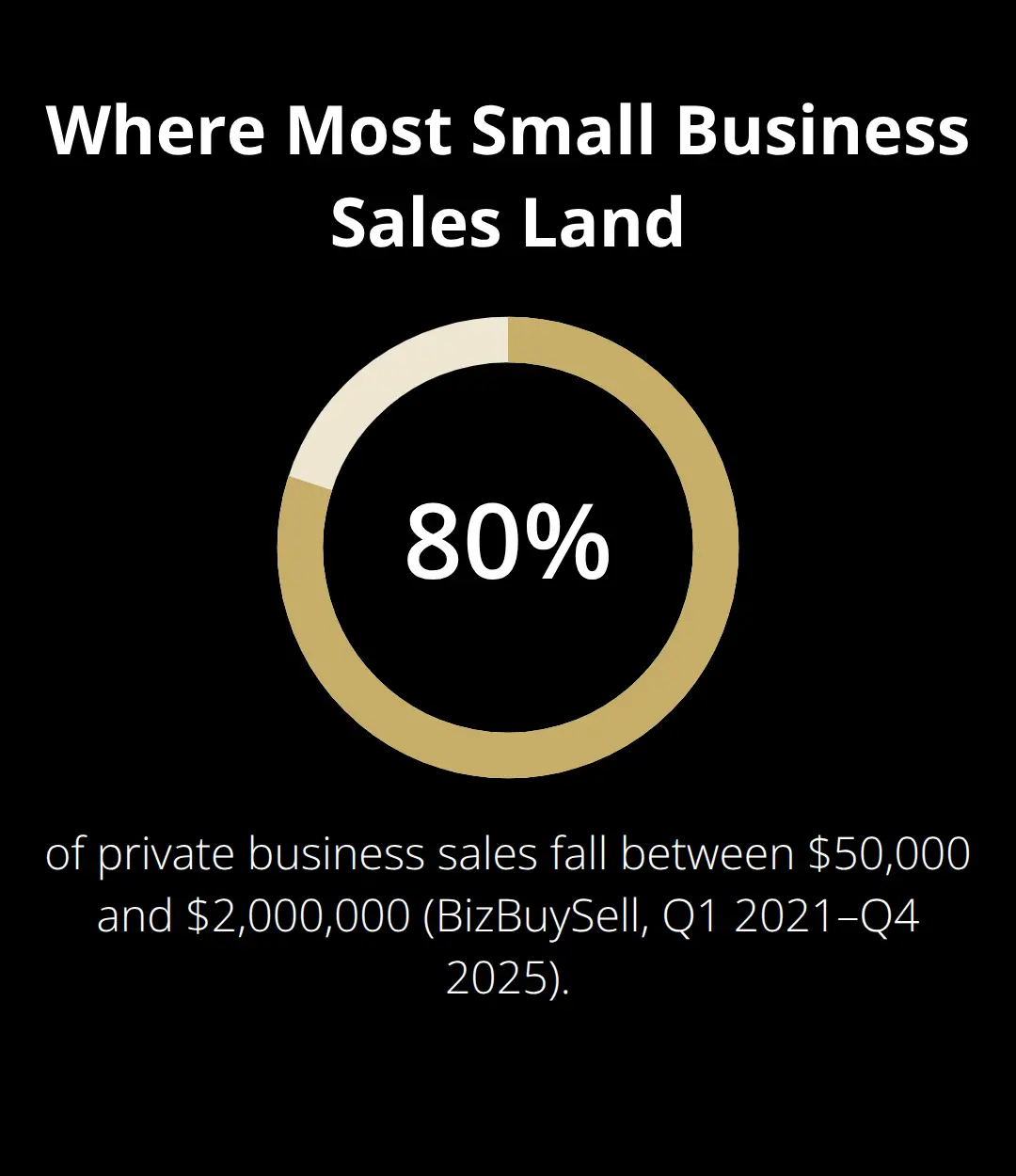
Your job is to find the deals closest to your situation and work backward from there.
Earnings multiples from comparable sales matter far more than revenue multiples because they reflect what buyers actually care about: cash in hand. Assisted Living facilities consistently trade at 4.30x earnings, Car Washes at 4.99x, and Websites & Ecommerce at 3.43x. If you run a tech-enabled business, look at Software & Apps deals trading at 3.28x and Websites at 3.43x to understand what your market will pay. If you’re in construction, Building Material Stores trade at 3.25x while Electrical Contracting hits 2.72x.
Recent Transaction Data and Precedent Deals
The spread within industries matters significantly-Restaurants range from 2.15x to 3.34x depending on whether you operate a quick-service location or a full-service establishment with strong margins. Find five to ten actual sales of businesses similar to yours in size, profitability, and customer base, then apply those multiples to your normalized earnings. This comparison approach works because it reflects real market expectations, not what you hope your business is worth.
Interest rate environments shift these multiples dramatically; higher rates typically compress multiples because buyers face higher financing costs. BizBuySell data showed multiples trending higher in 2022, dipping in 2023 when rates spiked, then resuming growth in 2024 and 2025. This volatility means you need recent comps, not sales from three years ago.
Industry Benchmarks and Adjustments
Adjusting comparable sales for your specific situation separates accurate valuations from wishful thinking. A business that sold for 3.0x earnings might deserve 2.5x if you have customer concentration risk or aging equipment, but could justify 3.5x if you own the real estate, have a ten-year customer retention rate, or operate in a high-growth market. Document every adjustment with specifics-don’t claim a premium without evidence.
If your business has recurring revenue contracts locked in for three years while the comparable sale had month-to-month customers, that’s worth a measurable uplift. If the comparable business operated in a major metro and yours sits in a secondary market, that’s a downward adjustment. Gather transaction data from business brokers in your sector, industry associations, and platforms that track small business sales. Cross-reference multiples across at least three independent sources to spot outliers. A broker claiming your business should sell for 4.5x earnings when comparable sales show 2.7x isn’t offering a valuation-they’re offering a sales pitch.
Final Thoughts
The three common business valuation methods each reveal different truths about your business. Asset-based valuation establishes your floor value, income-based methods show what buyers actually care about, and market-based methods anchor your price in reality. Combining all three approaches creates a credible valuation that withstands scrutiny from buyers, lenders, and tax authorities.
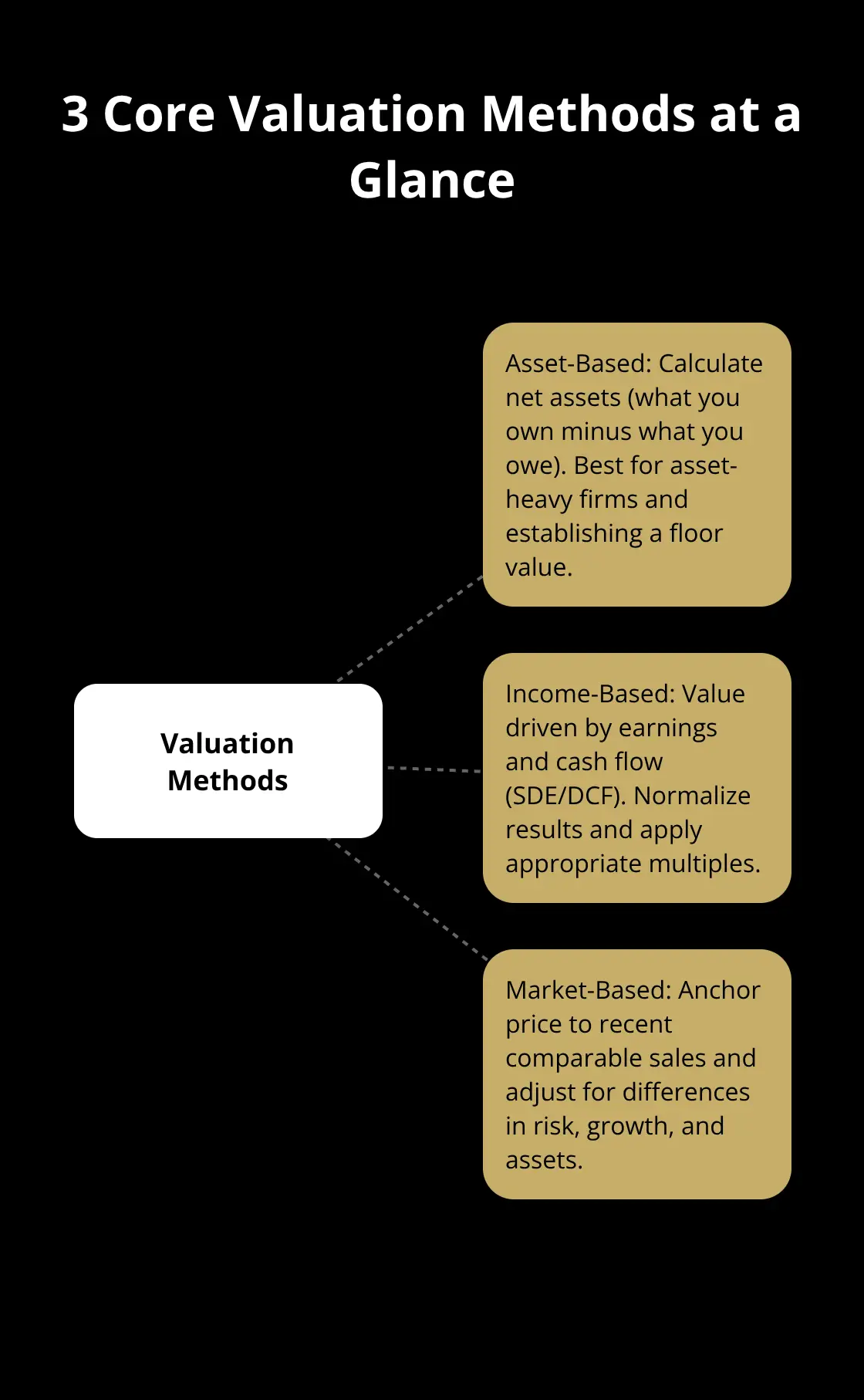
Start by gathering three to five years of financial statements and normalizing your earnings consistently across all periods. Find five to ten recent comparable sales in your industry, calculate your asset value, apply earnings multiples from those transactions, and project your cash flows forward three to five years. Document every assumption and adjustment so you can defend your valuation when negotiations begin.
If you’re selling your business, Unbroker provides transparent valuation support and connects you with qualified buyers without the high fees traditional brokers charge. Whether you handle the sale yourself or want expert guidance, starting with a solid valuation foundation makes the entire process faster and more profitable.