Becoming a licensed broker opens doors to a lucrative career in business sales, but the path isn’t straightforward. The licensing requirements, exam costs, and time investment can be substantial-and that’s before you even land your first client.
At Unbroker, we’ve watched the brokerage landscape shift dramatically. Traditional broker fees are climbing, technology is reshaping how deals happen, and new platforms are offering sellers and buyers cheaper alternatives than ever before.
What You Actually Need to Earn Your License
State Requirements Shape Your Path
Real estate licensure is the non-negotiable first step, and requirements depend entirely on where you operate. State requirements for business broker licensing vary by location, with many states mandating a real estate license to broker businesses. Illinois adds a twist-you must register with the state securities commission instead. If you work in a license-optional state, the Business Brokerage Press recommends waiting about 90 days after your first deal to decide whether licensure makes sense for your practice.
Most states require pre-licensing coursework followed by passing both a national and state exam portion, plus a background check. After that comes the broker license, which demands additional coursework and another exam. Check your state’s Department of Real Estate website for exact timelines and fees-they vary wildly. Some states charge under $200 for licensing; others exceed $500. The entire licensing process typically takes three to six months if you move efficiently, though some states have longer waiting periods between application and exam scheduling.
The CBI Credential Sets You Apart
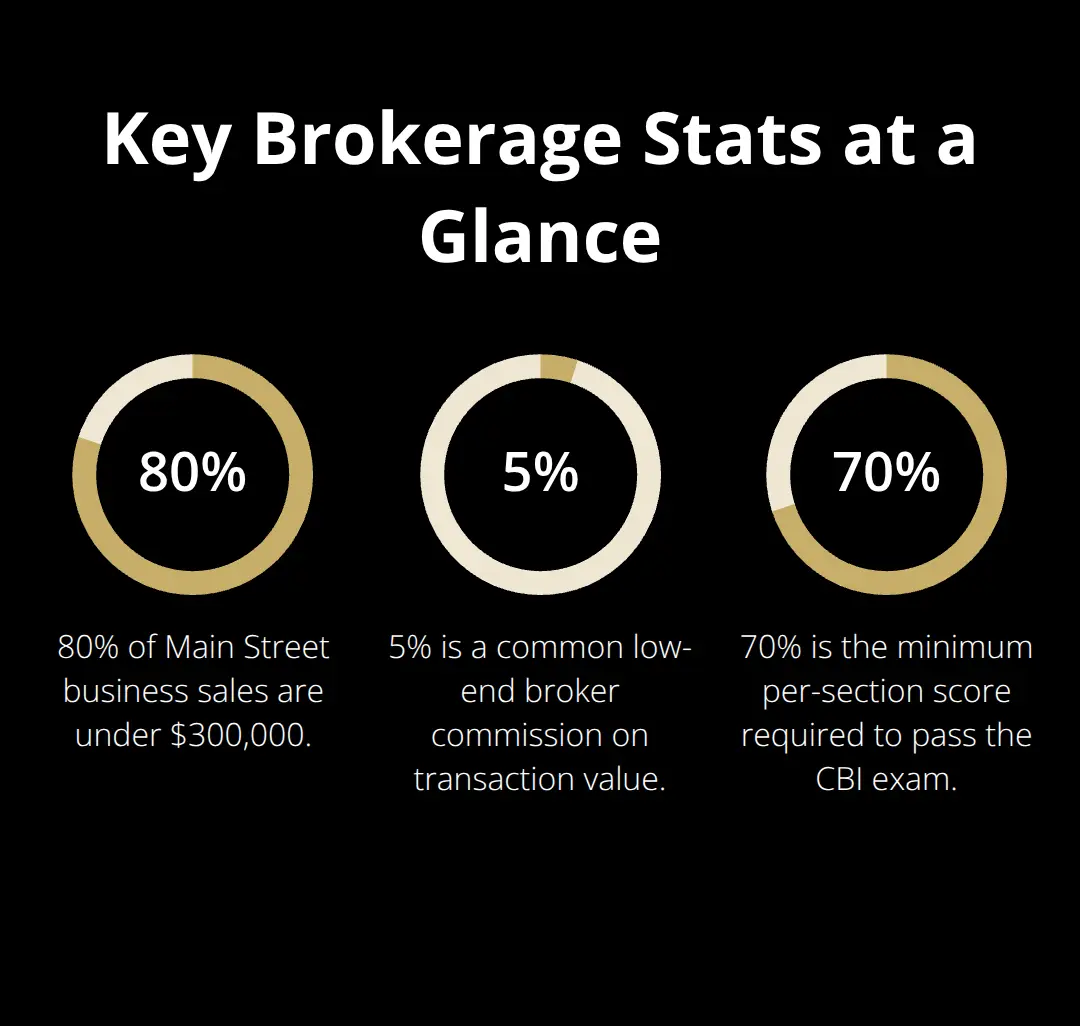
Once licensed, many brokers pursue the Certified Business Intermediary designation from the International Business Brokers Association to signal specialized expertise and boost credibility with buyers and sellers. The CBI requires meeting specific experience and education standards, then passing a comprehensive exam with a minimum 70% score on each section required. This credential genuinely matters-it separates serious professionals from part-timers and opens doors to exclusive listings and referral networks.
Mentorship and Hands-On Experience Matter Most
Your real education happens through mentorship and hands-on deal experience. The Business Brokerage Press emphasizes that mastering the fundamentals in year one beats tinkering with trendy tactics. You need to understand business valuation income asset market approaches-the market approach uses comparable transactions, the asset approach focuses on what a company owns, and the income approach evaluates earning potential-because your asking price either attracts serious buyers or wastes everyone’s time.
Build relationships with accountants, attorneys, lenders, and corporate counsel early; these referral networks generate deal flow that sustains your career. Technology matters too-invest in a solid CRM system, valuation software, data rooms for confidential listings, and e-signature tools. The field has shifted decisively online; buyers research extensively before contacting brokers, so your listings must balance information with strategic mystery.
Your First Year: Expect Lean Finances and Small Deals
Expect your first year to be lean financially while you build credibility on smaller transactions under $300,000, which represent about 80 percent of all Main Street business sales. Some brokers start as associates under an established sponsor to compress the learning curve, while others go solo immediately. The choice depends on your risk tolerance and available capital.
Your financial investment spans licensing fees, continuing education, technology subscriptions, marketing, and your living expenses during the ramp-up phase-realistically $15,000 to $40,000 in year one depending on your structure and location. As you close deals and establish yourself, commission structures typically involve a percentage of the sale price paid to the broker, often with a split to the sponsoring broker; exact terms depend on firm policy. This foundation sets the stage for understanding how income actually flows in the business brokerage world and what earnings potential truly looks like.
How Much Can You Actually Earn as a Business Broker
Deal Flow and Deal Size Drive Your Income
Income in business brokerage depends almost entirely on deal flow and deal size, not on a salary. According to Business Brokerage Press, commission structures involve a percentage of the sale price split between you and your sponsoring broker, though exact terms vary by firm. Most brokers earn between 5% and 10% of the transaction value, with the sponsoring broker taking a cut. On a $300,000 sale-the average for Main Street businesses-a 6% total commission generates $18,000 in gross revenue to your firm, but your personal take after the split might be $6,000 to $9,000.
Deal volume matters far more than individual transaction size. A broker closing five $300,000 deals annually generates vastly different income than one closing two deals, even if the deals are identical in price. Your first year will likely yield minimal income because you build credibility on smaller transactions and establish your referral networks. Most brokers don’t break even until month nine or ten of their first year.
When Your Network Accelerates Deal Flow
As you establish yourself and your network, deal flow accelerates dramatically. Brokers with strong referral relationships from accountants, attorneys, and lenders report closing deals faster and commanding better commission splits because they’ve proven their ability to close transactions successfully.
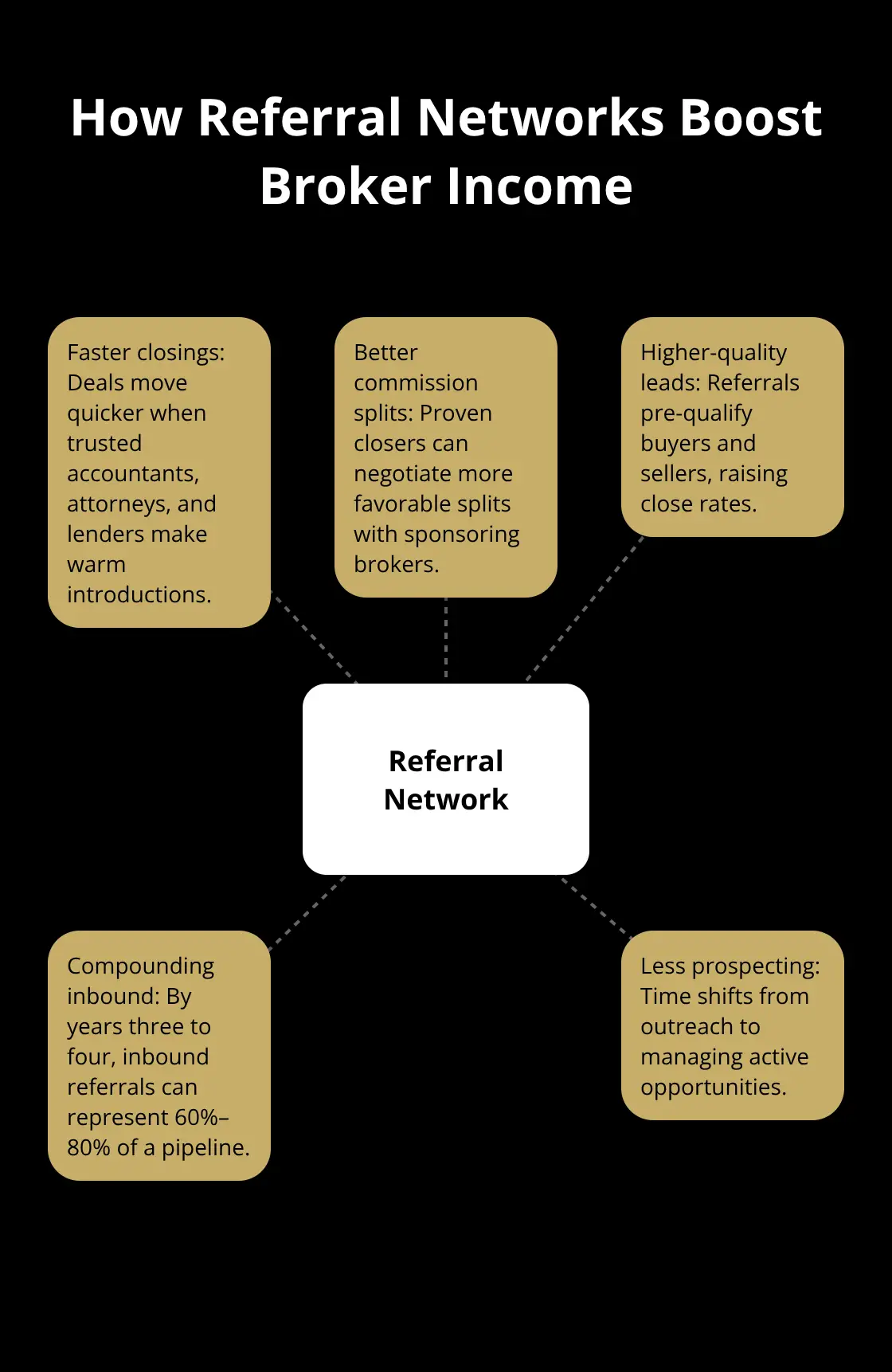
These relationships compound over time-many successful brokers report that by year three or four, inbound referrals represent 60% to 80% of their deal pipeline. This is the real income inflection point: you stop prospecting and start receiving opportunities.
Specialization Beats Generalization
Growth happens through specialization and niche focus rather than generalization. Some brokers specialize in specific industries like restaurants, professional practices, or manufacturing (which align with the actual market breakdown of 19% Service, 17% Manufacturing, 15% Retail, and 15% Food & Drink transactions according to Business Brokerage Press). Others focus on specific deal sizes or geographic regions. The West Coast commands roughly 5% higher valuations than the East Coast, while Central States run about 5% lower, so understanding your regional market proves essential for competitive pricing.
Building Reputation Through Consistent Execution
Closing three $150,000 transactions cleanly generates more referrals than chasing one $500,000 deal that stalls. Your reputation compounds over time as past clients and professional contacts refer you consistently. Solo practitioners represent roughly 40% of the field and often report higher margins because they keep 100% of commissions, though they absorb all overhead and carry the full workload. Established firms with multiple brokers distribute overhead across agents, which reduces individual margins but provides stability, mentorship, and immediate access to deal flow.
The income potential in business brokerage is real, but it requires patience during year one and strategic focus on building relationships that sustain your career long-term. Understanding these financial dynamics helps you evaluate whether traditional brokerage aligns with your goals-or whether alternative approaches might better suit your timeline and risk tolerance.
Why Business Owners Abandon Traditional Brokers
The Economics No Longer Justify the Cost
The traditional business brokerage model fails sellers financially. A Main Street business selling for $300,000 triggers a 10% commission ($30,000), with the broker keeping $15,000 after the sponsoring broker’s split. This fee structure made sense when brokers controlled exclusive market access through proprietary networks and print advertising. Today, sellers research buyers online before contacting anyone, and the information advantage that once justified high commissions has disappeared. Marketing shifted decisively from newspapers to online listing sites and websites, yet traditional brokers still charge 1990s-era fees for 2020s-era work. Sellers increasingly question why they should pay $15,000 to $30,000 when the broker’s primary function involves posting listings on sites the seller could access independently, coordinating with accountants and attorneys (professionals the seller often already knows), and managing basic paperwork. The frustration holds merit.
Traditional brokers claim they bring buyer networks and negotiation expertise, but those networks exist online now, accessible to anyone willing to invest time. The expertise argument collapses when you realize most brokers are generalists handling restaurants, manufacturing, and professional practices with equal superficiality rather than deep industry knowledge that commands premium fees. Research shows that business owners abandon traditional brokers because the math no longer favors them-an 8% commission on a $2 million sale costs $160,000, consuming capital that could fund growth or retirement.
Technology Eliminates the Justification for High Fees
Technology and alternative platforms have made the traditional model economically indefensible for smaller transactions. Modern platforms address this exact problem through transparent, low-cost structures that eliminate the 5% to 10% commission model entirely.
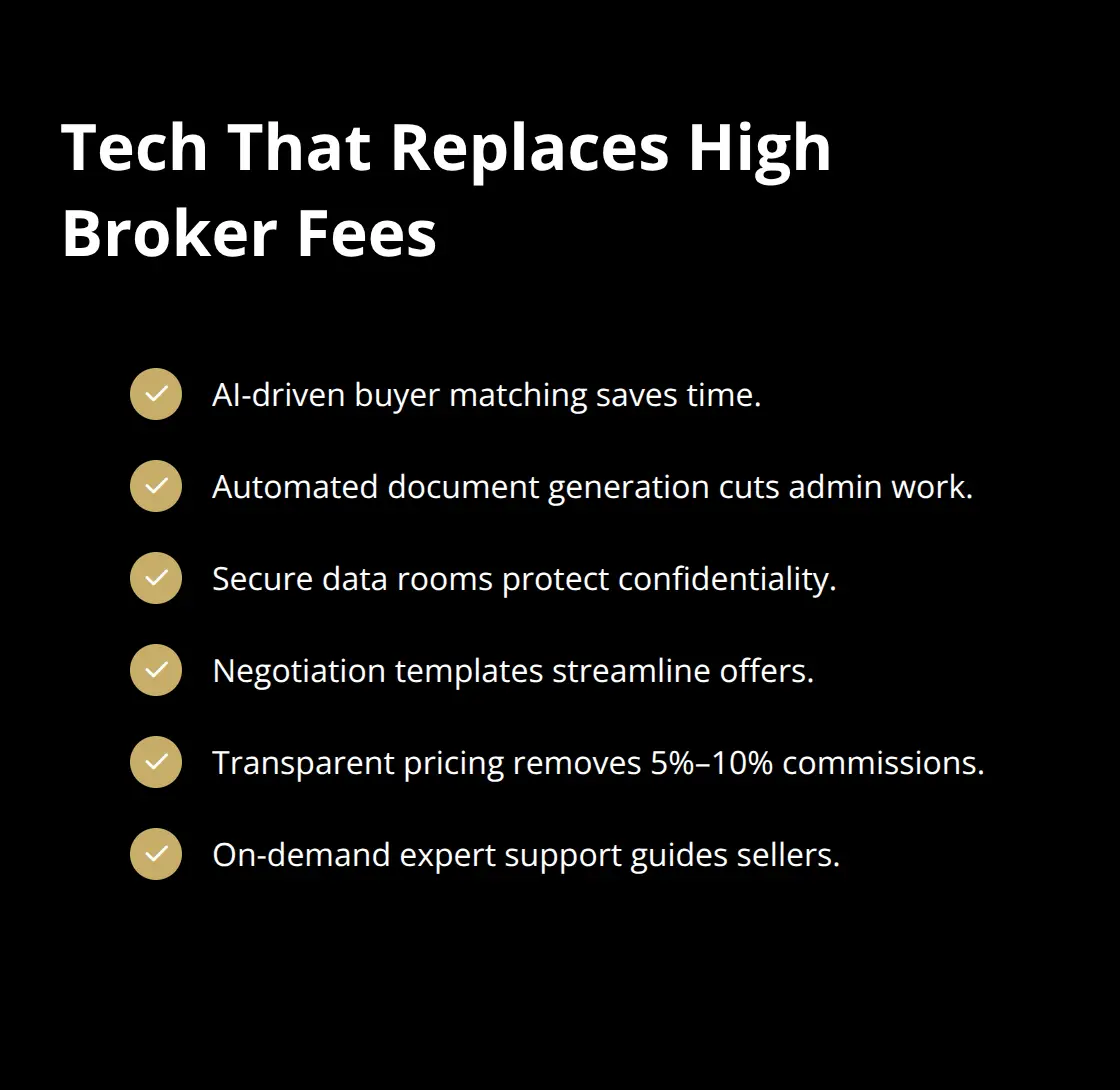
This approach works because technology handles tasks that previously required human time: AI-driven buyer matching, automated document generation, confidential data rooms, and negotiation templates reduce manual work dramatically. Sellers retain control over the process while accessing professional-grade tools and expert support without the traditional overhead costs.
The alternative isn’t limited to paying $30,000 to a traditional broker or fumbling through a sale alone. Assisted platforms provide a third option: sellers who want guidance but not full-service dependency pay monthly fees for on-demand expert support, legal templates, and marketing tools. This structure aligns incentives correctly-the platform succeeds when the seller succeeds, not when transaction size maximizes. Hidden broker fees can eat into your sale proceeds faster than you think, making transparent alternatives increasingly attractive.
Where Traditional Brokers Still Compete
Traditional brokers face an uncomfortable reality: their fee structure only makes economic sense for deals exceeding $500,000 or $1,000,000, where the absolute dollar commission justifies the work. For the 80% of transactions under $300,000, alternative platforms now deliver superior value. Sellers comparing options discover they can hire a business attorney for $5,000 to $10,000, use professional marketing tools included in modern platforms, and retain significantly more capital after the sale.
The shift isn’t ideological-it’s mathematical. Sellers no longer accept premium pricing for commodity services. They want transparency, control, and fair pricing. Traditional brokers built their business model on information scarcity and relationship gatekeeping. Both advantages have evaporated in a digital marketplace where buyers and sellers connect directly and information flows freely.
Final Thoughts
Becoming a licensed broker demands real investment: licensing fees, exam preparation, continuing education, and months of lean income while you build credibility. The traditional path works for people committed to conventional brokerage and willing to grind through year one on smaller transactions. Your income depends entirely on deal flow and deal size, with most brokers earning 5% to 10% of transaction value after splits with sponsoring brokers.
The data reveals a harder truth: the traditional brokerage model no longer serves most business sellers well. An 8% to 10% commission on a $300,000 sale costs $24,000 to $30,000, yet technology now handles tasks that once justified those fees. Buyers research online before contacting brokers, marketing happens on platforms sellers access independently, and valuation tools sit available to anyone-the information advantage that once made high commissions defensible has vanished entirely.
This creates a genuine choice for anyone considering whether to become a licensed broker or sell a business. You can pursue traditional licensing and compete in a market where 3,000 to 3,400 firms already operate, or you can recognize that the economics have shifted and explore modern alternatives that eliminate unnecessary costs. Either way, the data supports one conclusion: sellers deserve better economics than the traditional model delivers.