Selling a business is one of the biggest financial decisions you’ll make. Most sellers have no idea what their company is actually worth, which puts them at a disadvantage from day one.
At Unbroker, we’ve helped hundreds of business owners understand valuation basics for sellers so they can negotiate with confidence. This guide breaks down the three factors that matter most, explains the valuation methods buyers use, and shows you how to prepare your business for the process.
What Really Drives Your Business Value
Revenue and Profit Margins Set the Foundation
Your business value isn’t determined by what you think it’s worth or what you’d like it to be worth. It’s determined by what a buyer will actually pay, and that comes down to three concrete factors that directly impact cash flow. The first is your revenue and profit margins. A business that generates $500,000 in annual revenue with 40% profit margins is worth significantly more than one with the same revenue but only 10% margins, because the buyer cares about what they can extract from the business after expenses. The difference between a 20% and 30% margin on the same revenue can shift your valuation by hundreds of thousands of dollars.
Most sellers underestimate how much margin matters, but buyers don’t. They run the numbers immediately and adjust their offer accordingly. If your margins are thin, you can improve them before you sell-this is one of the fastest ways to increase valuation. Cut unnecessary expenses, renegotiate supplier contracts, or raise prices strategically in the months before you list. Even a 5% margin improvement on $1 million in revenue adds $50,000 to your bottom line annually, which translates directly into higher offers.
Customer Base and Retention Rates Determine Stability
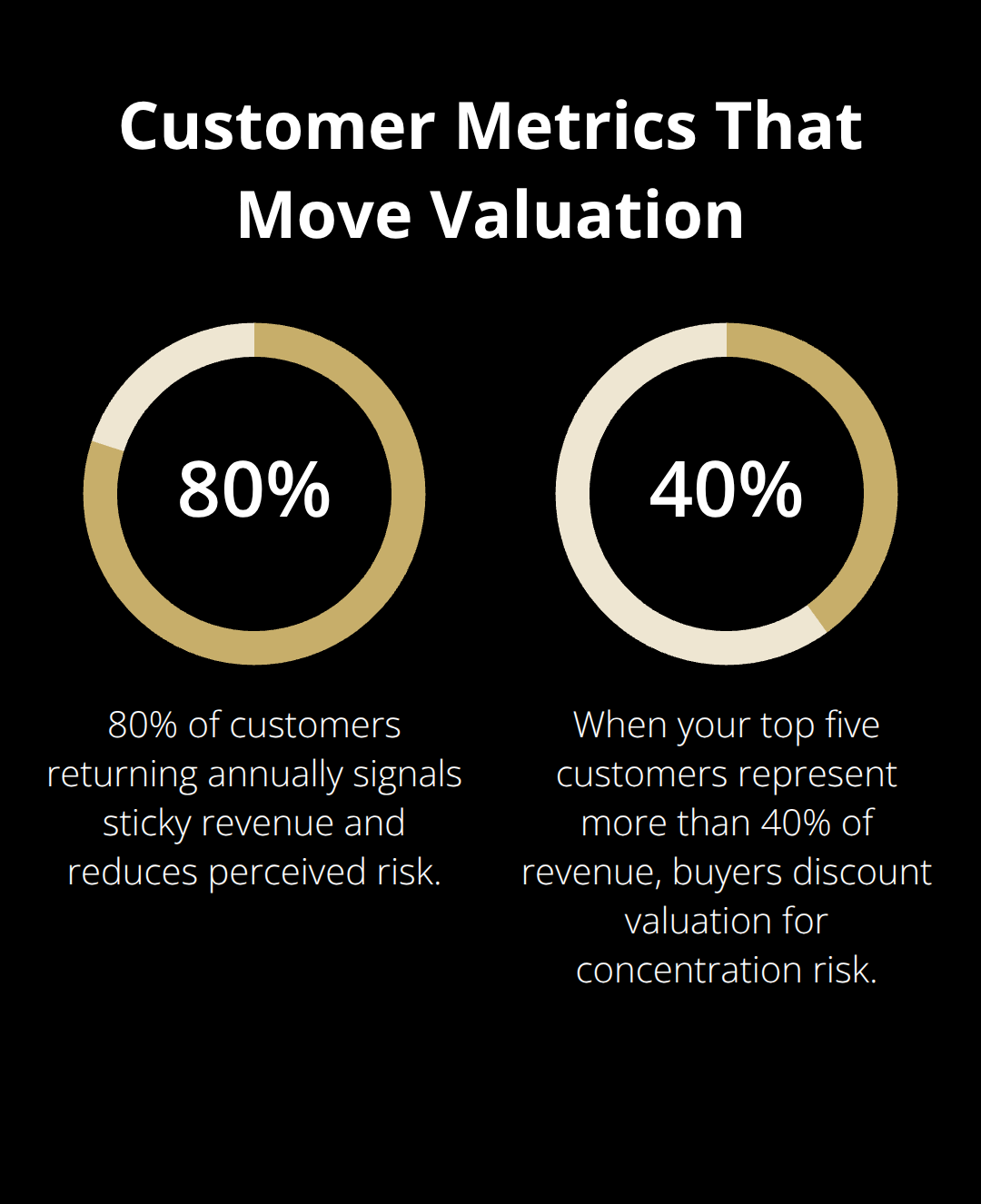
Your customer base and retention rates are the second factor, and this is where many sellers stumble. A business with 100 customers where 80% return annually is far more valuable than one with 500 one-time customers, even if revenue is identical. Buyers fear customer concentration and churn because they worry about revenue disappearing after takeover. If your top five customers represent more than 40% of revenue, buyers will discount your valuation significantly.
They’ll also ask hard questions about customer contracts, renewal terms, and whether relationships are tied to you personally. The stronger your customer relationships and the more diversified your revenue streams, the higher your valuation will climb. Buyers want to see that your business can survive and thrive without you at the helm.
Assets, Liabilities, and Balance Sheet Health
The third factor is your assets and liabilities balance sheet. This includes tangible assets like equipment and inventory, but also less obvious items like intellectual property, software licenses, and existing contracts. Liabilities matter too. If you carry significant debt, that reduces what a buyer will pay because they inherit those obligations.
Clean up your balance sheet before valuation. Try to pay down high-interest debt if possible, document all asset ownership clearly, and resolve any pending legal issues. The combination of strong margins, stable customer relationships, and a clean asset base positions you to command premium offers from serious buyers. With these three factors in place, you’re ready to understand how buyers actually calculate what they’ll offer-which brings us to the valuation methods they use.
How Buyers Actually Calculate What They’ll Pay
Revenue Multiples for Early-Stage and High-Growth Businesses
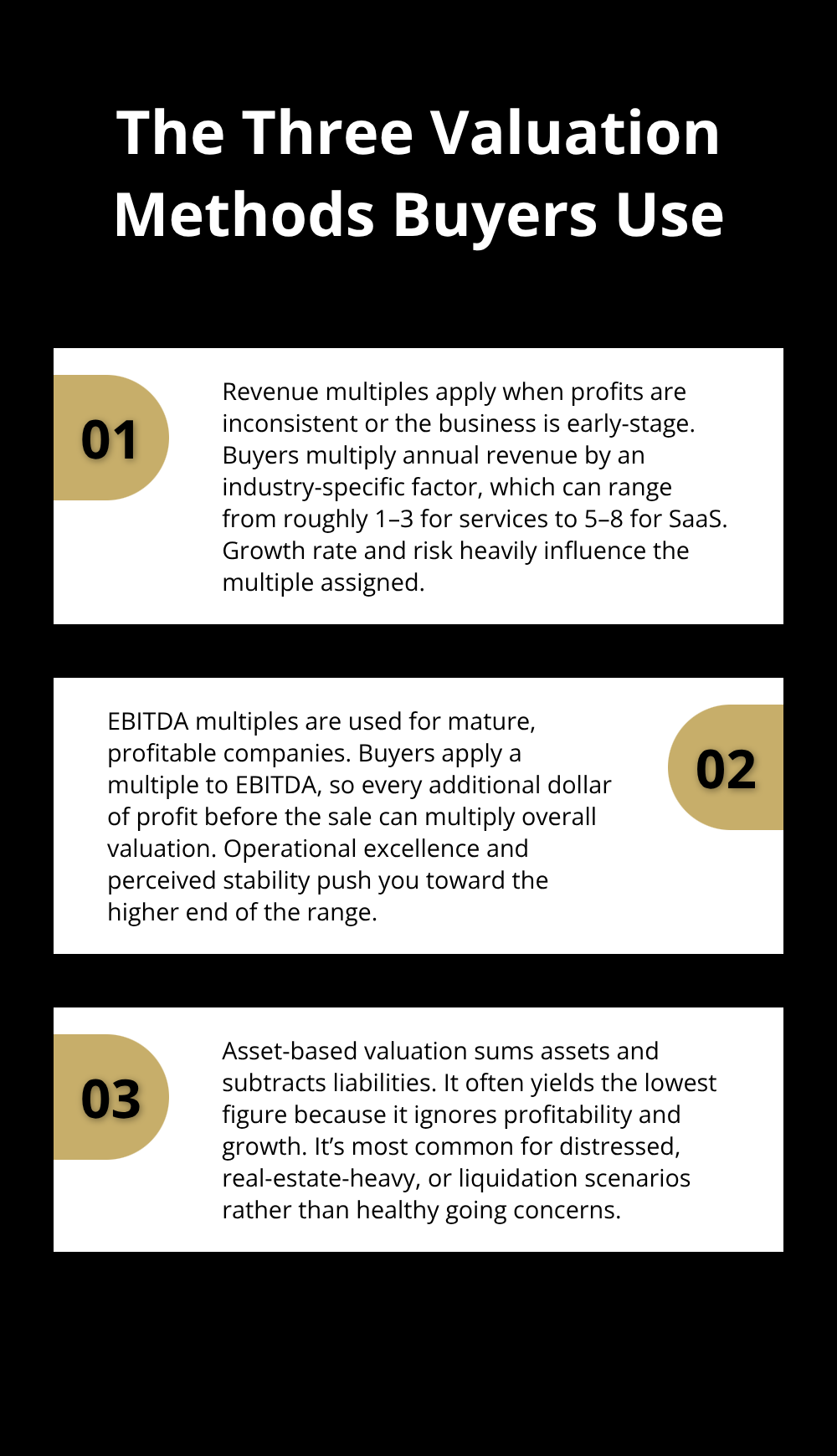
Buyers use three primary methods to value your business, and the method they choose depends entirely on your business type and stage. Early-stage companies and those without consistent profits get valued using revenue multiples, where a buyer multiplies your annual revenue by an industry-specific number. For a SaaS company, that multiplier might reach 5 to 8, while a service business could see 1 to 3. This means a $500,000 revenue business in the software space could command $2.5 to $4 million, while the same revenue in a local service business might only reach $500,000 to $1.5 million.
The multiplier depends on growth rate, market conditions, and perceived risk. Fast-growing businesses command higher multiples because buyers believe revenue will continue climbing. Slow-growth or declining revenue businesses face lower multiples. If your business grew 50% last year, expect a higher multiplier than if you grew just 5%. This is why revenue trajectory matters more than your absolute revenue number.
EBITDA Multiples Reward Operational Excellence
Earnings-based valuation is where most mature, profitable businesses get valued, and this method rewards operational excellence directly. Instead of multiplying revenue, buyers calculate your EBITDA (earnings before interest, taxes, depreciation, and amortization) and apply a multiple to that figure. A business that generates $200,000 in annual EBITDA with a 4x multiple reaches a valuation of $800,000. The critical insight here is that every dollar of profit you add before sale multiplies your valuation directly. Add $50,000 in annual profit, and you increase your business value by $200,000 to $400,000 depending on the multiple.
This is why margin improvement matters so much. The multiple itself varies dramatically by industry and risk profile. Stable, low-risk businesses see 5 to 8x EBITDA multiples, while riskier or cyclical businesses might only reach 3 to 4x. Your operational performance and market position determine which end of that range you’ll occupy.
Asset-Based Valuation Applies to Specific Situations
Asset-based valuation comes last and typically produces the lowest number because it simply adds up what you own and subtracts what you owe. Equipment worth $100,000, inventory worth $75,000, and intellectual property valued at $50,000 minus $30,000 in debt gives you $195,000. Buyers rarely use this method for healthy ongoing businesses because it ignores profitability and growth potential entirely.
Asset-based valuation applies mainly to struggling companies, real estate-heavy businesses, or situations where the business faces liquidation rather than sale as a going concern. Most healthy businesses that attract serious buyers will be valued using revenue or earnings multiples instead. Understanding which method applies to your situation helps you prepare the right financial information and set realistic expectations before you enter negotiations. The next step is preparing your business to withstand scrutiny from potential buyers-which means organizing your records and highlighting what makes your company stand out from the competition.
Getting Your Business Ready for Valuation
Organize Your Financial Records Now
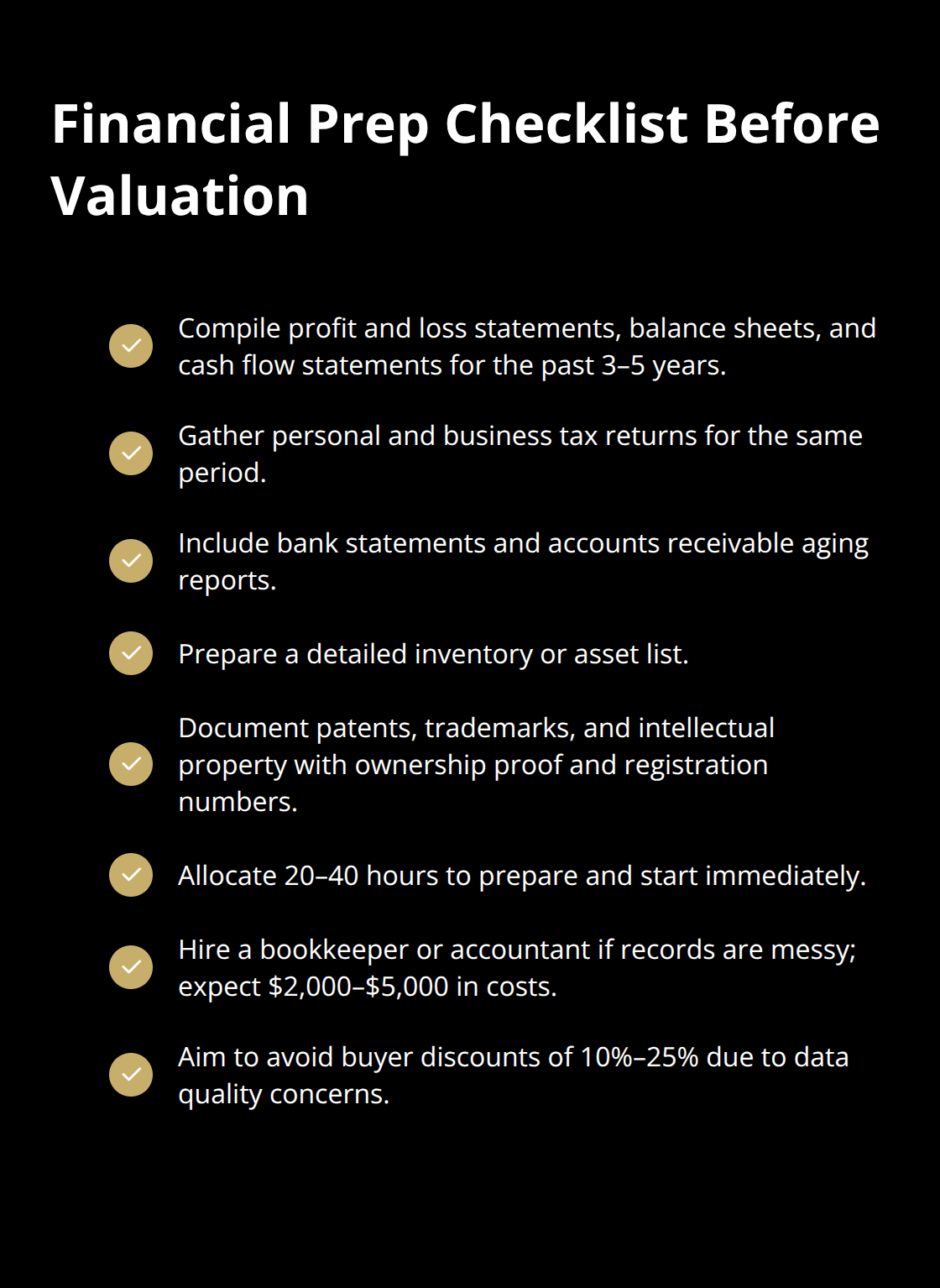
Buyers will request three years of complete financial documentation the moment they express serious interest, and most sellers scramble to assemble this at the last minute. Organize Your Financial Records Now: compile your profit and loss statements, balance sheets, and cash flow statements for the past three to five years, then add your personal and business tax returns for the same period. Include bank statements, accounts receivable aging reports, and a detailed inventory or asset list if applicable. Any patents, trademarks, or intellectual property should be documented with ownership proof and registration numbers. This preparation typically takes 20 to 40 hours depending on how disorganized your records are, so start immediately rather than waiting until you decide to sell. Clean financials dramatically improve buyer confidence and reduce the likelihood of post-sale disputes over accuracy. If your records are a mess, hire a bookkeeper or accountant to reconcile them before valuation-this investment costs $2,000 to $5,000 but prevents buyers from applying a discount of 10% to 25% for data quality concerns.
Highlight Your Competitive Advantages
Your competitive position matters equally to your financial records, and you need to articulate exactly why a buyer would choose your business over alternatives. Highlight Your Competitive Advantages by documenting your market share, customer acquisition costs, and what percentage of customers are recurring versus one-time. Identify any exclusive contracts, long-term customer agreements, or proprietary processes that create defensible advantages. If your business operates in a crowded market, highlight what makes you different-whether that’s superior retention rates, lower churn, higher margins, or exclusive supplier relationships.
Fix Operational Weaknesses Before Valuation
Address operational weaknesses before valuation starts: fix equipment that’s breaking down, resolve outstanding legal disputes, and eliminate customers or product lines that drain profitability without contributing meaningful revenue. A business that generates $100,000 in revenue from a problem customer at 5% margins is worth far less than one with $80,000 in revenue from reliable customers at 30% margins. Fix Operational Weaknesses proactively rather than hoping buyers will overlook them during due diligence.
Final Thoughts
Valuation basics for sellers rest on three pillars: margins matter, customer stability matters, and clean financials matter. A buyer will apply one of three methods depending on your business stage and profitability, and your job is to maximize the numbers they’ll multiply. Every dollar of profit you add before sale compounds your valuation through the multiple applied to your business, which means the preparation phase determines whether you gain or lose hundreds of thousands of dollars.
Organize your financial records now rather than scrambling later, document your competitive advantages clearly, and fix operational weaknesses that drain profitability. These steps take time but directly influence what serious buyers will offer, and we at Unbroker connect you to qualified buyers through our network while offering transparent pricing and no hidden fees. Start with a valuation conversation with a professional who understands your industry, bring your financial records and customer data, and ask specific questions about which method applies to your situation and what multiple range is realistic given current market conditions.