Selling a small business for sale requires more than just listing it online and hoping for the right buyer. The process demands careful preparation, strict confidentiality, and strategic planning at every stage.
At Unbroker, we’ve seen too many business owners rush through a sale and leave money on the table or expose sensitive information unnecessarily. This guide walks you through the exact steps to prepare your business, protect your data, and close a deal that works for you.
Prepare Your Financial and Operational Foundation
Buyers want proof, not promises. The first thing we see when evaluating a business for sale is that most owners lack organized financial documentation. You need three years of complete tax returns, profit and loss statements, and balance sheets in one accessible location. If your records sit scattered across spreadsheets, accounting software, and paper files, consolidate everything now. Buyers scrutinize cash flow statements intensely because they want to verify the actual money the business generates. If you’ve run personal expenses through the business, separate them clearly-buyers will reduce your valuation dollar-for-dollar for suspicious items. A CPA should review your financials before you market the business. This costs $1,500 to $3,000 but prevents months of back-and-forth explanations during due diligence.
Legal agreements determine deal viability
Every contract your business holds affects its value and transferability. Lease agreements, supplier contracts, customer agreements, employment contracts, and licensing arrangements all require review. A landlord might have the right to terminate your lease if ownership changes, which could destroy the business overnight. Customer contracts might require consent from clients before transfer. These aren’t minor details-they’re deal-breakers. Create a master list of every agreement and note renewal dates and any transfer restrictions. If problematic clauses exist, address them before selling. A buyer discovering unfavorable terms during due diligence will either walk away or demand a significant price reduction. An attorney should review your contracts specifically for sale-related issues. This typically costs $2,000 to $4,000 but prevents costly surprises.
Systems and processes replace owner dependence
Buyers invest in businesses that run without the owner’s constant involvement. If you’re the only person who knows how to perform critical tasks, the business is vulnerable and less valuable. Document your core processes in writing. What does onboarding look like? How do you handle customer service? What’s your sales process? How do you manage inventory or scheduling? This documentation doesn’t need to be elaborate-simple step-by-step guides work fine. The goal is showing that operations don’t depend on your personal effort. Clean up your digital infrastructure too. Organize files logically, remove personal data, and secure your systems. A buyer will want to audit your technology stack and data security practices. If your systems are chaotic, they’ll assume operations are chaotic.
Operational transparency attracts serious buyers
Spend time documenting and organizing before you market your business, and serious buyers will respond immediately. This foundation-clean financials, clear contracts, and documented processes-positions you to move into negotiations from a position of strength. When you control the narrative around your business’s operations and finances, you control the sale itself. The next stage involves protecting this information while you identify the right buyer.
How to Market Your Business Without Exposing Secrets
Start with strategic information withholding
The moment you start marketing your business, confidentiality becomes your biggest challenge. Most small business owners post detailed financial information, customer lists, or operational specifics in their sales listing. This approach attracts tire-kickers and gives away competitive advantages to people who never intended to buy. A tiered disclosure strategy reveals information only to serious, qualified buyers. Start your marketing with a business summary that highlights industry, location, revenue range, and basic operations without naming customers or revealing margins. Your first listing should feel intriguing but incomplete, designed to attract genuine interest rather than satisfy curiosity.
Screen buyers before sharing sensitive data
When prospects request more details, that’s your screening moment. Use a simple online form asking for business experience, funding source, timeline, and why they’re interested in your specific industry. Serious buyers answer these questions thoroughly. Tire-kickers skip them or give vague responses. This single filter eliminates most time-wasters before you invest energy in conversations. Professional buyers expect this screening as standard practice in business sales. The form takes 10 minutes to create and saves you weeks of wasted discussions with unqualified prospects.
Require non-disclosure agreements for all sensitive information
Non-disclosure agreements protect your business data during buyer evaluation. Many owners skip NDAs thinking they’ll scare away legitimate buyers, but the opposite is true. Professional buyers expect NDAs as standard practice. An NDA should specify what information is confidential, how it can be used, what happens if the deal doesn’t close, and consequences for breach. You can use legal document templates rather than hiring an attorney for every prospect, keeping costs under $500 for a solid agreement. The agreement must be signed before you provide financial statements, customer names, supplier contracts, or detailed operational information.
Track document distribution and enforce confidentiality
Track which buyer received which documents so you know who leaked information if it surfaces publicly. Some owners discover competitors obtained their data through failed sales processes. An NDA with clear breach penalties and your documented distribution history protects you legally. When a buyer refuses to sign an NDA, that’s your answer about their professionalism and intent. Move forward only with buyers willing to commit to confidentiality in writing. This documentation becomes critical during negotiations, where buyers will scrutinize every aspect of your operations and finances.
What Buyers Actually Want to Know
Cash flow and customer concentration matter most
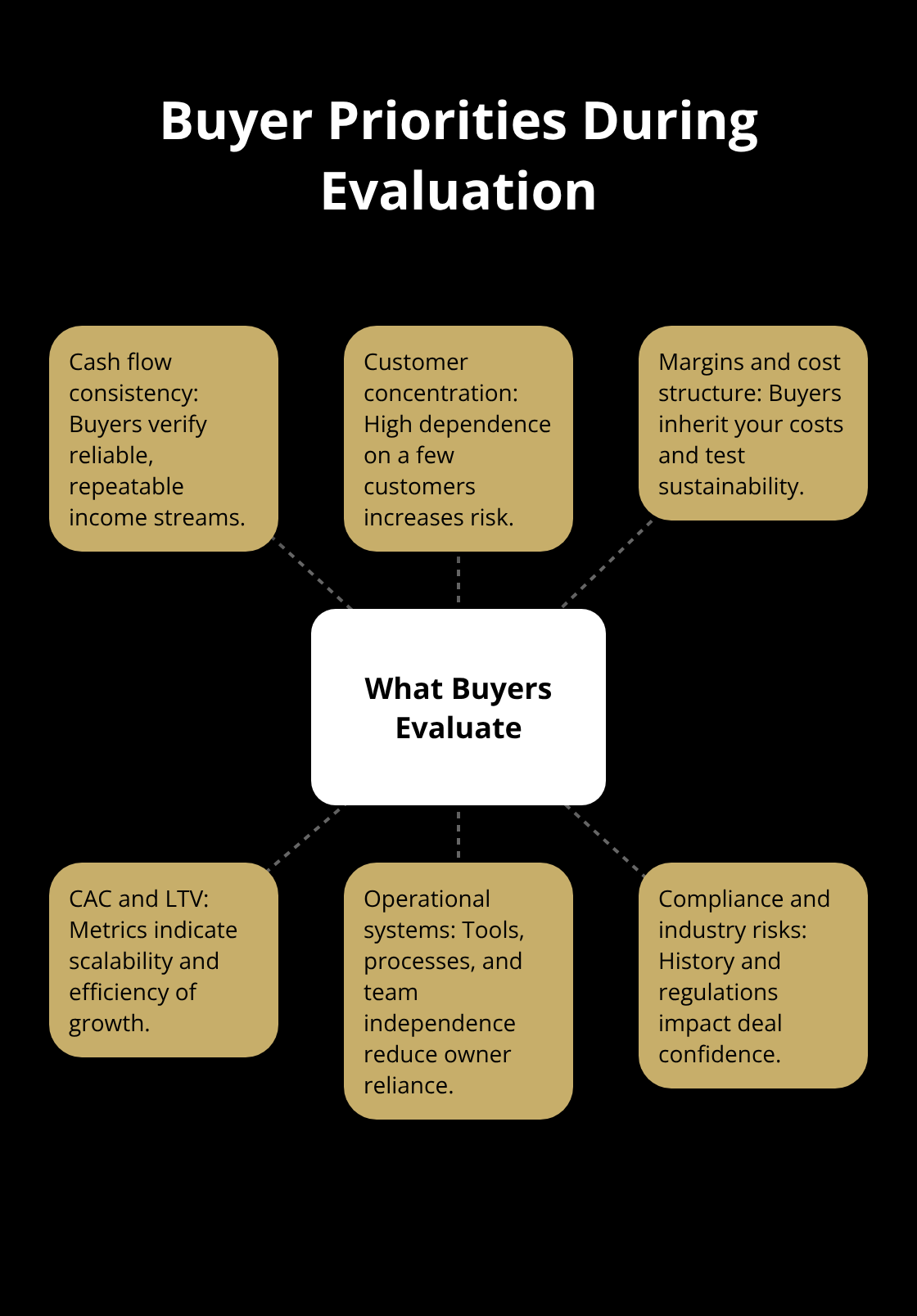
Buyers operate from a standard playbook, and understanding their priorities helps you prepare stronger answers. They spend most time examining cash flow consistency, customer concentration, and operational dependencies. If your top five customers represent more than 30–40% of revenue, expect intense questioning about contract terms and renewal likelihood. The SBA reports that buyer concerns center on revenue stability, so prepare documentation showing whether your income comes from long-term contracts, recurring subscriptions, or one-time transactions.
Buyers also scrutinize your margins closely because they’ll inherit your cost structure. If you’ve been absorbing costs to inflate profits, that ends immediately after sale. Provide three years of detailed P&L statements broken down by product line or service category, supplier contracts showing pricing, and employee records with compensation details before negotiations begin rather than scrambling during due diligence.
Metrics reveal whether your model scales
Most buyers investigate your customer acquisition cost and lifetime value metrics. If you track these numbers, provide them. If you don’t, calculate them now using your historical sales data. Buyers want to know whether your business model scales efficiently or requires constant marketing spend to maintain revenue. This distinction separates a sustainable business from one that depends on your personal effort to generate sales.
Operational systems and dependencies get scrutinized
The operational questions come next, and they’re far more detailed than most owners anticipate. Buyers ask about software systems, data security practices, vendor relationships, and employee turnover. They’ll want access to your accounting software to trace transactions themselves rather than accepting your summary. They’ll interview your key employees to understand whether operations depend on you personally or whether systems transfer smoothly.
Prepare your team for these conversations by explaining what’s happening and coaching them on consistent messaging. This coordination prevents conflicting stories that raise red flags during due diligence.
Compliance and industry-specific risks require attention
Buyers examine your compliance history, including tax filings, employment law adherence, and industry-specific regulations. If you’ve operated in gray areas or skipped compliance steps, address them before sale. The cost of fixing compliance issues before sale is always lower than post-sale liability.
Work with advisors who understand your specific industry because buyers hire their own specialists to identify sector-specific risks. A manufacturing buyer examines equipment condition and maintenance records. A SaaS buyer examines customer churn rates and feature roadmap. A retail buyer examines foot traffic patterns and lease terms. Your advisor should anticipate these questions and help you compile answers before buyers ask.
Final Thoughts
Your attorney should review every document before you sign anything, as purchase agreements contain language that affects your liability after closing, earnout structures, and representations you make about the business. If a buyer insists on representations you cannot stand behind, push back now rather than facing legal consequences later. The cost of legal review at this stage remains minimal compared to post-sale disputes.
Your transition plan matters more than most owners realize, and you should document it in writing and include it in your sale agreement. Specify how many hours you will dedicate to transition, what happens if critical issues emerge, and how you will be compensated for extended involvement (this clarity prevents misunderstandings that damage relationships right when you are trying to close). Tax implications deserve serious attention before you sign final documents, as the structure of your small business for sale-whether you sell assets or equity-dramatically affects your tax bill.
The structure of your sale, whether you sell as an S-corp, LLC, or C-corp, carries different tax consequences, and earnout payments, seller financing, and non-compete agreements all carry tax implications. Your CPA should model different scenarios so you understand your actual proceeds after taxes, since many owners discover too late that their expected payout was significantly reduced by tax obligations they did not anticipate. Unbroker guides sellers through this final stage with legal document templates, negotiation assistance, and advisors who have closed hundreds of deals.