Business valuations fall apart when numbers lack credibility. Buyers scrutinize every figure, and weak documentation or inconsistent methods kill deals before they start.
We at Unbroker have seen countless valuations rejected simply because owners skipped basic verification steps. These valuation accuracy tips separate sellers who close deals from those who watch buyers walk away.
What Actually Moves the Needle in Business Value
Buyers don’t care about vanity metrics. They care about whether your business generates predictable, defensible cash that survives without you. Revenue that grows 40% year-over-year means nothing if it comes from a single customer who could leave tomorrow. Profitability that looks impressive on paper evaporates when you account for owner-dependent expenses or unsustainable cost structures. Sellers often present numbers that look good in isolation but crumble under buyer scrutiny because they ignore what actually determines whether someone will pay a premium for the business.
Revenue Quality Beats Revenue Size
A business that generates $2 million annually from ten stable customers with multi-year contracts is worth far more than a business that generates $3 million from one dominant customer. Customer concentration above 20% in one account typically reduces business sale price 10–30%. You need to map exactly where your revenue comes from, how long customers stay, and what repeat purchase rates look like. If your top three customers represent more than 40% of revenue, buyers will immediately apply a discount.
Write down the contract terms, renewal rates, and customer tenure for every significant account. Revenue growth matters, but only if it comes from expanding your customer base or increasing wallet share with existing customers who actually stick around. Flat revenue from stable, diverse customers beats explosive growth that depends on one major client or a temporary market surge.
Cash Flow Consistency Separates Real Profit from Paper Gains
EBITDA measures operational profitability, while cash flow measures liquidity. A business can show strong earnings while cash dries up if inventory piles up, receivables stretch out, or capital expenditures spike unexpectedly. Track your operating cash flow for at least three years and show it alongside net income. If they diverge significantly, buyers will question which number is real.
Profitability margins matter, but only when they’re consistent. A business with 15% margins that fluctuate wildly between 8% and 22% year to year signals operational instability. Buyers want to see normalized profit margins and earnings consistency that reflect sustainable performance, not one exceptional year surrounded by mediocre ones. If your margins improved dramatically in the last year, prepare documentation showing whether that improvement comes from structural changes in your business (like a new process or product line) or from one-time factors that won’t repeat.
Why Buyers Scrutinize These Numbers
Buyers apply discounts the moment they spot inconsistencies or red flags in your financial story. A 20-30% valuation hit from customer concentration risk is just the beginning. Add operational instability, cash flow mismatches, or unexplained margin swings, and your multiple collapses fast. The next section covers the specific mistakes that trigger these discounts and how to avoid them.
Common Valuation Mistakes That Destroy Credibility
Most sellers present numbers that look reasonable in isolation but fall apart the moment a buyer’s accountant starts asking questions. The difference between a valuation that holds up and one that collapses often comes down to three specific mistakes that trigger immediate skepticism.
Adjusted EBITDA Separates Sustainable Profit from Owner Perks
Sellers rely on raw EBITDA without adjusting for one-time expenses or owner-dependent costs. A business that shows $500,000 in EBITDA might actually generate $350,000 in sustainable earnings once you remove the owner’s inflated salary, his wife’s non-working executive position, or the $50,000 annual consulting fee paid to his brother. Buyers don’t care about your current cost structure. They care about what a new owner can realistically achieve.
If your margins only look good because the owner works 80 hours weekly at a below-market salary, that profit disappears when someone else runs the operation. You need to normalize earnings by removing owner perks, discretionary expenses, and unsustainable cost cuts. Document exactly what adjustments you’re making and why. This transparency builds credibility instead of triggering red flags during due diligence.
Industry Benchmarks Expose Overpriced Valuations
Sellers ignore what comparable businesses in their industry actually sell for. A SaaS company with $2 million ARR and 70% gross margins might trade at 3–4x revenue based on recent market data, while a service business with similar revenue trades at 3–5x. If you price your business without showing comparable sales from similar businesses in your market, buyers dismiss your valuation as fantasy.
Research actual transactions in your industry, not hypothetical multiples from generic business valuation websites. Talk to brokers, look at SEC filings if your competitors are public, and find real examples of businesses like yours that actually sold. This evidence transforms your valuation from a guess into a defensible position that buyers respect.
Customer Concentration Risk Demands Transparency
Customer concentration risk destroys valuations faster than almost anything else, yet sellers consistently underestimate its impact. A business where one customer represents 35% of revenue gets hammered with a valuation discount because that revenue is at risk. Buyers factor in the probability that your major customer walks, and they price accordingly.
If you can’t eliminate customer concentration through genuine diversification before selling, you must be transparent about it upfront and let the valuation reflect that reality. Hiding it only guarantees that buyers will discover it during due diligence and either renegotiate aggressively or withdraw their offer entirely. The next section shows exactly how to strengthen your valuation by fixing these problems before buyers spot them.
Practical Steps to Strengthen Your Valuation
Document Historical Financial Performance with Clean Records
Clean financial records are non-negotiable. Start by pulling three years of tax returns, profit and loss statements, and bank statements. Buyers will compare what you claim in your valuation against what the IRS has on file, and any discrepancies torpedo credibility instantly.
Many sellers maintain two sets of books-one for tax purposes and one that shows adjusted earnings. Buyers assume the tax version is accurate and treat adjustments with extreme skepticism unless you document exactly why they exist. If you claim $100,000 in owner adjustments, show the specific line items from your actual financial statements that support that number. Don’t cite general categories like owner perks without itemizing what falls into that bucket.
Build a detailed reconciliation that shows how you moved from tax return net income to adjusted EBITDA, with every single adjustment explained and sourced to actual business records. This level of documentation signals that you understand your numbers and aren’t hiding anything. Spreadsheets matter here because they create an audit trail that buyers can follow.
Use Multiple Valuation Methods for Cross-Verification
Multiple valuation methods protect you against buyer pushback on price. Most sellers rely on one approach-usually revenue multiples-and get stuck when a buyer argues the multiple is too high.
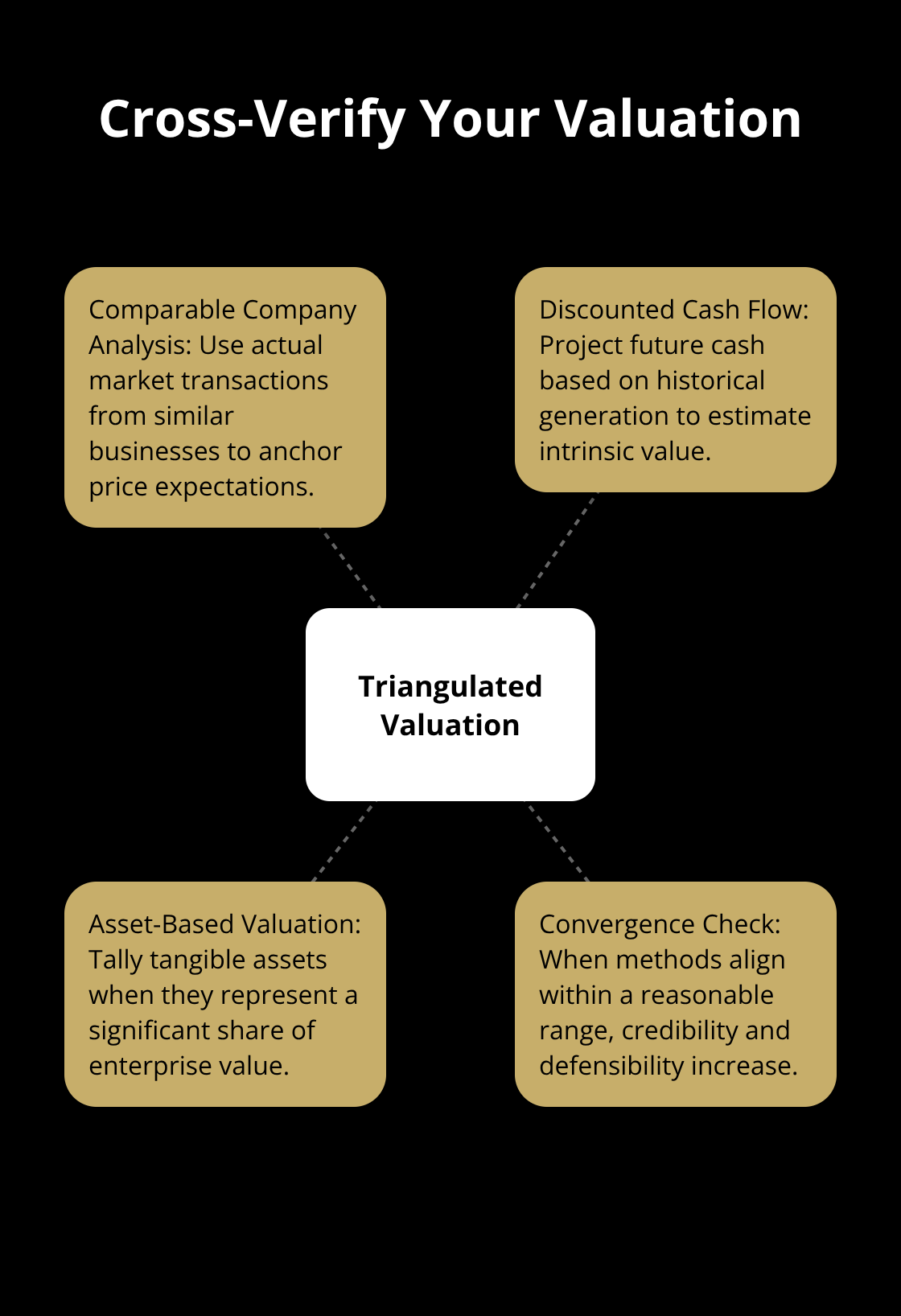
Instead, calculate your valuation using three distinct methods: comparable company analysis based on actual market transactions in your industry, discounted cash flow projections based on historical cash generation, and asset-based valuation if you carry significant tangible assets.
When all three methods converge within a reasonable range, your price becomes defensible. If they diverge widely, that gap signals something wrong with your assumptions or financials that needs fixing before you enter the market. This convergence transforms your valuation from a single opinion into a triangulated position that withstands scrutiny.
Get Professional Validation from Business Advisors
Professional business valuators typically charge $2,000 to $3,000 for a formal valuation report, depending on business complexity. This investment pays for itself the moment a buyer’s advisor questions your numbers and you hand over a third-party certified valuation instead of your own spreadsheet.
A formal valuation report from a qualified appraiser carries weight that internal calculations never will. The timing matters because fixing credibility issues takes weeks, and you don’t want to lose serious buyers while you scramble to document your numbers. Professional validation before you list protects you far more effectively than scrambling to produce it after buyers ask for it.
Final Thoughts
Accurate valuations close deals, while inaccurate ones kill them. The difference between a business that sells at asking price and one that gets lowballed comes down to whether your numbers hold up under scrutiny. Buyers have seen countless sellers present inflated valuations backed by weak documentation, and they’ve learned to discount aggressively whenever red flags appear. You can’t afford that discount.
These valuation accuracy tips work because they address what buyers actually care about: sustainable cash flow, customer stability, and honest financial reporting. When you document your numbers cleanly, adjust for owner-dependent costs, compare your valuation against real market transactions, and eliminate customer concentration risk, you transform your business from a risky bet into a credible investment. Buyers move faster and negotiate less aggressively when they trust your numbers, and a professional valuation report costs a few thousand dollars but buys you enormous credibility when questions arise.
We at Unbroker work with sellers who understand that valuation accuracy directly impacts sale price and deal certainty. Our platform connects you with qualified buyers who respect solid numbers and move quickly when they see them. Visit Unbroker to learn how we help sellers build buyer confidence through expert guidance and a structured sales process that rewards preparation.