Selling a business without knowing its true value is like walking into a negotiation blindfolded. At Unbroker, we’ve seen owners leave millions on the table simply because they skipped the fundamentals.
A solid business valuation checklist keeps you grounded in facts, not guesses. It walks you through the financial metrics, market position, and professional guidance you need to price your business right.
What Numbers Actually Tell You About Your Business
Revenue Growth and Customer Concentration
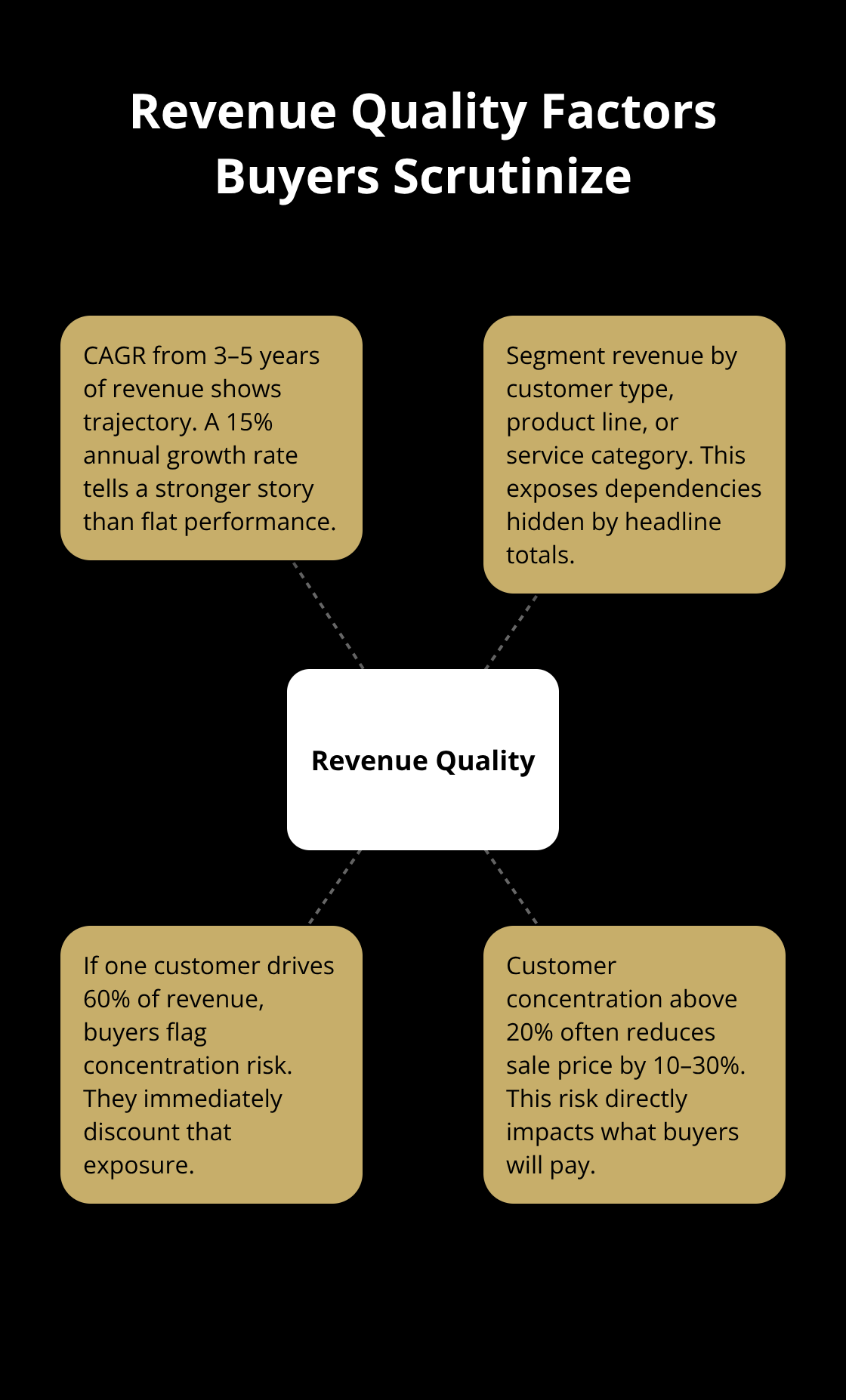
Your revenue might look impressive on paper, but what matters is the trajectory behind it. Pull the last three to five years of revenue data and calculate your compound annual growth rate, or CAGR. A business growing at 15% annually tells a completely different story than one treading water.
Look beyond the headline number-segment your revenue by customer type, product line, or service category. A company generating 60% of revenue from a single customer faces a major red flag that buyers immediately discount. Customer concentration above 20% typically reduces business sale price by 10–30%. This concentration risk directly impacts what buyers will pay.
Profitability Signals and Margin Trends
Check your gross margin trends closely. If margins compress year over year, that signals pricing pressure or rising costs that will tank your valuation. Profitable businesses typically maintain stable or expanding margins; shrinking margins suggest structural problems that buyers won’t ignore.
Cash flow matters more than profit. A business can report strong earnings while bleeding cash if inventory or receivables balloon. Calculate your free cash flow by taking operating cash flow and subtracting capital expenditures. Many owners get blindsided when buyers discover that reported profits never actually reached the bank.
Debt, Liabilities, and Working Capital
Debt and liabilities demand brutal honesty. List every loan, line of credit, equipment financing, and contingent liability. Buyers subtract total debt from enterprise value, so a business worth $2 million with $400,000 in debt nets the seller roughly $1.6 million before taxes and transaction costs.
Working capital-the difference between current assets and current liabilities-gets particular attention from buyers. If you need $200,000 in cash just to keep operations running, that’s money the buyer must inject, which reduces what they’ll pay you upfront. Tight working capital management during the final 12 months before sale can meaningfully improve your valuation. Document everything meticulously because appraisers verify these numbers, and inconsistencies create friction and delays.
With your financial foundation solid, the next step involves positioning your market advantage and competitive standing in front of potential buyers.
Market Position and Competitive Advantage
Industry Growth and Market Demand
Industry momentum and market demand set the ceiling on what buyers will pay. Start by researching your industry’s growth rate over the past three to five years. Industry growth rate compared to business growth rate involves dividing the difference in value observed over some period by the starting value. If your sector expands at 8% annually but your business grows at only 3%, that’s a valuation killer. Conversely, a company outpacing industry growth by 5+ percentage points signals competitive strength that buyers reward. Pull data from IBISWorld reports or industry associations specific to your sector-these sources give you concrete benchmarks to position against.
Market demand matters less as an abstract concept and more as measurable signals: are contract pipelines expanding, do customers renew at higher rates, is pricing power increasing? Buyers examine these specifics, not vague market optimism. If your industry faces structural headwinds-like traditional retail or declining manufacturing segments-your valuation multiple compresses regardless of individual business performance. This isn’t negotiable; it’s math.
Document exactly where your business sits within industry trends because this positioning directly influences whether a buyer sees growth potential or a sinking ship.
Customer Retention and Switching Costs
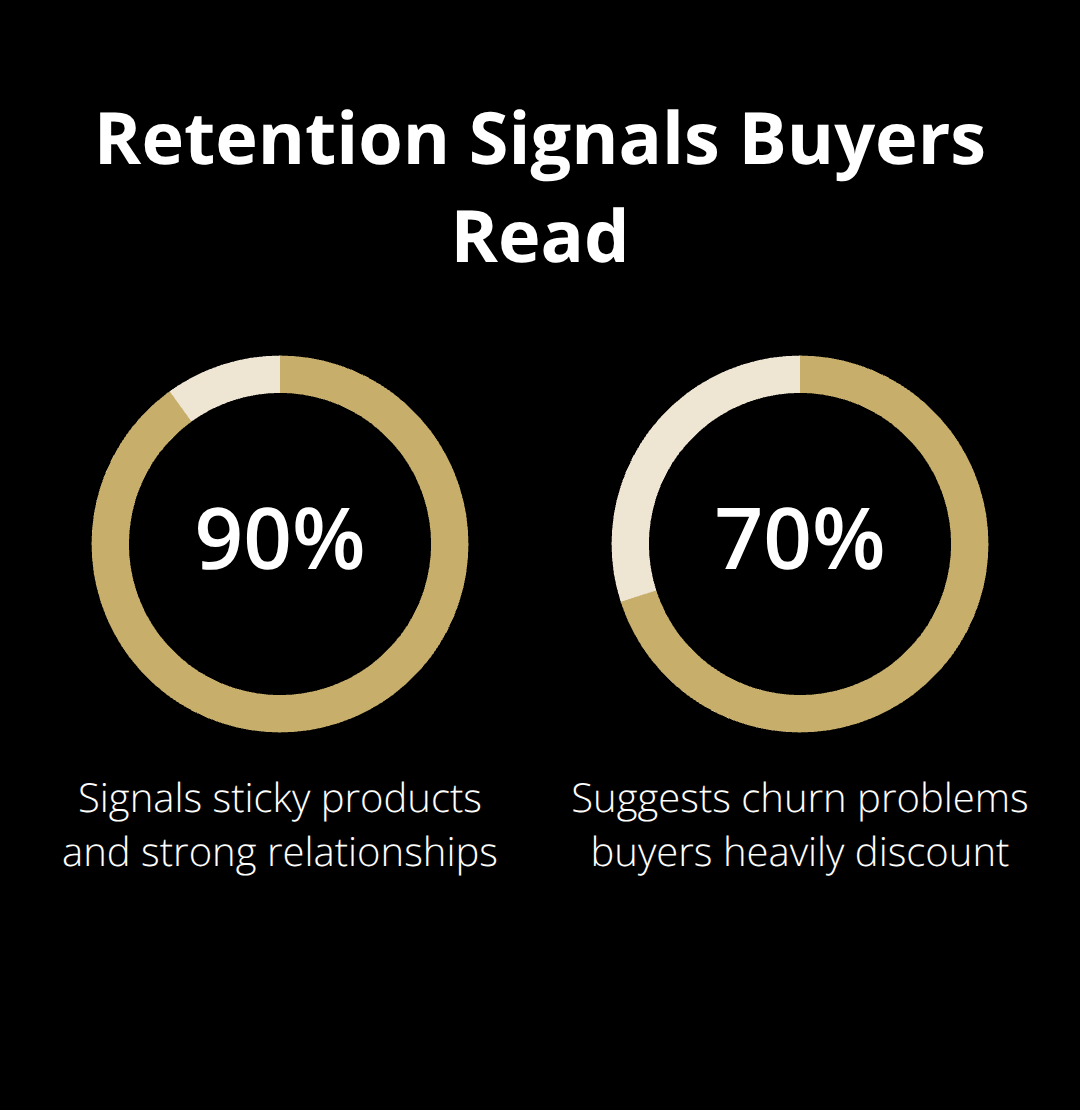
Customer retention and competitive moats determine long-term value more than any single financial metric. Customer retention rate calculation uses the formula [(E-N)÷S] x 100, where E is customers at period end, N is new customers acquired, and S is customers at period start. A 90% retention rate signals sticky products and strong customer relationships, while 70% suggests churn problems that buyers will heavily discount.
Audit your customer concentration through a different lens: switching costs and customer lock-in effects on valuation matter significantly because high switching costs add premium to valuations. Customers locked into your ecosystem stay put, which makes future revenue streams more reliable in a buyer’s eyes.
Intellectual Property and Defensible Advantages
Unique assets matter enormously-proprietary technology, exclusive licenses, patents, or established supplier relationships create defensible competitive advantages. A SaaS company with patented algorithms commands 5x to 8x revenue multiples, while a service business without differentiation might fetch 2x to 3x. Intellectual property gets professionally appraised separately and often becomes a major value driver at sale.
If your competitive advantage relies entirely on your personal relationships or expertise, that’s a major red flag because the business value evaporates when you leave. Buyers want to purchase a self-sustaining operation, not a personal services arrangement. The business must stand on its own merits, independent of your involvement.
With your market position clearly mapped, the next step involves selecting the right valuation methods and assembling the professional guidance that transforms these insights into a defensible price.
Valuation Methods and Professional Guidance
Understanding the Three Core Valuation Approaches
Three main valuation approaches exist, and most buyers expect you to understand which one applies to your situation. The income approach values your business based on the cash it generates, typically using a multiple of EBITDA or free cash flow. This method works best for established businesses with consistent, predictable earnings. A business generating $500,000 in annual EBITDA might fetch a multiple of 4x to 6x that figure depending on growth rate, industry, and risk profile, resulting in a $2 million to $3 million valuation.
The market approach compares your business to similar companies that sold recently, which requires access to real transaction data from your industry. The asset approach calculates value by totaling tangible and intangible assets minus liabilities, useful primarily for asset-heavy businesses or those with low earnings. Most owners make critical mistakes by applying the wrong method to their situation. A service business valued using only the asset approach ignores the revenue streams that actually drive value, while a high-growth tech company valued on trailing EBITDA alone misses the premium buyers pay for future growth potential.
Assembling Documentation Buyers Will Demand
Your job involves gathering documentation that appraisers and buyers will demand anyway. Pull together three to five years of tax returns, financial statements, and bank statements because discrepancies between these documents kill deals faster than anything else. Document your customer contracts, employee agreements, lease terms, and any contingent liabilities that might surprise a buyer during due diligence.
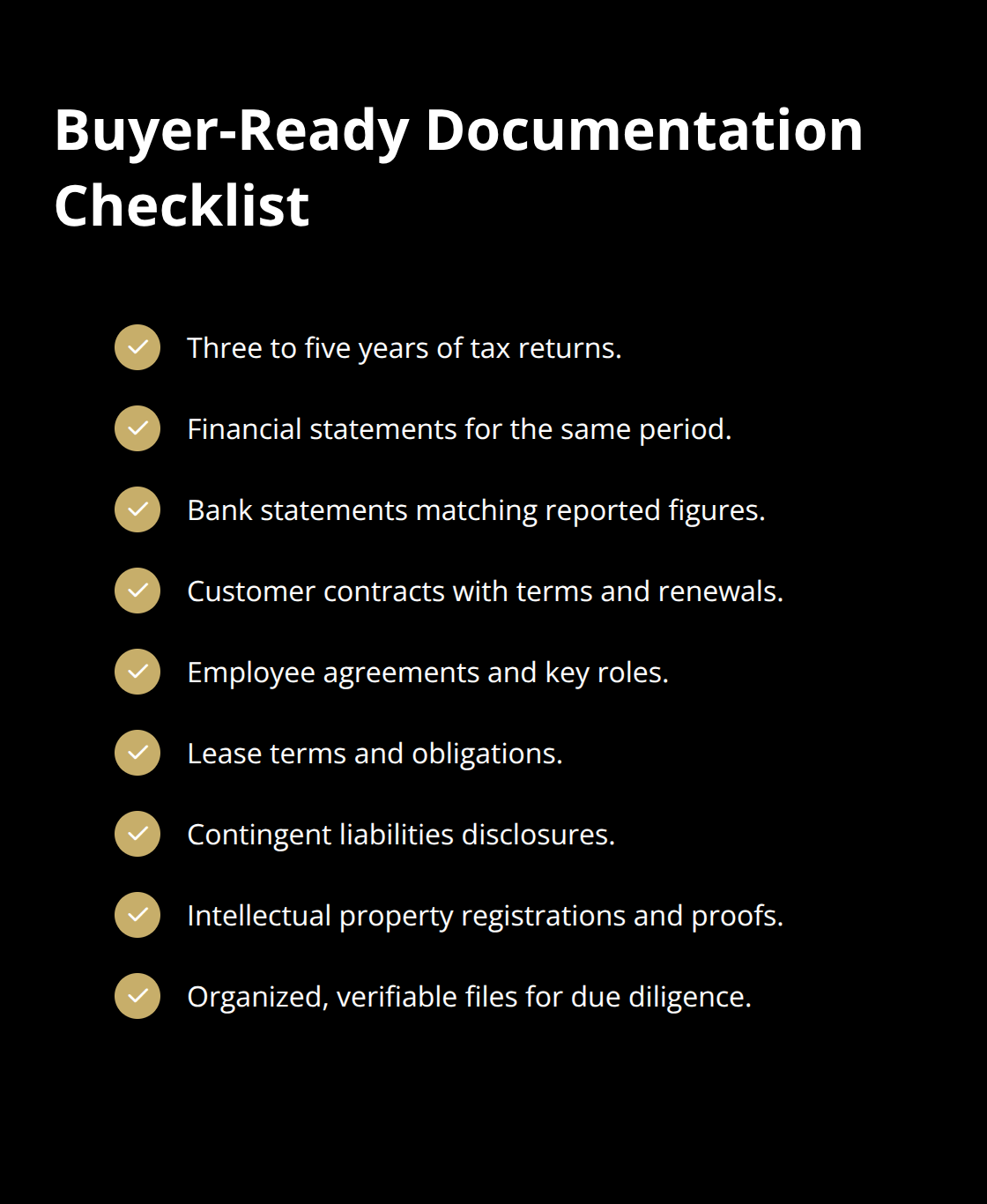
Create a detailed breakdown of your customer base showing the top 20 customers, their annual spend, contract terms, and renewal status. If you have intellectual property, patents, or proprietary processes, compile the registration documents and evidence of how these assets generate competitive advantage. Organize this material systematically so appraisers can verify claims without friction or delays.
Working with Experienced Business Advisors
Professional business advisors, particularly those experienced in your specific industry, identify value drivers you might miss and spot red flags that buyers will use to negotiate down your price. An experienced advisor catches issues like undisclosed liabilities, customer concentration problems, or operational inefficiencies before they become negotiation ammunition. The appraisal process typically costs between $5,000 and $25,000 depending on business complexity, but this investment pays for itself by preventing undervaluation far more costly than the appraisal fee.
Final Thoughts
A business valuation checklist transforms vague assumptions into concrete numbers that buyers respect. You’ve mapped your financial health, positioned your competitive advantage, and identified the valuation methods that apply to your situation. The real work happens when you compile this information into a defensible price that reflects your business’s actual performance and market position.
Accurate pricing determines everything in a business sale. Overprice and you’ll sit on the market while buyers shop elsewhere; underprice and you’ll leave substantial money on the table that you can never recover. The difference between a well-researched valuation and a guess can easily reach six figures or more, depending on your business size. Professional guidance matters because experienced advisors catch valuation mistakes before they cost you.
Organize the documentation you’ve identified throughout this checklist and connect with advisors who understand your specific industry. At Unbroker, we combine expert advisors with AI-driven buyer matching to help you navigate the entire sale process, with a 6% success fee paid only when your business sells. Start by gathering your financial records, customer data, and intellectual property documentation so you’re ready when serious buyers arrive.