Most business owners never create a formal exit plan, even though it’s one of the most important decisions they’ll make. At Unbroker, we’ve seen how the right business exit planning strategy can add hundreds of thousands of dollars to your company’s value.
The difference between a rushed exit and a strategic one comes down to preparation. This roadmap walks you through the exact steps to get there.
Why Most Owners Wait Too Long to Plan
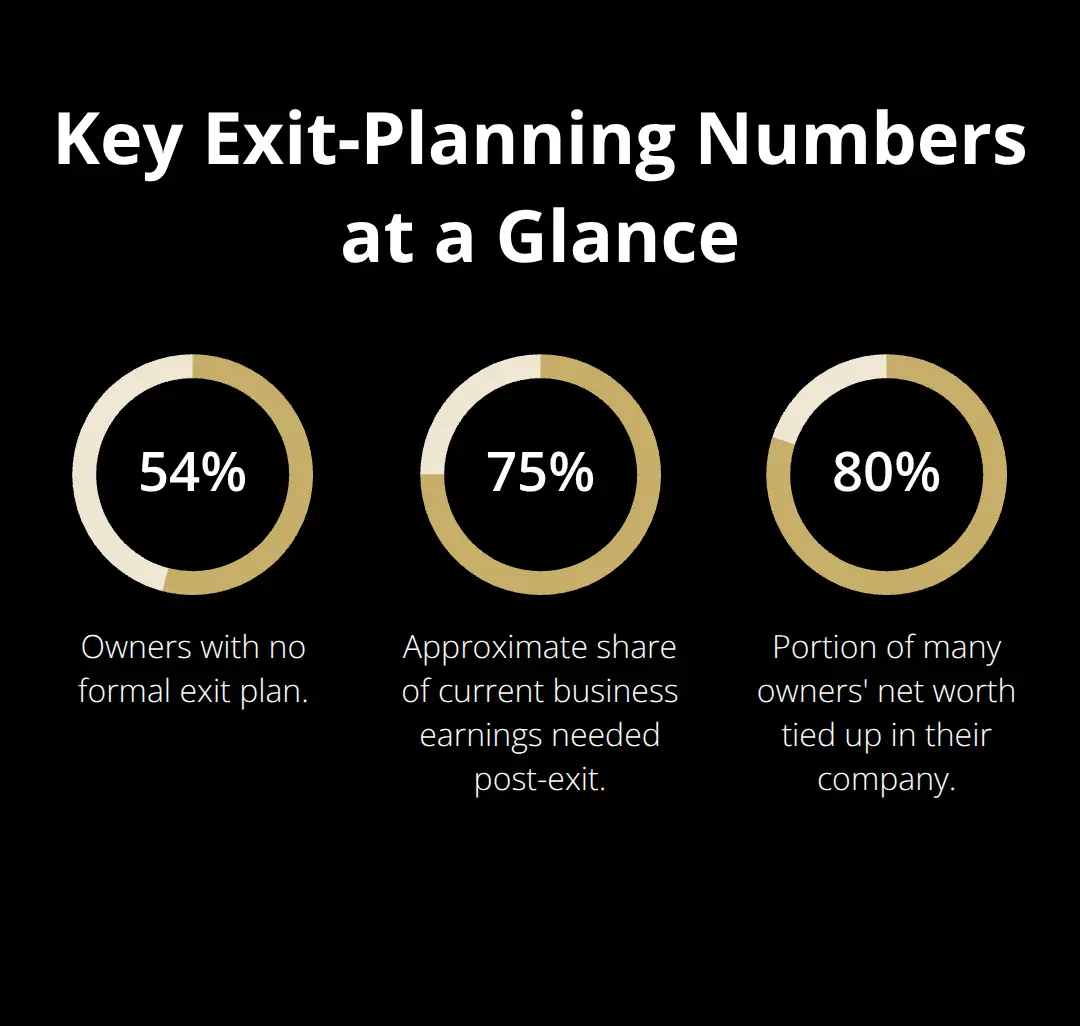
54% of business owners have no formal exit plan, according to industry data. This statistic alone reveals why so many exits underperform financially and emotionally. Without a plan, owners drift into decisions driven by circumstance rather than strategy. A health crisis, market downturn, or family pressure forces a rushed sale at whatever price a buyer offers.
The cost of this inaction is staggering: business valuations typically suffer 20 to 40 percent when owners haven’t prepared their financials, operations, and team for scrutiny. Buyers see disorder and demand discounts. More importantly, owners who skip planning often discover their business value falls short of retirement needs, leaving them with an impossible choice between accepting less money or staying longer than planned. Starting your exit plan three to ten years before your intended departure gives you time to build value systematically rather than scramble at the last moment.
The Real Numbers Behind Valuation
Your business value hinges on cash flow, not revenue alone. Most buyers evaluate small businesses using Seller’s Discretionary Earnings, which measures the normalized, operating profitability of your business. A rough starting point is multiplying your SDE by two to three times to estimate value. If your SDE is $200,000, your business might be worth $400,000 to $600,000. This is why owners who normalize their financial records before sale see dramatically higher offers. Remove one-time expenses, document recurring revenue streams, and clarify which costs are truly necessary. Buyers pay premiums for predictable cash flow and operational independence from the owner. A business that generates $100,000 annually in recurring subscription revenue sells for more than one relying on sporadic projects, even if both produce the same total income. Up to 80 percent of an owner’s net worth sits in their company, making accurate valuation essential to understanding whether your exit will actually fund your retirement.
Stress Dissolves When You Control the Timeline
A planned exit lets you set the timeline and terms rather than react to external pressure. Owners with no plan often face sudden events: a key employee leaves, a major customer departs, or health issues force an immediate decision. These crises drive down value and eliminate your ability to negotiate. With a formal plan anchored to a specific target date, you gain control. You can phase out your involvement gradually, develop your management team, and build systems that work without you. This independence from the owner is one of the key value drivers that buyers evaluate. A business running smoothly under strong management commands higher multiples and attracts more qualified buyers. The planning process itself reduces uncertainty by forcing you to confront financial reality early. You’ll know within months whether your business value meets your retirement target or whether you need to focus on value-building activities first. This clarity eliminates years of vague worry and replaces it with concrete, actionable steps.
What Happens Next in Your Exit Journey
The foundation you build now-clear financials, strong operations, and a capable team-directly shapes what buyers will pay and how smoothly your transition unfolds. The next section walks you through the specific steps to define your timeline, assess your current position, and select the exit path that aligns with your goals.
Building Your Exit Strategy
Set Your Target Departure Date
A concrete departure date anchors your strategy and drives action. Too many owners treat their target exit year as a vague aspiration rather than a fixed commitment. Set your target departure date to maintain momentum through preparation. Your target date should account for both personal goals and business readiness. If you want to exit in five years, work backward: what does your business need to achieve in year one, two, and three to command top-dollar offers? A typical timeline spans three to ten years, with five to seven years being the sweet spot for most owners. This window gives you time to normalize financials, strengthen operations, and develop independent management without rushing.
Calculate Your Financial Gap
Your financial goal isn’t just a retirement number-it’s the gap between what you need and what your business will likely provide. Calculate your target retirement income, estimate that you’ll need about 75% of your current business earnings post-exit, then subtract your business’s projected sale value. That gap tells you whether your current exit plan works or whether you need to focus on building business value first. If you’re projecting an SDE of $200,000 and a 2.5x multiple, your business might sell for $500,000. If you need $750,000 to retire comfortably, you have a $250,000 shortfall. That forces a real decision: stay longer to build more value, adjust your retirement expectations, or accelerate profitability improvements now.
Identify Your Weakest Value Drivers
Assessing your market position requires honest evaluation of what buyers actually see, not what you hope they see. Request a preliminary valuation from a professional-not to set a price, but to understand which factors are holding your business back. Most small businesses trade on cash flow multiples, but within that framework, buyers scrutinize growth trajectory, customer concentration, recurring revenue, and management depth. If a significant portion of your revenue comes from one customer, that’s a red flag that suppresses your multiple. If your management team relies entirely on you, buyers discount future stability. These aren’t minor issues-they can reduce your valuation by 20 to 30 percent. Spend the next year or two systematically addressing your weakest value drivers. Diversify customer concentration by landing three to five new accounts. Document your sales process and train a sales manager to own client relationships. These concrete improvements compound over time and translate directly into higher offers.
Choose Your Exit Path
Once you’ve assessed your position, choosing between a third-party sale, family succession, or employee ownership becomes clearer. A sale to an outside buyer typically yields the fastest liquidity and favorable capital gains treatment, but you lose operational control and face potential earn-out risks. Family succession preserves your legacy and keeps the business lineage intact, but historically fewer than 30% of family-owned businesses survive to the second generation-usually because successors lack real operating experience before taking the helm. Employee ownership through mechanisms like management buyouts or ESOPs transfers equity to people who understand your business, maintains company culture, and can qualify for certain tax benefits, but requires careful structuring and genuine alignment of interests. Your choice reflects what matters most: speed, legacy, culture, or financial certainty. The path you select shapes everything that follows-from how you prepare your operations to which advisors you engage and how you structure the deal itself.
What Buyers Actually Look for When They Inspect Your Business
Buyers evaluate your business through a lens entirely different from yours. They ignore the effort you’ve invested or the vision you’ve built over decades. Instead, they focus on three concrete factors: whether your financials are clean and verifiable, whether your business operates independently of you, and whether your customer relationships rest on genuine product value rather than personal ties. Most owners fail this inspection because they’ve never prepared for it. Your accounting software might show profit, but if your records mix personal and business expenses, a buyer’s accountant will spend weeks normalizing your numbers and demand a discount to account for uncertainty. Your operations might function smoothly in practice, but if only you understand the sales process, manage key accounts, or make critical decisions, buyers see a person-dependent business worth significantly less than an independent one. Your customer base might appear loyal, but if that loyalty stems from personal relationships with you rather than the actual product or service, it evaporates the moment you exit.
Clean Financials That Withstand Scrutiny
Separate your personal finances from business finances completely. If you take irregular distributions, pay personal expenses through the business, or blur lines between owner draws and legitimate business costs, hire an accountant now to restate your last three to five years of financial statements. One of the most important steps in preparing financials for a transaction is normalizing EBITDA. This process removes one-time items, documents recurring revenue clearly, and adjusts for owner compensation to show what a new owner would actually earn. A buyer needs to see consistent, auditable profit trends, not raw numbers that raise questions. The normalization work takes time, but it directly translates into higher offers. Buyers pay premiums for financial clarity because it reduces their risk and speeds their decision-making process.
Document Every Critical Process
Write down every critical process in your business. If you’re the only person who knows how to close deals, land customers, manage inventory, or handle vendor relationships, document it now. By documenting processes, you can reduce guesswork and make it easier for people to repeat those functions. Create simple process documents, checklists, and decision trees so that someone else could step in tomorrow and execute those functions effectively. This isn’t about perfection; it’s about proving independence. When a buyer sees documented systems, they envision the business running smoothly under new ownership. Without documentation, they assume everything depends on you and discount your valuation accordingly.
Transition Customer Relationships Away from You
Shift your customer relationships away from you personally. If you meet every client, attend every major conversation, or sign every contract, customers see you as the business. Start having your sales manager or account manager own those relationships. Invite them to client meetings, have them present proposals, and gradually shift the trust. This transition takes months, but it fundamentally changes how buyers perceive your business. A business where customers trust the team rather than the owner commands higher multiples and attracts more qualified buyers. Track this shift through Net Promoter Score surveys; measure whether customers are promoters or detractors of your business specifically, not just fans of you. Survey your customers every nine to twelve months to monitor progress. Customers with high NPS scores toward your company rather than you as an individual are far more likely to stay post-acquisition.
Final Thoughts
Exit planning isn’t something you finish and file away-it shapes how you run your business today and what happens tomorrow. The concrete steps matter most: set your target departure date, calculate your financial gap, identify which value drivers hold you back, and choose your exit path. These decisions force clarity and eliminate the vague anxiety that plagues owners without a plan.
Owners who start business exit planning three to ten years before their intended exit build significantly more value than those who rush. You gain time to normalize financials, strengthen operations, and develop independent management while you control the timeline rather than react to crisis. Professional guidance accelerates this process dramatically-an accountant restates your financials, a valuation expert identifies which factors suppress your multiple, and a business advisor coordinates your entire strategy.
We at Unbroker understand that selling a business shouldn’t require paying traditional brokerage fees that drain your proceeds. Unbroker provides the tools and network you need without hidden fees or unnecessary complexity, whether you want hands-off support or prefer to lead the process yourself with expert guidance. Write down your target departure date today, calculate what your business needs to be worth, and identify one value driver to improve this year.