Selling a business is one of the biggest financial decisions you’ll make. Getting the valuation right determines whether you walk away with fair value or leave money on the table.
At Unbroker, we’ve seen too many sellers price their businesses without understanding the fundamentals. Business valuation basics aren’t complicated-they’re just numbers that matter.
What Actually Drives Your Business Value
Most sellers focus on revenue as the primary value driver, but that’s where the confusion starts. A business generating $2 million in revenue isn’t automatically worth more than one generating $1.5 million if the second business converts that revenue into significantly higher profits. Profitability is what buyers actually care about, and they measure it through EBITDA-an alternate measure of profitability to net income. Middle-market businesses typically sell for 4 to 7 times EBITDA, while smaller businesses under $5 million in revenue command 2 to 3 times EBITDA due to higher perceived risk. This means a $1 million EBITDA business in the middle market could reasonably expect a valuation between $4 million and $7 million, whereas a smaller business with the same EBITDA might fetch only $2 to $3 million. The gap exists because larger businesses demonstrate more stability, diversified customer bases, and professional management structures that reduce buyer risk. To maximize your valuation, you need to show consistent profitability trends across multiple years, not just a single strong year. Buyers want to see normalized earnings-your actual operating profit stripped of one-time expenses, owner discretionary spending, and personal costs paid through the company. If you’ve been running company vehicles as personal assets or paying family members above-market salaries, those need to be removed from your financials to reveal true earning power.
Growth Trajectory Matters More Than Current Size
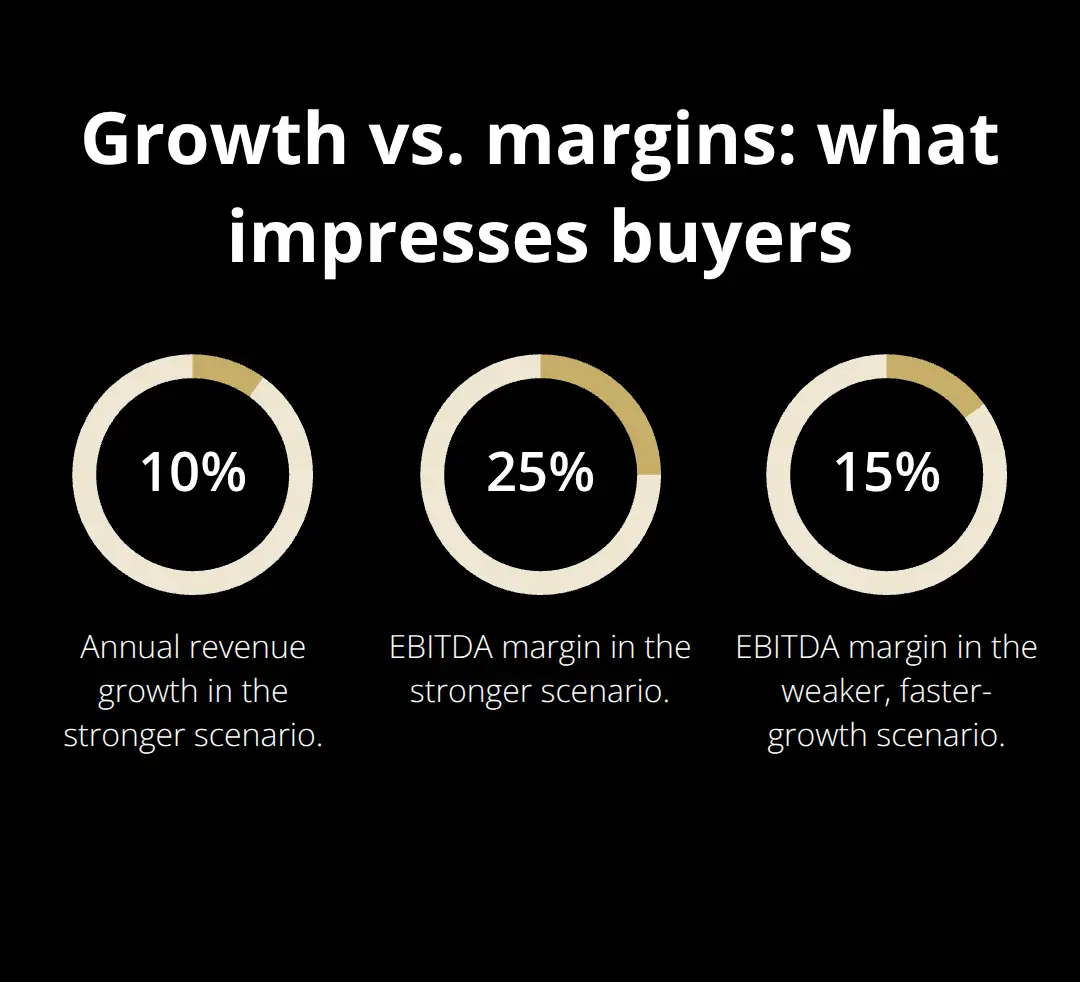
A business with flat revenue but improving margins often attracts more buyer interest than a fast-growing business with declining profitability. Buyers project future cash flows, so demonstrating a clear path to increased revenue or margin expansion directly impacts valuation. A company showing 10 percent annual revenue growth with stable 25 percent EBITDA margins tells a stronger story than one with 20 percent revenue growth but margins compressed to 15 percent.
Your market position and competitive advantages determine whether growth is sustainable or fragile. If your business dominates a specific niche with high switching costs and loyal customers, buyers perceive lower risk and justify higher multiples. Conversely, if you operate in a commoditized market with thin margins and intense competition, even strong revenue numbers won’t command premium valuations. The quality of your customer base directly impacts valuation too. A business with ten customers representing 80 percent of revenue carries significantly more risk than one with diversified revenue across hundreds of customers. Buyers will discount your value if they see customer concentration because they know retention becomes uncertain after ownership changes.
Cash Flow and Assets Form the Valuation Foundation
Your balance sheet tells buyers whether your business can sustain itself operationally and service debt. Strong working capital-the difference between current assets and current liabilities-demonstrates operational efficiency and reduces buyer financing risk. If your business requires constant cash infusions to fund inventory or receivables, that’s a red flag that suppresses valuation. Conversely, a business that generates cash faster than it spends it becomes more attractive because the buyer inherits a cash-generating machine rather than a cash-draining operation. Physical and intangible assets also matter, though differently. Real estate, equipment, and inventory provide tangible value that appears on the balance sheet, but they often represent a floor valuation rather than the true price. Intangible assets-your brand reputation, customer relationships, proprietary processes, and management team-typically drive the premium that buyers pay above asset value. A service business with minimal physical assets but strong recurring revenue and brand recognition often commands higher multiples than an asset-heavy manufacturing business with equivalent EBITDA because the service business’s earnings are more predictable and less dependent on capital replacement.
What Comes Next in Your Valuation Journey
Understanding what drives value sets the foundation, but knowing how to measure it separates sellers who negotiate from positions of strength from those who accept whatever offer arrives first. The three valuation methods-income, market, and asset-based approaches-each reveal different perspectives on what your business is worth, and the most credible valuations combine all three to produce a defensible range rather than a single number.
How the Three Valuation Methods Work
The Income Approach: What Your Business Earns
The income approach values your business based on what it earns, and this is where most professional valuations start because it directly answers the question buyers ask: what cash will this investment generate? The income approach typically uses EBITDA multiples as a shortcut, but the real calculation works like this-take your normalized EBITDA, apply a capitalization rate that reflects risk and market conditions, and you get enterprise value. A business generating $500,000 in EBITDA with a 20 percent capitalization rate produces a $2.5 million valuation.
The capitalization rate varies by industry, business stability, and growth prospects; a mature business with predictable cash flows might use 20 percent while a faster-growing business might justify 15 percent, which produces a higher valuation for the same earnings. The income approach works best when your business has consistent, documented profitability across multiple years because buyers need proof that earnings are sustainable, not a one-time spike. If your EBITDA fluctuates wildly year to year, adjust for that volatility by averaging normalized earnings across three to five years, removing extraordinary expenses and owner discretionary costs.
This method heavily favors profitable businesses with clear growth trajectories, which is why showing margin improvement or revenue acceleration matters more than absolute size.
The Market Approach: What Comparable Businesses Sold For
The market approach compares your business to recently sold companies in your industry and region, using real transaction data to ground valuation in what actual buyers paid. This requires finding genuinely comparable sales-same industry, similar revenue size, comparable profitability-and then applying multiples like EV/EBITDA or revenue multiples to your numbers. Middle-market businesses selling for 4 to 7 times EBITDA means if you identify five comparable sales in your sector, you can weight each transaction and calculate where your business likely falls within that range.
The challenge is data quality; most private business sales lack public disclosure, so you’re often working with incomplete information from industry databases, broker networks, or secondhand reports. Adjustments are critical-if a comparable company has a customer concentration problem you don’t have, or operates in a different geographic market with higher growth, those differences shift the multiple up or down.
The Asset-Based Approach: Your Balance Sheet Floor
The asset-based approach values what your business owns minus what it owes, which serves as a valuation floor rather than a ceiling. For asset-heavy businesses like manufacturing or real estate, this method provides meaningful insight because tangible assets represent significant value. For service or software businesses, the asset approach typically produces artificially low numbers because it ignores intangible value like customer relationships and brand reputation.
Use the asset approach as a sanity check-if your income-based valuation is $3 million but your net assets total only $500,000, that gap represents the premium buyers pay for your earnings power and growth potential, which is reasonable for profitable businesses but should prompt questions if earnings are unstable. The three methods rarely produce identical numbers, and that’s intentional; each reveals different perspectives on value.
Combining Methods for a Defensible Range
Professional valuations weight all three approaches rather than relying on a single method. An income approach might suggest $2.8 million, comparable sales might indicate $3.1 million, and asset value might establish a $1.2 million floor. A credible valuation presents this range and explains which method carries the most weight for your specific business.

The income approach typically receives the highest weight for profitable, cash-generating businesses because it directly reflects what buyers will earn. The market approach provides the strongest reality check because it shows what actual transactions have commanded in your sector. The asset approach matters most when your business carries significant physical assets or when profitability is inconsistent.
Understanding which method applies best to your situation positions you to negotiate from strength. The next step is learning how to present your valuation to buyers in a way that makes them confident in the price you’re asking.
Why Your Valuation Determines Your Sale Outcome
A realistic valuation separates sellers who close deals from those who watch their businesses sit on the market unsold. The gap between what you think your business is worth and what buyers will actually pay determines whether you negotiate from strength or desperation. Sellers who price based on emotion or arbitrary multiples without understanding their actual earnings power either scare away qualified buyers with inflated asking prices or accept lowball offers because they lack confidence in their numbers. The harsh reality is that your valuation isn’t a suggestion or an anchor point for negotiation-it’s a statement about your business’s actual cash-generating capacity, and buyers verify it through their own financial analysis.
Setting Your Asking Price Based on Data
When your asking price aligns with what comparable businesses sold for and what your normalized EBITDA justifies, qualified buyers respond. When it doesn’t, you either attract only bargain hunters or get no serious inquiries at all. Most private business sales happen within 10 to 15 percent of the initial asking price according to transaction data from middle-market firms, which means your opening number matters enormously. Set it too high and you waste months on the market while serious buyers move on to priced-appropriately alternatives. Set it too low and you leave hundreds of thousands of dollars on the table that you’ll never recover.
The difference between a $3 million asking price and a $3.5 million asking price on a business with $500,000 in EBITDA isn’t just accounting-it’s the difference between six times EBITDA and seven times EBITDA, both defensible multiples. Yet most sellers choose a number intuitively rather than grounding it in the three valuation methods, which creates confusion during buyer conversations and weakens negotiating power.
How Buyers Verify Your Valuation
Qualified buyers conduct their own due diligence and financial modeling, so they quickly identify whether your asking price reflects reality or fantasy. A buyer analyzing your business will normalize your EBITDA, apply industry multiples, compare to recent comparable sales, and calculate their own valuation range. If your asking price sits significantly above that range without clear explanation, the buyer assumes you’re either uninformed or unwilling to accept market reality, both of which signal a difficult negotiation ahead.
Conversely, when your valuation is supported by documented earnings, industry benchmarks, and comparable transaction data, buyers perceive legitimacy and move faster toward offers. The speed of the sale process directly correlates to the confidence your valuation instills.
The Cost of Pricing Mistakes
Overpriced businesses linger on the market, attracting only tire-kickers and strategic lowball offers designed to test your resolve. Accurately priced businesses generate multiple offers within weeks because serious buyers recognize fair value and compete for the opportunity. This competition among buyers is what actually increases your final sale price above your asking price-not negotiation tactics or holding firm on inflated numbers.
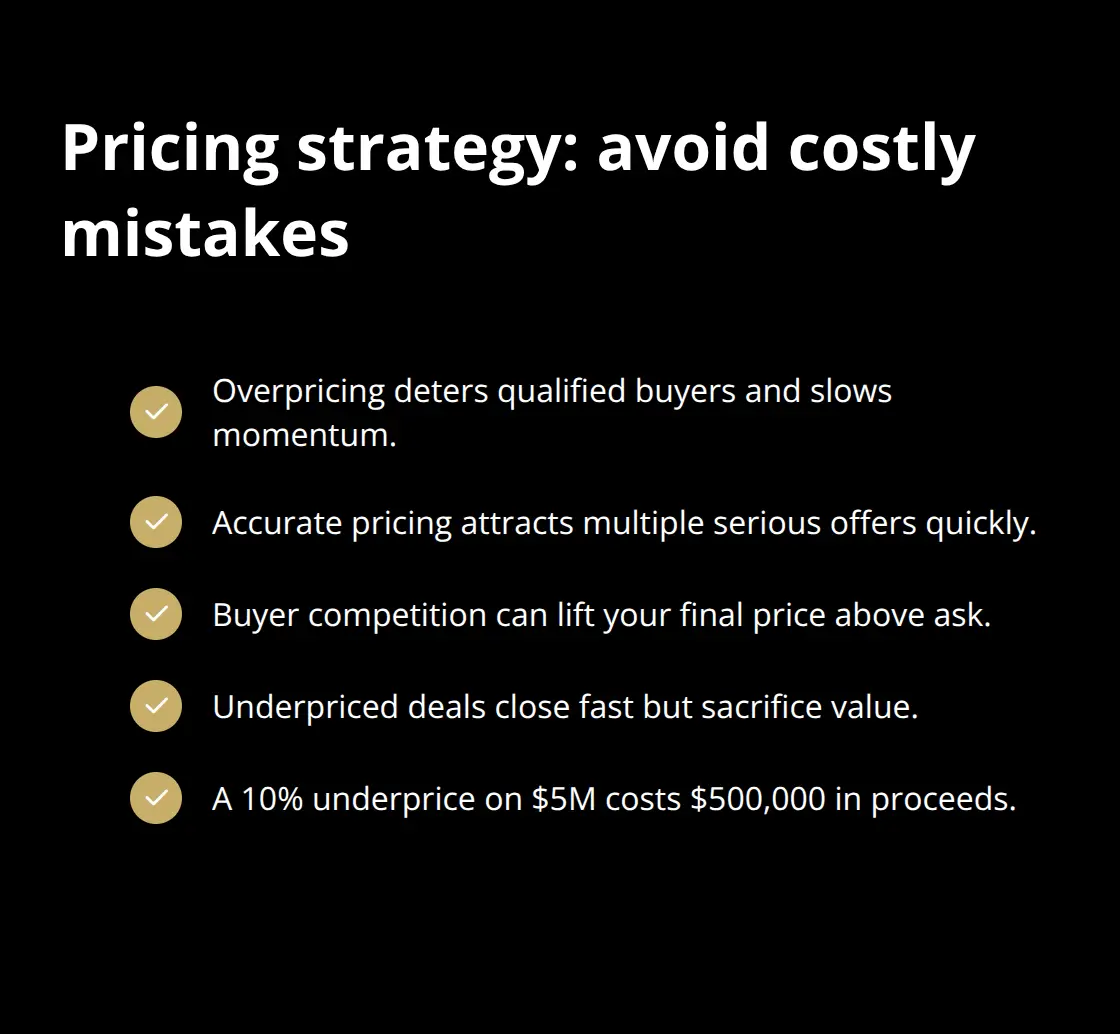
A business with three serious offers at $3 million when you asked $2.8 million produces better outcomes than one with a single offer at $2.5 million against a $3.5 million ask. Underpriced businesses disappear quickly, which feels like success until you realize six months later that you left significant value on the table. The cost of underpricing a $5 million business by just 10 percent is $500,000 in lost proceeds that you can never recover.
Final Thoughts
Business valuation basics rest on three core principles: understand what drives your value, measure it using multiple methods, and price accordingly. Most sellers skip this foundation and wonder why their businesses either languish on the market or sell for less than they deserve. The income approach, market approach, and asset-based approach aren’t theoretical exercises-they’re the language buyers speak when evaluating your business, and mastering them transforms how you negotiate.
Before you list your business, organize your financial history to tell a clear story by gathering multiple years of profit and loss statements, tax returns, and balance sheets. Remove discretionary owner spending and one-time expenses to reveal normalized EBITDA, which transforms vague conversations into concrete negotiations backed by numbers. Your asking price should reflect what comparable businesses in your industry actually sold for, weighted against your specific earnings power and growth trajectory (a business generating $400,000 in EBITDA deserves a different multiple than one generating $1 million).
Buyers will conduct their own analysis and negotiate based on what they discover during due diligence, so your valuation isn’t final-it’s a defensible starting point. When your valuation is grounded in documented earnings and industry benchmarks, negotiations happen faster and outcomes improve. We at Unbroker help sellers navigate this process with transparent pricing and expert support, so start by getting your numbers organized and your valuation clear.