Most small business owners have no idea what their company is actually worth. At Unbroker, we’ve seen this gap cost owners thousands when they try to sell, refinance, or plan for the future.
Understanding small business valuation basics doesn’t require an MBA. We’ll walk you through the three methods that actually matter and show you which factors move your valuation needle.
What Your Business Valuation Actually Means
A business valuation is the dollar amount your company would sell for today in an arm’s length transaction. It’s not what you think it’s worth or what you hope to get. It’s what a reasonable buyer would actually pay based on financials, market conditions, and the business itself. The core purpose is straightforward: to give you a defensible number for selling, refinancing, estate planning, or partnership disputes. Most small business owners skip this step entirely, which means they either leave money on the table during a sale or overpay when buying.
The Data Problem That Affects Your Valuation
Statistics Canada found that there are just over 1 million small businesses in Canada but only about 14 million residential dwellings. This matters because real estate has established comparable sales data everywhere. Small businesses don’t. Most are private, owners don’t disclose sales information publicly, and finding truly comparable businesses is nearly impossible. That’s why many small business owners rely on quick online calculators or rules of thumb that multiply cash flow by three or four. These shortcuts might get you in the ballpark, but they ignore critical factors like your customer concentration, market position, and whether your revenue actually translates to profit.
Why You Need to Know This Number Now
Small business owners typically think about valuation only when they’re already selling or facing a financial crisis. That’s a mistake. Knowing your business value right now helps you make better decisions about growth investments, debt financing, and whether to hold or exit. A buyer won’t value your business based on sweat equity or how long you’ve worked. They value it on cash flow, customer retention, and how replaceable you are. If your business falls apart the moment you step away, that’s a major value killer. If 40 percent of your revenue comes from three customers, that’s another red flag that tanks valuations.
Three Misconceptions That Cost Owners Money
Many believe that revenue equals value, but two businesses with identical sales can have vastly different valuations if one is profitable and the other barely breaks even. Others think location doesn’t matter much for valuation, yet a growing neighborhood versus a declining town can shift value significantly. The biggest misconception is that business valuation is a precise science with one correct answer. It’s not. Valuation is both art and science. Professional valuators blend multiple methods-asset-based, income-based, and market-based approaches-to triangulate a defensible range rather than a single number. Understanding these three approaches is what separates owners who negotiate from a position of strength from those who accept whatever offer lands on the table.
How the Three Valuation Methods Actually Work
Asset-based valuation calculates what your business is worth by adding up everything you own and subtracting what you owe. This includes equipment, inventory, real estate, customer lists, and intellectual property. Then you subtract all liabilities: loans, vendor payables, and other debts. What’s left is your net asset value. This method works best if your business is asset-heavy, like manufacturing, retail, or equipment rental. It also establishes the floor value in any sale scenario. If your business fails, a buyer pays at least what your assets are worth.
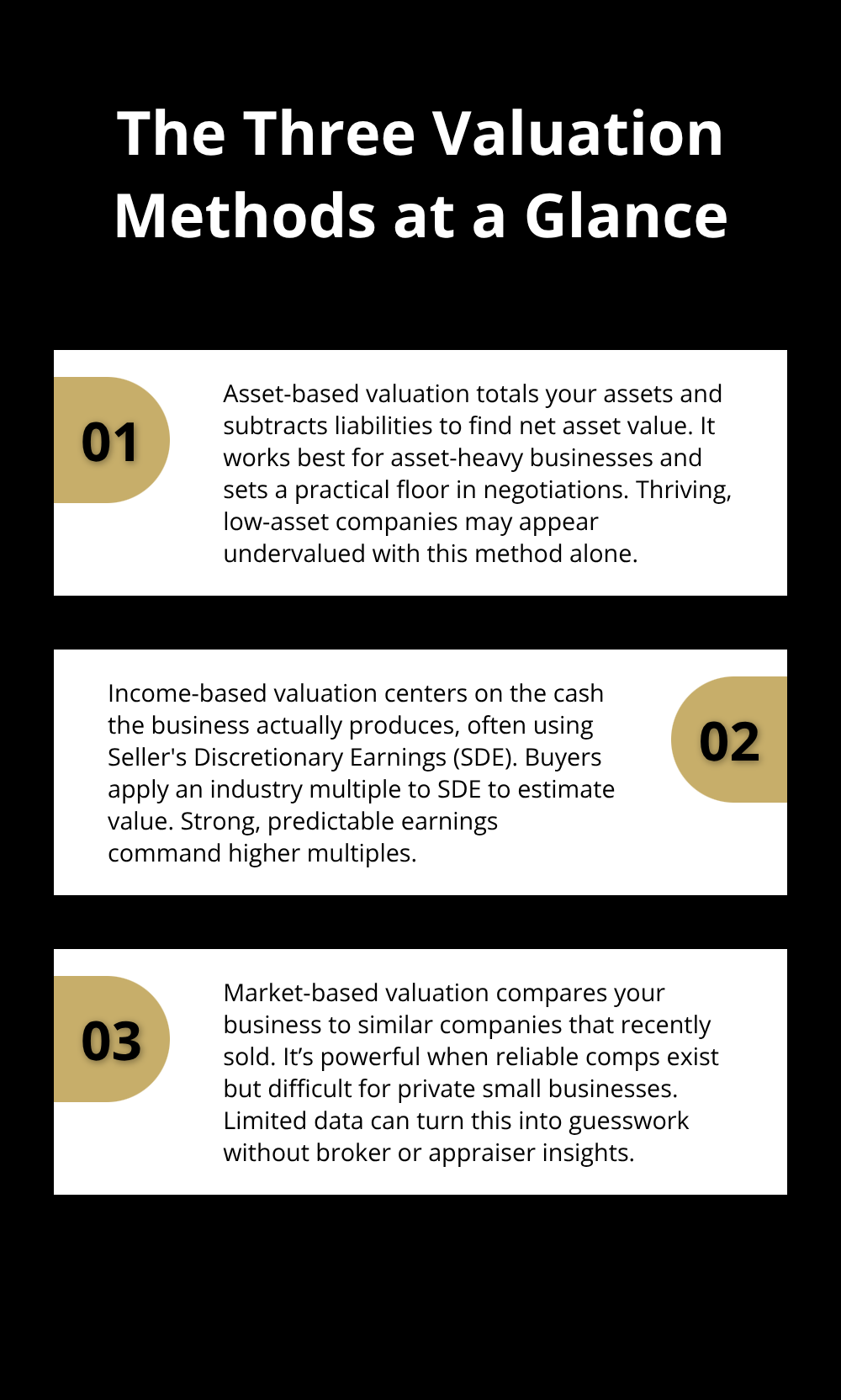
The weakness is obvious: this number often undervalues thriving businesses. A software company with almost no physical assets but millions in recurring revenue would look worthless on an asset sheet alone. Net asset value gives you a lower bound, not a fair market price. Most small business owners find their asset value falls far short of what they actually expect to receive, which is why this method alone never tells the full story.
Income-Based Valuation Focuses on What Your Business Actually Earns
This method values your business based on the money it generates, not what sits on the balance sheet. The most practical version for small businesses involves calculating Seller’s Discretionary Earnings, or SDE. Start with your net profit, then add back owner salary, owner benefits, depreciation, amortization, and any personal expenses the business paid. This gives you the true cash available to an owner. From there, you apply an industry multiple. If your SDE is $80,000 and the typical small service business sells for 3 to 5 times SDE, your business is worth somewhere between $240,000 and $400,000. The specific multiple depends on your industry, growth rate, and customer concentration. A stable, profitable business with diverse clients commands a higher multiple. A business dependent on one customer or declining revenue gets a lower multiple. Income-based valuation is the most common approach for small business sales because it reflects what a buyer actually cares about: consistent, predictable cash flow. The challenge lies in making realistic earnings projections. If you’ve been hiding income or overstating expenses, this method exposes that immediately.
Market-Based Valuation Requires Data You Probably Don’t Have
This approach values your business by comparing it to similar businesses that recently sold. It’s straightforward in theory: if a comparable landscaping company with similar revenue and profit sold last year for $500,000, yours is worth roughly the same. In practice, this method is nearly impossible for most small business owners. Real estate has comparable sales everywhere. Small businesses don’t. Most are private, sales prices aren’t public, and finding truly comparable transactions is extremely difficult. When you do find comparable data, private businesses typically trade at a 30 to 50 percent discount compared to public company valuations (because they lack liquidity and marketability). The best place to find comparable sales is through business brokers in your industry or professional appraisers who track actual transactions. Without solid comparable data, this method becomes a guess dressed up as analysis.
Why Most Valuations Blend All Three Methods
Each method reveals a different piece of the puzzle. Asset-based valuation shows your financial foundation. Income-based valuation reflects earning power. Market-based valuation anchors your price to real-world transactions. A business worth $300,000 on assets alone might generate $100,000 in SDE (suggesting a $300,000 to $500,000 value) while comparable sales show $350,000. These three numbers create a defensible range rather than a single, arbitrary figure. Professional valuators triangulate across all three approaches to build credibility with buyers, lenders, and tax authorities. Relying on one method alone leaves you vulnerable to challenges and negotiation losses. The method you emphasize should match your goal: selling, refinancing, or estate planning each benefit from different approaches. Understanding which method applies to your situation puts you in control of the valuation conversation instead of accepting whatever number someone else proposes.
What Actually Moves Your Business Valuation
The three valuation methods we covered give you a framework, but they’re only as good as the inputs you feed them. What actually determines whether a buyer pays $250,000 or $500,000 for your business comes down to five concrete factors that show up in your financials and operational reality.
Revenue Trajectory and Profit Margin Drive Buyer Premiums
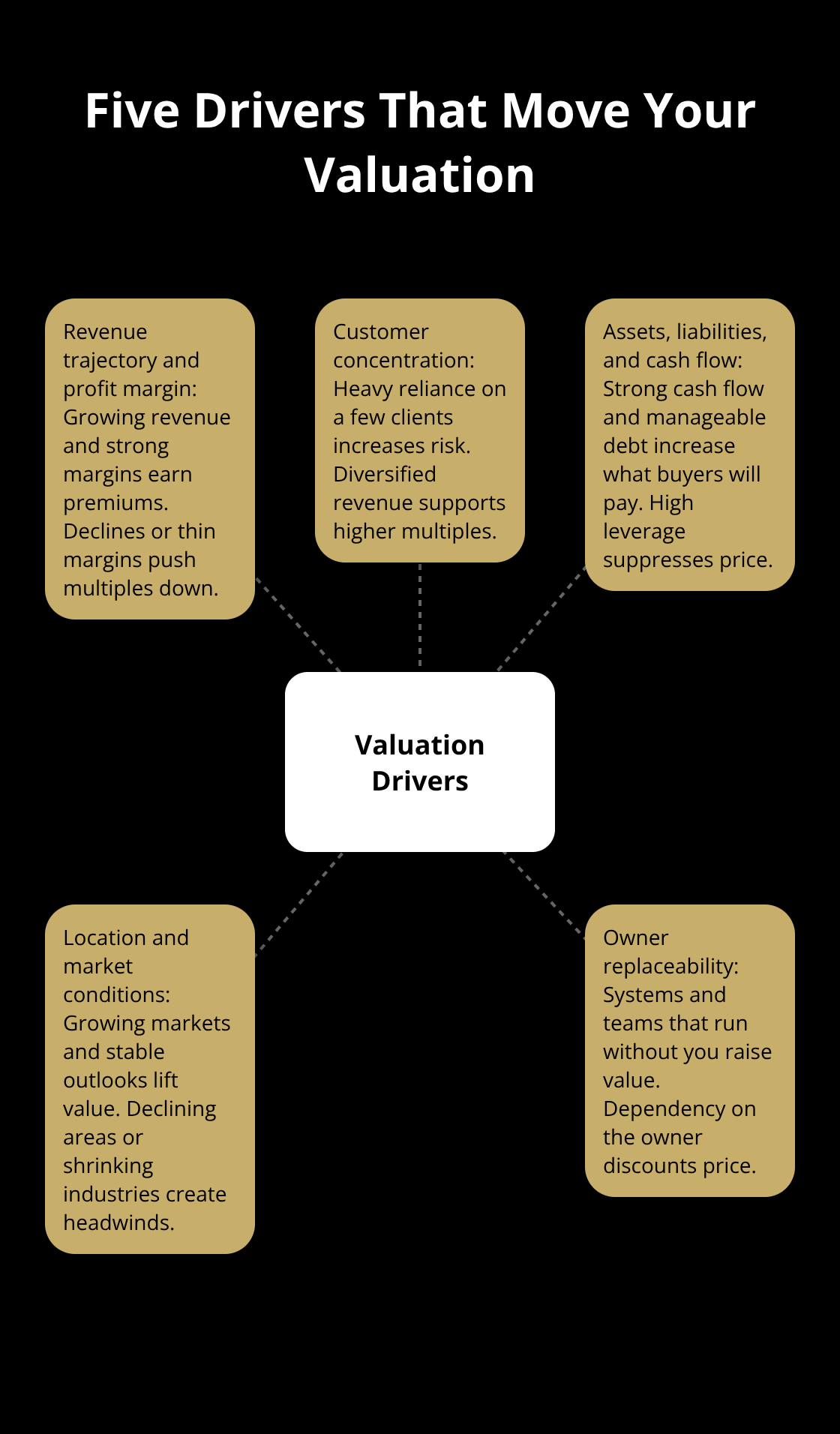
A business that grows 20 percent year-over-year with 30 percent net profit commands far higher valuations than a flat business with 5 percent margins, even if current revenue is identical. Buyers pay premiums for momentum and predictability. If your last three years show declining revenue, you face an uphill battle in any negotiation. Your profit trend matters more than absolute revenue size because revenue trajectory and profit margin reveals whether you actually make money or just move sales volume. A buyer evaluates whether your earnings will sustain after purchase, not whether you’ve simply accumulated high sales numbers.
Customer Concentration Creates Valuation Risk
If 40 percent of your revenue comes from three customers, professional valuators apply a concentration discount that can reduce your valuation by 20 to 40 percent. A buyer sees immediate risk: lose one major client and your business collapses.
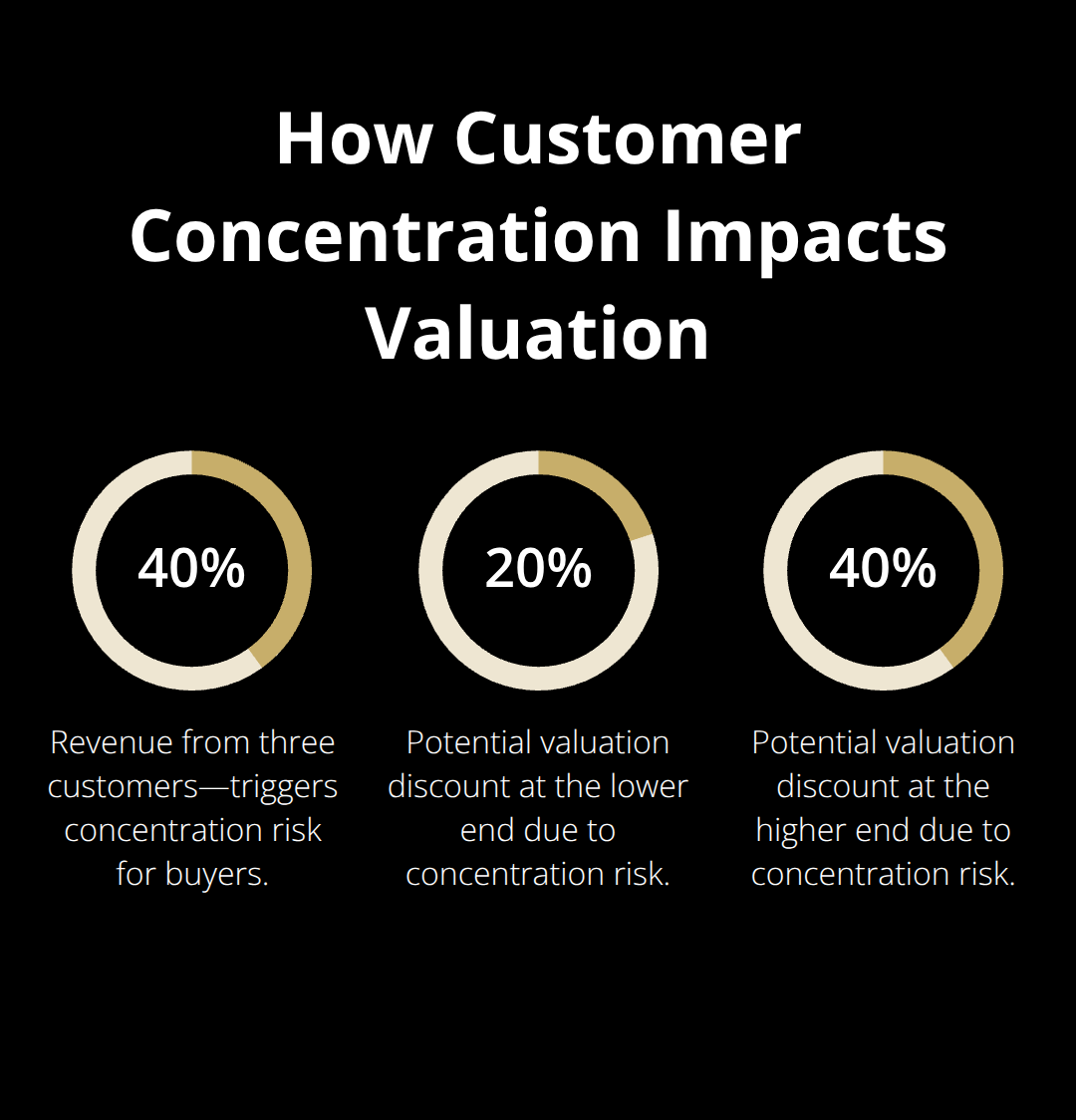
Customer concentration risk means diversified revenue across dozens of customers commands higher multiples because the business survives losing individual accounts. This single factor often separates businesses that sell quickly at premium prices from those that languish on the market.
Assets, Liabilities, and Cash Flow Shape What Buyers Will Pay
A business with $100,000 in Seller’s Discretionary Earnings but $200,000 in outstanding debt looks riskier than one with minimal liabilities, even if earnings are identical. Cash flow matters because a buyer needs to service existing debt while extracting profit. If your business generates $100,000 in annual cash but owes $80,000 annually in payments, the buyer has only $20,000 left for themselves. That constrains what they’ll pay upfront and forces you to accept lower offers.
Location and Market Conditions Affect Value Beyond the Numbers
Market trends and economic stability significantly affect value beyond comparable revenue or profit figures. A service business in a growing neighborhood commands higher multiples than an identical business in a declining area. Economic outlook matters too. A business operating in a shrinking industry faces valuation headwinds regardless of current profitability. These external factors sit outside your control but heavily influence what a buyer will offer.
Owner Replaceability Determines Premium or Discount Pricing
If the business depends entirely on your relationships, skills, or daily involvement, the valuation drops substantially. A buyer purchasing your business expects to either step into your role or hire someone to replace you. Owner replaceability and business systems determine whether you receive premium or discount pricing. Conversely, a business with documented systems, a trained management team, and customer relationships that survive your departure commands premium pricing. Professional valuators assess all five factors together to determine which multiple within an industry range applies to your specific situation. You might find that comparable small service businesses sell for 3 to 5 times SDE, but your customer concentration and owner dependency push you toward the 3x end while a competitor with stable, diversified revenue hits 5x. Understanding where your business stands on each factor gives you concrete targets for improvement before pursuing a sale or refinance.
Final Thoughts
You now understand small business valuation basics and how the three methods work together to establish what your business is actually worth. Asset-based valuation provides your floor value, income-based valuation reflects your earning power through SDE and industry multiples, and market-based valuation anchors your price to real transactions. The five factors that move your valuation-revenue trajectory, customer concentration, assets and liabilities, market conditions, and owner replaceability-show you exactly where to focus before selling or refinancing.
Knowing your business value transforms how you make decisions about growth investments, debt financing, and whether to hold or exit. You negotiate from strength instead of accepting whatever offer arrives first, and you identify which operational improvements actually increase value. If you’re selling within the next year, a professional valuation from an accredited appraiser costs $5,000 to $20,000 depending on complexity, but it pays for itself through better negotiation outcomes and defensibility with buyers and lenders.
When you’re ready to sell, Unbroker offers transparent, low-cost options that eliminate high brokerage fees and connect you with a vast buyer network. You maintain control while accessing premium marketing tools without hidden costs, whether you choose hands-off selling or expert support throughout the process.