A plumbing company is hard to hand over because so much of it sits in people: a licensed qualifier, a crew that knows the customers, and an owner who still picks up the phone at 10 p.m. This guide shows you how to sell a plumbing business by getting those pieces ready before a buyer asks about them.
You will see how buyers think about licenses, technicians, service versus project revenue, the numbers, and equipment. You will also get advice on staying confidential, a way to choose between a managed sale and a hands-on one, and a pre-listing checklist you can start on this week.
Why Plumbing Companies Attract Buyers: Steady Demand and a Tight Labor Pool
Buyers look at plumbing because the work does not go away. The Bureau of Labor Statistics (BLS) says demand for plumbers comes from new construction and from the need to maintain and repair plumbing systems in existing residences and other buildings. That second source is why a buyer treats repair and service revenue as its own line, separate from new-construction jobs.
The labor side matters just as much. BLS reports that plumbers, pipefitters, and steamfitters held about 510,600 jobs in the U.S. in 2025. It projects about 42,000 openings in this occupation each year on average over 2025 to 2035, and says many of them are expected to come from replacing workers who move to other occupations or leave the labor force, such as to retire. A buyer who knows how hard it is to hire may place real value on a crew that is already in place.
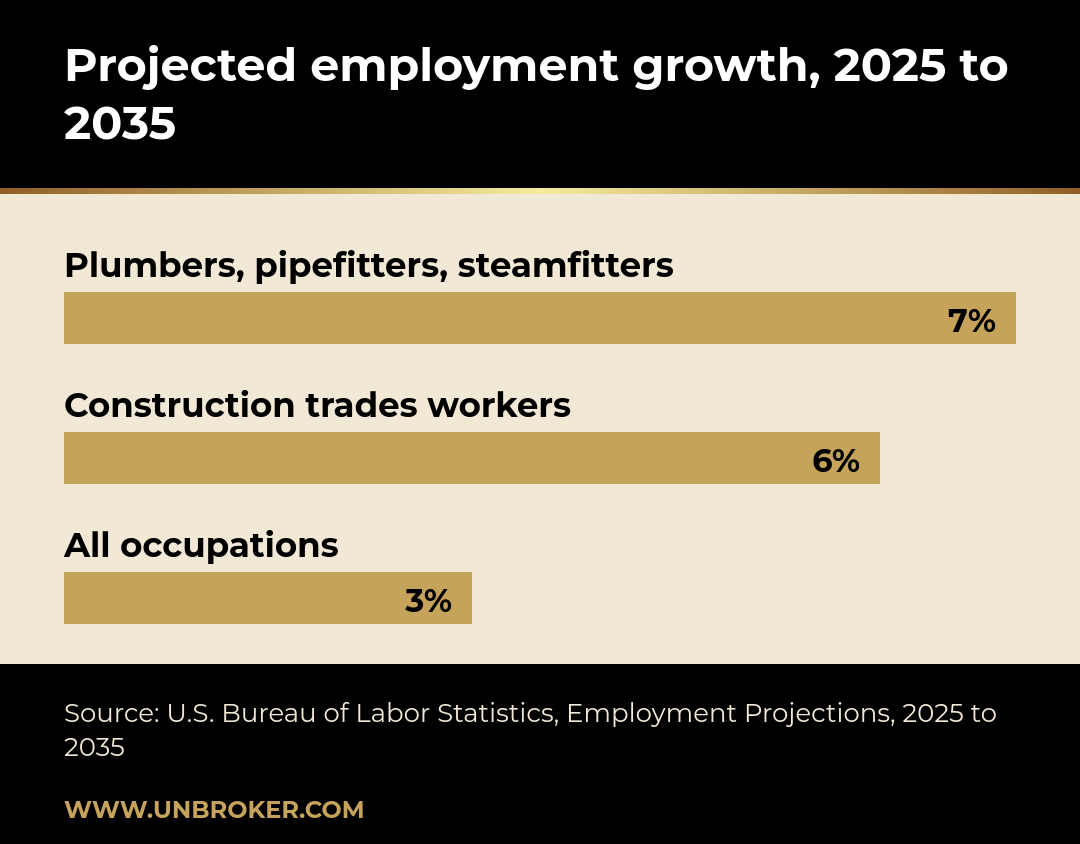
BLS projects employment of plumbers, pipefitters, and steamfitters to grow 7% from 2025 to 2035, compared with 6% for construction trades workers and 3% for all occupations. In its words, that is much faster than the average for all occupations.
One more detail from BLS shapes who is buying and what they are buying. In 2025, 65 percent of plumbers, pipefitters, and steamfitters worked in plumbing, heating, and air-conditioning contractor firms and 8 percent were self-employed. Most of the workforce is employed inside contractor firms like yours. A buyer is often acquiring a team and a system, not just a person with a truck.
None of this guarantees a price or a timeline. It does explain why a well-organized plumbing company can draw interest, and why the quality of your preparation decides how much of that interest holds up in due diligence.
The License Question: Who Holds It and What Happens at Closing
The license is the first thing a serious buyer asks about, and the answer is not the same in every state. BLS notes that most states and some localities require plumbers to be licensed. Requirements vary, but states and localities often require 2 to 5 years of experience and a passed exam before a plumber may work independently. Some states require master plumber status to obtain a plumbing contractor’s license.
That last point is where owners get surprised. If your contractor’s license depends on your personal master plumber status, the business may not be able to operate legally under a buyer’s ownership unless someone with the right credential is in place. Do not assume the license moves with the company.
Questions to answer before you list
- Who is the qualifier? Is the license held by you, by an employee, or by the company through a named individual?
- Is it tied to a person or an entity? Some licensing boards treat a change of ownership as a new application. Check with yours.
- Does the buyer hold a license? If not, can an employee qualify, or can you stay on in a defined role? Whether that arrangement is allowed depends on your state and local rules.
- What else is attached? Bonds, insurance, local registrations, backflow or gas certifications and permit accounts may each have their own transfer or reissue steps.
Start with your state licensing board, as BLS advises sellers and buyers to do, and then have an attorney review how the structure of the deal (asset sale or sale of the entity) interacts with those rules. A buyer’s counsel is going to ask, so it helps to have answers in writing first.
The strongest position is a business where a second licensed person already exists. If a master plumber on your payroll can serve as qualifier, the buyer sees continuity instead of a gap. If you are the only license holder, think now about whether a senior technician could pursue the credential, since the experience and exam requirements BLS describes take time.
Your Technicians Are Part of the Deal: Retention, Pay and Apprentices
When a buyer says they are buying your plumbing company, a large share of what they are buying walks out the door every evening. Technicians hold the customer relationships, the job knowledge and the on-call rotation. If they leave after closing, the value can leave with them.
Show the pipeline, not just the headcount
Most plumbers learn the trade through an apprenticeship. BLS says most plumbers, pipefitters, and steamfitters train through a 4- or 5-year apprenticeship, with typically 2,000 hours of paid on-the-job training each year. Apprentices earn less than fully trained workers, and their pay rises as they learn to do more.
That has a practical meaning for your sale. If you have apprentices at different stages, a buyer is looking at future journeyman capacity that took years to build. Make it easy to see: a roster with each person’s role, start date, license or certification status, and where they are in their training, plus your pay scale for each step.
Know where your pay stands
Buyers check whether your wages are in line with the market, because underpaid technicians are a flight risk and a cost the buyer may have to fix. The median annual wage for plumbers, pipefitters, and steamfitters was $63,800 in May 2025, versus $58,150 for construction trades workers and $50,980 for all occupations, according to BLS wage data.
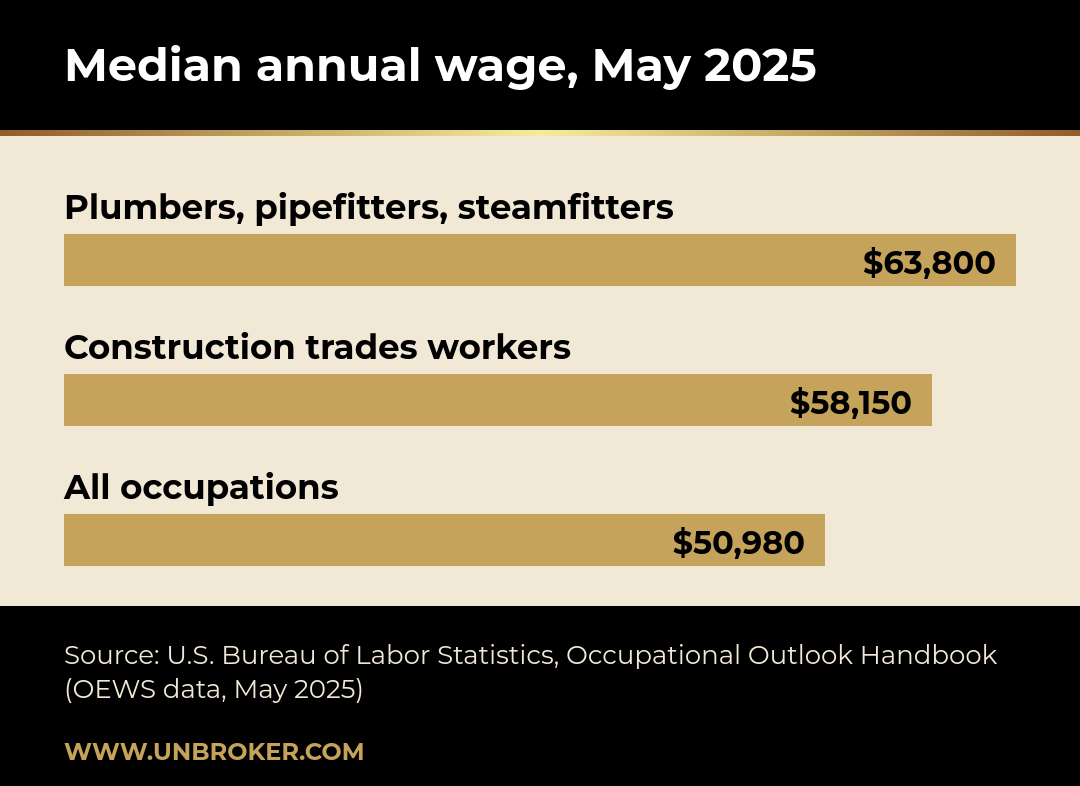
The spread inside the occupation is wide. In that same May 2025 data, the lowest 10 percent earned less than $44,150 and the highest 10 percent earned more than $108,420. BLS wage data do not include self-employed workers, so your own owner pay is not reflected in these figures. Use them as a rough reference point and compare against your local market, since pay differs by region.
Retention before and after the announcement
Think about what keeps your best people through a change of ownership. Possible tools include documented pay scales, a clear path from apprentice to journeyman, and a retention arrangement funded by the deal. Agreements that restrict where technicians can work afterward are treated differently from state to state, so ask an attorney before relying on them. For timing and wording on telling your crew, see our post on whether to tell employees you are selling, and when.
Cover the after-hours calls
Plumbing does not keep office hours. BLS notes that plumbers are often on call for emergencies, so evening and weekend work is common, and most plumbers, pipefitters, and steamfitters work full time, including nights and weekends. A buyer is going to ask who covers after-hours calls if you step away. If the honest answer is “me,” that is the first thing to fix. Build a written rotation, set the on-call pay, and let it run without you for a while so the record shows it works.
Service Work vs. Project Work: How Buyers Read Your Revenue
Two plumbing companies with the same annual revenue can look very different to a buyer. One earns most of its income from repairs, drain work, water heaters and returning homeowners. The other earns most of it from new-construction bids for a few builders. Because BLS identifies new construction and the maintenance and repair of existing systems as the two sources of demand, buyers often split your revenue along the same line.
Break your last several years of revenue into service and repair, remodel or replacement, and new construction. Then show for each line:
- How much comes from repeat customers versus first-time calls
- Any recurring maintenance or service agreements, and their renewal history
- Your largest customers, especially builders or property managers, and how much work each one gives you
- Open bids and backlog on project work, with realistic start dates
If a handful of customers produce most of your project revenue, expect questions. Our guide to selling a business with client concentration risk covers how to present that honestly. Project work is not worse than service work, but buyers price the risk of each differently, so present both clearly and let the numbers speak.
BLS also describes core plumbing duties such as preparing cost estimates for clients, reading blueprints, following state and local building codes, and inspecting and testing installed systems. A buyer may ask to review exactly those records: past estimates and how they compared with actual job cost, permit and inspection history, and any callbacks or warranty claims. Gather them in advance.
Getting the Numbers Ready: Clean Books, Job Costing and Owner Pay
Buyers value a plumbing company on its normalized earnings, and the cleaner your books, the less room there is for a buyer to argue the figure down. Three areas deserve attention.
Clean books and consistent job costing
Keep revenue, materials, labor, subcontractors, vehicle costs and overhead in separate, consistently named accounts. Job costing is the part many plumbing owners skip. If you can show materials and labor hours by job type, a buyer can see which work earns its keep. Without job costing, a buyer has to guess, and guesses usually go against the seller. Reconcile your books monthly, and make sure sales tax, payroll tax and permit fees are current.
Owner pay: the measure decides the treatment
Many plumbing owners still run jobs. How your pay is handled depends on which earnings measure the buyer uses, so name the measure before you compare numbers.
- Seller’s discretionary earnings (SDE) is common for smaller, owner-operated companies. Personal expenses and one-time costs are added back, and one owner-operator’s full pay is added back, whatever its level.
- Adjusted EBITDA is more common for larger companies with management. Personal expenses and one-time costs are added back, but owner pay is reset to a market rate. Pay above market is added back. Pay below market is a deduction that lowers EBITDA, because a buyer must pay a replacement the market rate.
That last point matters in plumbing. If you work as the lead technician or estimator while paying yourself little, an adjusted EBITDA calculation has to account for what it costs to hire someone to do that job, including a licensed one. The same business can therefore look different under each measure. Multiples are always tied to a base such as revenue, SDE or EBITDA and to the kind of business being valued, and they vary by market, so ask a valuation adviser which fits your company. Our post on how to apply business valuation add-backs walks through the mechanics.
Add-backs you can support
Personal vehicle use, family members on payroll who do not work in the business, one-time legal or equipment-repair costs, and similar items can be added back, but only if you can document them. Keep invoices and explain each item in plain language. Aggressive add-backs with no paper behind them cost you credibility.
Vehicles, Tools and Equipment: What Transfers and What Needs Titles
Trucks, vans, trailers, drain machines, cameras, jetters and tools can be a big part of what a buyer acquires. Build a complete asset list before you go to market.
- Vehicles: list each with year, make, VIN, mileage, condition and maintenance records. Titled vehicles must be transferred through your state’s motor vehicle process, so check the steps and any fees early.
- Liens and loans: if a lender holds a lien on a truck or on business assets, a payoff or consent is part of closing. Our post on selling a business with an SBA loan explains how liens, consent and payoff work.
- Tools: separate company-owned tools from tools your technicians own. A buyer should not assume that a technician’s personal toolkit comes with the sale.
- Equipment condition: note what is near replacement. A buyer who finds an aging fleet in diligence may ask for a price adjustment, so get ahead of it with honest descriptions.
- Inventory: fittings, water heaters, fixtures and parts on the shelf and on trucks. Decide whether inventory is included in the price or counted separately at closing.
Also ask your attorney and tax adviser how the deal structure affects what transfers, how the purchase price is allocated across assets, and what the tax consequences are for you. Those answers depend on your entity type and your state, and no general rule covers every plumbing company.
Staying Confidential While Customers and Crews Watch
A plumbing company is visible. Your trucks are on the street, your technicians are in customers’ homes, and your phone is answered by people who talk. A rumor that you are selling can unsettle technicians, prompt competitors to recruit your crew, and make customers wonder who will show up next year.
A few habits help:
- Market the business without naming it. A confidential listing describes the company by size, service mix and region, not by name or address.
- Require a signed non-disclosure agreement before sharing identifying details, and share financials in stages as a buyer shows they are serious and able to pay.
- Keep operations normal. Same scheduling, same service, same follow-up. Delayed maintenance or skipped marketing can lower value and signal that something is happening.
- Limit who knows. Tell your accountant, attorney and perhaps one trusted senior person. Decide in advance when and how the wider crew hears.
- Plan the customer message. Have a short, calm script ready for after the deal is signed.
For more on keeping a sale private, see protecting your privacy during a confidential business sale.
Choosing How to Sell: Professionally Managed or Hands-On
There are two reasonable ways to approach the sale, and the right one depends on your time, your comfort with negotiation and how complicated your company is.
Professionally managed
If you are still running jobs, handling dispatch and covering on-call shifts, the sale competes with your day job. A managed process puts an advisor in charge of valuation support, buyer outreach, confidentiality, negotiation and the paperwork. That fits owners whose company has real complexity, such as multiple licenses, project backlog, bonded work or a fleet with liens. You still answer questions and make decisions, but you do not carry every task.
Hands-on
If you are cost-conscious, comfortable with documents and willing to spend evenings on buyer questions, you can run more of the process yourself, using templates, a valuation tool and a marketing package. That means you manage buyer screening, confidentiality and negotiation, and you should still bring in an attorney and a tax adviser for the license and deal-structure questions above. Our guide to selling an electrical contracting company covers a closely related trade and is worth a read either way.
A simple test: if a missed buyer call or a delayed response would cost you a job or a customer, you probably need more help. If you have the time and the temperament, a hands-on sale can work well. Either way, the preparation in this guide is the same.
A Pre-Listing Checklist for Plumbing Owners
Work through this list before you speak with a buyer. Each item answers a question you are likely to be asked.
- License map: identify who holds each license, whether it is tied to a person or the company, and what your state board requires after a change of ownership.
- Second qualifier: decide whether a master plumber or senior technician can serve as qualifier, or start that path now.
- Crew roster: record each person’s role, tenure, certifications, pay and training stage, including apprentices.
- Pay review: compare technician pay to your local market and fix obvious gaps before diligence.
- On-call rotation: document who covers after-hours calls and let it run without you.
- Revenue split: separate service and repair, replacement and remodel, and new-construction revenue for several years.
- Customer concentration: list your largest customers and the share of work each provides.
- Estimating and inspection records: collect past estimates, permits, inspection results, callbacks and warranty claims.
- Books and job costing: reconcile monthly accounts and be able to show margin by job type.
- Normalized earnings: choose the measure (SDE or adjusted EBITDA), document each add-back, and account for market-rate pay for any role you fill.
- Asset list: list vehicles with VINs and titles, tools, equipment, inventory and any liens.
- Insurance and compliance: gather policies, claims history, bonds and tax filings.
- Confidentiality plan: prepare an NDA, an anonymous description of the company and a staged disclosure plan.
- Advisers: line up an attorney and a tax adviser who know your state and entity type.
If you want help getting a plumbing company ready for buyers, Unbroker offers a modern platform that combines expert advisors, AI-driven buyer matching and national marketing in a confidential process. Our Full Service Business Sale charges a 6% success fee, paid when the business sells. You can learn more at unbroker.com.