Industry consolidation reshapes entire markets, creating winners and losers almost overnight. Smart business owners who understand these shifts can time their exits to capture maximum value.
We at Unbroker have seen firsthand how industry trends can double or halve sale prices within months. The key lies in recognizing consolidation patterns before your competitors do.
What Drives Industry Consolidation
Industry consolidation transforms fragmented markets into concentrated powerhouses through three distinct mechanisms. Statutory consolidation creates entirely new entities when companies merge completely, while stock acquisitions allow brands to maintain separate identities under unified ownership. Variable interest equity deals grant control without majority ownership, making them popular for strategic partnerships.
The Economics Behind Market Concentration
Cost reduction drives most consolidation activity, with technology integration that cuts post-merger costs significantly. Larger players achieve economies of scale that smaller competitors cannot match, particularly in customer acquisition where consolidated firms reduce costs per new client substantially.
Banking exemplifies this pattern perfectly – merged institutions cross-sell mortgages, asset management, and insurance products to expanded customer bases. These institutions generate revenue streams impossible for standalone operations. The software industry demonstrates consolidation’s staying power, with Microsoft Windows that maintains market dominance for four decades through strategic acquisitions and competitive positioning.
Market Power and Buyer Leverage
Consolidated companies wield significant influence over both suppliers and customers through enhanced market position. Larger entities negotiate better terms with suppliers while simultaneously commanding premium prices from customers who face fewer alternatives. This dual advantage creates substantial barriers for new market entrants and forces remaining competitors to either consolidate or accept diminished margins.
Three-Stage Consolidation Timeline
Market consolidation follows a predictable three-phase pattern that determines optimal sale timing. The fragmentation stage features numerous small players who compete for market share, with acquisition multiples that remain modest as buyers focus on growth over profitability.
During the acquisition phase, dominant players emerge and control significant market share. This phase creates premium valuations for strategic targets. Many U.S. service businesses remain fragmented, which presents immediate opportunities for both buyers and sellers.

The expansion stage sees fewer but larger deals as market leaders fill operational gaps. However, premiums decline as strategic fit becomes paramount over simple market access. Companies that understand these phases position themselves to capitalize on the valuation premiums that each stage offers.
How Consolidation Changes Your Business Value
Consolidation creates dramatic valuation swings that catch unprepared sellers off guard. Strategic buyers pay premium multiples during active consolidation phases, often 20-40% above market rates for companies that fill operational gaps or expand geographic reach. Financial sector acquisitions typically command EBITDA multiples between 7-12x during peak consolidation, while food processing businesses attract 5-10x multiples when supermarket relationships and health trends align favorably. These premiums exist because consolidated entities generate synergies impossible for standalone operations.
Strategic Position Determines Premium Potential
Market leaders capture the highest valuations during consolidation waves, while followers face compressed multiples as buyer options multiply. Companies with diversified revenue streams and strong customer relationships command premiums because they reduce acquisition risk for buyers. Healthcare businesses achieve strong multiples when they possess national presence and favorable demographics, with deal values increasing approximately 50% in recent periods. Private equity activity in U.S. service businesses remains highly active, creating immediate premium opportunities for well-positioned sellers.
Late-Stage Consolidation Penalties
Saturated markets punish sellers who wait too long to exit. EBITDA multiples decline significantly when industries reach maturity, with buyers who become highly selective about strategic fit rather than simple market access. Transport and logistics companies see multiples range from 4-13x based on automation levels and cargo volume, but late-stage sellers face the lower end of these ranges. Professional services firms typically achieve 5-10x multiples, but only those with revenue streams that recur and diversified client bases maintain premium valuations as consolidation matures.
Financial Transparency Impact
Poor financial transparency and operational inefficiencies cause dramatic valuation drops in buyer-favored markets where alternatives abound. Buyers now prioritize operational readiness, scalability, and clean financial records over mere profitability when they evaluate businesses. Companies that implement AI technology see improved profit growth potential, though 58% of small businesses use AI while only 25% can prove effectiveness. This technological edge becomes even more valuable as consolidation intensifies and buyers seek competitive advantages.

The stage of consolidation in your industry determines not just your sale price, but also the optimal timing strategy you should employ. Before entering the market, ensure your business is truly ready for sale to maximize your exit potential.
When Should You Sell During Consolidation
The fragmentation phase offers the highest profit potential for early sellers who recognize consolidation signals before competitors react. Companies that exit during initial consolidation waves capture premium valuations as strategic buyers aggressively acquire market share and operational capabilities. Technology companies that sold during Microsoft’s early acquisition sprees achieved multiples 30-50% above market rates, while bank mergers in the 1990s created windfall exits for regional players who timed their sales perfectly.
Peak Window Identification
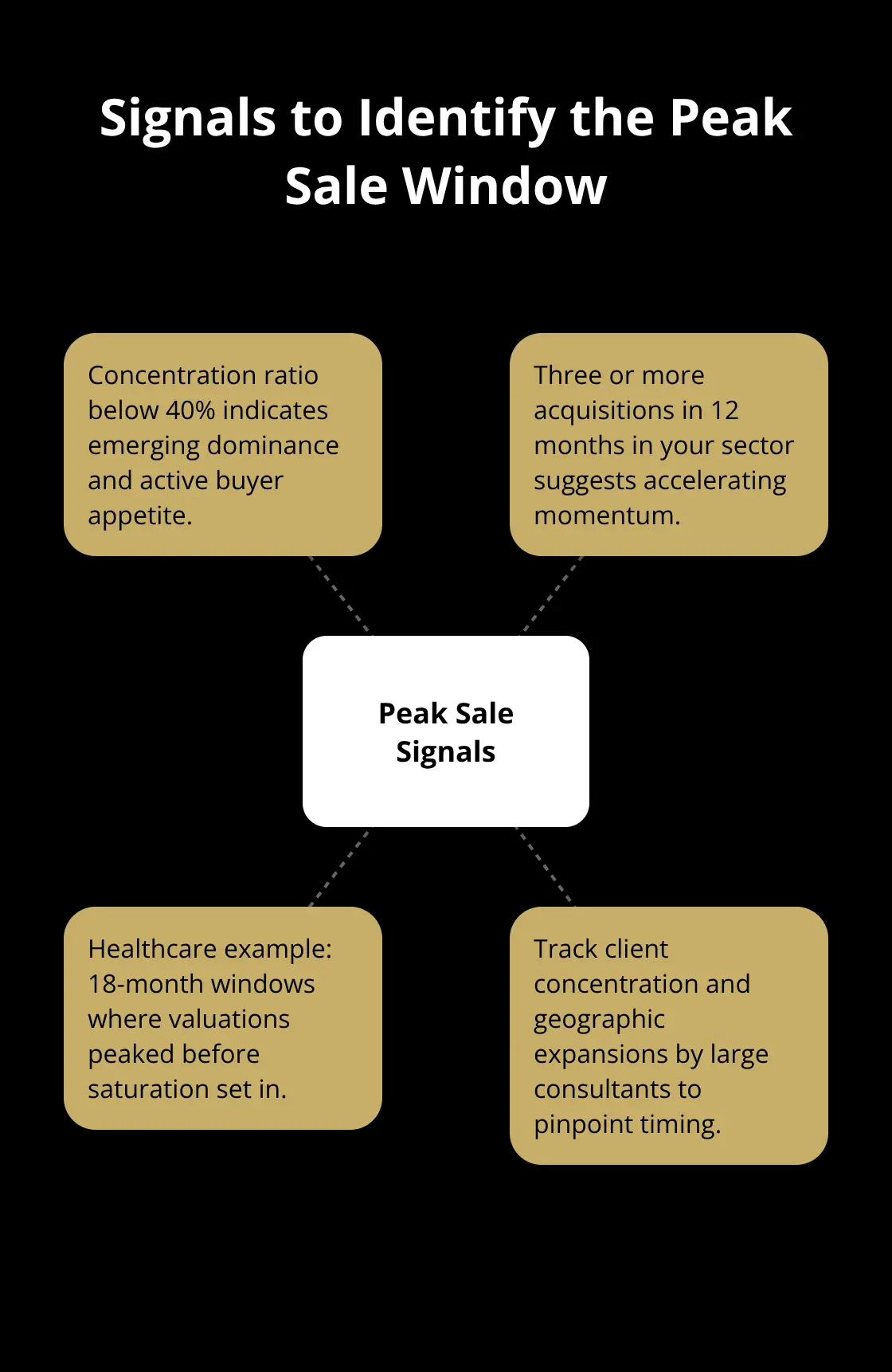
Market concentration ratios below 40% signal prime sale opportunities as dominant players emerge and seek strategic acquisitions. Monitor competitor acquisition activity closely – when three or more transactions occur within 12 months in your sector, consolidation momentum builds rapidly. Healthcare consolidation accelerated when national chains began to acquire regional practices, which created 18-month windows where valuations peaked before market saturation set in. Professional services firms that tracked client concentration data identified optimal exit times when large consultants started geographic expansion strategies.
Early Stage Advantages
First movers capture the highest premiums because strategic buyers compete aggressively for market position. Waste and industrial sector companies that sold early achieved EBITDA multiples between 8-10x (compared to 5-7x for late sellers) as buyers valued asset levels and regulatory compliance capabilities. Energy sector businesses commanded 10-12x multiples when sustainability practices became strategic priorities, but only early sellers captured these peak valuations before market standards shifted.
Late Stage Consolidation Risks
Companies that wait too long face devastated exit valuations as buyer options shrink and strategic premiums disappear. Transport logistics firms that delayed sales during the expansion phase faced significant valuation declines as automation requirements and cargo volume metrics became buyer prerequisites rather than bonuses. The automotive industry demonstrates consolidation maturity – acquisition opportunities virtually disappeared as players focused on internal efficiency rather than external growth. eCommerce businesses now face compressed multiples between 1-6x as market leaders dominate customer acquisition channels. Med spas represent a prime example of fragmented markets where independent operators can still capture consolidation premiums.
Final Thoughts
Industry consolidation alters business valuations through predictable cycles that reward prepared sellers and punish those who wait too long. Companies that monitor market concentration ratios and competitor acquisition activity position themselves to capture premium multiples during peak consolidation windows. Business owners must track industry trends continuously rather than react to consolidation after it accelerates.
The fragmentation phase offers maximum profit potential, while late-stage consolidation severely compresses valuations as strategic premiums disappear and buyer options shrink. Successful exit plans require three years of clean financial records, operational efficiency improvements, and technology adoption that demonstrates scalability to strategic buyers. Companies with diversified revenue streams and strong customer relationships command the highest premiums during active consolidation phases.
The timing decision ultimately determines whether you capture windfall valuations or face compressed multiples in saturated markets (timing beats everything else in M&A). We at Unbroker help business owners navigate these complex market dynamics through our transparent platform that provides expert guidance throughout the sale process. Start monitoring your industry consolidation signals today.