Selling your business is one of the biggest financial decisions you’ll make. Exit planning for sellers requires clear thinking, solid preparation, and the right guidance at each stage.
At Unbroker, we’ve helped countless business owners navigate this complex journey. This guide walks you through the essential steps-from valuing your business to closing the deal.
Assess Your Business Value and Readiness
Get a Professional Valuation of Your Business
A professional valuation is non-negotiable, yet most owners skip this step or rely on rough estimates. A formal valuation identifies what your business is actually worth based on market data, financial performance, and industry benchmarks-not what you hope it’s worth. This number becomes your foundation for everything that follows: setting asking prices, understanding negotiation room, and making informed decisions about timing.
Valuators typically use three approaches. The discounted cash flow method estimates enterprise value by projecting unlevered free cash flow and discounting those cash flows to present value, which works well if your business has predictable revenue. Comparable company analysis looks at what similar businesses sold for and applies those multiples to your financials. Precedent transactions examine recent sales in your industry to establish realistic benchmarks. A qualified valuator will synthesize all three to give you a defensible number that buyers and their advisors will respect.
Without this grounding, you negotiate blind and leave significant money on the table.
Evaluate Financial Health and Documentation
Your financial records are your credibility during a sale. Buyers and their accountants will scrutinize every number, and messy records raise red flags that tank valuations faster than almost anything else.
Start with accrual-based accounting rather than cash-in-cash-out methods, which show a clearer picture of profitability and sustainability. Have a CPA review or audit your last two to three years of statements to establish confidence in the numbers. Then normalize your earnings by removing one-time expenses, owner perks, and non-operating items. If you wrote off a lawsuit settlement or took a one-time tax charge, adjust these out so buyers see what the business actually produces under normal conditions. This normalized earnings figure drives valuation multiples.
Identify Strengths and Areas for Improvement
Document your operational strengths: customer concentration, recurring revenue, supplier relationships, and management team depth. A business where 80 percent of revenue comes from three customers looks riskier than one with a diversified customer base. A business with month-to-month contracts looks weaker than one with multi-year agreements.
Buyers will identify these risks anyway, so surface them yourself and explain how you address them. This transparency builds trust and prevents last-minute surprises that crater deal momentum. Once you understand your valuation and have cleaned up your financial picture, the next step is preparing your business operationally for the transition ahead.
Prepare Your Business for Sale
Organize Financial Records as Your Marketing Asset
The gap between what owners think their business is worth and what buyers will actually pay often comes down to preparation. You’ve identified your valuation and financial baseline. Now you need to make your business look like a machine that runs without you. Treat your financial records as a marketing asset, not a compliance checkbox. Buyers expect organized, professional documentation that tells a coherent story.
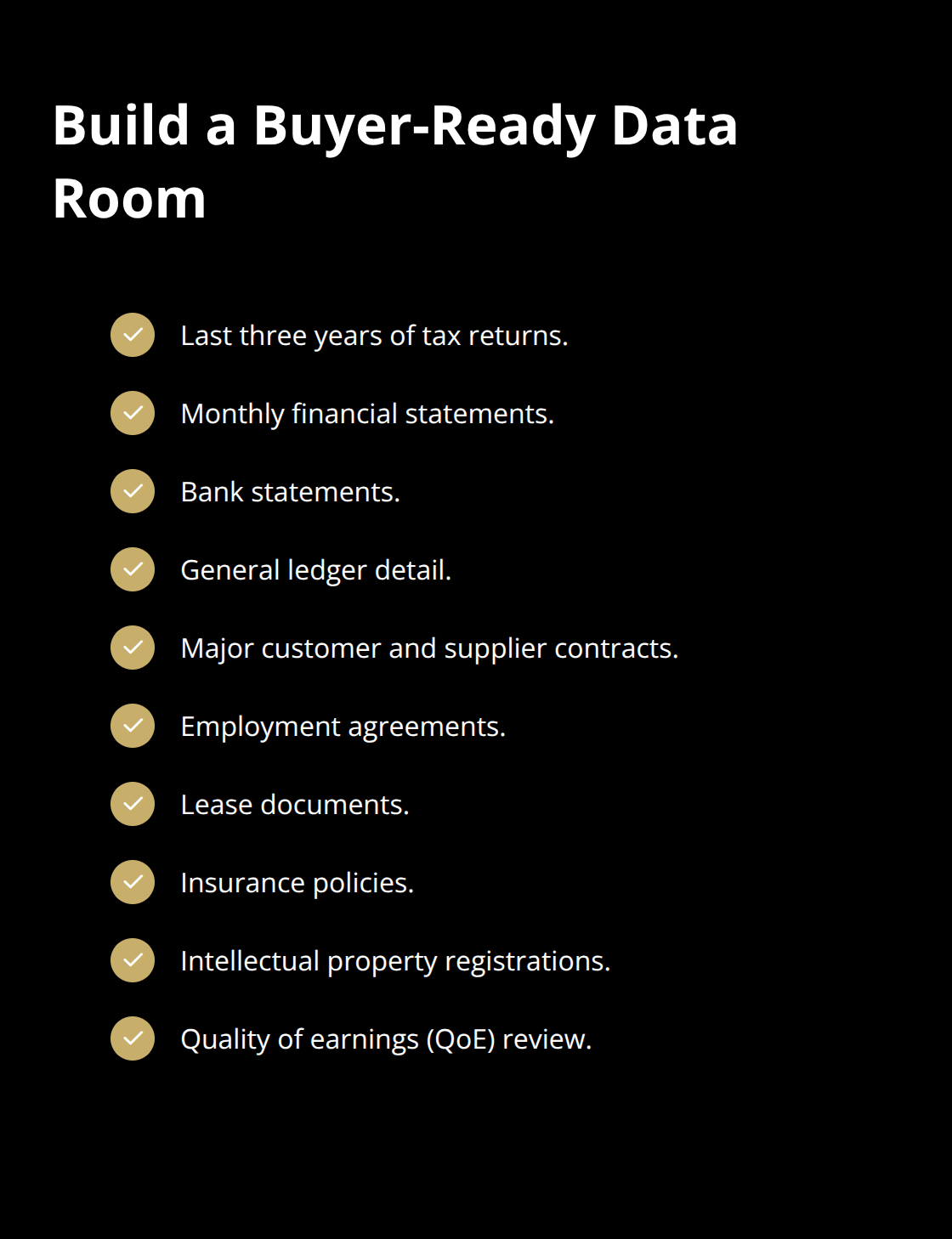
Create a centralized data room-either physical or digital-with your last three years of tax returns, monthly financial statements, bank statements, and general ledger detail. Include contracts with major customers and suppliers, employment agreements, lease documents, insurance policies, and any intellectual property registrations.
A quality of earnings review, conducted before you go to market, identifies discrepancies early so you can fix them rather than have a buyer’s accountant weaponize them during due diligence. This costs between $5,000 and $15,000 but saves far more by preventing deal friction.
Document Operations to Reduce Buyer Risk
One critical step most owners overlook: document your standard operating procedures. Write down how your sales process works, how you onboard customers, how you manage inventory, and how your team handles key decisions. This transforms your business from owner-dependent to buyer-ready. Buyers pay premiums for businesses that can function under new leadership because the transition risk drops dramatically.
Eliminate Operational Drag and Strengthen Your Position
Ruthlessly eliminate operational drag. Review your last 12 months of expenses and identify anything that serves the owner rather than the business-country club memberships, vehicle leases, consulting fees to friends, inflated salaries for family members. Strip these out or document them separately so normalized earnings reflect what a new owner would actually spend.
Customer concentration is another critical weakness. If your top three customers represent more than 50 percent of revenue, that’s a valuation killer. Spend the next 6 to 12 months before sale deliberately diversifying your customer base and, where possible, securing longer-term contracts. Reduce supplier dependency too: if one vendor supplies 70 percent of your materials, work to establish relationships with alternatives. These aren’t cosmetic fixes-they directly impact the multiple a buyer will pay.
Craft a Compelling Narrative About Your Business
Finally, craft a narrative about your business that resonates with buyers. Not a sales pitch, but a clear explanation of why your business matters, what problems it solves, how it makes money, and where growth opportunities exist. Include data: customer retention rates, repeat purchase frequency, average customer lifetime value, year-over-year revenue growth, and any industry trends that favor your sector. If your business serves healthcare or technology, mention that explicitly because those sectors command higher valuations.
This narrative becomes the foundation for your marketing materials and buyer conversations. The cleaner your operations and the clearer your story, the higher the price you’ll command. With your business positioned and your narrative ready, you’re prepared to navigate the actual sales process-selecting the right channel, managing buyer interactions, and closing the deal on terms that work for you.
Navigate the Sales Process and Closing
Choose Your Sales Channel Strategically
The sales process is where most owners lose leverage. You’ve prepared your business, cleaned your financials, and built a compelling story. Now comes the part where emotion, time pressure, and bad advice can destroy months of preparation. Start by deciding upfront whether you want a targeted or non-targeted approach. Targeted outreach means you curate a list of 10 to 20 qualified buyers who make strategic sense for your business, protecting confidentiality and accelerating timelines. Non-targeted approaches cast a wider net through brokers or online platforms, which can drive competition but risk confidentiality leaks that damage your negotiating position or spook your team.
Most owners underestimate how quickly word spreads. If your key employees learn about a sale from competitors or customers instead of from you, retention collapses and deal value evaporates. Choose your channel deliberately: work with an M&A advisor who has direct relationships with strategic buyers in your industry, use a platform that combines transparency with a vetted buyer network, or engage a traditional broker if you’re willing to pay 8 to 10 percent in fees. The platform approach costs significantly less and eliminates the pressure brokers create to sell faster than your timeline demands.
Plan Your Timeline to Maximize Value
Whatever channel you select, plan 12 to 24 months from decision to close, with 9 to 12 months dedicated to marketing and buyer engagement. Rushing this process costs money. Research on private company sales shows that sellers who compress timelines typically accept 15 to 25 percent lower valuations because buyers sense desperation and reduce their offers accordingly.
Manage Due Diligence Proactively
Due diligence is where buyers verify everything you’ve claimed. They conduct site visits, request additional documentation, interview your management team, and dig through contracts. This is not the time to get defensive or evasive. Proactive transparency wins here. If you’ve already conducted a quality of earnings review, you know what issues exist and you’ve explained them. When a buyer’s accountant finds something, you’re not surprised because you disclosed it first.
Keep your data room organized and current throughout the process. The moment a buyer signals serious interest, your team should be available for conversations and tours. Delays frustrate buyers and signal that you’re not fully committed. During due diligence, buyers will challenge assumptions in your financial projections and question customer concentration or contract terms. Stand firm on facts but stay flexible on interpretation. If a buyer’s team identifies a legitimate risk, acknowledge it and discuss pricing adjustments rather than fighting. You’ll negotiate price anyway, and fighting over validation details wastes time and damages relationship trust that you’ll need during final negotiations.
Structure the Deal to Protect Your Interests
Purchase agreements lock down deal terms. Never sign anything without a transaction attorney reviewing it. The difference between asset sales and stock sales has massive tax implications. Asset sales let you leave liabilities behind but trigger double taxation in many cases. Stock sales simplify the transaction but you retain all liabilities. Your tax advisor and attorney must coordinate structure before you sign the LOI.
Earnouts are common in smaller deals: the buyer pays a portion of the purchase price upfront and the remainder over time based on performance metrics. Earnouts sound good because they suggest confidence in future growth, but they’re risky. If the buyer changes operational strategy, cuts costs, or shifts focus, the earnout metrics become harder to hit and you lose money. Limit earnouts to 10 to 20 percent of total purchase price and require clear, auditable metrics. Walk away from deals where earnouts exceed 30 percent.
Execute the Final Closing Phase
Closing typically takes 60 to 90 days after you sign the purchase agreement. During this phase, your attorney handles regulatory approvals, document preparation, and final adjustments. Maintain business performance throughout closing because buyers reserve the right to walk if EBITDA drops materially or key employees resign. This is the final sprint where discipline matters.
Final Thoughts
Exit planning for sellers succeeds when you treat the process as a marathon, not a sprint. You’ve now walked through the three critical phases: assessing your business value, preparing it operationally, and navigating the sales process itself. The owners who walk away satisfied aren’t the ones who rushed or cut corners-they’re the ones who started early, stayed disciplined, and made decisions based on data rather than emotion. On a $5 million business, proper preparation can mean the difference between $750,000 and $1.25 million in lost value.
The biggest mistake we see is letting the first offer feel like the final offer. Buyers make low opening bids expecting negotiation, and if you’ve prepared properly with multiple interested parties, you have leverage to use it. Walk away from deals where earnouts exceed 30 percent of the purchase price because you lose control over whether you actually get paid, and structure the deal with your tax advisor before signing anything, not after.
After closing, many sellers struggle with what comes next because they didn’t plan for life after the sale. Think about this now: Do you want to stay involved in an advisory role, start something new, or invest the proceeds differently? We at Unbroker built a platform specifically to help sellers navigate this journey without the traditional broker markup, and our approach combines transparent pricing with real support whether you want hands-on guidance or prefer to manage the process yourself.