Selling your business without professional guidance often leads to leaving money on the table. Most DIY sellers make critical mistakes in valuation, negotiation, and documentation that significantly reduce what they could actually receive.
At Unbroker, we’ve seen countless deals fall apart because owners didn’t understand the real value of their business or how to protect it during the sale process. This guide walks through the most common pitfalls and how to avoid them.
What’s Your Business Actually Worth?
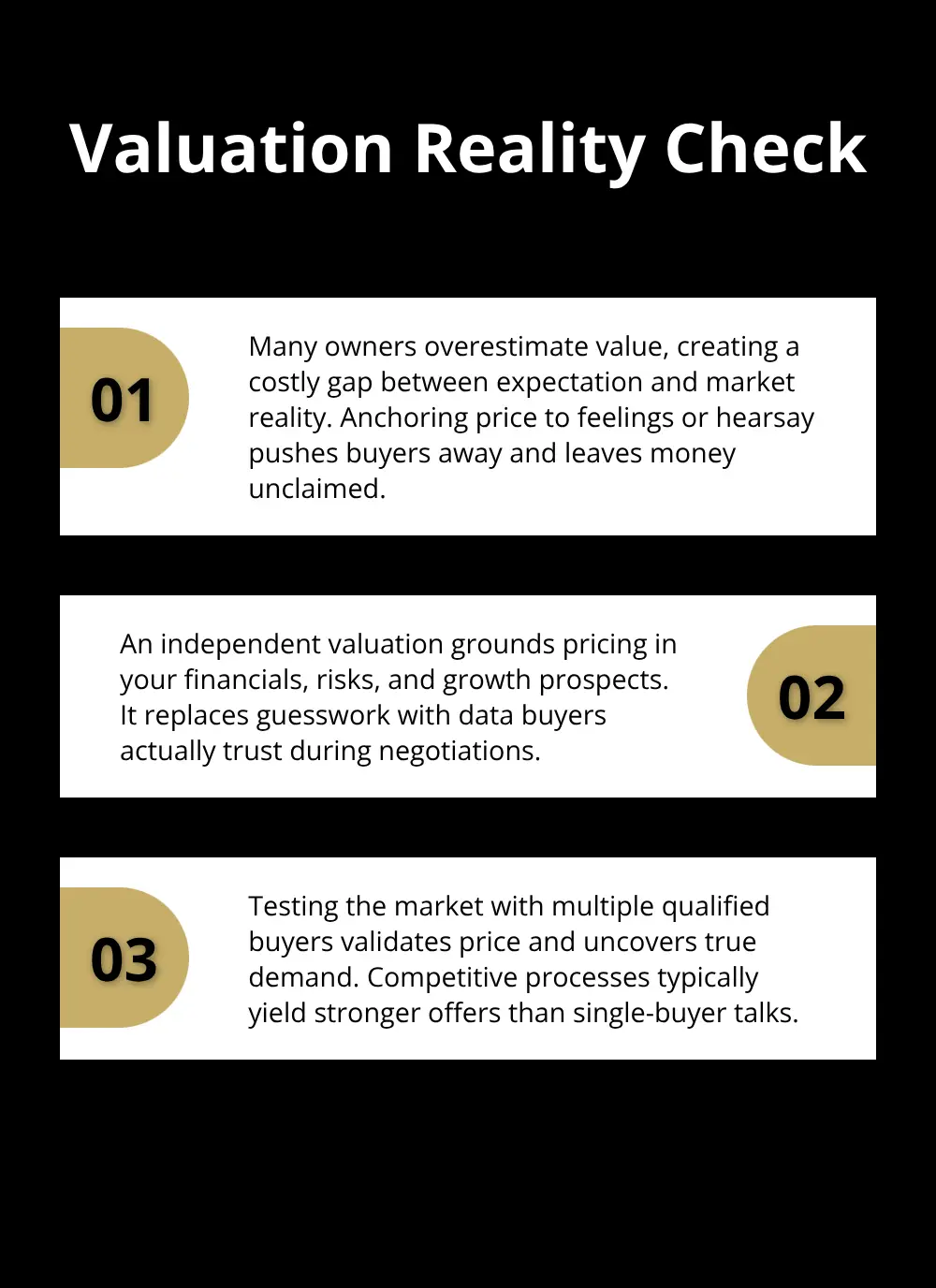
Most DIY sellers price their business based on gut feeling, a multiple of revenue they heard at a networking event, or what they need to retire. None of these approaches reflect what a buyer will actually pay. More than half of business owners overestimate their business value, according to exit planning research, which means they either price themselves out of the market or accept offers far below what competitive bidding would reveal. The gap between what you think your business is worth and what the market will pay can easily reach 20 to 30 percent, and that difference comes directly out of your pocket.
Get an Independent Valuation
A qualified professional valuation anchors your expectations in reality. The valuation accounts for your financials, growth trajectory, customer concentration, operational dependencies, and the specific risks buyers will worry about when evaluating your deal. Without this independent assessment, you negotiate from a position of weakness. Buyers always know more about market conditions than you do, and that information advantage translates directly into lower offers.
Test the Market With Multiple Buyers
When you approach a single buyer or accept the first offer without testing the market, you leave substantial value on the table. Competitive sales processes typically generate 15 to 20 percent higher offers than single-buyer negotiations because multiple serious buyers create genuine competition and validate your price. Most owners never get a second chance to sell their business, so testing the market with qualified buyers is not optional.
You need to understand what similar businesses in your industry have sold for recently, not just what they list for. Public M&A databases and broker networks contain transaction data that shows actual sale prices, multiples, and deal structures in your sector. Business valuation multiples in your industry depend on the size of your company, its profitability, growth prospects, and competitive position. Without this benchmark data, you negotiate blind. A buyer will always have stronger information than you do, and that asymmetry works against your interests every single time.
Identify the Hidden Assets Buyers Will Pay For
Most owners focus on revenue and profit when valifying their business, but buyers also value things that don’t show up on your balance sheet. Recurring revenue and long-term customer contracts provide income stability, predictability, and strong appeal across various valuation methods. Proprietary processes, brand reputation, and a capable management team all command premium valuations.
Intellectual property-whether patents, trademarks, or documented workflows-adds real value if you properly register and assign it to the company. Customer concentration risk works the opposite direction: if three customers represent 50 percent of revenue, buyers will discount your valuation substantially because losing even one customer tanks profitability. Demonstrating that your customer base is diverse and sticky, with documented retention rates above industry averages, justifies a higher multiple.
Your ability to take a two-week vacation without the business falling apart signals that operations don’t depend on you personally, which buyers reward with higher valuations. Clean, normalized financial statements and owner discretionary spending matter far more than raw revenue numbers. If you’ve been running personal expenses through the business, that practice suppresses your apparent profitability and destroys valuation multiples. A qualified CPA documents your financial history and normalizes distributions properly, preparing accurate financials that reflect what a new owner would actually earn.
These valuation foundations determine your negotiating position in the next phase of the sale. Without them, you walk into buyer conversations unprepared and vulnerable to pressure tactics that erode deal value before negotiations even begin.
Mishandling Buyer Negotiations and Deal Terms
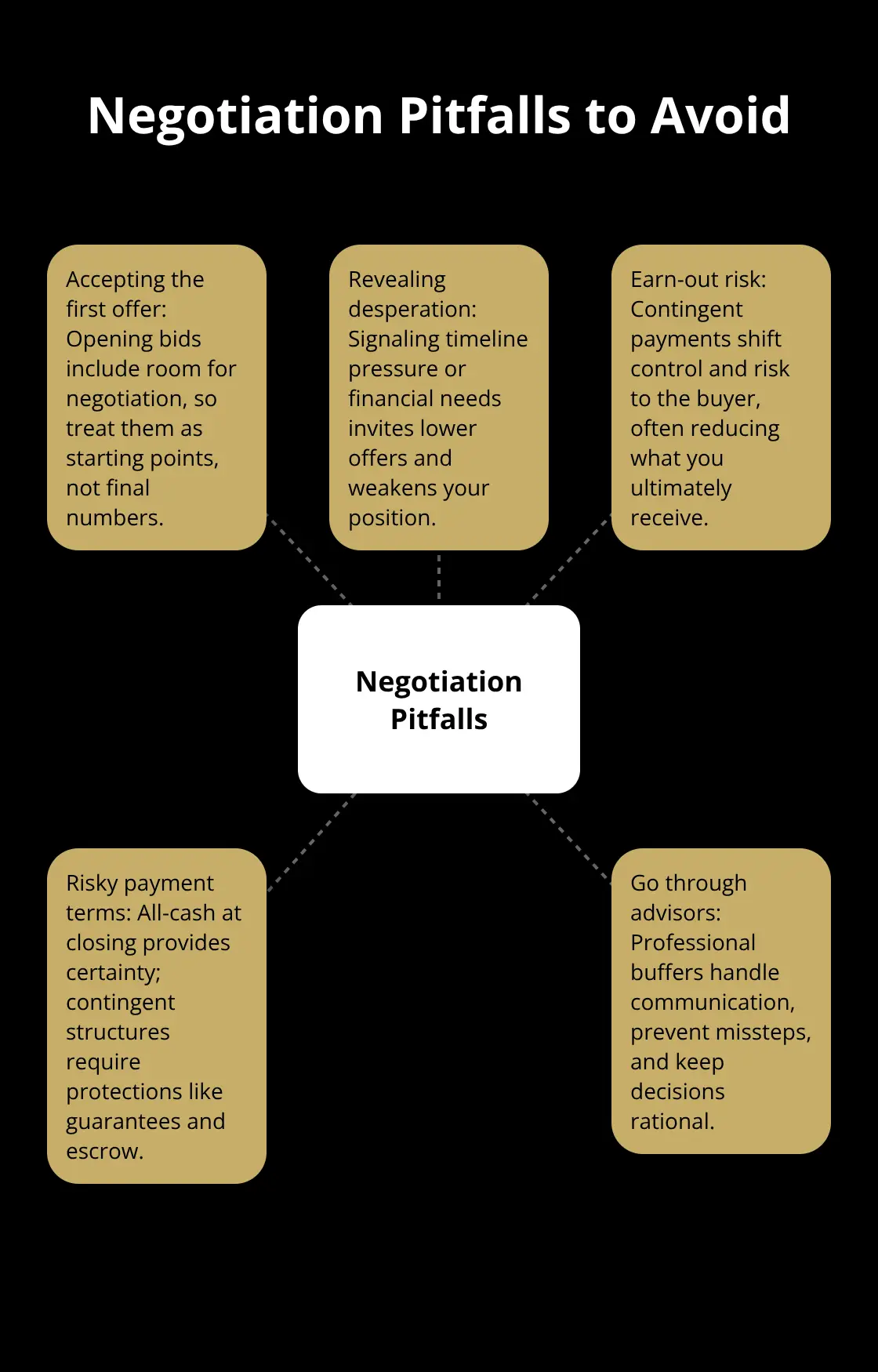
The moment a buyer makes an offer, most DIY sellers feel relief rather than skepticism. After months of uncertainty, a concrete number on the table feels like validation. This emotional response destroys deal value. Research on business sales shows that skipping a competitive process leaves 15 to 20 percent in value on the table, and that gap widens when you negotiate alone without professional buffers. Treat any opening offer as a starting position, not a final number. Buyers expect counteroffers; they build negotiating room into their initial bid specifically because they know sellers will push back. If you accept without countering, you signal weakness and leave money sitting in the buyer’s pocket.
Revealing Desperation Kills Your Negotiating Power
The real damage happens when you accidentally reveal your timeline or financial situation during negotiations. Buyers are trained to detect desperation, and once they sense you need to close quickly or have financial pressure, they adjust their offers downward. Poor negotiating tactics tank value before you reach the documentation stage. Never mention that you need the sale to fund retirement, that you’ve already committed to a departure date, or that you have limited runway with your lenders. Your advisor team should handle all buyer communications and field questions, protecting you from accidentally undermining your own position. If a buyer asks directly about your timeline, the answer through your advisor is always that you’re exploring options and have no external pressure to decide quickly. This is the truth from a buyer’s perspective: you do have options if you’ve tested the market properly.
Understanding Earn-Out Risk
Many DIY sellers get pressured into earn-outs, seller financing, or contingent payments because they don’t understand the real risk. An earn-out means you receive payment only if the business hits certain targets after the buyer takes over. This structure shifts operational risk onto you even though you no longer control the business. If the buyer cuts marketing spend, changes pricing strategy, or alienates customers, your earn-out evaporates. You lose twice: you already sold the business at a discounted price, and now you’re depending on a new owner to run it profitably. Experienced M&A attorneys negotiate earn-outs with clear caps, specific metrics, and seller involvement in financial reporting. A qualified CPA also reviews how earn-outs affect your tax situation, since the timing and structure of payments creates different tax consequences than a cash sale.
Structuring for Certainty, Not Compromise
All-cash closings at signing represent the gold standard, and that should be your target. If a buyer insists on seller financing or earn-outs, you need an advisor team to quantify the real cost of that risk. A higher offer with payment risk attached almost always loses value compared to a lower all-cash offer. Require personal guarantees from the buyer, hold back escrow funds, and get detailed financial reporting rights if any portion of the sale is contingent. Many DIY sellers accept unfavorable payment terms simply because they don’t know better. Your M&A attorney should review every payment structure to confirm it protects your interests and doesn’t create surprise tax liabilities. The sale price only matters if you actually collect it; certainty beats contingency every time.
Moving Forward With Professional Protection
Negotiating alone exposes you to tactics that erode value before you even realize what happened. Your advisor team acts as a buffer between you and buyers, helping you evaluate proposals rationally rather than emotionally. This protection becomes especially important when payment terms enter the discussion, since buyers will push for structures that benefit them at your expense. The next phase of the sale process introduces even greater complexity: preparing your financial records and legal documentation for buyer scrutiny.
Documentation That Actually Protects Your Deal
Buyers don’t trust what you tell them; they trust what you can prove. Documentation that actually protects your deal allows the buyer to feel more comfortable that their expectations regarding the transaction are correct. Most DIY sellers underestimate how deeply buyers scrutinize financial records, contracts, and compliance history during due diligence. A single missing document, unexplained expense, or inconsistency between tax filings and your claimed financials creates doubt that spreads across the entire valuation. Buyers assume the worst when they find gaps, and that assumption costs you money.
Your financial statements need to match your tax returns exactly; any discrepancies trigger questions that waste weeks and erode buyer confidence. Normalized EBITDA calculations should clearly document what personal expenses you removed and why, so buyers understand your actual earnings potential. Organize every contract-customer agreements, supplier relationships, lease terms, employment arrangements, loan documents-in a single data room with consistent naming and clear dates. If you’ve been running the business informally with handshake deals and verbal agreements, you now face a critical problem: buyers need written evidence of recurring revenue, and without it, they’ll discount your valuation substantially. Equipment leases, software licenses, and subscription services all need documentation showing they’re transferable or renewable under new ownership.
Organize Your Data Room Before Buyers Arrive
Compile every material document into a well-organized data room before you contact serious buyers. This includes three years of tax returns, financial statements, bank statements, customer contracts, supplier agreements, lease terms, employment contracts, insurance policies, intellectual property registrations, permits and licenses, litigation history, and any environmental or regulatory compliance records.
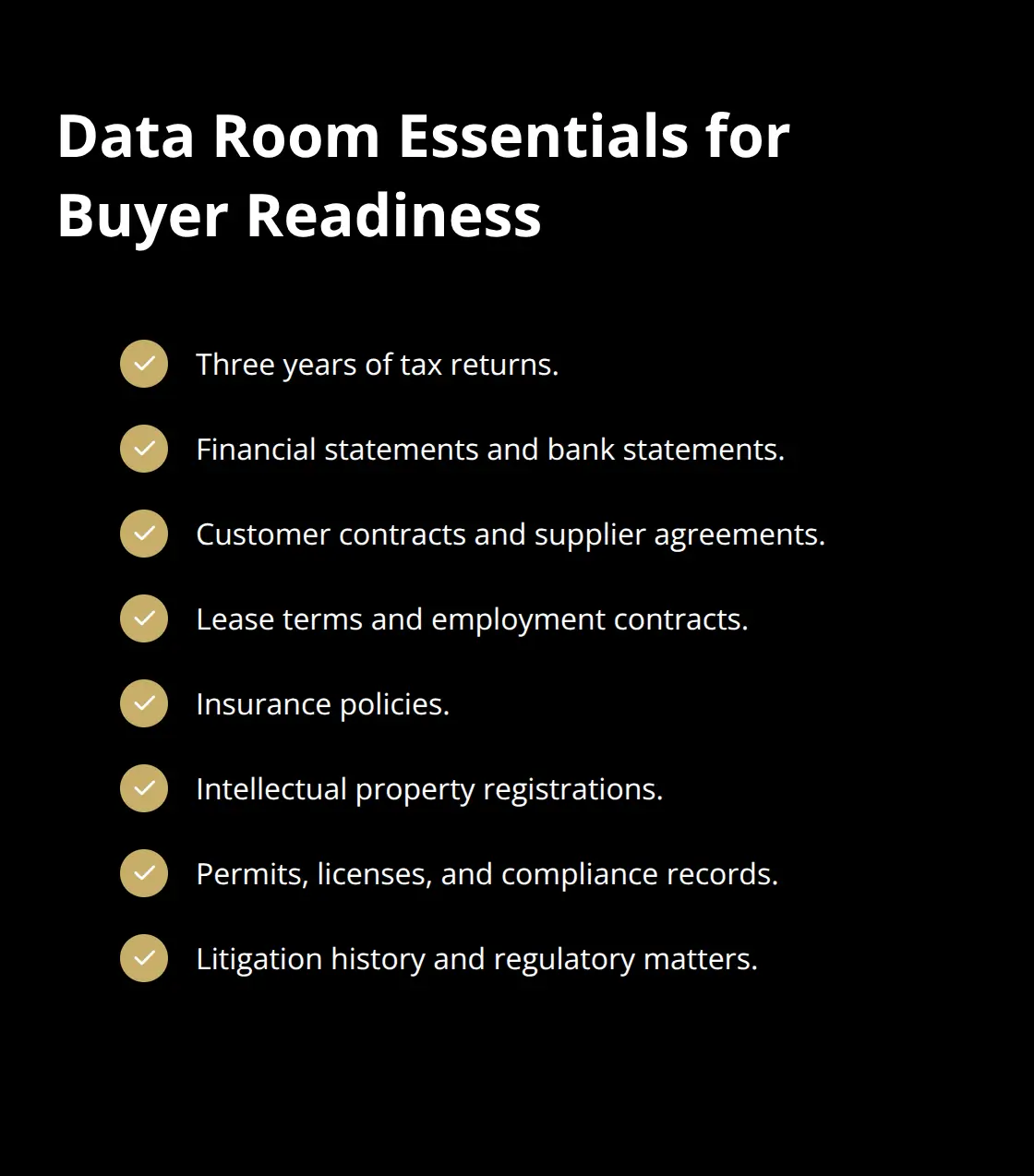
Buyers expect immediate access to these documents once they sign a non-disclosure agreement, and delays signal disorganization or that you’re hiding something.
A structured data room with clear folders, consistent file naming, and an index makes due diligence faster and removes friction from the buyer’s evaluation process. Faster, smoother due diligence translates directly into higher offers because buyers feel confident in their assessment and close without extended negotiations over missing information. If you’ve never organized your records this way, start immediately; the effort now prevents weeks of delay and negotiation pressure later.
Fix Compliance Issues Before Disclosure
Environmental violations, unpaid employment taxes, wage and hour disputes, or safety violations discovered during due diligence create post-closing liability that buyers will demand you indemnify or that they’ll deduct from the purchase price. Address known compliance issues before the sale process begins-fix them, document the remediation, and disclose them proactively with a plan to minimize impact. Buyers respect transparency far more than they respect discovering problems themselves.
If you know your workplace safety record has gaps or you’ve received regulatory notices, your M&A attorney should develop a strategy to present this information in context and quantify the actual financial risk. Missing or outdated permits, licenses, and compliance certifications create post-closing liability that buyers will either demand you fix before closing or deduct from the purchase price. A pre-sale audit by a qualified CPA identifies these gaps before a buyer does, giving you time to resolve issues and present clean records.
Align Your Records and Tax History
Tax filings from the past three to five years must be consistent with your financial statements; any red flags here signal potential hidden liabilities or aggressive tax positions that buyers will investigate intensely. Hiding problems from advisors sabotages the deal because they can’t develop effective mitigation strategies. Hiding problems from buyers is even more dangerous because the discovery during due diligence destroys trust and creates leverage for the buyer to renegotiate price downward.
Final Thoughts
Selling your business without professional support exposes you to avoidable mistakes that cost real money. The DIY pitfalls covered in this guide-underpricing without market data, negotiating alone, and presenting incomplete documentation-consistently reduce what owners actually receive. More than 70 percent of business owners approach a sale without strategic guidance, and that lack of preparation directly correlates with regret and lost value.
Your business represents years of work and capital investment. Protecting that value requires the right team around you: a qualified valuation professional to anchor your price in market reality, an M&A attorney to structure terms that protect your interests, and a CPA to present clean financials that reflect actual earning potential. These advisors act as buffers between you and buyers, helping you make rational decisions instead of emotional ones when offers arrive. At Unbroker, we understand that professional guidance doesn’t have to mean paying traditional brokerage fees, and we offer transparent, low-cost options designed to give you expert support without the markup.
Start with an independent valuation and organize your financial records today. Test the market with multiple qualified buyers and involve advisors in all negotiations. These steps take time, but they’re the difference between leaving 20 to 30 percent on the table and closing at fair market value.