Most business owners never plan their exit until it’s too late. We at Unbroker see this pattern constantly-owners wait until they’re ready to leave, then scramble to get their finances and operations in order.
The exit planning steps you take today directly determine how much your business is worth tomorrow. Starting early gives you years to strengthen your financials, document your processes, and build systems that run without you.
Why Business Owners Delay Exit Planning
Most business owners operate under the assumption that exit planning is something they’ll handle when they’re ready to leave. That assumption costs them hundreds of thousands of dollars. Nearly half of business owners plan to exit their company within the next five years, yet many lack a documented exit plan and 53% lack any written, formal transition plan at all. This isn’t because owners don’t care about their financial future-it’s because they underestimate how long proper preparation takes and how much value erodes without it.
The Reasons Owners Postpone Action
The delay happens for predictable reasons. Owners are consumed by daily operations and growth targets. They believe the business will always be valuable, so there’s no urgency. They assume they can figure out valuation and buyer identification quickly when the time comes. They don’t realize that buyers investigate everything from financial records to management depth to customer concentration, and unprepared businesses fail these checks immediately. A business that looks strong operationally can tank in valuation because its financial records are messy, its owner is irreplaceable, or its revenue depends on three major clients. When you wait until you’re ready to sell, you’re negotiating from weakness. Buyers see a rushed owner and they lower their offers accordingly.
The Financial Cost of Waiting
Starting your exit plan three to five years before you actually want to leave isn’t conservative-it’s the minimum timeline required to move the needle on valuation. Well-prepared businesses command higher prices and close faster, while unprepared ones languish on the market or sell at steep discounts. A business with clean financials, documented processes, and a proven management team attracts multiple buyers. The same business without these elements attracts one buyer if you’re lucky, and that buyer knows you have limited options. The difference in sale price between a prepared and unprepared business of similar size often exceeds 20%, sometimes reaching 30% or more depending on the industry and buyer pool. If your business is worth $2 million, that’s $400,000 to $600,000 left on the table. That money doesn’t materialize in the final year. It builds through years of incremental improvements.
What Early Planning Accomplishes
Starting now means you control the narrative around your business instead of reacting to market conditions or personal circumstances. You can diversify your revenue so you’re not dependent on a handful of clients. You can formalize your management structure so the business runs without you present every day. You can clean up your financial records, eliminate personal guarantees, and resolve any operational inefficiencies that would raise red flags during due diligence. You can develop your successor or prepare the organization for new leadership. You can time your exit for favorable market conditions instead of being forced to sell during an economic downturn or industry shift. Early planning also gives you flexibility. If your business hits a rough patch, you have time to recover. If a health issue emerges, you can accelerate your timeline without panic. If an unexpected buyer approaches, you’re ready to negotiate from a position of strength rather than scrambling to gather documents and explain gaps in your records.
Moving From Awareness to Action
The owners who start this work now aren’t hoping for a good outcome-they’re building one. This shift from passive waiting to active preparation transforms how you approach the next phase of your business. The specific steps you take to strengthen your organization directly determine whether you’ll command top dollar or accept a discount. Understanding what buyers actually look for during their investigation reveals exactly where to focus your energy over the next few years.
Three Preparation Steps That Actually Move the Needle
Buyers focus on three things: whether your financials tell a consistent story, whether the business operates without depending entirely on you, and whether the management team can execute after you leave. These aren’t nice-to-have improvements. They’re the foundation of valuation.
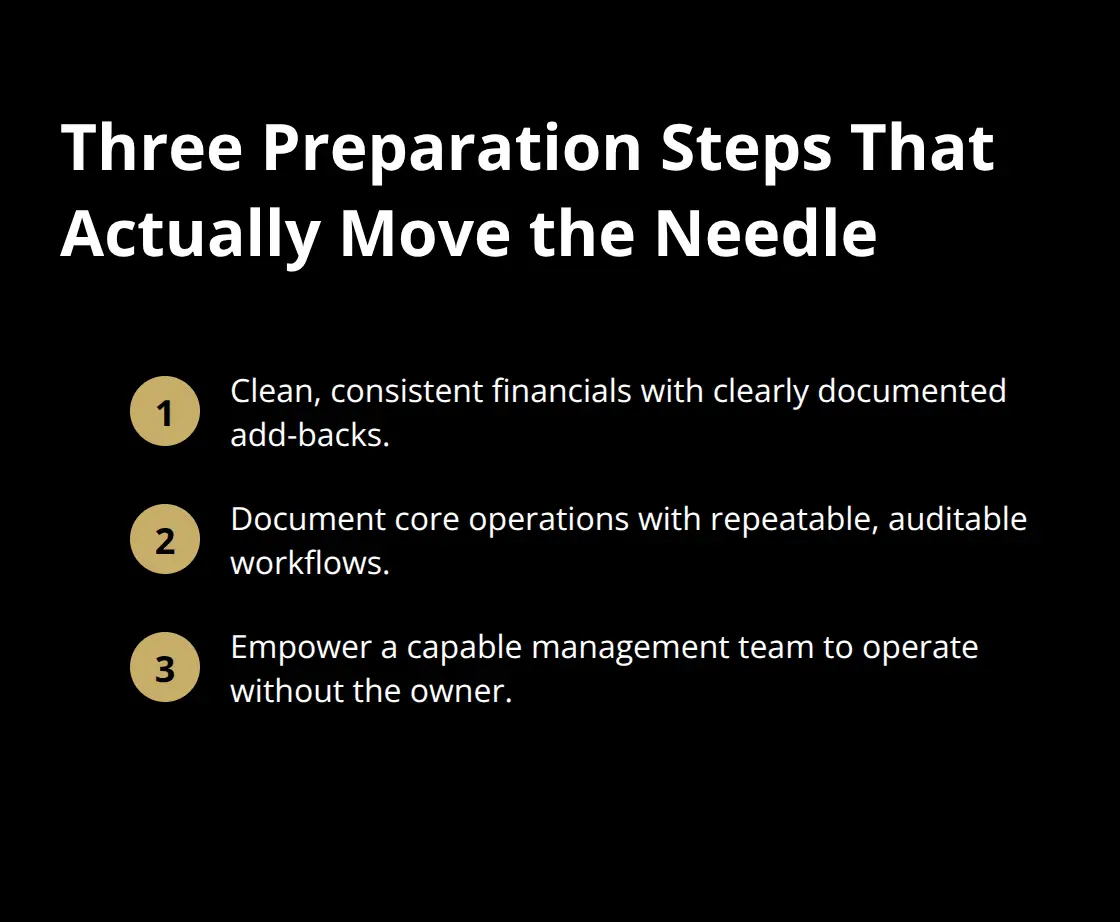
A business that fails on any of these three fronts gets marked down by 20 to 30 percent or more, regardless of revenue or profitability. The owners who understand this work backward from what buyers demand and build toward it systematically.
Get Your Financial Records in Order
Your financial records are the first place buyers investigate because numbers don’t lie the way stories do. If your accountant has been reconciling your books annually but you’ve never actually reviewed them line by line, you’re already behind. Pull your last three years of tax returns and profit-and-loss statements. Identify every expense category where your business paid for personal items, whether intentionally or accidentally.
Owners often run car payments, meals, travel, or insurance through the business, and while this reduces their tax burden, it also reduces the financial picture buyers see. During due diligence, buyers will add back certain owner expenses to calculate true earnings, but only if those expenses are clearly documented and defensible. If your records are messy, buyers assume you’re hiding something and apply a bigger discount.
Clean financials mean consistent documentation, clear revenue streams that don’t depend on a single client, and expense categories that make sense for your industry. If more than 20 percent of your revenue comes from one customer, document that explicitly so buyers understand the concentration risk upfront rather than discovering it during their investigation. Stable, documented revenue commands significantly higher multiples than speculative projections.
Document Your Operations and Processes
Map out every process that keeps your business running. This means documenting how customer orders flow through your system, how your team handles product delivery or service delivery, where decisions get made, and what happens when you’re not in the room. Most owners operate on instinct and relationships rather than systems. Customers call them directly, they approve every major decision, and key employees know how things work because they’ve watched the owner do it a thousand times.
The moment you leave, that knowledge walks out the door. Buyers see this immediately and they penalize it heavily. Start documenting the workflows that matter: client onboarding, project delivery, quality control, customer support, and financial management. Use simple tools like process maps or written procedures. If a task takes three steps, write those steps down. If a decision requires approval from multiple people, document who approves and when.
This work seems tedious, but it answers the question every buyer asks: can this business survive without the current owner present every single day? The answer you provide through your documentation determines whether the buyer sees a scalable business or a one-person show.
Build a Strong Management Team
Your management team determines whether the buyer sees a scalable business or a one-person show. If every important decision flows through you, or if your top revenue generators are personal relationships you’ve built over decades, you have a people problem, not a business problem. Start identifying your strongest managers and give them real authority over their domains. If you don’t have strong managers yet, hire them now.
The cost of bringing in a capable operations manager or sales leader 18 months before your exit is far lower than the valuation discount you’ll absorb if those roles don’t exist. Buyers often retain the current owner on a transition contract for six to twelve months, but they do this to manage risk, not because they expect the owner to run the business long-term.
A strong management team that has been making decisions independently, hitting targets, and managing client relationships without the owner’s constant input proves the business has real value beyond the founder. That proof is worth hundreds of thousands of dollars. Once you’ve strengthened these three areas, your business transforms from a personal venture into an asset that functions without you-and that’s when valuation discussions shift in your favor.
Valuation and Pricing Your Business Correctly
Most business owners have no idea what their company is worth until someone makes an offer. That’s like walking into a negotiation with your eyes closed. We see this constantly: owners either price themselves out of the market or leave hundreds of thousands on the table because they guessed instead of calculated. Valuation isn’t mysterious. It’s a structured process that uses your actual financial data to determine what a buyer will pay.
The methods vary, but they all start with the same foundation: your last three years of tax returns, profit-and-loss statements, and balance sheets. The most common approach for small to mid-sized businesses is the earnings multiple method, where buyers apply a multiplier to your annual earnings.
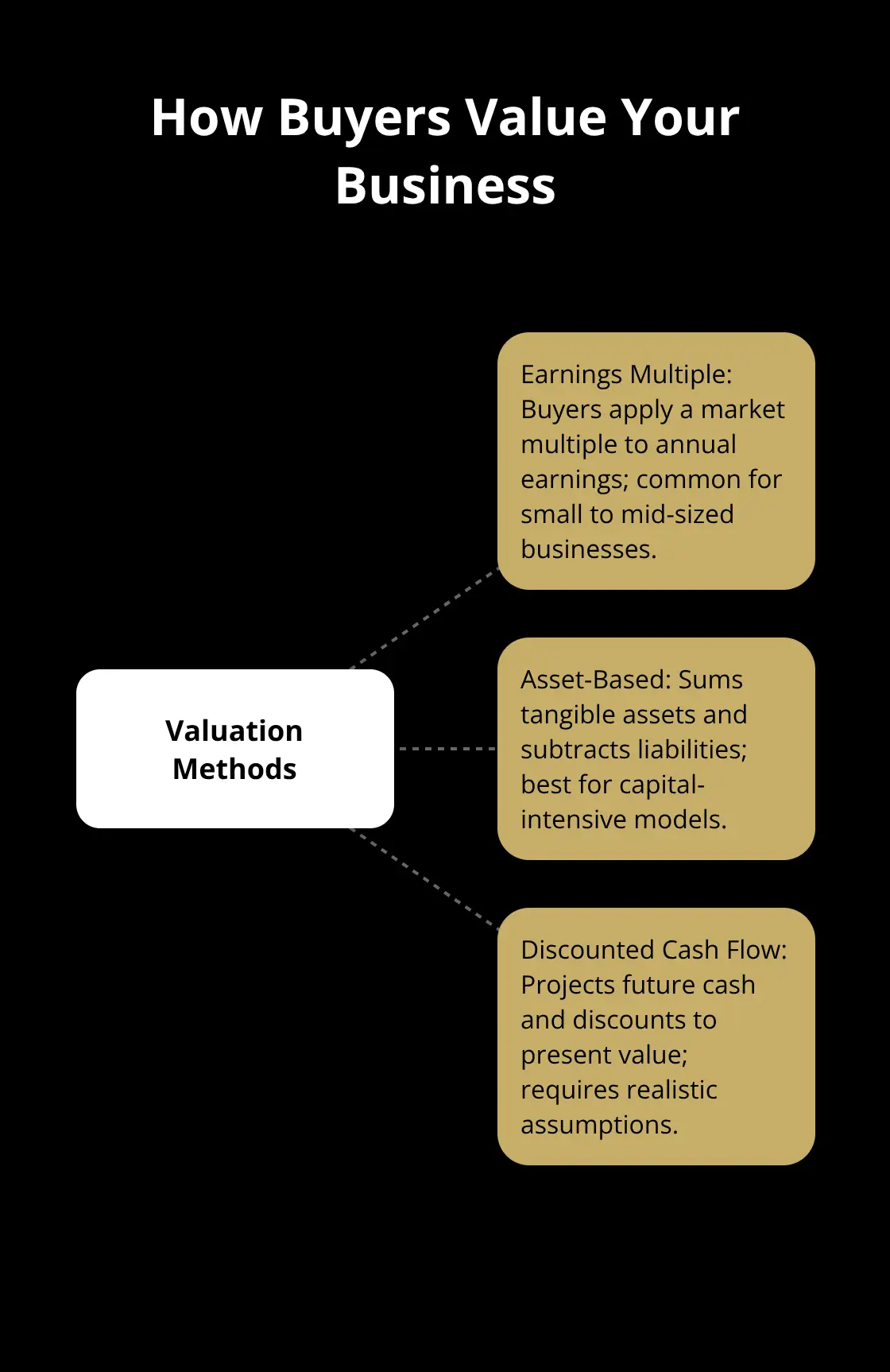
If your business generates $500,000 in annual profit and the market multiple for your industry is 4 to 5 times earnings, your valuation lands between $2 million and $2.5 million.
That multiplier depends on your industry, growth trajectory, customer concentration, and management depth. A software company with recurring revenue and low customer concentration commands a higher multiple than a service business where the owner is the primary relationship. The asset-based method works differently-it adds up your tangible assets (equipment, inventory, real estate) and adjusts for liabilities. This approach works for capital-intensive businesses but undervalues companies built on customer relationships and brand reputation.
The discounted cash flow method projects your future earnings and calculates their present value. It’s more sophisticated but requires honest projections and assumptions about growth rates. Most buyers use the earnings multiple method because it’s straightforward and based on what actually happened, not what you hope will happen.
Realistic Pricing Determines Your Outcome
Setting your asking price too high kills deal momentum immediately. Buyers investigate comparable sales in your industry, and if your asking price is 30 percent above what similar businesses sold for, they walk.
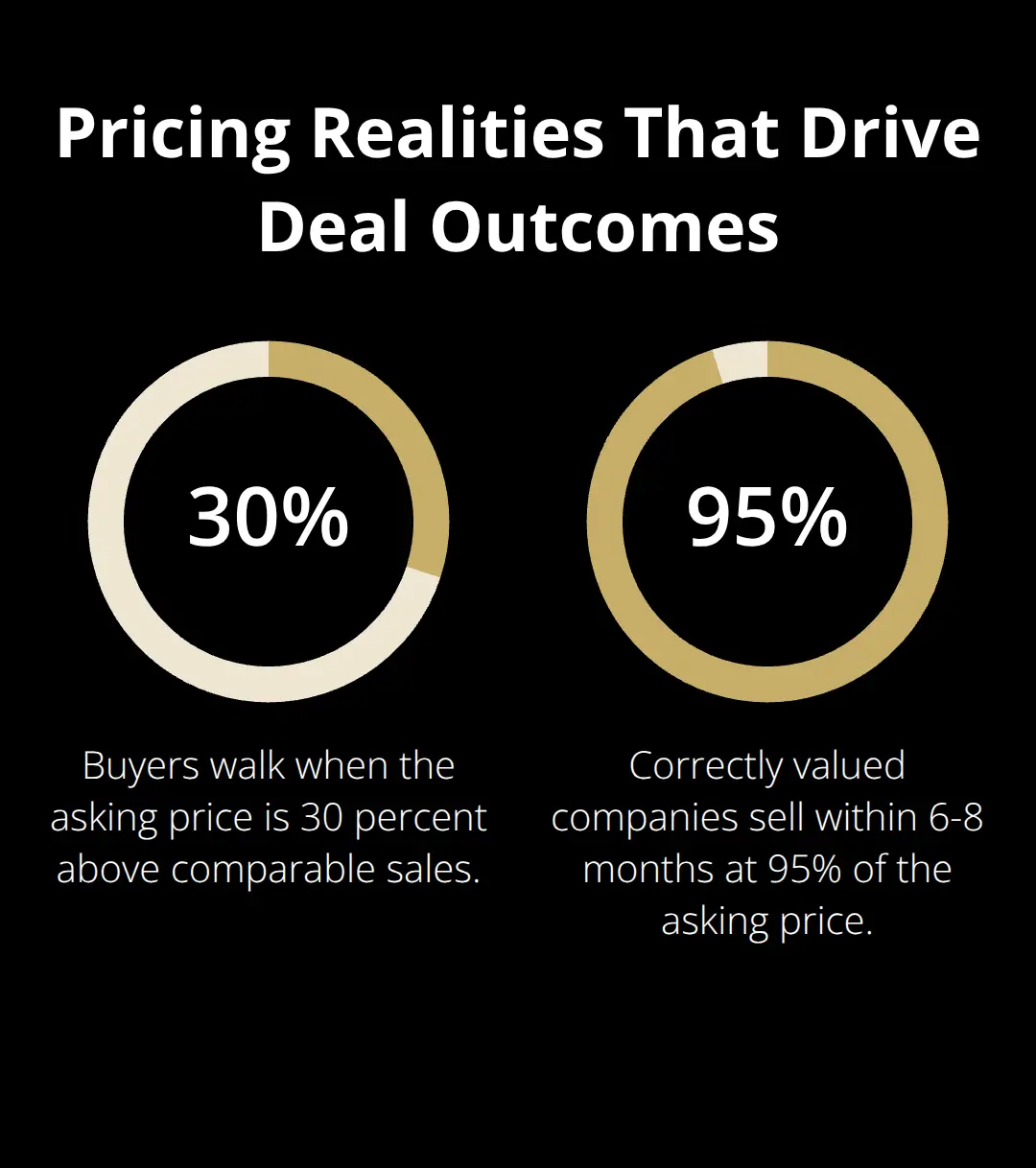
Overpriced businesses sit on the market for 18+ months while correctly valued companies sell within 6-8 months at 95% of their asking price.
Setting your price too low is equally damaging but in a different way. You leave money on the table that you’ll never recover. The gap between a realistic price and an inflated one often determines your lifestyle for the next 20 years. Here’s what actually happens during due diligence: a buyer receives your valuation estimate and then conducts their own investigation. They review your financials line by line, interview your key employees, and analyze your customer contracts.
If your valuation assumed 15 percent annual growth but your actual growth came from a single large contract that’s expiring, the buyer adjusts the valuation downward. If you documented that 60 percent of your revenue comes from three customers, the buyer applies a risk discount. If your management team hasn’t proven it can execute without you, the buyer reduces the valuation further. These adjustments happen in every deal. The owners who understand this beforehand price their businesses realistically and avoid the shock of a much lower offer during negotiation.
Professional Valuation Protects Your Interests
A professional business valuator costs between $2,500 and $10,000 depending on your business complexity, but that investment pays for itself immediately. A valuator who understands your industry, your growth patterns, and your competitive position produces a defensible valuation that withstands buyer scrutiny. They also identify which specific improvements will move your valuation most.
If your valuator tells you that reducing customer concentration from 50 percent to 30 percent with three major customers would increase your valuation by $200,000, that’s actionable intelligence. You now know exactly what to prioritize in your final years before sale. The wrong choice is hiring a general accountant who’s never completed a valuation and asking them to estimate your business value. They’ll produce a number, but it won’t hold up when a serious buyer brings in their own appraiser.
When you’re ready to move forward with a sale, you’ll work with a professional who understands your market, has completed similar transactions, and can explain how they arrived at their number. That credibility matters because buyers trust valuations that come from recognized professionals more than estimates from the business owner. The owner always has an incentive to overstate value, so buyers discount owner estimates automatically.
Final Thoughts
The exit planning steps you implement today determine your financial outcome tomorrow. Structured exit planning isn’t about rushing to sell-it’s about building a business that’s worth more, operates without you, and attracts serious buyers willing to pay top dollar. The owners who start this work years in advance don’t scramble during negotiations because they’ve already addressed the issues buyers investigate: clean financials, documented operations, and a capable management team.
The financial difference between a prepared business and an unprepared one often exceeds 20 to 30 percent of your sale price (for a $2 million business, that’s $400,000 to $600,000 in lost value). Start by pulling your last three years of financial records and identifying what needs cleaning. Map out your core processes so the business doesn’t depend entirely on you, and invest in your management team so buyers see a scalable operation.
Unbroker helps business owners sell with transparent, low-cost options that eliminate traditional brokerage fees. Whether you need hands-off support or expert guidance while maintaining control, we offer flexible services designed for your situation. Start your preparation now, and when you’re ready to move forward, you’ll do it from a position of strength.