Selling a company with government contracts presents unique challenges and opportunities. At Unbroker, we’ve guided numerous business owners through this complex process.
Buyers interested in these acquisitions need to understand the intricacies of government contracts, including compliance requirements and transfer procedures. This post will explore what buyers should know when considering a business with government contracts, from due diligence to long-term value potential.
What Are Government Contracts?
Types of Government Contracts
Government contracts are agreements between federal agencies and private businesses to provide goods or services. These contracts present unique challenges and opportunities that distinguish them from commercial deals.
The two primary types of government contracts are fixed-price and cost-reimbursement. Fixed-price contracts establish a specific price for goods or services, regardless of the contractor’s costs. Cost-reimbursement contracts allow contractors to recover allowable expenses plus a fee.
Compliance and Regulations
Government contracts operate under strict regulations. The Federal Acquisition Regulation (FAR), a comprehensive rulebook, governs everything from bidding procedures to contract performance.
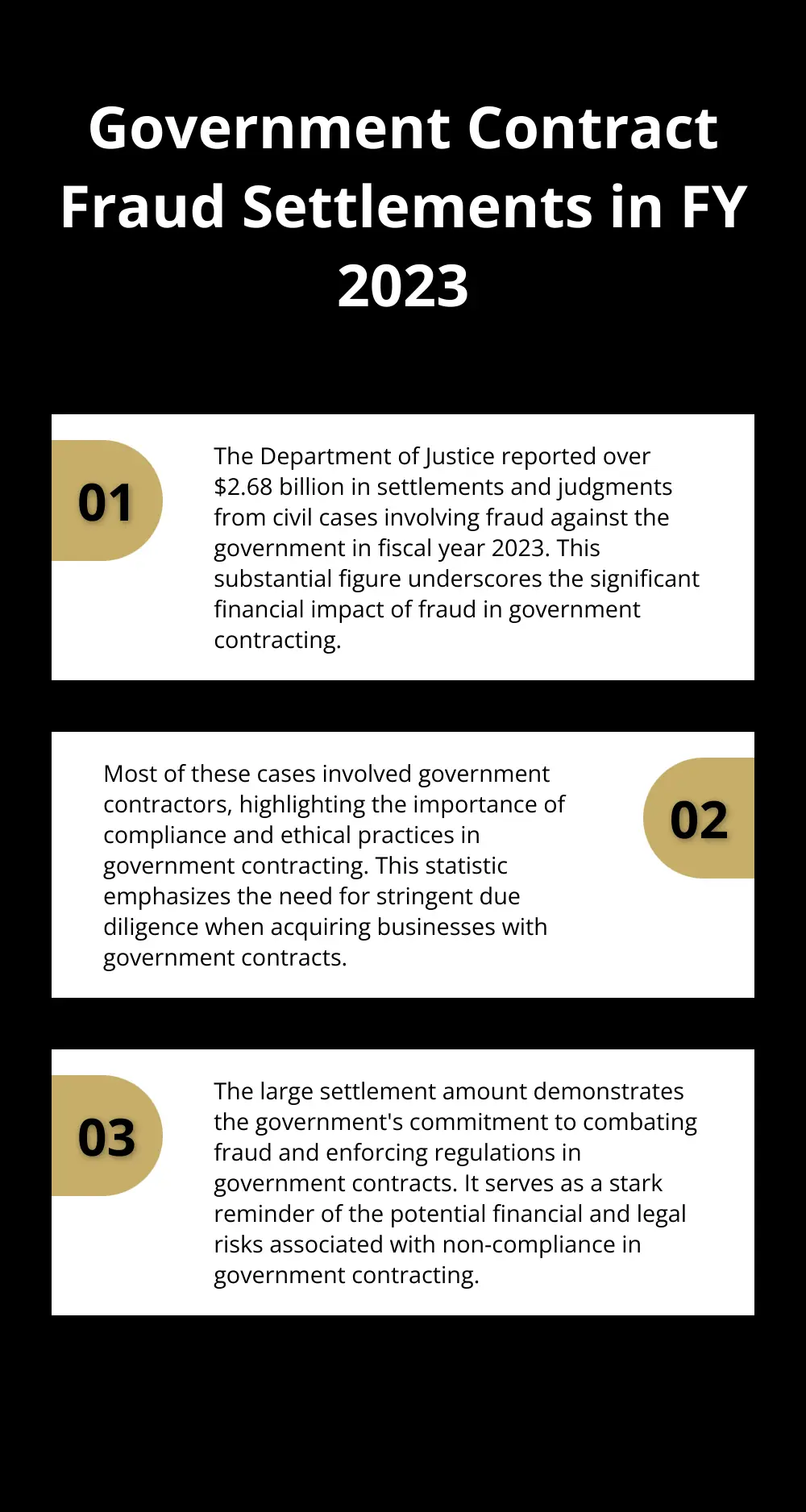
Compliance is mandatory. The Department of Justice reported over $2.68 billion in settlements and judgments from civil cases involving fraud against the government in fiscal year 2023. Most of these cases involved government contractors.
Unique Features of Government Contracts
Government contracts often include clauses not typically found in commercial agreements. For example:
- The “Changes” clause allows the government to unilaterally modify contract terms.
- The “Termination for Convenience” clause permits the government to end a contract when it’s in the public interest, without the contractor being at fault.
These unique features can significantly impact a company’s operations and financial stability. Buyers must understand these clauses and their potential effects on the business they’re considering.
Impact on Business Operations
The unique nature of government contracts can profoundly affect day-to-day business operations. Companies must adapt their processes to meet stringent government requirements, which often include:
- Detailed record-keeping
- Regular audits
- Specific reporting procedures
These requirements (which are more extensive than those typically found in commercial contracts) can increase operational costs and complexity.
Long-term Business Implications
While government contracts can provide stable, long-term revenue streams, they also come with potential risks. Changes in administration, budget cuts, or shifts in government priorities can impact contract renewals or new opportunities.
Businesses heavily reliant on government contracts may need to diversify their client base to mitigate these risks. Buyers should carefully evaluate the target company’s contract portfolio and assess its vulnerability to changes in government spending.
Understanding these nuances of government contracts is essential for potential buyers. The next section will explore the critical due diligence process for businesses with government contracts, including contract review, past performance evaluation, and security clearance considerations.
Navigating Due Diligence for Government Contracts
Scrutinizing Contract Details
The examination of government contracts requires meticulous attention to detail. Buyers must review each contract’s terms, obligations, and potential risks. Focus on contract types (fixed-price or cost-reimbursement), duration, and unique clauses.
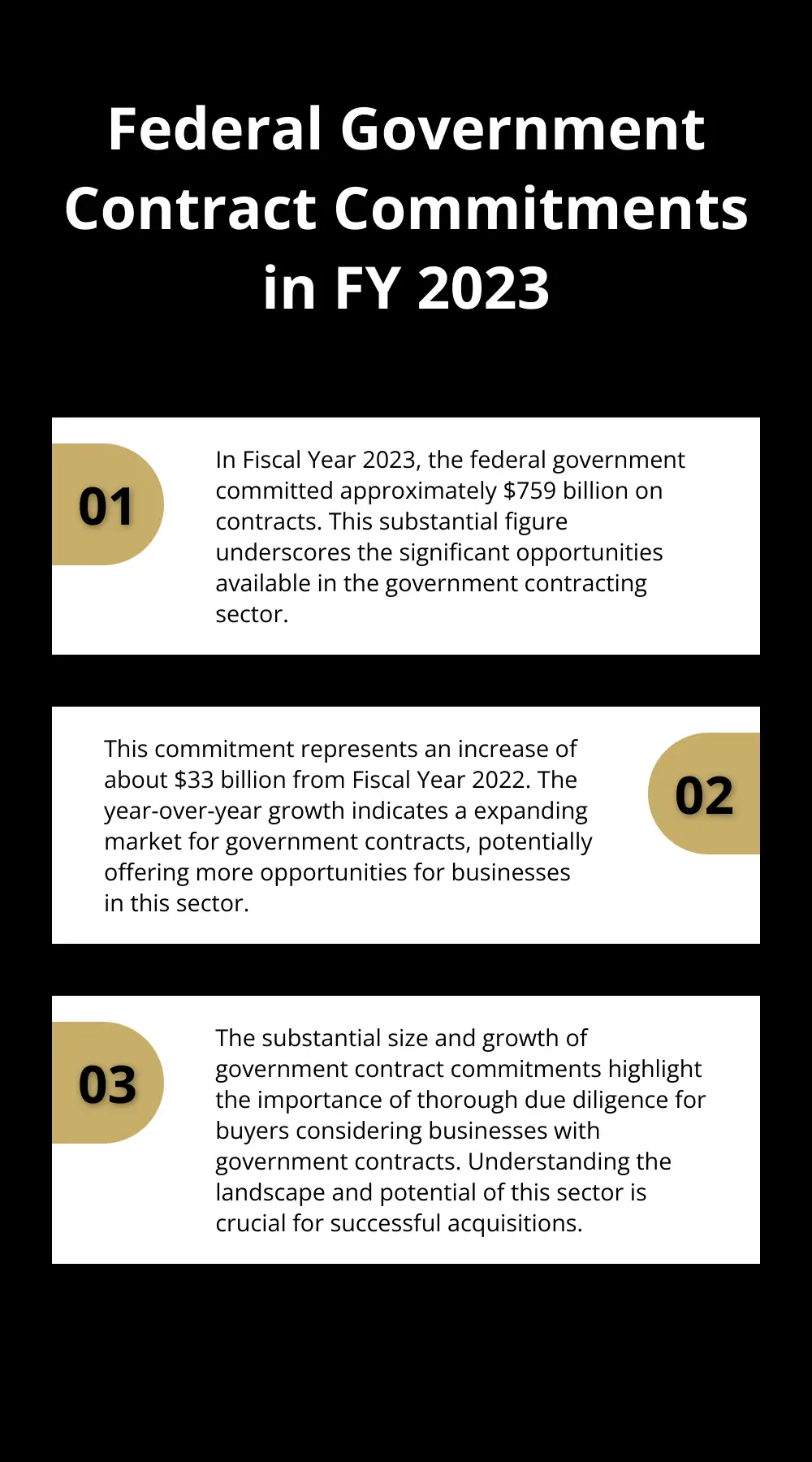
In Fiscal Year 2023, the federal government committed about $759 billion on contracts, an increase of about $33 billion from Fiscal Year 2022. This figure highlights the enormous potential in the government contracting sector, but also underscores the need for careful evaluation.
Subcontracts often fly under the radar during due diligence. These agreements can significantly impact the prime contractor’s obligations and profitability. A thorough examination of all subcontracting arrangements is essential.
Evaluating Past Performance
Past performance plays a pivotal role in winning future government contracts. Buyers should request and analyze Contractor Performance Assessment Reporting System (CPARS) evaluations for each contract. These reports offer insights into the company’s track record in areas such as quality, timeliness, cost control, and management.
Official reports tell only part of the story. Conversations with contracting officers and other government personnel who have worked with the company can provide invaluable insights into the company’s reputation and relationships within the government contracting community.
Assessing Security Clearances
For contracts involving classified information, security clearances are non-negotiable. Buyers must verify the status of all required facility and personnel clearances. Understanding the process for transferring these clearances post-acquisition is critical.
The Defense Counterintelligence and Security Agency (DCSA) oversees the National Industrial Security Program. Buyers should familiarize themselves with DCSA requirements and prepare for a potentially lengthy clearance transfer process.
Untangling Intellectual Property Rights
Government contracts often involve complex intellectual property (IP) arrangements. The government may have rights to IP developed under the contract, which could limit the company’s ability to commercialize certain technologies.
A thorough review of all contracts for IP clauses is necessary. Buyers must understand which rights belong to the government and which remain with the contractor. This information is crucial for assessing the true value of the company’s intellectual property portfolio.
In one case (handled by a leading M&A advisory firm), a buyer almost overlooked a clause granting the government unlimited rights to software developed under a contract. This oversight could have significantly impacted the company’s value proposition in commercial markets.
The complexity of government contract due diligence cannot be overstated. Buyers should not rush this process and should engage experts familiar with government contracting to ensure they don’t miss critical details that could impact the deal’s success. With a solid understanding of the target company’s contract portfolio, past performance, security clearances, and IP rights, buyers can move on to the next critical step: understanding the process of transferring government contracts.
How to Transfer Government Contracts
Understanding the Novation Process
The transfer of government contracts during a business acquisition requires a novation process. This legal procedure transfers the rights and obligations of an existing contract to a new entity. The Federal Acquisition Regulation (FAR) Subpart 42.12 governs this process, prescribing policies and procedures for recognition of a successor in interest to Government contracts when contractor assets are transferred. The government must approve the transfer of contracts to the new owner, which does not happen automatically upon the sale of a business.
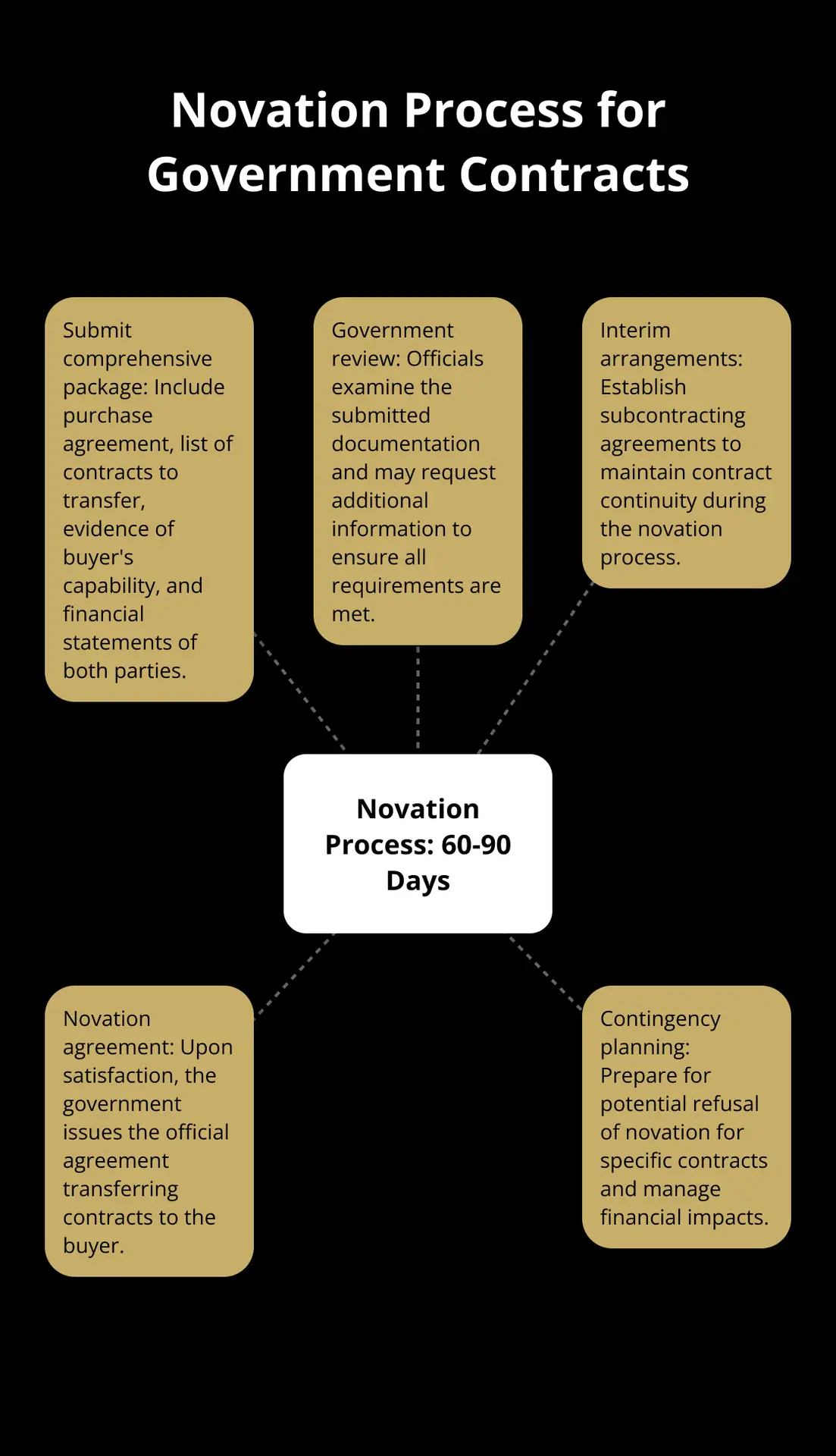
The novation process typically takes 60 to 90 days. However, complex cases can extend longer. The timeline depends on factors such as the complexity of the transaction and the number of contracts involved.
Required Documentation and Approvals
To start the novation process, buyers must submit a comprehensive package to the government. This package typically includes:
- The purchase agreement
- A list of all contracts to transfer
- Evidence of the buyer’s capability to perform the contracts
- Financial statements of both the buyer and seller
The government will review the package and may request additional information. Once satisfied, they will issue a novation agreement, officially transferring the contracts to the buyer.
Common Pitfalls in the Novation Process
Novation packages often face rejection due to incomplete documentation. A frequent mistake involves the failure to provide adequate evidence of the buyer’s capability to perform the contracts. This evidence should include past performance records, technical capabilities, and proof of financial stability.
Maintaining Contract Continuity
Contract performance must continue during the novation process. To avoid issues, buyers and sellers often enter into interim subcontracting arrangements.
These arrangements allow the buyer to perform the contracts under the seller’s name until the novation completes. However, these agreements must comply with government regulations and avoid potential conflicts of interest.
Contingency Planning
Buyers should prepare for the possibility that not all contracts will transfer. The government retains the right to refuse novation for specific contracts. In such cases, buyers must have contingency plans to manage the financial impact of losing these contracts.
The transfer of government contracts demands expertise and careful planning. Buyers who understand and prepare for the challenges of novation position themselves to successfully acquire and maintain valuable government contracts.
Final Thoughts
Selling a company with government contracts presents unique challenges and opportunities. The complex landscape demands a thorough understanding of contract types, compliance requirements, and transfer procedures. Buyers must scrutinize contract details, evaluate past performance, and assess security clearances and intellectual property rights.
The novation process requires careful planning and execution to transfer government contracts successfully. Buyers must prepare comprehensive documentation, maintain contract continuity during the transition, and develop contingency plans for potential hurdles. The timeline for this process can extend from 60 to 90 days (or longer), depending on the complexity of the transaction.
Expert guidance proves invaluable for those considering selling a business with government contracts. At Unbroker, we specialize in facilitating business sales with transparent, low-cost options. Our platform combines AI-driven processes with expert support, ensuring a smooth transition for businesses with complex contract portfolios.