Selling a business is one of the biggest financial decisions you’ll make. Getting the best business brokers on your side makes the difference between a smooth transaction and a costly mistake.
At Unbroker, we’ve seen firsthand how the wrong broker choice can cost sellers hundreds of thousands of dollars. The right partner combines proven results, transparent pricing, and deep industry knowledge.
What Makes a Broker Worth Hiring
Execution Beats Commission Rates
The broker you choose will shape your entire sales experience and directly impact your final price. Most sellers focus on commission rates first, but that’s backwards. A broker charging 10% who closes your deal in four months at full asking price outperforms a broker charging 5% who takes nine months and leaves money on the table. What matters is the broker’s ability to execute, not the percentage they take.
Demand Specific Deal Data
Start by asking for specific numbers about their recent deals. How many businesses similar to yours have they sold in the last two years? What were the average sale prices, and how long did closings take? A broker worth hiring answers these questions with exact figures, not vague generalizations.
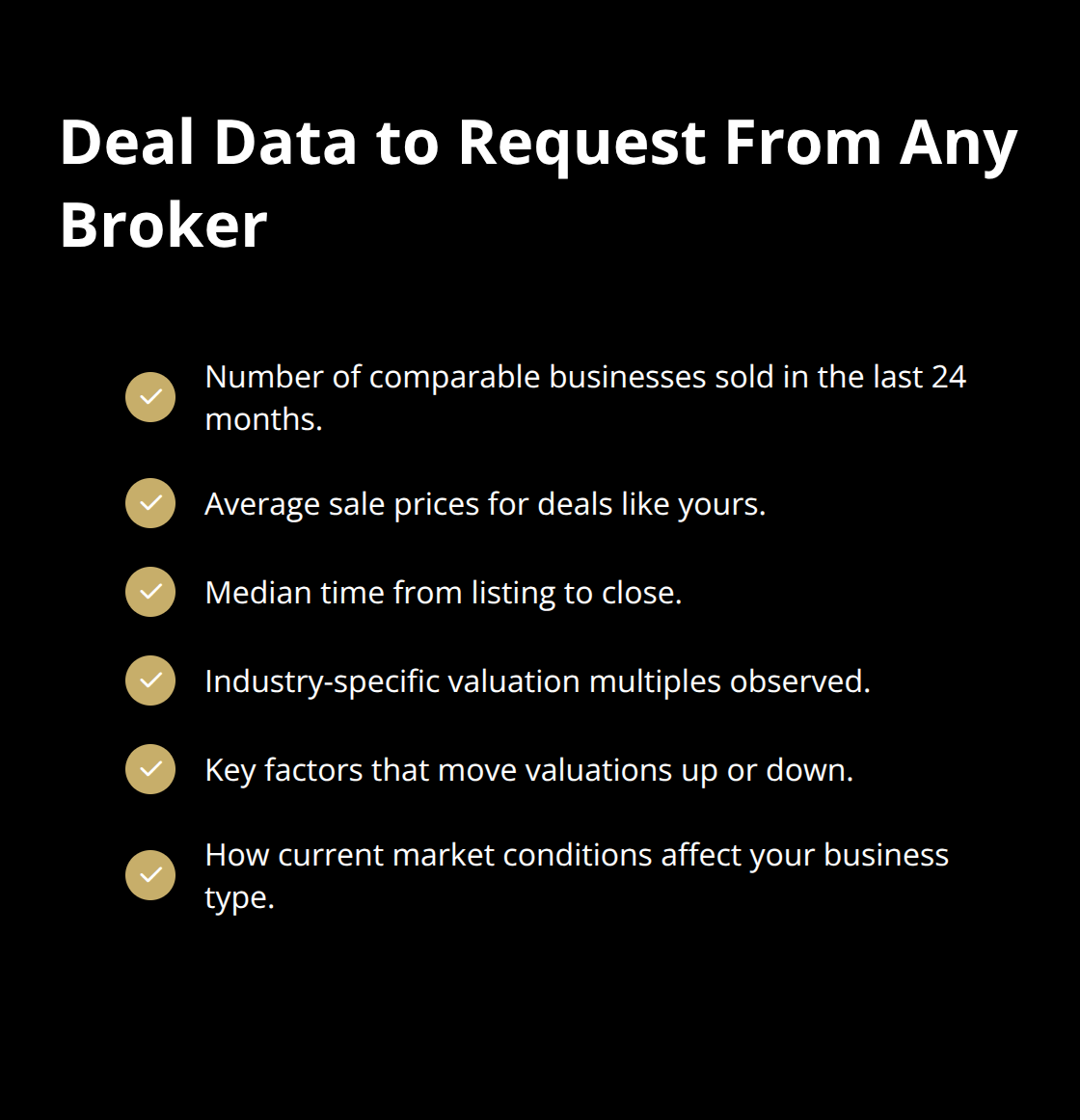
If they sold five manufacturing firms in your revenue range within the past 24 months, that’s concrete evidence. If they hedge with phrases like “most of our deals” or “typically we see,” move on.
Industry expertise means they’ve actually worked in your sector and understand your operational metrics, customer concentration risks, and valuation drivers. A broker who’s handled three tech startups and two bakeries has no meaningful experience in either. Ask what multiples they typically see in your industry, what factors drive valuations up or down, and how current market conditions affect your specific business type. Their answers should reflect real market data, not generic advice.
Transparency in Fees Separates Professionals
Transparency in fees separates professionals from amateurs. The industry average runs 5% to 15% of the sale price, but the structure matters more than the percentage. Some brokers charge flat fees upfront, others work on commission only, and many use hybrids. Ask for their complete fee breakdown in writing before you sign anything.
Hidden costs for marketing materials, legal coordination, or data room access kill deals that should succeed. A broker who itemizes every charge and explains why each service costs what it does protects your interests, not hides something. You’ll want to compare this against modern alternatives with transparent, low-cost pricing and no hidden fees.
Verify References From Recent Deals
When you evaluate track records, request client references from deals closed within the last 18 months, specifically sellers in your industry or revenue range. Call these references directly and ask three things: Did the broker deliver what they promised? Did they communicate regularly during the process? Would you hire them again? A broker’s willingness to provide recent references without hesitation signals confidence in their work.
The answers you receive will reveal whether a broker truly understands your market or simply talks a good game. This vetting process takes time, but it’s the only way to separate brokers who produce results from those who produce excuses. Once you’ve narrowed your list to brokers with proven execution, industry knowledge, and transparent pricing, you’re ready to examine the mistakes most sellers make when making their final choice.
Common Mistakes When Choosing a Business Broker
Commission Rates Distract From What Actually Matters
The biggest mistake sellers make isn’t choosing the wrong broker-it’s choosing a broker for the wrong reasons. Commission rates dominate the conversation because they’re easy to compare, but they mask what actually matters: execution quality and market access. A broker charging 8% who sells your business in five months at 95% of asking price generates far more value than one charging 6% who takes eleven months and settles for 88% of asking price.
The math is straightforward. If your business sells for $2 million, that 2% difference in final price costs you $40,000. The commission difference between 8% and 6% also costs you $40,000. They’re identical financially, but sellers obsess over the latter and ignore the former. This happens because commission is visible and negotiable, while execution quality feels abstract until it’s too late.
When you evaluate brokers, flip your priority: focus on their track record of closing speed and final sale prices first, then examine their fees. Ask for specific data on their last ten comparable deals. What percentage of asking price did they achieve? How many months passed between listing and close? A broker who consistently closes at 92% of asking in six months beats one who averages 87% in nine months, regardless of their fee structure.
Overlooking Credentials and Licensing
Credentials matter far more than most sellers realize, yet they’re often overlooked entirely. The International Business Brokers Association sets professional standards, and membership signals that a broker follows ethical guidelines and stays current on market practices. Licensing requirements vary by state, but you can verify that your broker holds current credentials in fifteen minutes.
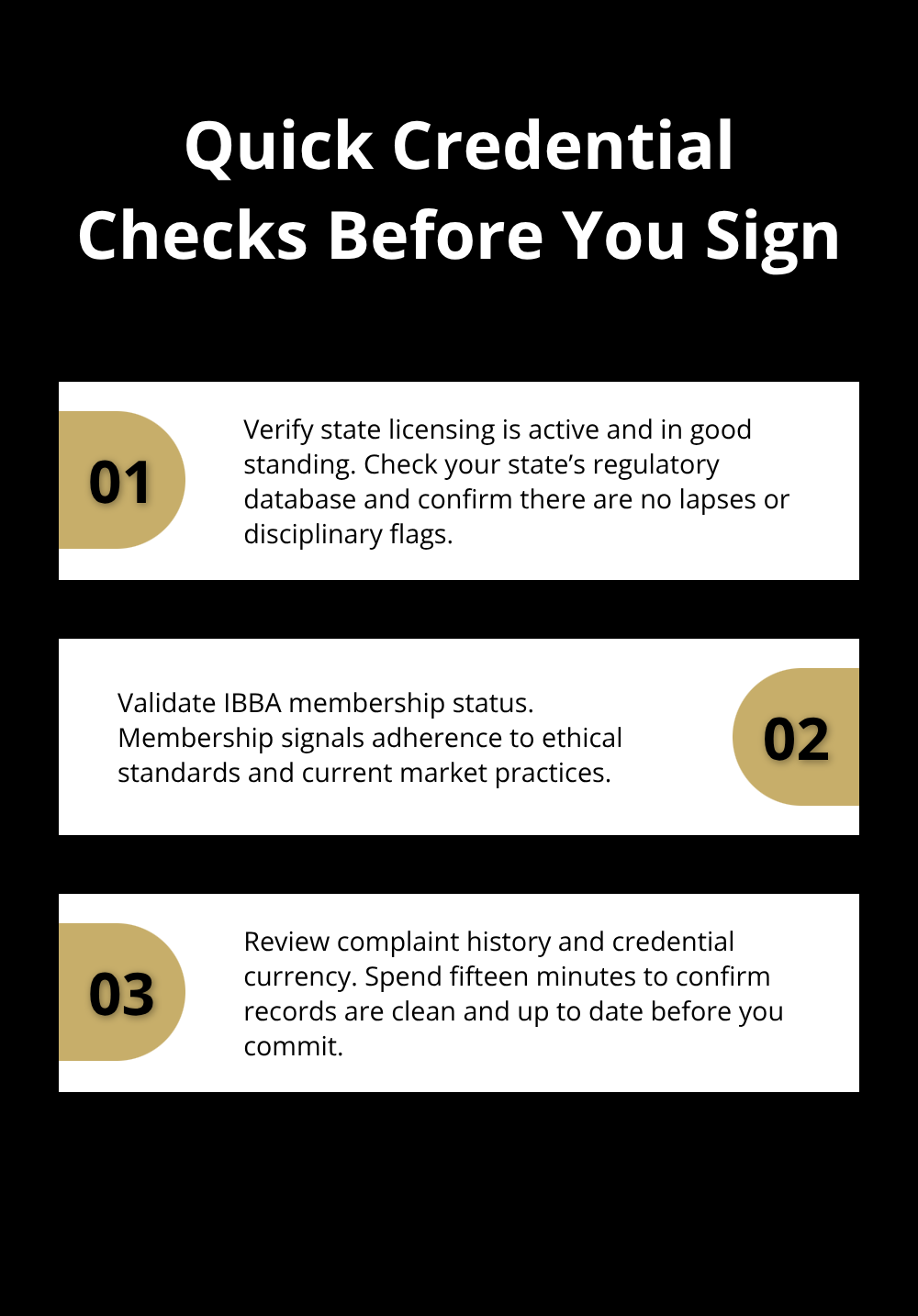
Many sellers skip this step because it feels administrative, then discover mid-transaction that their broker lacks proper licensing or has a history of complaints. Check your state’s regulatory body and the IBBA database before you commit. This simple verification protects you from working with someone who operates outside legitimate channels.
Demanding Industry-Specific Experience
Industry-specific experience separates competent brokers from excellent ones. A broker who has sold five businesses in your industry understands your valuation multiples, customer concentration risks, and seasonal revenue patterns. One who has sold five businesses across five different industries understands none of these dynamics.
Ask brokers to name specific deals they’ve closed in your sector within the last 24 months, then contact those sellers directly. Don’t accept vague references or general market knowledge as a substitute for proven sector expertise. The broker’s ability to articulate industry-specific valuation multiples and market conditions reveals whether they truly understand your business or simply talk a good game.
Verifying References With Tough Questions
References reveal truth that marketing materials hide. Most sellers request references but fail to ask the right questions or follow up thoroughly. Contact at least three sellers from deals closed within the last eighteen months, specifically in your industry or revenue range.
Ask whether the broker delivered what was promised, maintained regular communication, and whether they’d hire them again. Push for specifics: Did the broker secure multiple offers? How did they handle negotiations? Were there surprises at closing? The quality of answers you receive directly correlates with the quality of service you’ll receive. A broker hesitant to provide recent references or who offers only outdated ones signals that their recent track record won’t withstand scrutiny.
Aligning Fee Structure With Your Interests
Many sellers fail to verify that a broker’s fee structure actually aligns with their interests. Performance-based commissions paid after closing align the broker’s incentive with yours: they succeed when you succeed. Upfront fees or flat fees paid before closing can create misaligned incentives, where the broker collects money regardless of outcome.
Commission structures and seller outcomes show that rates generally range from 8–12% of the final sale price, with smaller deals often landing closer to 10–12%. Understand exactly what you’re paying for and when payment occurs. Hidden fees for marketing materials, legal document preparation, or data room access surface late in the process and create friction. Transparent brokers provide complete fee breakdowns in writing before engagement. This protects you from surprises and signals professionalism. Once you’ve identified brokers with aligned incentives and transparent pricing, you’re ready to examine how modern platforms are reshaping the entire business sales landscape.
How Modern Platforms Cut Costs and Speed Up Sales
Traditional Broker Fees No Longer Match the Work
Traditional business brokers charge between 8% and 10% of your sale price, which translates to $50,000 to $150,000 on a $1 million sale. That fee structure has remained virtually unchanged for decades, even though the tools brokers use have transformed completely. Modern platforms now handle tasks that once required expensive manual labor: buyer outreach, document management, confidentiality protocols, and deal tracking all run on software rather than human time. This technological shift creates a fundamental problem for traditional brokers-their cost structure no longer reflects the actual work required.
The gap between what brokers charge and what they actually do has widened dramatically. Software automates buyer identification, document preparation, and communication tracking. Yet traditional brokers still collect commissions based on sale price, not on the complexity or effort involved. A $500,000 sale requires nearly identical platform work as a $5 million sale, but traditional brokers collect ten times the fee. This misalignment benefits brokers, not sellers.
Transparent Pricing Replaces Commission Structures
Modern platforms operate on success-based fees rather than the inflated percentage commissions of traditional brokers. This shift changes the economics of selling. A seller with a $2 million business pays a 6% success fee, calculated fairly as a percentage of the actual sale price, due only when the deal closes. Traditional brokers charging 8-12% would collect $160,000 to $240,000 in commissions on that same $2 million sale, so a 6% success fee can leave tens of thousands more in your pocket.
The transparency matters as much as the price. You know exactly what you’ll pay before you commit. No hidden charges for marketing materials, legal document preparation, or data room access surface mid-transaction. This clarity protects you from surprises and signals professionalism. When you compare total costs across options, the financial advantage of modern platforms becomes impossible to ignore.
Buyer Networks Powered by Data, Not Relationships
Traditional brokers guard their buyer networks jealously because that exclusivity justifies their fees. Modern platforms invert this model by building buyer networks through technology rather than personal relationships. AI-driven matching systems identify qualified buyers across industries and geographies, then route your business to genuinely interested prospects rather than broadcasting it to everyone. This targeted approach produces better outcomes than broad marketing ever did.
Brokers historically marketed by listing your business in general marketplaces and hoping someone noticed. Modern platforms use data to identify specific buyer profiles-whether that’s private equity firms seeking tech acquisitions, operators expanding into your sector, or individual buyers with demonstrated capital. Sellers retain full control over their buyer conversations while accessing the same professional infrastructure that traditional brokers charged premium fees to provide. The result: faster timelines and better deal terms because you negotiate from a position of real optionality rather than hoping a single broker delivers qualified interest.
Centralized Workflows Eliminate Coordination Delays
Selling a business traditionally involves coordinating between your broker, a lawyer, an accountant, possibly a valuation specialist, and the buyer’s team. Each party works from different documents, uses different communication channels, and operates on their own timeline. This fragmentation creates delays and errors that cost sellers real money. Most middle market transactions take 6 to 12 months or longer from preparation to closing, with coordination inefficiencies adding significant time to these timelines.
Modern platforms centralize this workflow. Document templates, confidentiality agreements, buyer questionnaires, and offer tracking all live in one system accessible to every participant. You upload your financial statements once rather than emailing them separately to five different parties. Buyers submit offers through standardized forms that prevent the vague, conditional proposals that waste everyone’s time. Legal document preparation happens within the platform rather than through back-and-forth email chains with an external attorney. This operational efficiency directly translates to faster closings-modern platforms target 60 to 90 days from initial buyer interest to closing, compared to the industry average of 120 to 180 days for traditional brokers. Faster closings reduce your exposure to market risk and competitive threats. When you sell in 75 days instead of 150 days, you’re not subject to changing buyer sentiment, rising interest rates, or new competitors entering your market.
Final Thoughts
Choosing the best business brokers comes down to three non-negotiable factors: execution quality, industry expertise, and transparent pricing. Demand specific data about their recent deals, verify their credentials, and contact their references directly. The best brokers prove their value through concrete results, not marketing language.
Traditional brokerage models crack under their own weight because commissions that once reflected actual work now represent outdated pricing for tasks that technology handles automatically. Buyers expect faster timelines, clearer communication, and lower costs, while sellers increasingly recognize that paying 8 to 10 percent of their sale price no longer makes sense when modern alternatives deliver superior outcomes at a fraction of the cost. This shift toward transparent, technology-driven platforms represents a fundamental realignment of how business sales work.
Your choice of partner shapes whether you sell your business efficiently or waste months navigating coordination delays and hidden fees. Look for brokers who embrace transparency, demonstrate industry-specific expertise, and align their incentives with yours by rejecting anyone who can’t provide concrete data about their recent deals or who resists answering tough questions about their process.