If you want to know how to sell a daycare business, start with the license, not the price. In many states a child care license cannot be handed to a buyer the way you would hand over equipment or a customer list. The buyer may need to apply for a license of their own, and the sale has to be timed around that approval.
This guide walks through how change of ownership works, how a few states handle it differently, what happens to subsidy and food program payments, and what staff and parents need to hear. It also covers how buyers read your earnings and which records to pull together before you list.
Why selling a child care center is different
Most small businesses sell as a bundle: equipment, customer relationships, a lease, a name and some goodwill. A child care center has all of that, plus a regulated product. The state decides who may care for children, in which building, under what staffing and safety conditions. A buyer is not only buying your cash flow. They are asking the state for permission to step into your role.
That changes the order of operations. In a typical sale, closing day is when the keys change hands. In child care, closing day may be the day children go without a licensed provider if the paperwork is not ready. Regulators in several states say plainly that the seller must stop providing care once the buyer’s authorization begins, and that the buyer cannot run the program before holding the right authorization.
The market itself is large and fragmented. In 2023 the U.S. had 82,162 employer establishments in child day care services (NAICS 624410) with 1,045,052 employees, according to Census County Business Patterns data compiled for 2023. The same year, 533,596 nonemployer child day care businesses (NAICS 62441, meaning no paid employees) were counted in Census Nonemployer Statistics. Those counts are not a licensing registry or a count of seats, so they do not tell you how many centers are for sale or how many buyers exist. They do show that child care is a sector of many small operators, and a buyer will compare your center against plenty of alternatives.
Licenses usually do not transfer: what change of ownership means
“Change of ownership” is the term most state agencies use for a sale or transfer of a child care program. The details differ, but the core idea repeats: the state treats the new owner as a new applicant, even if nothing about the daily program changes.
Nebraska’s licensing rules are direct about it. Under 391 Neb. Admin. Code ch. 3, section 003, child care licenses are not transferable or assignable, a change of ownership terminates the license, and the new owner must apply for a license. The rule defines change of ownership to include the sale or transfer of ownership or control of a center to someone other than the current licensee.
Connecticut takes a similar position. The Office of Early Childhood says child care licenses are not transferable, and a buyer must obtain a new license and approval before the change happens. If the sale is finalized before a new license is issued, the program must close immediately and may face penalties. The new owner cannot run the program day to day until holding their own license.
Two points deserve attention if you plan to sell the company rather than the assets:
- Selling the entity may still count. Connecticut’s 2024 guidance says the ownership changes covered by the rule include changes in ownership of the business entity that owns or operates the program, not only direct sales of the center. Do not assume a stock or membership-interest sale lets you skip the process.
- Small ownership stakes can matter. North Carolina defines an owner as any person with a 5% or greater equity interest in a child care facility, according to its center provider guidance. If you have partners, silent investors or family members on the cap table, find out who counts as an owner in your state.
Your attorney can tell you how your sale structure interacts with your state’s definition. If you are weighing an asset sale against an entity sale, our guide to the asset sale approach covers the general tradeoffs, but the licensing question comes first for a center.
How states handle it: new license, temporary permit or approved transfer
States generally land in one of three camps, and some mix them. The examples below show the range. Your own state’s licensing agency is the authority, and its rules and forms may change, so confirm before you sign anything.
New license with a bridge permit
In Georgia, the Department of Early Care and Learning requires a change of ownership when a new owner buys an existing child care business, building or property that continues operating. The new owner receives a permit that allows operation until the final license is granted. Provisions that were previously grandfathered do not transfer to the new owner, so a buyer may need to bring the building up to current requirements that your center was excused from.
That last point is worth a close look. If your center operates under an older exception, whether for space, layout or a similar item, tell your broker or advisor early and ask the agency how it applies to a buyer. Surprises here can reopen price discussions late in the deal.
Temporary license, then a full one
North Carolina requires the Change of Owner form to be received at least 30 days before the official date of ownership transfer. The state issues the buyer a temporary license and terminates the seller’s license. The seller’s side of this is simple but strict: your license ends, so there is no overlap in which both of you are licensed for the same children.
Full new application with fire and background steps
Louisiana’s change-of-ownership checklist for early learning centers says the process should take no more than 30 days. It calls for:
- a new license application and the full licensure fee;
- a new State Fire Marshal inspection and approval within 60 days of the change;
- signed statements giving the last day of care by the seller and the first day of care by the buyer;
- criminal background check determinations for each owner, director and staff member.
Those fees and inspections are the buyer’s to arrange, but they affect your timeline and your negotiation. A buyer who expects extra upgrade costs may ask for a price adjustment.
An approved transfer
A few states allow the license itself to move. Washington is an example: under WAC 110-300-0011, a full child care license may be transferred to a new licensee on a transfer of ownership, but only if the new licensee meets statutory requirements and the department determines before the transfer that the new operation is substantially similar to or an improvement on the original. The department also determines and discloses whether the license is in good standing before transferring it.
Even in a state like this, the transfer is conditional. A buyer who plans to change the program, the age groups or the staffing model may not qualify for the simple path, and a license with open compliance issues is a weaker asset. Cleaning up your standing before you list is a smart move wherever you operate.
Build the timeline around the license, not just the closing date
Because the license controls when a buyer can legally operate, treat the license approval as the center of your timeline. Closing date, lease assignment, payroll cutover and parent notices all hang off it.
A practical sequence looks like this:
- Ask the agency first. Before you accept an offer, get the current change-of-ownership forms, fees and review steps for your state. Many agencies publish a checklist. Share it with serious buyers early.
- Make the license a condition. Have your attorney draft the purchase agreement so the closing, or at least the handover of operations, depends on the buyer receiving the permit, temporary license or license your state requires. Connecticut’s warning about immediate closure and penalties for closing early is the risk you are guarding against.
- Coordinate the old and new license. Connecticut recommends that the current and new owner coordinate closing the old license with issuing the new one. Set a shared calendar with the agency’s contact, the buyer and the attorneys.
- Plan the first and last day of care. Where a state asks for signed statements on those dates, as Louisiana does, agree on them in advance so nobody scrambles.
- Line up the building. If you lease, the landlord’s consent and the lease assignment need to line up with the license date. If you own the real estate, decide whether it sells with the business or is leased to the buyer, since the agency may look at the property too.
Do not promise a buyer a fixed closing date. Agencies work at their own pace, and a rushed timeline invites trouble. If you want to understand how long the non-regulatory parts of a deal typically run, see our business sale timeline overview and then layer the licensing steps on top.
Subsidy payments, food program and quality rating: what moves and what does not
Revenue streams that rely on public programs rarely move automatically with the sale. Buyers will ask about each one, so have clear answers.
Georgia’s guidance gives a useful picture. Once the new owner receives a permit, temporary license or continuing license, the seller cannot provide care or receive CAPS (child care subsidy) payments. Scholarships transfer to the new owner based on completion of Quality Rated and licensing requirements. Nutrition program payments are made only to the entity that holds the Child Care Learning Center license.
The takeaways apply broadly, even though program names and rules differ by state:
- Subsidy income follows the license holder. After the cutover, you should not expect to bill for care. Plan a clean handoff of claims for the period before it, and settle who collects any amounts still owed for earlier dates of service.
- Food program payments belong to whoever holds the license. A buyer may need to enroll in the program in their own name. Ask your sponsor or agency what that involves, and do not count on the buyer inheriting your approvals.
- Quality ratings and scholarships may be conditional. In Georgia, scholarships transfer based on completion of quality and licensing requirements. If your center holds a quality rating that supports higher rates or enrollment, find out how it carries over, if at all.
Buyers who underwrite the deal on subsidy-heavy revenue will want to see what share of income comes from public programs and how those payments have behaved. Pull a clean report from your billing system so you are not guessing in a meeting. Also tell the buyer which payments depend on your license or your enrollment in a program, so the deal model is honest from the start.
Staff, directors and background checks: what buyers need to see
Your teachers and your director are the product. A buyer who cannot keep them has an empty building and a license application with nothing behind it.
Expect buyers to ask for a staff roster showing role, certifications, hire date, current pay and status. They will also ask about background check clearances. Louisiana’s checklist asks for criminal background check determinations for each owner, director and staff member, and other states have their own clearance rules. Gather the records for each person now and check that they are current. A missing clearance for even one employee can slow the buyer’s application.
Keep the labor market in mind. BLS reported a median hourly wage of $15.41 for childcare workers in May 2024, and that figure excludes self-employed workers because the survey does not collect their pay (BLS Occupational Outlook Handbook, Childcare Workers). BLS also projects employment of childcare workers to change by -3% from 2024 to 2034 (BLS, Preschool and Childcare Center Directors and Childcare Workers). A buyer reading those numbers will think about how hard it is to hire and keep staff. If your team is stable, that is an asset, so be ready to show it.
Think about retention before you list. Buyers like to hear that the lead teachers and the director plan to stay. You cannot promise that for them, but you can talk with key people at the right time, with the buyer’s input, and consider whether a retention bonus tied to closing makes sense. Our post on whether and when to tell employees you are selling goes deeper on timing.
Owner pay, a replacement director and how buyers read your earnings
If you run the center yourself, this is where your numbers can get misread. Buyers normalize earnings, and the measure they use decides how your pay is treated.
With seller’s discretionary earnings (SDE), the earnings of one owner-operator are shown before that owner’s pay, so your full compensation is added back, whatever its level. Personal expenses and one-time costs are added back too. SDE is the measure many buyers use for smaller, owner-operated centers.
With adjusted EBITDA, the logic is different. Owner pay is reset to a market rate. If you pay yourself above market, the excess is added back. If you pay yourself below market, that gap is a deduction that lowers EBITDA, because a buyer who does not want to run the center must hire a director at the going rate. Personal expenses and one-time costs are still added back. Larger centers or multi-site operators are more likely to be viewed this way.
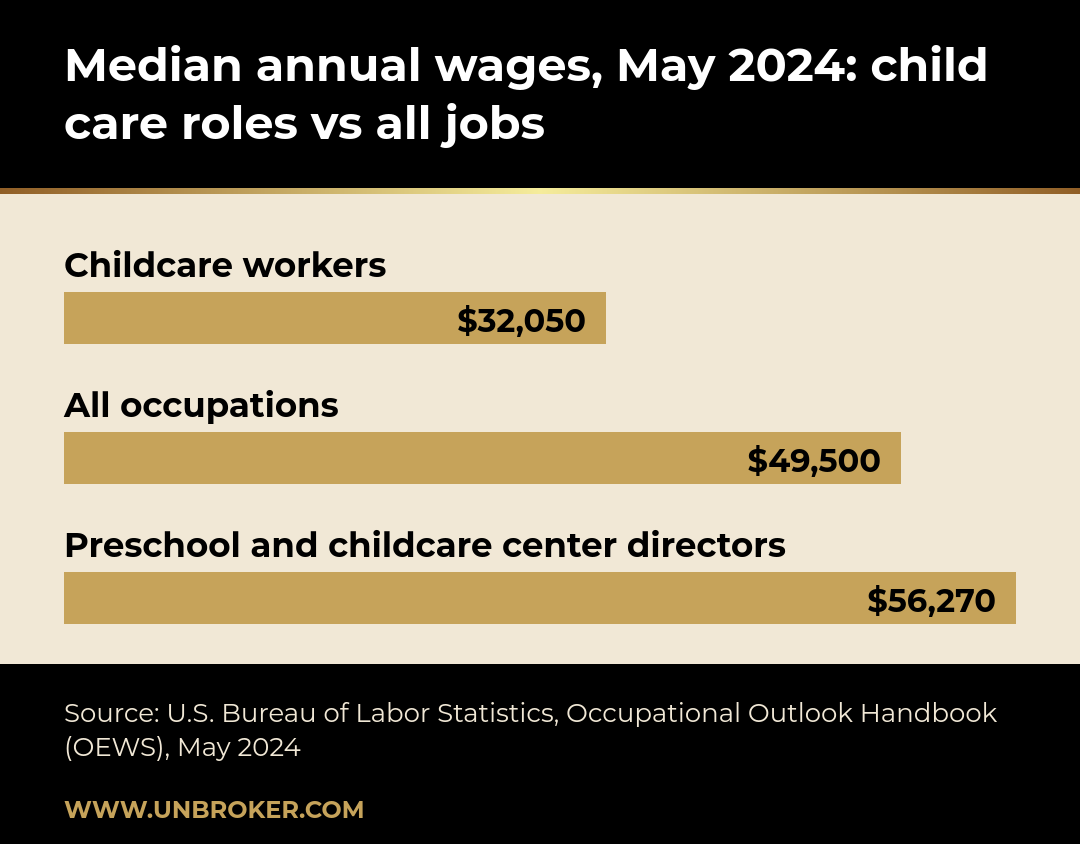
For a sense of what a replacement director can cost, BLS reported these median annual wages in May 2024: $32,050 for childcare workers, $49,500 for all occupations and $56,270 for preschool and childcare center directors. BLS wage data do not cover self-employed workers, so they say nothing about what an owner-operator takes home, and pay for directors varies by region and center size. See the BLS Occupational Outlook Handbook figures for the full breakdown.
If you act as the director and pay yourself little or nothing, the center’s profit may look strong on paper. A buyer using adjusted EBITDA will subtract a market wage for the person who replaces you, and the profit may look smaller. If you are using SDE with a buyer who will work in the center, that same pay is added back. Know which measure your likely buyer uses, and show both views in your financial package so no one is caught off guard.
Valuation multiples vary by market and by kind of business, and each one rests on a base: revenue, EBITDA or SDE. A multiple of SDE for a single-site owner-operated center does not compare to a multiple of EBITDA for a larger operator. Ask a valuation adviser which base and which comparable businesses fit your center, and read our guide on how to apply business valuation add-backs before you recast your statements.
Records to gather before you list
Buyers of regulated businesses read the paper trail closely. Getting it organized before you list helps you answer questions faster and keeps your story consistent. Our seller due diligence tips give the general framework. For a child care center, add these:
- Licensing file: your current license, any conditions or waivers, grandfathered provisions, and the agency’s change-of-ownership forms for your state.
- Inspection history: licensing inspections, fire and health inspections, and documentation of how you corrected any citations. A clean record helps, and so does proof that you fixed problems promptly.
- Ratios and capacity: a record of staff-to-child ratios by classroom and age group, plus licensed capacity compared with actual enrollment.
- Enrollment data: current enrollment, waitlist, attendance patterns and tuition rates by age group. Separate private-pay families from those paid through subsidy or scholarship programs.
- Incident files: incident and accident reports, how they were handled, and any parent complaints. Be honest here. Buyers and agencies may check, and surprises hurt trust.
- Staff files: background check clearances, training hours, certifications, health screenings and job descriptions.
- Financials: profit and loss statements, tax returns, payroll records and any recast schedule showing your add-backs.
- Program payments: subsidy, scholarship and food program billing and payment histories, so the buyer can see what depends on the license.
- Facility documents: lease, landlord contact, certificate of occupancy, equipment list and maintenance records.
- Insurance: current policies and claims history, so the buyer can price their own coverage.
Children’s records and family information are private. Do not share them in a listing or with early-stage buyers. Provide enrollment data in aggregate form until a buyer is qualified and a confidentiality agreement is in place, and ask your attorney what the buyer may see and when. Our guide on protecting your privacy during a business sale covers confidentiality practices in more depth.
Telling parents and staff without losing enrollment
Enrollment is the lifeblood of a center, and word of a sale can spook families and teachers. A rushed or leaked announcement may lead to withdrawals, and a buyer will notice a falling headcount before closing.
A few principles help:
- Keep the sale confidential until it is real. Early marketing should not identify your center by name or address. Share identifying details only with buyers who have signed a confidentiality agreement.
- Tell the director and key staff first. Do it once a deal is likely and a buyer is committed, and do it in person. They will be asked questions by parents the moment the news spreads.
- Plan one message for families. Families care about continuity: who is in the classroom, who is in charge, what happens to tuition and policies, and whether their child’s spot is safe. Where the state requires notice of a change of ownership, follow it. Coordinate the wording and the timing with the buyer and your attorney.
- Introduce the buyer. A friendly handover, such as a letter, an open house or an introduction at drop-off, can help families feel they are in good hands. A buyer who plans to keep your curriculum, your hours and your people can say so.
- Be accurate about dates. Because your license ends and the buyer’s begins on a specific schedule, say clearly when the new operator takes over. Do not announce a date before the agency has confirmed the buyer’s authorization.
Consider a transition period in which you stay on as a consultant if the buyer wants it. Whether you can work in the center during that time depends on state licensing rules, so ask the agency and your attorney before you promise a buyer an on-site role. Our guide on owner transition planning offers a framework for the handover.
Finally, remember that tax and legal details around a sale, including how the purchase price is allocated and how proceeds are taxed, depend on your entity type and facts. Confirm them with a tax adviser and an attorney who understand both small business sales and child care regulation in your state.
Unbroker helps owners sell businesses like child care centers through a confidential process, expert advisors and AI-driven buyer matching across a large national buyer network. Our Full Service Business Sale charges a 6% success fee, paid when the business sells. Learn more at unbroker.com.