Pest control is a business buyers understand: customers on repeat schedules, routes that run on a calendar, and demand that does not take a holiday. But a pest control company is also regulated, labor-dependent and full of long-tail obligations. Buyers know that, and they will look closely at your licenses, your technicians and your service contracts.
This guide walks through what matters most when you sell: how your recurring revenue reads to a buyer, why state licenses do not simply change hands, how to handle technicians and termite warranties, how to clean up your financials, and how to keep the sale quiet. It ends with a pre-sale checklist you can work from this month.
Why pest control businesses attract buyers
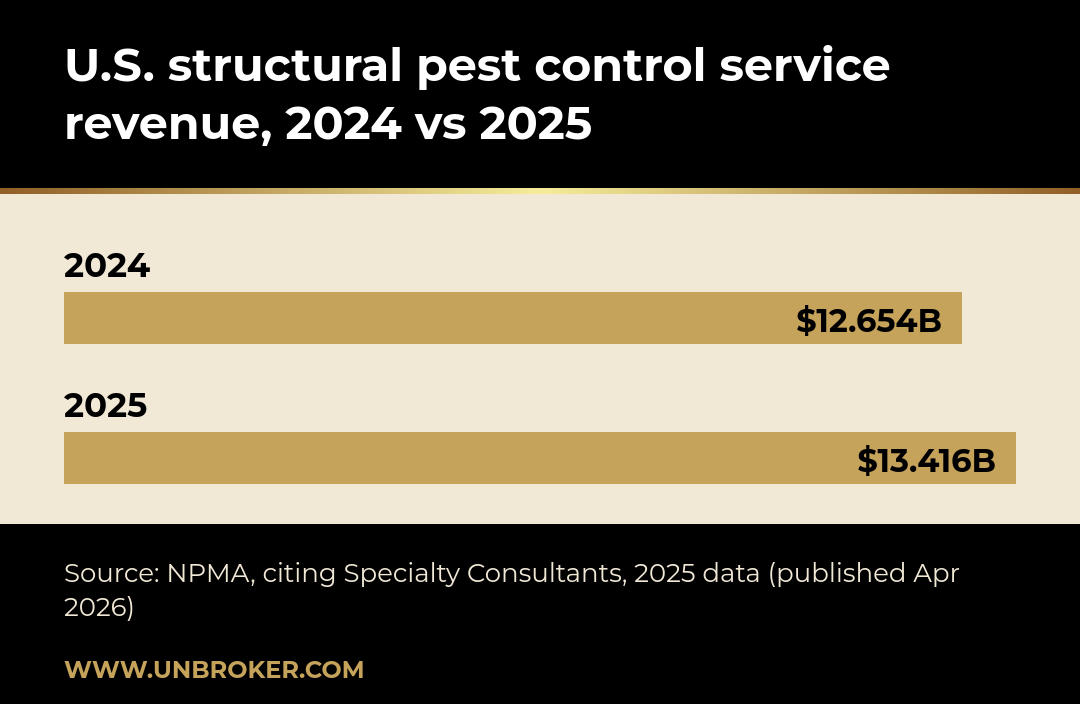
Buyers like industries with steady demand and a clear operating model. Pest control has both. U.S. structural pest control firms generated $13.416 billion in total service revenue in 2025, a 6% increase from $12.654 billion in 2024, according to the Specialty Consultants report covered by the National Pest Management Association (NPMA).
The same NPMA coverage says nearly 13.29 million residential customers received professional pest control services in 2025, and the commercial segment’s service revenue rose nearly 7.0% that year. In NPMA’s 2025 survey of 800 pest control company owners and managers, 66.8% of respondents expected their residential service revenue to grow in 2026. Those are industry-wide signals, not a prediction for your company, but they help explain why buyers keep looking at the space.
The industry is also fragmented. NPMA reported 16,565 pest control firms operating in the U.S. in 2025, with 81.4% running one or two locations. In practice, a buyer is often looking at an owner-run operation, which shapes what they ask for: proof the business can run without you, a transferable customer base and a clean compliance record.
What buyers want to see in your recurring revenue
Recurring revenue is the center of most pest control valuations. A customer on a quarterly or monthly plan is more predictable than a one-off treatment, and buyers pay attention to how much of your income comes from plans.
For context, NPMA’s 2025 industry coverage says recurring revenue accounted for 85.4% of residential service revenue in the U.S. structural pest control industry, up from 85.2% in 2024. Separately, the 2025 Pest Control Industry Cost Study from NPMA and PCO Bookkeepers, released December 16, 2025, covers 246 firms and found recurring revenue represented 74% of total income. These two figures cover different groups: the first is residential service revenue across the industry, the second is total income across the firms in that study. Do not read either as a target for your own books. Show a buyer your actual mix.
Here is how to present your recurring revenue so it reads as reliable:
- Break out revenue by type. Separate recurring plans, one-time treatments, termite work, and commercial accounts.
- Show customer tenure and cancellations. A buyer wants to know how long customers stay and why they leave.
- Document billing. Autopay, invoicing and collections history all matter, and so do any customers on paper contracts versus verbal agreements.
- Be clear on pricing history. If you have not raised plan prices in years, say so. A buyer may see room to grow, or may see a risk that customers push back.
- Separate residential from commercial. Commercial accounts often have different contract terms, audit requirements and decision-makers.
The goal is for a buyer to look at your customer list and see a stable base, not a pile of loosely documented relationships. If you want to see how other service owners package this kind of income, our guide on selling a plumbing business covers a similar mix of licenses, crews and records.
State licenses do not simply change hands: plan the ownership change early
This is the piece owners most often underestimate. The U.S. Bureau of Labor Statistics says in its Occupational Outlook Handbook that state laws require pest control workers to be licensed, that requirements vary by state, and that workers usually must complete training and pass an exam. Business licensing is a separate layer, and it is regulated state by state.
Two examples show how this can work:
- California. The Department of Pesticide Regulation states in its pest control business renewal application that pest control business licenses are not transferable. A new application and fee are required for a change of business organization or ownership, and each business location must have a qualified applicator holding a valid Qualified Applicator License.
- Texas. The state’s structural pest control licensing agency, in its business information change form, states that a new tax identification number indicates a change in ownership, that the license does not transfer, and that a new application and fee are required.
Other states differ. Do not assume your state works like either of these. Call your state pesticide or structural pest control regulator early and ask exactly what a change of ownership triggers for your entity type and your deal structure.
What this means for you in practical terms:
- Ask the regulator before you sign anything. Find out what a buyer must file, what the buyer needs to hold personally (for example, a qualified individual or certified applicator), and whether anything must be in place before the buyer can operate.
- Talk to an attorney about timing. Your purchase agreement should address what happens between closing and license approval. Whether the buyer can service your customers during that window is a legal question, and the answer depends on your state.
- Let the buyer know up front. A buyer who learns about a licensing gap late may lower the price or walk away. A buyer who sees a clear plan early is more likely to stay engaged.
- Keep your own license in good standing. Renewals, insurance, financial responsibility requirements and any pending notices should all be current before you list.
Deal structure also plays a role here. Whether the transaction is an asset sale or an entity sale may change what the regulator treats as an ownership change, so confirm with an attorney. Our guide to structuring a sale as an asset purchase explains the basics you will want to discuss with your adviser.
Technician certifications and the labor question
In pest control, your people are part of the product. Customers know their technician by name, and the technicians hold the certifications that keep the company legal. A buyer will want to know who is certified, in which categories, and whether those people are likely to stay.
Labor is also a real constraint across the industry. In NPMA’s 2025 survey, 36.8% of respondents said their company’s growth was constrained by an insufficient number of technicians, and NPMA estimated the industry employed 109,384 service technicians. When hiring is hard, a buyer values a stable, trained team more highly, and worries more about losing it.
Prepare a clean technician summary for buyers:
- Each technician’s role, certification categories and renewal dates (without names at the early stage, if you want to stay confidential)
- Pay structure, including any commissions, route bonuses or per-account incentives
- Tenure and how technicians were trained
- Any non-solicitation or confidentiality agreements already in place, reviewed by your attorney
- Who handles scheduling, customer calls and quality checks if you step away
If you personally hold the certification that the business depends on, that is a key-person risk. A buyer will ask who can fill that role after closing. Solving it early, by helping a senior technician get certified or by agreeing to a transition period, can make the business easier to sell. Our post on selling when a key employee walks away is worth a read if this applies to you.
Termite contracts, warranties and callback exposure
Termite work and warranties add value, and they add obligations. A buyer who takes over your customers also takes on the promise to retreat, repair or respond. Expect questions about every open commitment.
Make a list of what is outstanding:
- Termite bonds and renewal agreements. What does each one cover, when does it renew, and what is the retreatment or repair obligation?
- Warranties on one-time work. Bed bug, rodent exclusion or wildlife jobs may carry guarantees that outlast the service date.
- Pending claims or complaints. Disclose them. Buyers find them in due diligence anyway.
- Insurance. Policies, claims history and any coverage tied to your entity.
Callbacks are another area a buyer may ask about. In the 2025 NPMA survey of pest control company owners and managers, 51.6% of respondents named ants as the pest most responsible for callbacks, followed by cockroaches at 42.6%. If you track callbacks by pest and by technician, you can give a buyer a straight answer and show you manage quality, not just revenue.
How warranty and termite obligations are handled in the deal, whether the buyer assumes them, whether you keep some liability, or whether a portion of the price is held back, is a negotiation and a legal matter. The rules and the contract language vary, so have an attorney review how these obligations are written and how they pass to a buyer.
Route density, equipment and chemical inventory
A buyer is also buying a route map. Dense, well-organized routes mean less drive time and more stops per day. Scattered accounts mean more fuel, more windshield time and a harder handover. Before you list, look at your routes the way a buyer would.
- Map your accounts. A simple map by technician and by service day shows density at a glance.
- Identify outliers. Low-value accounts far from any cluster may be worth repricing or releasing before the sale.
- Note service frequency. Customers on regular schedules are easier for a buyer to slot into routes.
- List vehicles and equipment. Include condition, age, maintenance records and any liens or loans.
- Inventory chemicals and materials. Storage and handling rules apply to pesticides, so confirm with your regulator and attorney how inventory is documented and what can be transferred in a sale.
- Review software and data. Your scheduling and billing system holds the customer history. Make sure you can export it cleanly.
A buyer who sees tidy routes and well-kept equipment tends to trust the rest of your records. A buyer who finds missing maintenance logs may start discounting everything.
Cleaning up your financials so buyers can trust them
Pest control financials can look different from one company to the next, so buyers will want to understand your real earnings. The 2025 cost study offers useful benchmarks to compare against your own books, based on 246 firms with combined annual revenue of $584 million. It found an average gross margin of 58% across all regions, and direct labor averaging 25.8% of revenue, the largest cost category.
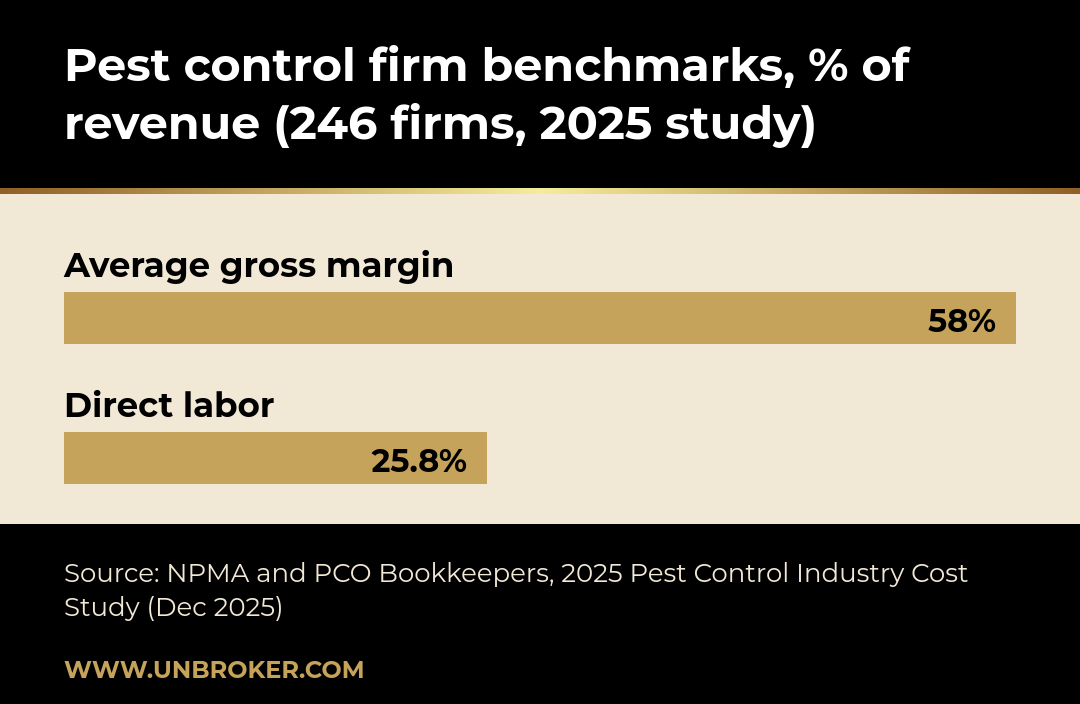
Those are averages for the firms in that study, not a standard you must meet. If your margins differ, be ready to explain why: pricing, route density, product costs, technician pay or a mix of services. Buyers respond better to a clear explanation than to a surprise.
Name the earnings measure you are using
When you present earnings, say which measure you mean, because owner pay is treated differently in each.
- Seller’s discretionary earnings (SDE) is the usual measure for owner-operated small businesses. Personal expenses and one-time costs are added back, and one owner-operator’s full pay is added back, whatever its level. Our guide to seller’s discretionary earnings goes deeper.
- Adjusted EBITDA is more common for larger companies with management in place. Personal expenses and one-time costs are added back, but owner pay is reset to a market rate. Pay above market is added back. Pay below market is a deduction that lowers EBITDA, because a buyer must pay a replacement the market rate.
If you work routes yourself and pay yourself little, an adjusted EBITDA view may show lower earnings than you expect, since a buyer would need to hire someone to do your job. Valuation multiples depend on the base (SDE or EBITDA), the size of the company and the kind of pest control business, and they vary by market, so ask a valuation adviser which one fits your situation rather than quoting a number from a friend.
Before you list, do these basics:
- Reconcile your books so revenue by service line matches deposits.
- Document every add-back with a receipt or explanation.
- Separate personal vehicle, phone and family payroll costs from business costs.
- Keep tax returns, profit and loss statements and balance sheets consistent with each other.
Keeping the sale confidential from customers and technicians
In a route-based business, rumors travel fast. Customers may wonder if service will change. Technicians may wonder about their jobs. Competitors may try to use the news. A confidential process protects the value you have built.
- Use an anonymous listing. Describe the business by region, size and service mix, without a name, logo or exact address.
- Require a signed confidentiality agreement. Share identifying details only after a buyer signs and you have a sense of who they are and whether they can afford the deal.
- Screen buyers. Ask about experience, financing and licensing plans before releasing customer-level data.
- Control the data. Share customer lists late in the process, and consider anonymizing account names until the buyer is serious.
- Decide when to tell your team. Telling technicians too early may cause departures. Telling them too late may hurt trust. Our post on when to tell employees you are selling can help you think it through.
For more on the mechanics, see how to keep your business sale secret while attracting buyers. Marketing through syndication partners and listing sites can reach many buyers while keeping your identity hidden, as long as the listing is written without identifying details.
Choosing how to sell: professionally managed or hands-on
There are two reasonable paths, and the right one depends on your time, your comfort with negotiation and how complex your deal is.
Professionally managed
If you are busy running routes and answering customer calls, a managed sale can take much of the work off your plate. An advisor can help prepare your financials, write the confidential listing, screen buyers, run negotiations and coordinate documents. This may suit owners with multiple locations, commercial contracts, complicated warranty obligations or a tight personal timeline.
Hands-on
If you are cost-conscious and comfortable doing the work, you can stay in control: gather your records, write the listing, respond to buyers and negotiate yourself, using templates and tools where helpful. This route asks more of your time. Make sure you get legal and tax advice, especially on licensing, warranties and deal structure, which are the areas that tend to trip up first-time sellers.
Whichever path you choose, the preparation is the same: clean books, documented recurring revenue, a clear licensing plan and a team a buyer can trust.
Pre-sale checklist for pest control owners
- Call your state regulator. Ask what a change of ownership requires for your entity type and deal structure, and what a buyer must hold.
- Review your license and certification renewals. Confirm the business, qualified individuals and technicians are current.
- Split revenue by type. Recurring plans, one-time work, termite and commercial, each reported on its own line.
- Pull customer tenure and cancellation data. Be ready to explain who leaves and why.
- List every open warranty, bond and renewal. Have your attorney review how these pass to a buyer.
- Track callbacks. By pest type and technician, if your software allows it.
- Map your routes. Identify clusters, outliers and technician workloads.
- Document equipment, vehicles and inventory. Include maintenance logs and any liens.
- Reconcile your financials. Decide whether SDE or adjusted EBITDA is the right measure and document every add-back.
- Prepare a technician summary. Roles, certifications, pay structure and retention risks.
- Plan your confidentiality steps. Anonymous listing, confidentiality agreements and a communication plan for your team and customers.
- Meet with your attorney and tax adviser. Cover deal structure, license timing and tax consequences before you accept an offer.
Selling a pest control company takes more groundwork than many service businesses, but the work pays off in a smoother process and fewer surprises in diligence. If you want help along the way, Unbroker combines expert advisors, AI-driven buyer matching and national marketing in a confidential process. Our Full Service Business Sale charges a 6% success fee, paid when the business sells. Visit Unbroker to see how it works.