Most articles about taxes on a business sale cover capital gains rates and asset versus stock deals, then stop. They skip Section 1202, the qualified small business stock (QSBS) rule, which can matter a great deal if you own a C corporation. This post explains who may qualify, how the law signed on July 4, 2025 treats older and newer stock differently, and what to confirm before you list.
You will not get tax advice here, and nobody can tell you from a blog post whether your shares qualify. You will get a clear picture of the conditions, the questions to bring to a tax adviser or attorney, and the records to gather. Read it as a map for a qualified small business stock sale of business planning conversation, not as a verdict.
What QSBS is and why it matters when you sell
Section 1202 of the Internal Revenue Code lets certain shareholders exclude some or all of the gain when they sell qualified small business stock. For stock acquired after September 27, 2010 and on or before July 4, 2025, non-corporate taxpayers may exclude up to 100% of gain from the sale of QSBS held for more than five years, subject to limits. The stock must be acquired directly from a domestic C corporation at original issuance.
That is a big deal for an exit. If a large part of your gain can be excluded, the number that matters is what you keep after tax, not only the headline price. A buyer’s offer, the structure of the deal and your tax outcome are tied together, and the time to learn this is before you go to market, not after you sign a letter of intent.
Two cautions up front. First, this rule is narrow. Many small businesses are LLCs or S corporations, and for them the analysis starts somewhere else. Second, even if you own a C corporation, qualifying depends on facts about when and how the stock was issued, what the company does and how the deal is built. Treat QSBS as something to test, not something to assume.
Does your business even qualify?
Think of the qualification as a series of gates. Miss one and the exclusion may not be available. Your adviser will walk through the details, but you can screen yourself first.
Gate one: a domestic C corporation, and stock you received at original issuance
The stock must come from a domestic C corporation. It also generally has to be acquired directly from the company at original issuance, as the law firm summary of the pre-2025 rules puts it. That usually means you got your shares from the corporation, for example when you founded it or invested in it, rather than buying them from another shareholder. If you bought a business from a prior owner by purchasing their shares, your shares may not meet this test. Ask.
Gate two: an active U.S. trade or business
The company must be engaged in an active U.S. trade or business during substantially all of the shareholder’s holding period. A company that spent years as an operating business but also sat on idle investments or drifted into something else is a candidate for a closer look.
Gate three: the industry
Certain industries are excluded under the pre-2025 rules as summarized by that same source, including law, accounting, health, finance and hospitality. If you run a professional practice, a clinic, a financial services firm or a restaurant or hotel business, do not assume the exclusion is off the table or on the table. Ask your adviser how your specific activities are classified. If you own a practice, our guides to selling a dental practice and other practice types cover value and buyers, but the tax classification question belongs with a tax professional.
Gate four: the company’s size when the stock was issued
There is also a gross assets test for the issuing corporation. It is measured around the time the stock was issued, as the dollar figures below show, so it is a question about the company’s balance sheet at that earlier point. It is not the same as asking whether your business is small today. Confirm the numbers with your adviser using the actual issuance dates.
What the July 4, 2025 law changed (and what it did not change for older stock)
The One Big Beautiful Bill Act was signed into law on July 4, 2025. It did not rewrite the rules for everyone. It created a split based on when your stock was acquired or issued.
- Stock acquired after September 27, 2010 and on or before July 4, 2025: the pre-2025 rules still apply. That means a single holding period test, a $50 million gross assets ceiling for the issuing corporation before or immediately after issuance, and an exclusion limit of the greater of $10 million or 10 times your basis in the stock.
- Stock acquired or issued after July 4, 2025: a staggered exclusion based on how long you hold, a higher asset ceiling and a higher cap, all covered below.
If you hold stock from both periods, for instance founder shares from years ago and a newer issuance to a partner or employee, each block of stock follows its own set of rules. Stock acquired at other times may be governed by yet other rules, so ask your adviser to map each issuance to the right regime.
The practical message: do not read a headline about the new law and assume it describes your shares. A founder who received stock years ago is likely under the older rules, while someone who received newly issued stock after July 4, 2025 is under the newer ones.
Holding period math: the staggered tiers versus the older five-year rule
Under the older rules, the question was binary: hold for more than five years and you may be eligible for up to 100% exclusion; sell sooner and the exclusion generally is not available. For QSBS acquired after July 4, 2025, the law replaced the single five-year holding period with a staggered exclusion: 50% of gain after at least three years, 75% after at least four years, and 100% after five years or more.
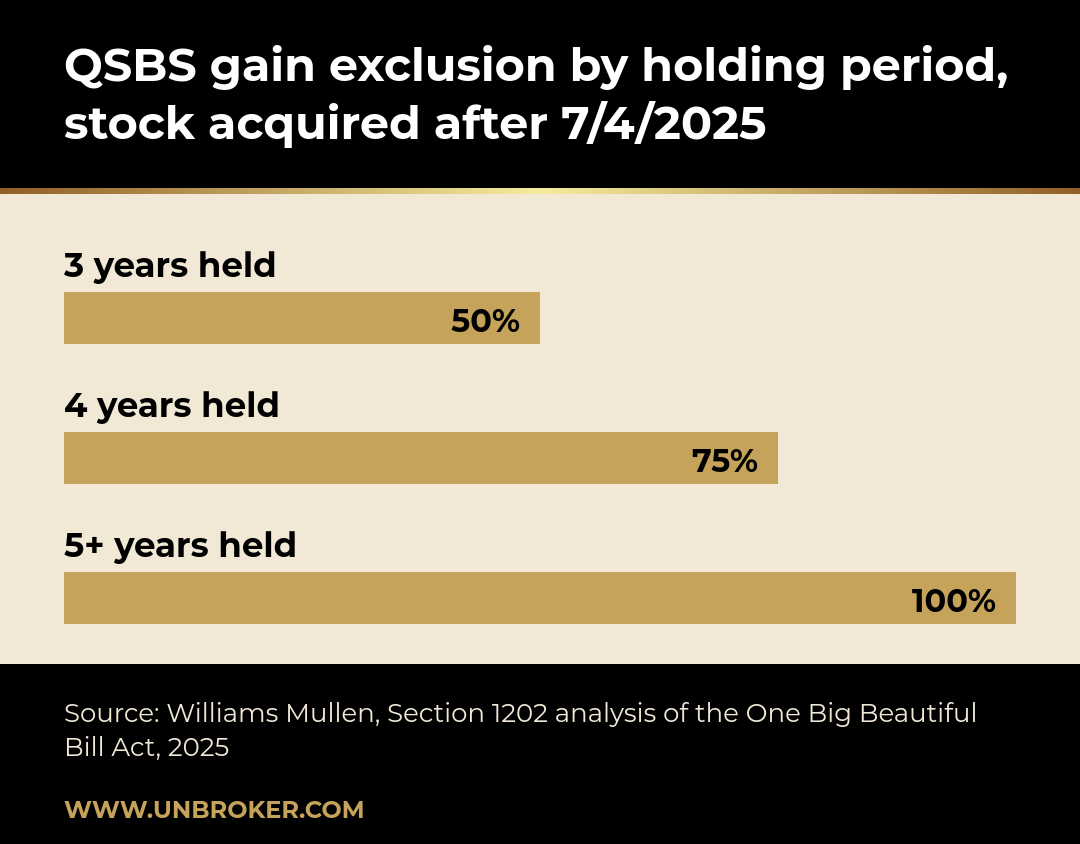
What does this change for a seller? Mostly it changes the cost of timing. Under the older approach, a sale a little short of the line could mean a very different outcome. With the tiers, a sale at three or four years may still produce a partial exclusion on newer stock. That does not mean you should sell early. A partial exclusion is still partial, and a buyer, your health, your market or your plans may set the timing more than the tax calendar does.
Because tax outcomes depend on exact dates, build a simple timeline with your adviser: when each block of stock was acquired, when the holding period began and when each tier would be reached. Then compare that against realistic sale timing. If a tier date is close, ask whether a short delay is sensible, but weigh that against the risk of a buyer cooling off. Waiting always carries market risk, and no process can promise a sale date or price.
The cap: the greater of a dollar limit or 10 times basis
The exclusion is not unlimited. Under the pre-2025 rules, the issuing corporation’s gross assets could not exceed $50 million before or immediately after the stock issuance, and the exclusion was limited to the greater of $10 million or 10 times the taxpayer’s basis in the stock. For stock issued after July 4, 2025, the gross assets ceiling rose from $50 million to $75 million, measured immediately before and after issuance, and the per-taxpayer, per-issuer exclusion cap rose to the greater of $15 million or 10 times the taxpayer’s adjusted basis in the stock.
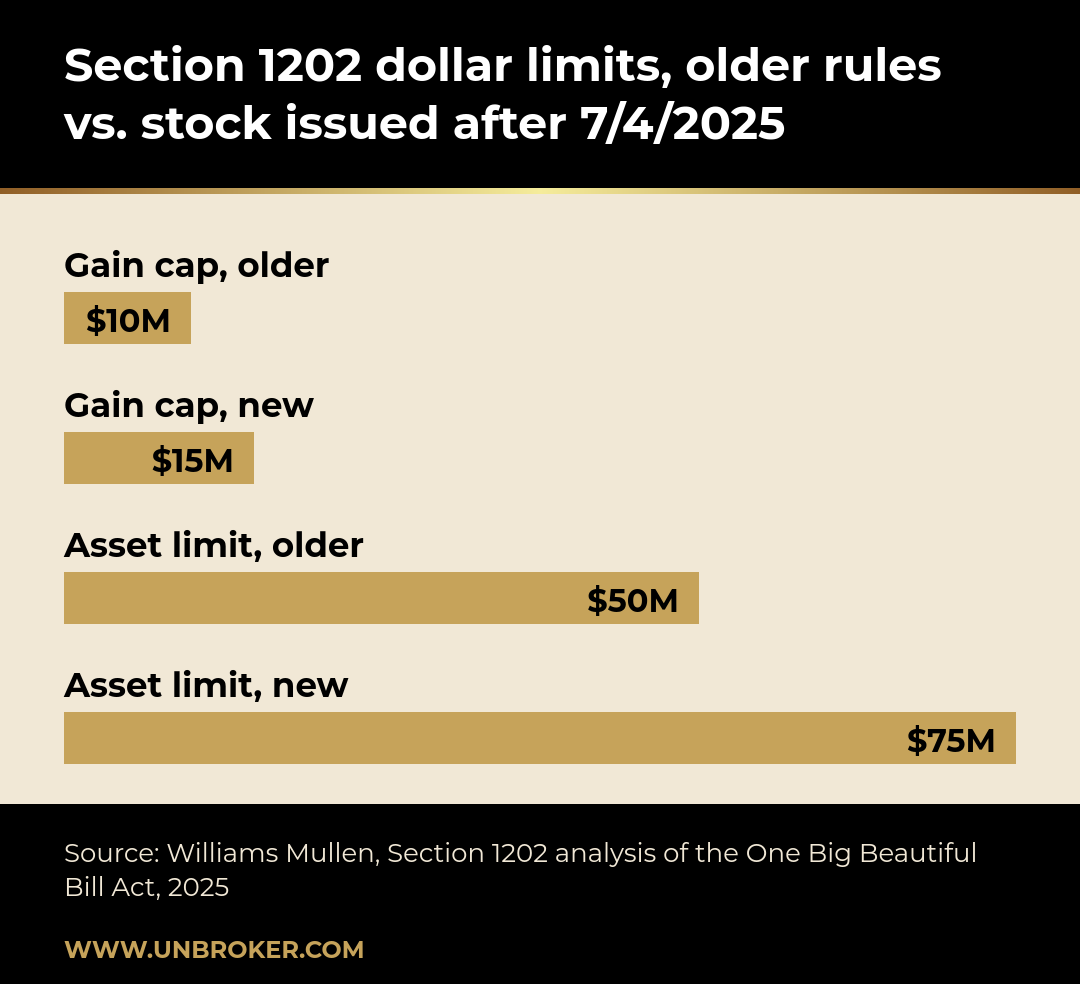
Put simply, the older gain cap is $10 million and the newer one is $15 million, while the older asset limit is $50 million and the newer one is $75 million. Read the cap language carefully:
- Greater of: the cap is whichever is larger, the dollar figure or 10 times your basis. If you paid a lot for your shares relative to the dollar figure, the basis-based limit may matter more.
- Per taxpayer: each eligible taxpayer has their own limit, so ownership among several people is something your adviser should model individually, not as one lump.
- Per issuer: the cap applies to each issuing corporation. If you have gain from more than one company, each is looked at separately.
- Gain above the cap: any gain beyond the limit is not covered by the exclusion and is taxed under the normal rules for that gain.
One more wrinkle: law firm summaries say the $15 million cap and the $75 million asset threshold will be indexed for inflation in later years, with one summary pointing to 2027 and another to 2026. Do not rely on a blog post for the current indexed figures. Ask your tax adviser what they are for the year you expect to close.
Why deal structure matters: stock sale, asset sale and pass-through entities
You can qualify on paper and still lose the benefit through how the deal is structured. The central point is that the Section 1202 exclusion applies to the sale or exchange of stock. Whatever else is true, the exclusion is tied to the stock you hold being sold or exchanged.
Stock sale versus asset sale
Many small business buyers prefer to buy assets rather than shares. In an asset purchase, the company sells its assets and the buyer does not take your stock. That is a different transaction from you selling your shares, and its tax results for you as a shareholder can differ. If you own QSBS, the structure can be one of the biggest levers on your after-tax result, and it may pull against what a buyer wants.
That is not a reason to refuse an asset deal. It is a reason to know the trade-offs before negotiating. Ask your adviser to compare the after-tax result of a stock sale and an asset sale for your facts, then negotiate price and structure together. For background on how structure changes proceeds, see which sale structure maximizes your after-tax proceeds and how to structure your business sale as an asset purchase.
Pass-through entities
If you hold your shares through a partnership or other pass-through, the rule is strict: an owner of a pass-through entity can claim the exclusion only by holding the interest from the date the entity bought the QSBS until the entity sells it. If you joined later, or if ownership shifted during the holding period, the answer may be different for different owners. Get this reviewed early, especially if there are multiple owners with different entry dates.
Converting from a pass-through to a C corporation
Some owners will read about the higher limits and ask whether to convert an LLC or S corporation into a C corporation. Law firm commentary notes that the higher $15 million cap and $75 million asset threshold may encourage some pass-through businesses to convert into C corporations to reach QSBS benefits. Whether a conversion helps depends on the facts, so it needs professional tax advice.
Be careful here. A conversion changes how the business is taxed every year, not just at the sale. It raises questions about holding periods, original issuance, and whether you plan to sell soon. If your exit is near, a conversion may not be a fit. If it is years away, it is a legitimate planning conversation, but only with a tax adviser who has your numbers in front of them.
Other tax effects to ask about: AMT, net investment income tax and your state
Federal capital gain rates are only part of the picture. Under the pre-2025 rules as summarized by the law firm source, gain excluded under Section 1202 is not subject to the alternative minimum tax or the net investment income tax. State tax treatment of the exclusion varies by state. That last point is easy to miss: a federal exclusion does not automatically mean your state follows it.
If you live in one state and the company operates in another, ask how both treat the gain. State rules can change your net proceeds in a way that dwarfs small differences in a purchase price. Also ask whether the AMT and net investment income tax treatment described for the older rules carries over to your particular stock, so you are not relying on a summary written for a different category of shares.
For a wider view of how owners reduce tax on a sale, our post on how to minimize capital gains tax when selling your business is a useful companion, but QSBS is a specific rule with specific conditions, not a general strategy.
Records to gather and how the exclusion is reported
If QSBS might apply, documentation is the difference between a defensible position and a guess. Start collecting these items now, before a buyer’s due diligence team asks for them:
- Issuance records: stock certificates or ledger entries, subscription agreements and board approvals showing that you received shares directly from the corporation.
- Dates: the exact date each block of shares was acquired, so you know which rules and which holding period tiers govern.
- Basis records: what you paid, in cash or property, for each block, since the cap can depend on your basis.
- Company balance sheets around issuance: evidence of the corporation’s gross assets before and immediately after each issuance.
- Business description over time: what the company actually did during your holding period, to support the active business and industry questions.
- Entity history: articles, tax elections and any conversion or reorganization paperwork.
- Cap table and ownership history: who held what and when, especially if shares moved between owners or through a pass-through.
These overlap with what buyers ask for in any case. Our checklist of documents needed to sell can help you organize the broader file.
On reporting, the mechanics are specific. On individual returns, a QSBS sale is reported on Form 8949, Part II, with the Section 1202 exclusion entered in column (g) and code “Q” in column (f), and the Schedule D instructions for tax year 2025 refer to this reporting. Forms and instructions can change from year to year, so ask your preparer to confirm what applies for the year of your sale. Do not wait until filing season to discover that a record is missing.
Questions to bring to your tax adviser or attorney before you list
Use this list in your first meeting. Good answers early may shape your price expectations, your timing and your negotiation.
- Is my company a domestic C corporation for the whole holding period, and did I receive my shares at original issuance?
- For each block of stock, was it acquired on or before July 4, 2025 or after, and which set of rules governs it?
- Does the business fall into an excluded industry, given what it actually does?
- Did the company meet the gross assets test at each issuance, using the correct figure for that period?
- What is my holding period for each block, and where are the tier dates if the newer rules apply?
- What is my exclusion cap per issuer, and how does my basis interact with it?
- If other owners hold shares, how is each person’s cap and holding period handled?
- What are the current inflation-indexed figures for the year I expect to close?
- How does my state treat the exclusion?
- Would a stock sale, an asset sale or another structure give me the best after-tax result, and what will the buyer accept?
- If I hold through a pass-through, did I hold the interest for the entire required period?
- What forms and statements will I need to file, and what documentation should I keep?
If your deal is complex, with multiple owners, multiple entities or a structure a buyer is pushing back on, it is worth reading when business sales become too complex for DIY approaches, and considering whether you need an attorney for your business exit. For a QSBS question, the answer is very likely yes: bring both a tax adviser and an attorney in early.
How a confidential, well-prepared sale process supports a tax-aware exit
Tax planning and sale preparation are one project. If your adviser tells you that structure matters, you want to learn that before a buyer anchors on a deal shape. A few habits help:
- Get the tax review done first. Know which stock may qualify, what the cap looks like and which structures you prefer before you speak with buyers.
- Organize records in advance. A clean file on issuance, basis and ownership history makes diligence smoother and supports your tax position.
- Keep the process confidential. Employees, customers and suppliers can react badly to news that a sale is under way, and you may be reworking structure or paperwork while you prepare. A private process gives you room to work through tax questions without an audience.
- Qualify buyers before you share details. A serious buyer should be able to discuss structure openly. If a buyer will only consider one deal shape, you need to know early what that costs you.
- Negotiate price and structure together. A higher price in a structure that costs you tax may leave you with less than a lower price in a structure that preserves an exclusion. Compare the after-tax result, not just the headline.
None of this guarantees a particular price, timeline or tax outcome. It simply puts you in a stronger position to make informed choices. The owners who benefit most from a rule like Section 1202 are usually the ones who asked the question early. For more on preparing, see our exit planning guidance for owners if you are earlier in the process. If you have only just started thinking about it, add one item to your to-do list today: ask your tax adviser whether any of your shares may be QSBS.
If you are weighing a sale, Unbroker combines expert advisors, AI-driven buyer matching and national marketing in a confidential process, and our Full Service Business Sale charges a 6% success fee, paid when the business sells. Your tax adviser and attorney should still guide the QSBS questions, and we can work alongside them as you prepare. You can learn more at Unbroker.