If you want to sell a veterinary practice, the details of your clinic matter more than a generic small-business rule of thumb. You are usually the lead doctor as well as the owner, you may or may not own the building, and your buyer could be a colleague, a regional group or a national corporate group.
This guide walks through the market, the buyers, how to normalize earnings when the owner is also the doctor, how to talk about multiples without misleading yourself, and what to do in the first 90 days of preparation.
Why selling a veterinary practice is different from selling other small businesses
Most small-business sales involve an owner who manages people and a business that keeps running when the owner steps back. A clinic is different because the owner is often the main producer of revenue. A buyer is not only buying equipment, a client list and a lease. The buyer is buying a stream of earnings that partly depends on a licensed doctor being in the building.
AVMA’s 2024 Veterinary Practice Owners Survey shows how much of an owner’s week goes to clinical work. Responding owners spent on average more than 65% of their time with clients and patients, and between 18.6% and 23.3% of their time managing operations, depending on practice type (AVMA, 2025 Report on the Economic State of the Veterinary Profession). These figures describe survey respondents, not every owner in the country. They still point to why owner-doctor labor is a central issue when a buyer looks at your earnings.
Three questions shape almost every veterinary deal:
- How much of the profit exists only because you work as a doctor, and what would a buyer pay to replace you?
- Who owns the land and building, and will the real estate sell with the practice or be leased?
- Which type of buyer fits your clinic, and what does that buyer need from you after closing?
The sections below take these in turn. If you are new to the general process, our step-by-step guide to selling a business covers the basics that apply to any company.
A fragmented market that is slowly getting bigger
Veterinary medicine is still made up of many small establishments, but the mix is shifting. The U.S. Census Bureau estimated 34,000 veterinary establishments in 2022, compared with 32,634 in 2021. From 2009 to 2022 the count rose from 28,691 to 34,000, a change of 18.5%. Those are Census figures as reported by AVMA, and 2022 was the latest year available in the report (AVMA, 2025 Report on the Economic State of the Veterinary Profession).
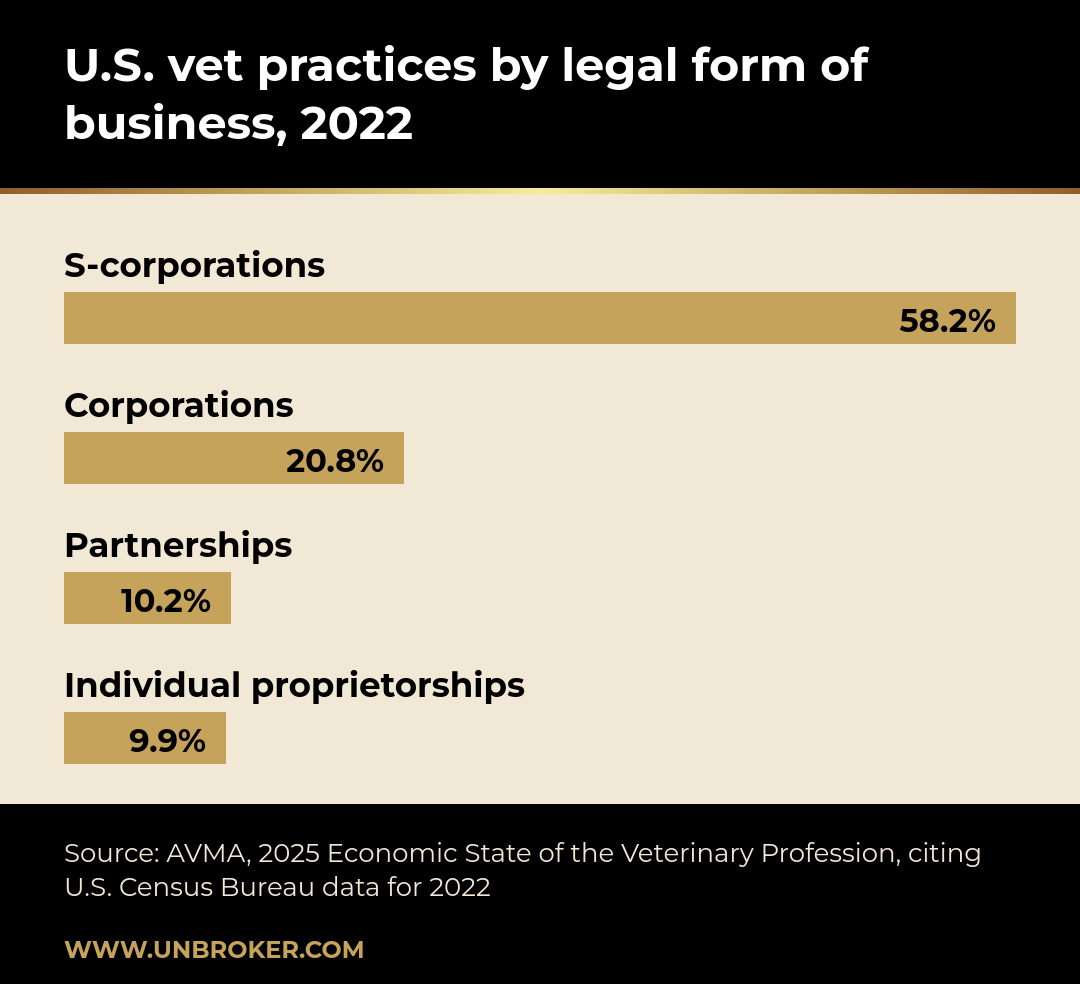
Legal form is changing too. Among U.S. veterinary practices in 2022, S-corporations were 58.2%, corporations 20.8%, partnerships 10.2% and individual proprietorships 9.9%. Individual proprietorships were 19.7% of practices in 2012. These are Census Bureau data as reported by AVMA. AVMA notes this is a change in legal form, not a direct measure of who owns a practice. A clinic organized as a corporation is not necessarily owned by a corporate group, so do not read “corporations” in this chart as “corporate-owned.”
Size is shifting as well. Veterinary establishments with fewer than 10 employees were 50.5% of all U.S. veterinary establishments in 2022, down from 60.0% in 2012. Establishments with 20 or more employees grew from 11.7% to 19.6% over the same period. In 2022 the full breakdown was 28.1% with 1 to 4 employees, 22.4% with 5 to 9 employees, 29.9% with 10 to 19 employees and 19.6% with 20 or more (Census Bureau data as reported by AVMA).
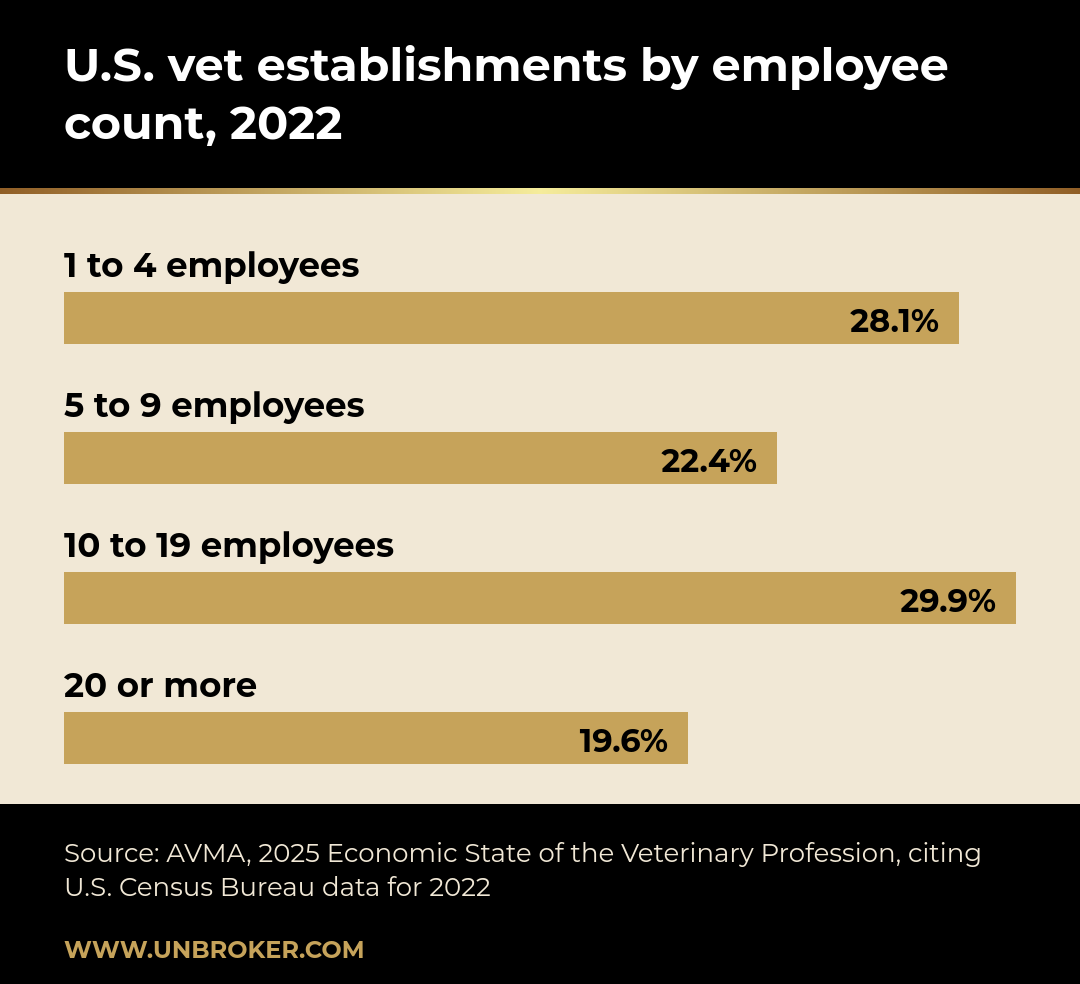
For a seller, the takeaway is practical. Small clinics are still common, yet the establishments around you are increasingly larger. Buyers who run larger operations may see your clinic as a way to add capacity, a new location or a new community. Knowing where you sit on the size curve helps you decide which buyers to approach.
Who buys: independent owners, group practices and corporate groups
Buyers of veterinary practices fall into three broad groups, and each wants something slightly different.
Independent owner-doctors
An associate veterinarian or a nearby owner may want to buy a single clinic and run it. These buyers often care about the culture, the existing team and a smooth handoff. They may need financing, so clean records and realistic expectations matter. In AVMA’s 2024 Veterinary Practice Owners Survey, 524 practices were analyzed and 93.9% were independently owned. AVMA states that these data describe the survey population, meaning owners in the AVMA membership database who responded, with an overall response rate of 8.8%. They do not describe the full U.S. practice population (AVMA, 2025 Report on the Economic State of the Veterinary Profession). Independent ownership is clearly common among the owners who answered, but it is not a verified national share.
Group practices
Regional groups and multi-location owners often buy to add a clinic to an existing network. They tend to look closely at systems, reporting and staffing, because they plan to fold your clinic into their operation.
Corporate groups
Larger corporate buyers acquire clinics as part of a broader strategy. In 2018, Brakke Consulting estimated that corporations owned about 10 percent of general companion animal practices and 40 to 50 percent of referral practices (AVMA JAVMA News, December 1, 2018). These are 2018 estimates, and published figures since then vary by how “corporate” is defined. Treat them as a snapshot of the past, not today’s ownership mix.
Which buyer is right for you depends on what you want after closing: a clean exit, a transition period as a working doctor, or a say in who takes care of your clients and staff. Make that decision before you talk to anyone, so you can judge offers against your own goals rather than the first number you hear. Our post on how industry consolidation affects your business sale value adds more on this dynamic.
Normalizing earnings when the owner is also the doctor
Normalized earnings are your profit after adjusting for items that a buyer would not inherit. For a clinic, the hard part is your own pay. Name the measure you use, because owner pay works differently in each.
Seller’s discretionary earnings (SDE)
SDE is the measure most often used for smaller, owner-operated businesses. Personal expenses and one-time costs are added back. One owner-operator’s full pay is added back too, whatever its level. The idea is that SDE shows the total benefit available to one working owner. For a one-doctor clinic where you are the main producer, SDE can be a reasonable starting point, but it treats your doctor labor as profit. A buyer who is also a veterinarian may see it that way, since that buyer plans to do the same work. A buyer who must hire a doctor will not.
Adjusted EBITDA
Adjusted EBITDA starts with earnings before interest, taxes, depreciation and amortization, then adjusts for personal and one-time items as above. Owner pay is handled differently: it is reset to a market rate. If you pay yourself above market, the excess is added back. If you pay yourself below market, the shortfall is a deduction that lowers EBITDA, because a buyer must pay a replacement doctor the market rate. Never treat below-market owner pay as an add-back to EBITDA. That error overstates earnings, and a buyer’s diligence team may catch it quickly, which can damage trust in the rest of your numbers.
The measure also affects which buyers you can talk to. Smaller owner-operator deals tend to be framed in SDE, and larger or multi-doctor practices tend to be framed in adjusted EBITDA. Whichever you use, say which one in every conversation and every document. For more on add-backs, see our guide to applying business valuation add-backs, and for the SDE basics, what SDE is and why it matters.
What a replacement veterinarian costs, and why it matters to the price
If a buyer has to hire a doctor to replace you, that doctor’s compensation reduces the profit the buyer can expect. So you need a realistic sense of the market rate for a doctor in your kind of practice.
AVMA’s 2024 Census of Veterinarians, with professional income reported in 2024 for 2023, gives reference points for companion animal exclusive practices. Owners reported mean income of $191,352 and median income of $160,000 (275 respondents). Associate veterinarians reported mean income of $146,196 and median income of $133,000 (873 respondents) (AVMA, 2025 Report on the Economic State of the Veterinary Profession).
Read these carefully. They cover companion animal exclusive practices only, and they are 2023 income reported in 2024, so they may be out of date by the time you sell. They are also total professional income for the owner or associate, not practice earnings and not the full cost of employing a doctor. They do not describe mixed animal or other practice types, and they should not be applied to them. Use them to start a conversation with your accountant or valuation adviser about a defensible market-rate figure for your clinic and region.
Owner pay and associate pay may also differ in ways that matter to a buyer. As an owner you may take income as salary, distributions or both. Your adviser can help you separate what you earn as a doctor from what you earn as an owner.
Valuation multiples: name the base, the practice type and the year
A multiple means little unless you say what it is multiplied against. Every multiple should come with three labels: the base (revenue, EBITDA or seller’s discretionary earnings), the kind of business, and the year.
Here is a dated example. In a 2018 JAVMA News report, a Brakke Consulting analyst said practices with three or more veterinarians and average or above-average performance had many sale options. For practices with $1.2 million or more in annual revenue, he put then-current prices at seven to eight times earnings before interest, taxes, depreciation and amortization (EBITDA) (AVMA JAVMA News, September 1, 2018).
That is a 2018 figure for larger multi-doctor practices. It is not a current multiple, and it should not be applied to one- or two-doctor clinics. If someone quotes you a number, ask three questions:
- Is it a multiple of revenue, EBITDA or SDE?
- Does it describe a clinic like mine in size, species mix and number of doctors?
- What year does it come from?
A multiple of one base cannot be swapped for another. Applying an EBITDA multiple to SDE, or the reverse, can produce a price that is far from what a buyer would actually pay. For a broader look at how multiples are used, read our post on using typical multiples for business valuation. Nothing here predicts what your clinic will fetch. Price depends on your earnings, your doctors, your location and the buyer.
Real estate: selling the practice, the building, or both
Many clinic owners hold the practice and the property in separate entities, and that affects how you structure the deal. In AVMA’s 2024 Veterinary Practice Owners Survey, 54.9% of responding owners owned the practice in one legal entity with land and buildings in a separate entity, 24.7% owned the practice but not the land and building, and 19.3% owned practice, land and building in one legal entity. These figures cover survey respondents only, not all U.S. practices (AVMA, 2025 Report on the Economic State of the Veterinary Profession).
In practical terms you have three paths:
- Sell the practice and the building together. This can suit a buyer who wants full control, but it narrows the pool to buyers who can finance both.
- Sell the practice and lease the building to the buyer. You may keep an income stream, and the buyer needs less capital up front. The lease terms matter a great deal, so have an attorney review them.
- Sell the practice only because you do not own the building. Here the lease itself becomes a diligence item. Buyers will want to know how long it runs, what renewal rights exist and whether the landlord must consent to a transfer.
If you lease the building to your buyer, set the rent at a level that reflects the market. Otherwise earnings may be distorted. A below-market rent paid to yourself can inflate the practice’s profit, and an above-market rent can hide it. Your adviser may need to normalize rent in the same way as owner pay. Tax treatment and entity structure can change what you keep, so confirm the details with a tax adviser and an attorney before you decide.
Revenue mix, productivity and technology: what buyers may look at in diligence
Buyers will want to understand where your revenue comes from and how well the clinic runs. Three areas often come up.
Revenue mix
Across all practices in AVMA’s 2024 Veterinary Practice Owners Survey, revenue came on average 78.5% from veterinary services, 16.6% from inventory sales (pharmacy, food and over-the-counter) and 4.9% from ancillary services such as boarding and grooming. These are survey respondents only (AVMA, 2025 Report on the Economic State of the Veterinary Profession). Compare your own mix with this picture, and be ready to explain differences. If a large share of revenue comes from a single doctor’s procedures, a buyer may want to know what happens when that doctor leaves.
Productivity
Median gross revenue per full-time-equivalent veterinarian, reported in 2024 for 2023, was $616,667 in companion animal exclusive practices, $608,553 in companion animal predominant practices and $416,250 in mixed animal practices. These come from practices responding to AVMA’s survey. If you know your own revenue per full-time-equivalent doctor, you can compare it with the matching practice type. Use only the category that fits your clinic. Do not compare a mixed animal practice to a companion animal figure.
Technology
In AVMA’s 2024 survey of practice owners, 76.5% of represented practices had practice management software, 66.8% had electronic medical record software and 33.4% offered online appointment scheduling. Again, these are survey respondents only (AVMA, 2025 Report on the Economic State of the Veterinary Profession). Good systems make it easier for a buyer to verify your numbers, which supports your story in diligence. If your records are scattered, start consolidating them now. Our checklist of documents needed to sell is a useful starting list.
State ownership and licensing rules: why to confirm with an attorney
Veterinary medicine is regulated by each state, and the rules on who may own a practice, how licenses transfer and how a practice may be structured are not the same everywhere, so this guide does not state any of them as settled. Some states may limit ownership to licensed veterinarians or require certain entity types. Others may treat a change of ownership differently for facility registrations, controlled-substance registrations and medical records.
Before you sign a letter of intent, ask a veterinary-experienced attorney in your state to confirm:
- Who is allowed to own the practice you are selling, and which entity types a buyer may use.
- What happens to facility permits, licenses and drug registrations at closing, and whether the buyer must apply separately.
- How medical records must be kept, transferred and made available to clients.
- What non-compete or non-solicitation terms are reasonable and enforceable where you practice.
Also ask a tax adviser how an asset sale and an entity sale may differ for you. The right structure depends on your entity type, your goals and your state. For more on structure, see our guide to structuring a sale as an asset purchase.
Choosing how to sell, and keeping the sale confidential
Owners tend to fall into two camps. Some want a professional team to manage the process, from valuation and marketing to buyer screening and negotiation. Others want to stay hands-on, control costs and use tools and templates to run the sale themselves. Both approaches can work. The right one depends on how much time you can spare away from patients, how comfortable you are negotiating, and how complex your deal is.
A few questions can help you decide:
- Can you review buyer inquiries, schedule calls and respond to diligence requests while keeping a full clinical schedule?
- Are you comfortable explaining normalized earnings and defending them?
- Does your deal involve real estate, multiple owners or an unusual structure that calls for more expert support?
Confidentiality deserves special attention in a clinic. Staff may worry about their jobs, and clients may worry about continuity of care. If news leaks early, you could lose team members or see clients drift to a competitor. Good practice includes confidentiality agreements before sharing identifying details, screening buyers before they learn who you are, and marketing the practice without naming it. Think carefully, and plan with your adviser, about when and how to tell your team. Our guide on whether to tell employees you are selling, and when can help you plan that conversation.
Seller checklist for the first 90 days of preparation
Preparation is where you have the most control. Use the first 90 days to build a record that a buyer can trust. Nothing here promises a particular price or timeline, but it can put you in a stronger position when buyers start asking questions.
Days 1 to 30: understand your numbers
- Pull several years of financial statements and tax returns, and confirm they reconcile.
- Decide which measure you will use, SDE or adjusted EBITDA, and list every add-back and deduction with documentation.
- Work out a market-rate figure for replacing your own clinical work, with your accountant’s help.
- Identify what you own: the practice, the land, the building, equipment and any related entities.
Days 31 to 60: organize operations and risk
- Break down revenue by veterinary services, inventory sales and ancillary services, and note which doctors produce what.
- Gather leases, equipment lists, vendor contracts, employment agreements and license records.
- Check that your practice management and medical record systems produce clean, exportable reports.
- Note any staff or client dependencies a buyer might worry about, and write down how you would address them.
Days 61 to 90: set your strategy
- Meet with an attorney and a tax adviser about state rules, entity structure and real estate.
- Decide what kind of buyer you prefer, and what role, if any, you want after closing.
- Choose between a professionally managed process and a hands-on one, and set up your confidentiality plan.
- Prepare a short confidential summary of the practice that does not name it, for use with screened buyers.
If you are still deciding on timing, our post on exit timing clues may help. And remember that the data in this guide comes from reports published in 2025 and 2018, so check for newer editions of the AVMA data before you rely on any figure in a negotiation.
Unbroker pairs expert advisors with AI-driven buyer matching and national marketing, inside a confidential process built for owners who want a modern way to sell. Our Full Service Business Sale carries a 6% success fee, paid when the business sells. To see how it could fit your clinic, visit unbroker.com.