Most business owners never create a formal exit plan, which costs them hundreds of thousands in lost value when they eventually sell. At Unbroker, we’ve seen firsthand how exit planning for owners transforms a chaotic sale into a profitable, controlled process.
The difference between a rushed exit and a strategic one often comes down to preparation. Starting today gives you the time to strengthen your business, organize your finances, and position yourself as a confident seller.
Why Exit Planning Matters
One-third of business owners admit they either don’t have a long-term plan or are unsure what will happen to their business after they leave, according to Gallup research from 2024. This isn’t a minor oversight. The Exit Planning Institute reports that only about 50% of owners have a detailed succession plan, and even then, the quality of those plans varies widely. When you lack a formal exit strategy, you’re essentially gambling with what’s likely your largest asset. Most owners have up to 80% of their net worth tied directly to their business, which means a poorly executed exit can devastate your retirement security and financial future.
The Real Cost of Waiting
You should start exit planning 5 to 10 years before a potential transaction to maximize your valuation and control your timing. Yet 63% of owners say exit planning is too early to start, and 45% claim they’re too busy to begin. This mindset is expensive.

Businesses without formal exit plans frequently face distressed sales where owners accept lower offers simply because they lack options. A planned exit reduces this risk by offering structured alternatives like restructuring, phased transitions, or favorable sale terms. The Exit Planning Institute reports that employers planning to sell or transfer achieve higher median profits-$100,000 or $85,000-compared to those planning to shut down at $20,000. That gap reflects the difference between strategic preparation and reactive desperation.
Eight Value Drivers That Buyers Actually Care About
Exit planning isn’t just about preparing to leave; it’s about strengthening your business today. Many factors determine what a buyer will pay, including the state of the M&A market, the appeal of your industry, and who your target buyer is. When you treat exit planning as an ongoing strategic process-not a last-minute checklist-you naturally invest in these areas. You’ll organize your financials, document your processes, develop your team, and reduce operational risks.
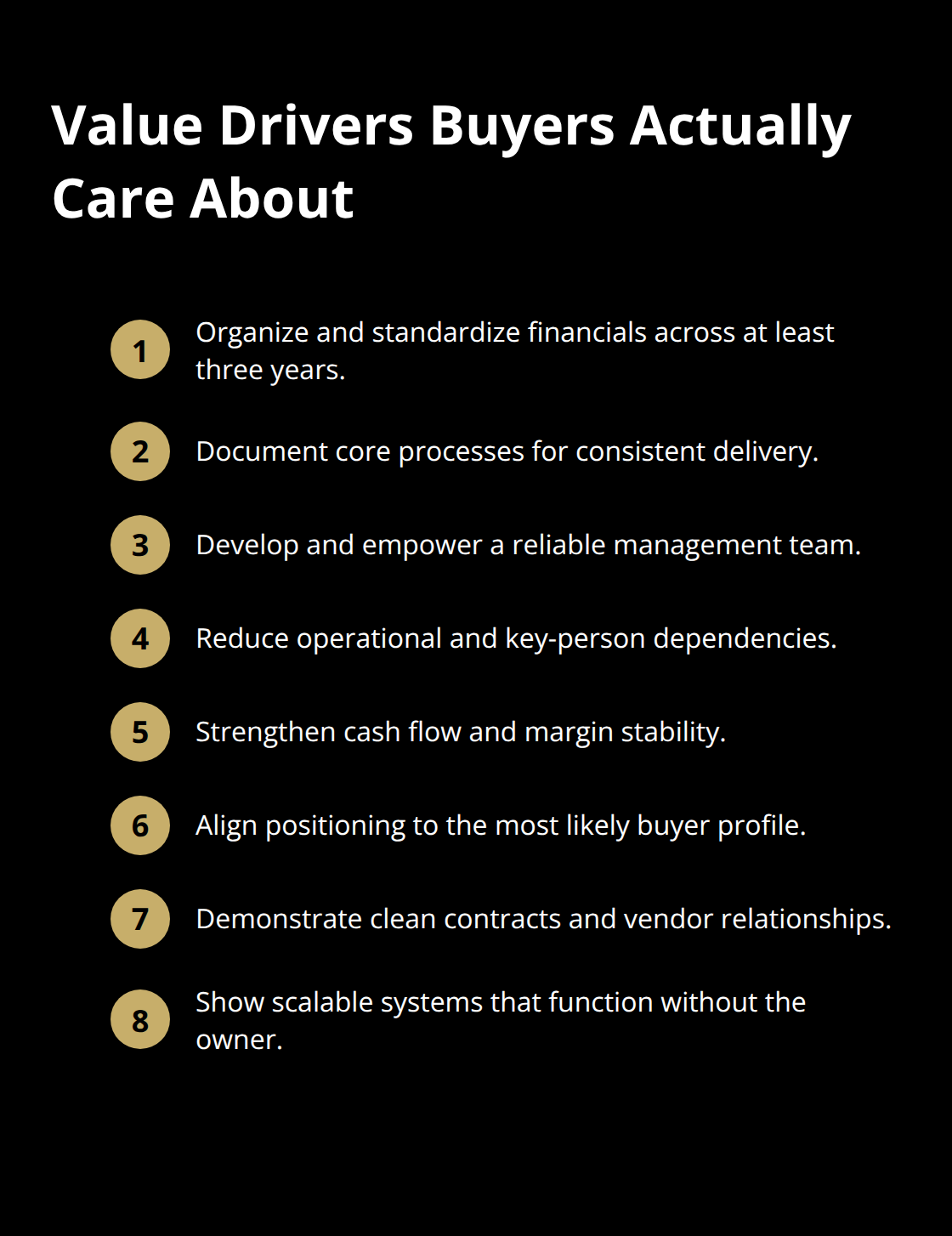
These improvements make your business more attractive to buyers and more profitable while you own it.
Address Weaknesses Before Buyers Find Them
Early planning gives you time to address weaknesses before due diligence begins, preventing buyers from discovering problems that tank your valuation. A buyer’s comprehensive appraisal will examine your financial records, contracts, liabilities, and operational dependencies. If you wait until a buyer arrives, you lose your negotiating power and your ability to fix issues on your own terms. Owners who prepare in advance control the narrative and present a business that’s already been vetted and strengthened. This confidence translates directly into higher offers and smoother negotiations.
The next step is understanding exactly what preparation looks like. Your financial records, operational systems, and business structure all need attention before you list your business for sale.
How to Prepare Your Business for Sale
Organize Your Financial Records for Buyer Scrutiny
Buyers scrutinize financial records first, and messy documentation kills deals before they start. Serious buyers expect three years of tax returns, profit-and-loss statements, balance sheets, and bank statements that tell a consistent story. If your records scatter across spreadsheets, email attachments, and accounting software from different eras, you negotiate from weakness. Start by organizing your financial records into a single, clean format and standardizing your accounting methods across all three years so comparisons become straightforward. Close any gaps between your tax returns and your internal accounting. If you’ve underreported income or claimed personal expenses through the business, resolve those discrepancies now while you control the narrative.
Get a professional business valuation done well before you list. About 60 percent of owners have had their business formally valued, which shows more owners take valuation seriously. This gives you a realistic price anchor and helps you spot which financial metrics buyers will focus on. Beyond financials, document every significant contract, customer agreement, supplier relationship, and lease. Buyers will request these during due diligence, and delays in producing them signal disorganization and create doubt about what you might be hiding.
Build Systems That Function Without You
Systems and processes get valued in a business sale, not just your personal effort. A buyer purchases the ability to maintain revenue after you leave, so if your business depends entirely on you showing up every day, your valuation takes a massive hit. Start documenting your core processes now, even the ones that feel obvious to you. Write down how you acquire customers, how you deliver your product or service, how you manage cash flow, and how you handle quality control.
Identify which roles are irreplaceable because of personal relationships or specialized knowledge, then invest in training someone else to handle those responsibilities. If a key customer only deals with you personally, introduce them to your operations manager or successor now. If you’re the only person who understands your pricing model or vendor negotiations, transfer that knowledge while you still own the business. This preparation transforms operational dependencies into managed risks that buyers view favorably.
Address Weaknesses Before Due Diligence Begins
Operational weaknesses that seem minor to you will look like major risks to a buyer. If your customer retention rate declines, if your profit margins remain inconsistent, or if you rely on a handful of large customers for most of your revenue, a buyer will demand a significant discount to compensate for that risk. Address these weaknesses before due diligence begins rather than hoping a buyer overlooks them.
If customer concentration poses a problem, spend the next year or two deliberately building a more diversified customer base. If your team is thin, hire and train people in advance. If your operations are inefficient, streamline them now when you’re doing it for your own benefit, not under the pressure of a pending sale. This proactive approach transforms weaknesses into strengths and positions you to command a higher price when the time comes. Once your business stands strong operationally and financially, the next critical step involves understanding exactly what buyers will examine during their evaluation process.
Selling Your Business With Confidence
What Buyers Examine During Due Diligence
Buyer expectations during due diligence are non-negotiable, and understanding exactly what they’ll examine separates owners who close deals from those who watch them fall apart. A buyer’s comprehensive appraisal scrutinizes your financial records, contracts, liabilities, and operational dependencies with forensic detail. According to the Exit Planning Institute, 68% of owners sought advice on business transitions in 2023, yet 78% lacked a formal transition team to coordinate this process. That coordination matters because buyers move fast.
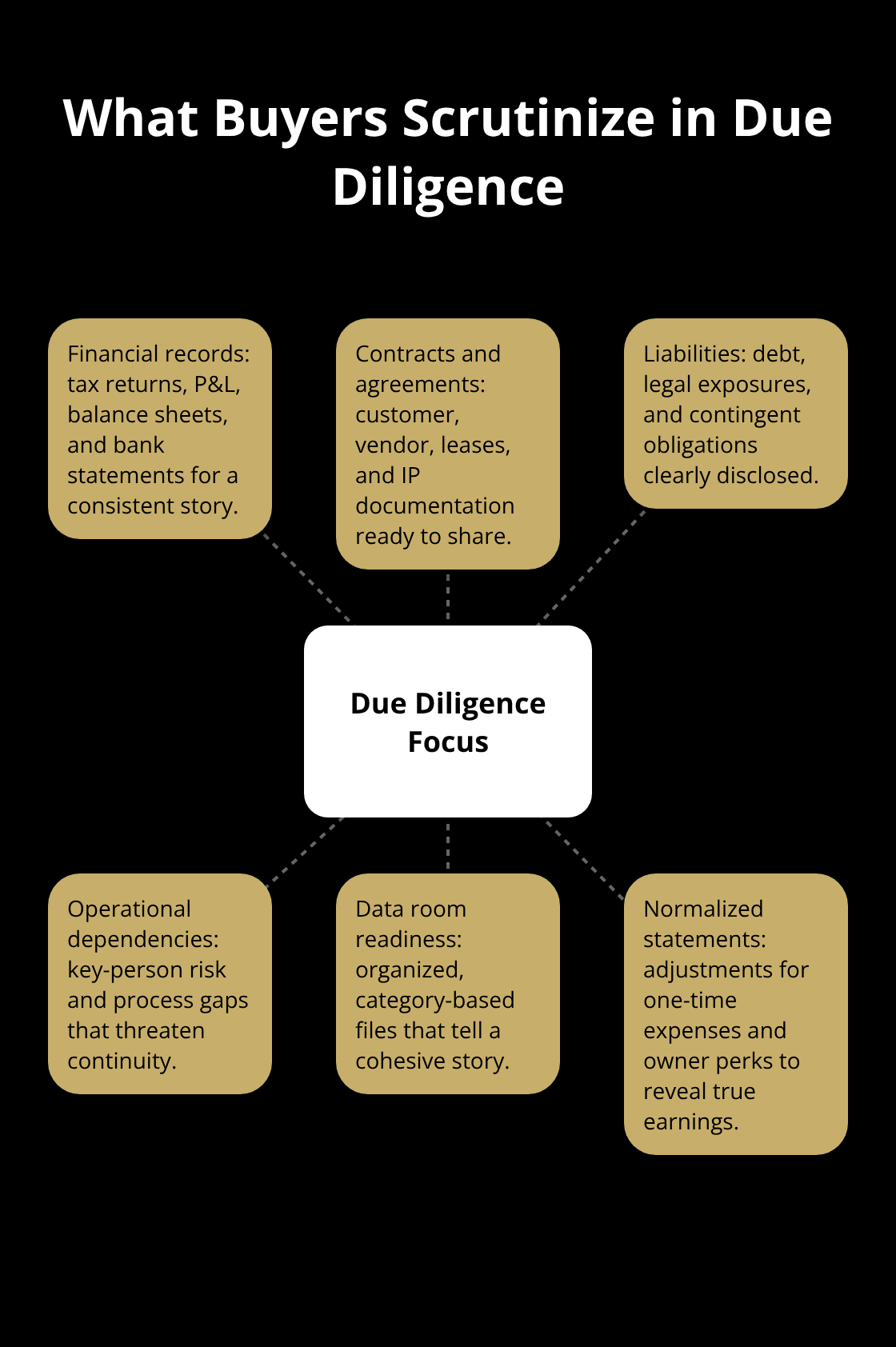
Once due diligence begins, you’ll face requests for customer contracts, employee agreements, vendor relationships, lease terms, intellectual property documentation, and detailed explanations of any revenue fluctuations or expense anomalies. If you scramble to produce these materials, you signal disorganization and hand negotiating power directly to the buyer. Prepare a due diligence data room months in advance, organized by category with clean, consistent documentation that tells a cohesive story about your business.
Include normalized financial statements that adjust for one-time expenses or owner perks, because buyers care about what the business actually produces, not what your personal tax return reflects. Have your accountant and attorney review everything before a buyer sees it. This preparation removes surprises and lets you control the narrative rather than defending problems under pressure.
Building Leverage Through Multiple Buyers
Negotiations begin the moment a serious buyer appears, and your leverage depends entirely on having options. If you work with a single buyer, you have no leverage. Employers planning to sell or transfer their business achieve higher median profits-around $100,000 or $85,000-compared to those with no exit strategy at $20,000, according to Gallup research. That difference reflects what happens when multiple buyers compete for your attention.
Work with advisors who can present your business to several qualified buyers simultaneously, creating genuine competition that drives price and terms in your favor. During negotiations, never negotiate price alone. Buyers will push on valuation, but they’ll also negotiate earn-outs, non-competes, and transition support. An aggressive buyer might demand that you stay involved for 12 months post-close at reduced compensation, or structure half the purchase price as an earn-out tied to performance metrics you can’t control. These terms matter as much as the headline number.
Protecting Confidentiality at Every Stage
Protect confidentiality throughout the entire process by requiring all potential buyers to sign a non-disclosure agreement before reviewing any information about your business. Share only what’s necessary at each stage, starting with basic business overview information and moving to detailed financials only after serious interest emerges. Never discuss your sale timeline, personal financial needs, or reasons for selling with anyone outside your core advisory team.
Buyers will probe for weakness, and any hint that you’re desperate or on a tight deadline gives them ammunition to negotiate harder. The moment you close, your business belongs to someone else, so every detail you control before closing shapes your outcome.
Final Thoughts
Exit planning for owners shapes every decision you make today, from how you hire and train your team to how you structure your finances and document your operations. Owners who exit confidently started preparing years in advance, not weeks before they decided to sell. The data proves this approach works: owners with formal exit plans achieve dramatically higher valuations and smoother transactions than those who improvise.
Your business represents your largest asset, and treating exit planning as an afterthought costs you hundreds of thousands of dollars. Define what success looks like for you personally, not just financially, then assemble a team of advisors who understand the full scope of what a successful exit requires. Get your business formally valued so you know what you’re working with, and spend the next few years strengthening your business while you still own it.
We at Unbroker help business owners navigate this entire process with expert advisors, AI-driven buyer matching, and a confidential sales platform. Explore how we support sellers through every stage of their exit, and start your exit planning for owners today.