Selling your business without broadcasting it to the world is a real challenge. Anonymous buyer outreach lets you attract serious interest while keeping your competitive edge intact.
At Unbroker, we’ve seen how the right approach protects your employees, customers, and market position during the sale process. This guide shows you exactly how to do it.
Why Confidentiality Protects Your Business During Sale
Leaking your sale plans early destroys value. Employees hear rumors and start job hunting. Competitors poach your customers and undercut your pricing. Suppliers renegotiate terms or shift relationships. Businesses lose millions when news spreads before serious buyers even sign NDAs. The damage compounds fast, which is why confidentiality isn’t optional-it’s the foundation of a successful exit.
Your Employees Will Leave If They Know Too Soon
Employee turnover during a sale announcement typically jumps in the first 90 days. Key staff members fear layoffs, cultural changes, or new management. Losing your operations manager, lead developer, or top salesperson mid-sale tanks deal value because buyers pay premiums for stable teams. A confidential process keeps operations running normally while you vet buyers seriously. Bring your finance person, legal counsel, and perhaps one or two trusted managers into the loop initially. This small group manages due diligence while everyone else focuses on hitting quarterly targets. Announce the sale later, after you’ve narrowed buyers to serious contenders.
Competitors Will Attack If They Smell Weakness
News of a sale signals opportunity to your rivals. They aggressively recruit your salespeople, launch discount campaigns to steal customers, or accelerate product launches to block your market position. Revenue loss during sale conversations directly impacts buyer valuations because buyers factor in financial performance risk. Keeping the sale quiet prevents competitors from timing their moves against you. Use a blind profile instead of revealing your company name. Describe your business by industry, geographic region, revenue range, and customer base without naming the actual company. This approach attracts qualified buyers who move fast while keeping your identity safe from market vultures.
Customer Relationships Stay Stable When You Stay Quiet
Customers worry that a new owner will raise prices, cut service quality, or discontinue products they depend on. If word gets out that you’re selling, major clients may start exploring alternatives or demand contract renegotiations. Enterprise customers may reduce spending when ownership changes hands. A confidential sale process lets you control the narrative. You disclose the transition only after closing is near and you’ve confirmed the buyer’s commitment to customer relationships. Until then, customers experience zero disruption, and you maintain full negotiating power with serious buyers.
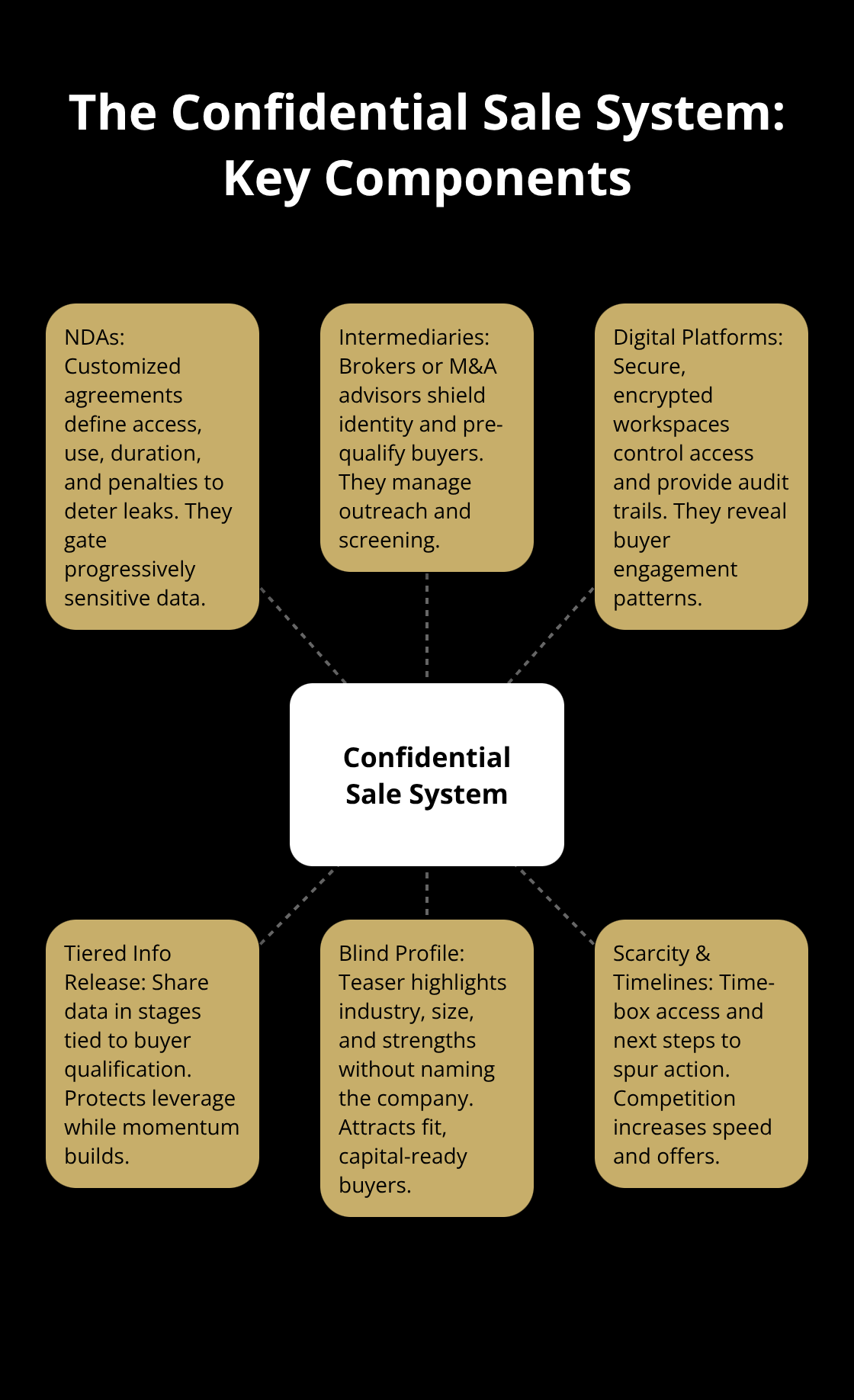
Now that you understand why confidentiality matters, the next step is learning how to execute it. Strategic outreach methods-from NDAs to intermediaries to digital platforms-turn confidentiality from a goal into a working system.
How to Run a Confidential Buyer Search Without Exposing Your Business
Craft NDAs That Actually Protect You
Non-disclosure agreements form the legal backbone of any confidential sale process, but most sellers treat them as afterthoughts. Your attorney must customize the agreement to specify exactly who can access information, what they can do with it, and what happens if they breach. A generic NDA template won’t work. Your lawyer should define information tiers: the blind profile stays public, financial details require an NDA, and operational specifics come only after serious interest surfaces. Set clear timelines too-an NDA typically lasts 2-3 years post-disclosure, which prevents a buyer from using your information to compete or poach customers after backing out. Non-disclosure agreements authorize injunctive relief and may include liquidated damages clauses with specific dollar amounts rather than vague language. Courts favor concrete penalties, which deters casual leaks. Use these agreements with every potential buyer before sharing sensitive information, as many sellers skip this step and regret it when a prospect shares revenue figures with a competitor or posts business details on internal Slack channels.
Use Intermediaries to Shield Your Identity
Working with intermediaries changes the game because they absorb the exposure. A business broker or M&A advisor acts as your shield, contacting buyers on your behalf without revealing your identity until the right moment. Intermediaries to shield seller identity extends beyond simple transaction facilitation to include market analysis and buyer screening.
They maintain a database of qualified buyers and know which ones have capital, sector experience, and genuine acquisition appetite. Their reputation depends on protecting seller confidentiality, so they take it seriously. An intermediary also filters out tire-kickers and time-wasters by qualifying prospects before sending even the blind profile, which means you spend energy only on buyers with real purchasing power.
Leverage Digital Platforms for Secure Transactions
Digital platforms for confidential transactions add another layer of protection by letting sellers post blind profiles and connect with vetted buyers in a gated environment. These platforms use end-to-end encryption, access controls and audit capabilities to meet security and compliance requirements. They track who views what and when, giving you visibility into buyer engagement without compromising privacy. A prospect who repeatedly visits your financial section signals serious interest and justifies a follow-up conversation.
Combine All Three Approaches Into One System
Start with a professional intermediary or platform to source buyers, require NDAs before sharing anything beyond the blind profile, and use tiered information release to control what gets revealed when. This layered system keeps your business running smoothly while attracting serious acquisition candidates. The next critical step involves identifying which buyers to target and how to spark their interest without tipping your hand.
How to Spark Buyer Interest Without Revealing Who You Are
Create a Blind Profile That Attracts Serious Buyers
The blind profile is your most powerful tool for anonymous outreach because it tells buyers enough to get excited without exposing your company. Include your industry, geographic footprint, annual revenue range (e.g., $5–7 million), EBITDA or SDE figures, and growth trajectory over the past five years. A business showing 10% average annual growth signals momentum and attracts serious acquisition candidates. Describe your competitive edge in concrete terms: proprietary software, a niche market position, recurring revenue contracts, or a management team that runs lean operations. Skip the company name entirely. Instead, highlight what makes your business valuable-recurring customers, efficient unit economics, or market dominance in a specific geography. This approach filters for buyers who understand your sector and have capital ready to move. Tire-kickers vanish because the teaser demands industry knowledge to even assess the opportunity.
Release Information in Stages Tied to Buyer Qualification
Information release in stages protects your business while momentum builds with the right people. First, the blind profile reaches a broad list of potential acquirers and strategic buyers who fit your ideal profile. Track who opens it, who requests more details, and who asks intelligent questions about growth levers or customer concentration. These engagement signals reveal serious candidates. Second, only after a prospect proves genuine interest through follow-up questions do you share financial statements, customer lists (by percentage, not names), and supplier concentration data. Third, you invite qualified buyers to management meetings and site visits only after they sign the NDA and demonstrate readiness to move forward. Most sellers rush disclosure and lose negotiating leverage; the disciplined approach compounds your advantage.
Use Scarcity and Timelines to Accelerate Buyer Action
When multiple buyers compete for access to deeper information, they move faster and bid higher because they fear losing the deal to rivals. Set clear timelines-tell prospects the blind profile stays available for two weeks, then you’ll narrow the field to serious contenders. This artificial scarcity works because acquisition teams operate under budget cycles and acquisition authority windows that close fast. A buyer who delays loses the chance entirely. The pressure you create through limited availability mirrors real market conditions and forces decision-makers to act rather than stall.
Final Thoughts
Confidential business sales work because they protect what matters most: your competitive position, your team’s stability, and your deal value. Anonymous buyer outreach transforms a risky process into a managed one by controlling the narrative and attracting serious acquisition candidates who move fast and bid fairly. The three-part system-NDAs, intermediaries, and tiered information release-compounds your negotiating power at every stage.
Technology amplifies your advantage here. Digital platforms with encryption and access controls let you track buyer engagement in real time, revealing who’s serious and who’s wasting your time. You see which prospects visit your financial section repeatedly, which ones ask intelligent follow-up questions, and which ones disappear after the first glance. This visibility lets you prioritize outreach and accelerate conversations with the right people.
Businesses that run confidential sales processes typically close faster, achieve higher valuations, and experience less operational disruption than those that broadcast their sale plans early. We at Unbroker built our platform specifically to support this kind of confidential, controlled process-our modern business sale platform eliminates high brokerage fees while giving you access to a vast buyer network, legal templates, and AI-driven marketing tools designed to keep your business private while attracting qualified buyers.