Buying a business involves more than just agreeing on a price. The financing options for buyers can make or break the deal, and choosing the wrong path costs thousands in unnecessary fees.
At Unbroker, we’ve seen buyers overpay simply because they didn’t understand their options. This post breaks down the real financing choices available to you, how modern platforms cut costs, and what you’ll actually pay across different purchase methods.
What Financing Routes Actually Work for Business Buyers
Traditional Bank Loans and SBA Loans
When you’re buying a business, your financing choice determines how much you pay and how quickly you close. Traditional bank loans sound safe but move slowly-most lenders require 20 to 30 percent down and take weeks to underwrite. SBA loans offer better terms with down payments around 10 percent, but the application process stretches across months, and you’ll face strict eligibility requirements tied to your personal credit and business experience.
Seller Financing and Earnouts
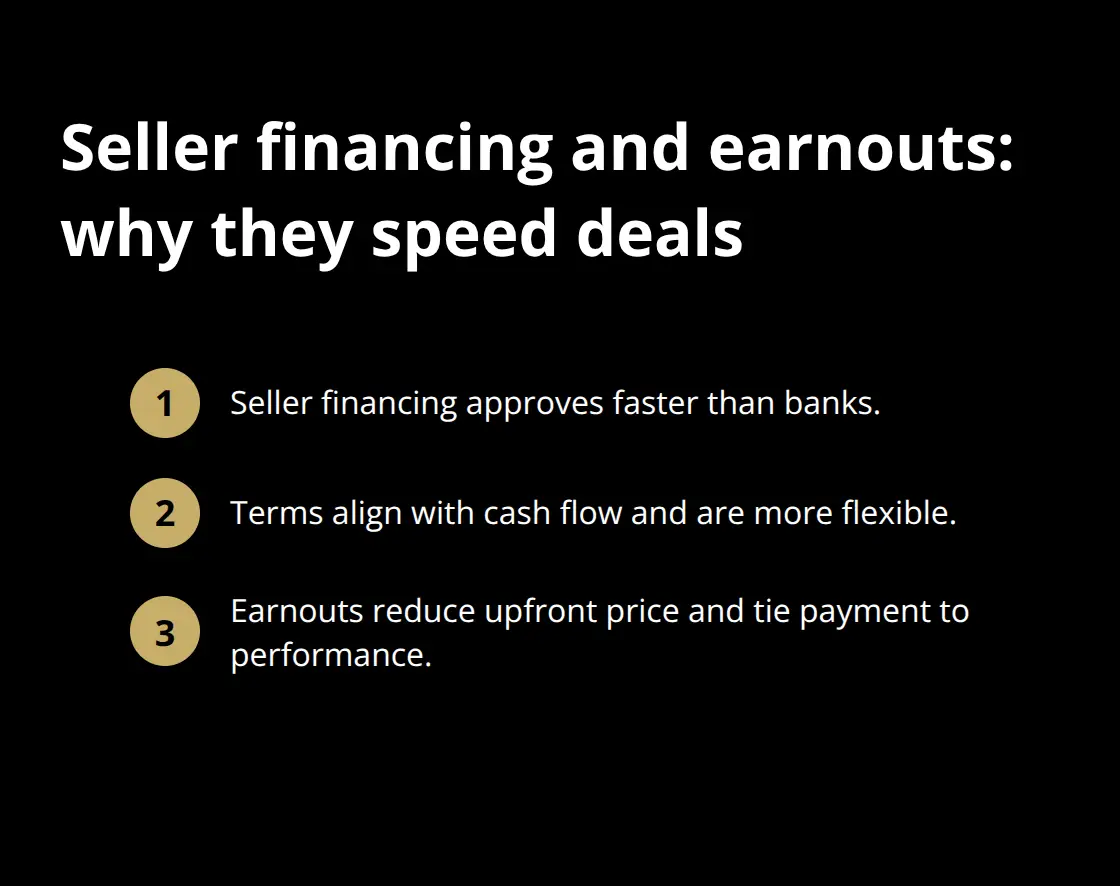
Seller financing cuts through this friction entirely. The seller becomes your lender, which means faster approvals and more flexible terms tailored to the business’s cash flow rather than rigid bank criteria. Sellers often structure deals with flexible payment windows and interest rates, making the deal structure feel less like a transaction and more like a partnership.
Earnouts-where part of the purchase price depends on future performance-work best when there’s uncertainty about revenue projections. You pay less upfront and more later if the business hits targets, which protects you from overpaying for optimistic forecasts. This approach also aligns your interests with the seller’s, since they benefit when the business succeeds under your ownership.
Alternative Funding and Layered Approaches
Alternative funding sources like investment groups and private equity firms appeal to buyers with larger deals, typically above $500,000. These sources move faster than traditional banks and tolerate more risk, but they demand equity stakes or high returns that shrink your ownership percentage.
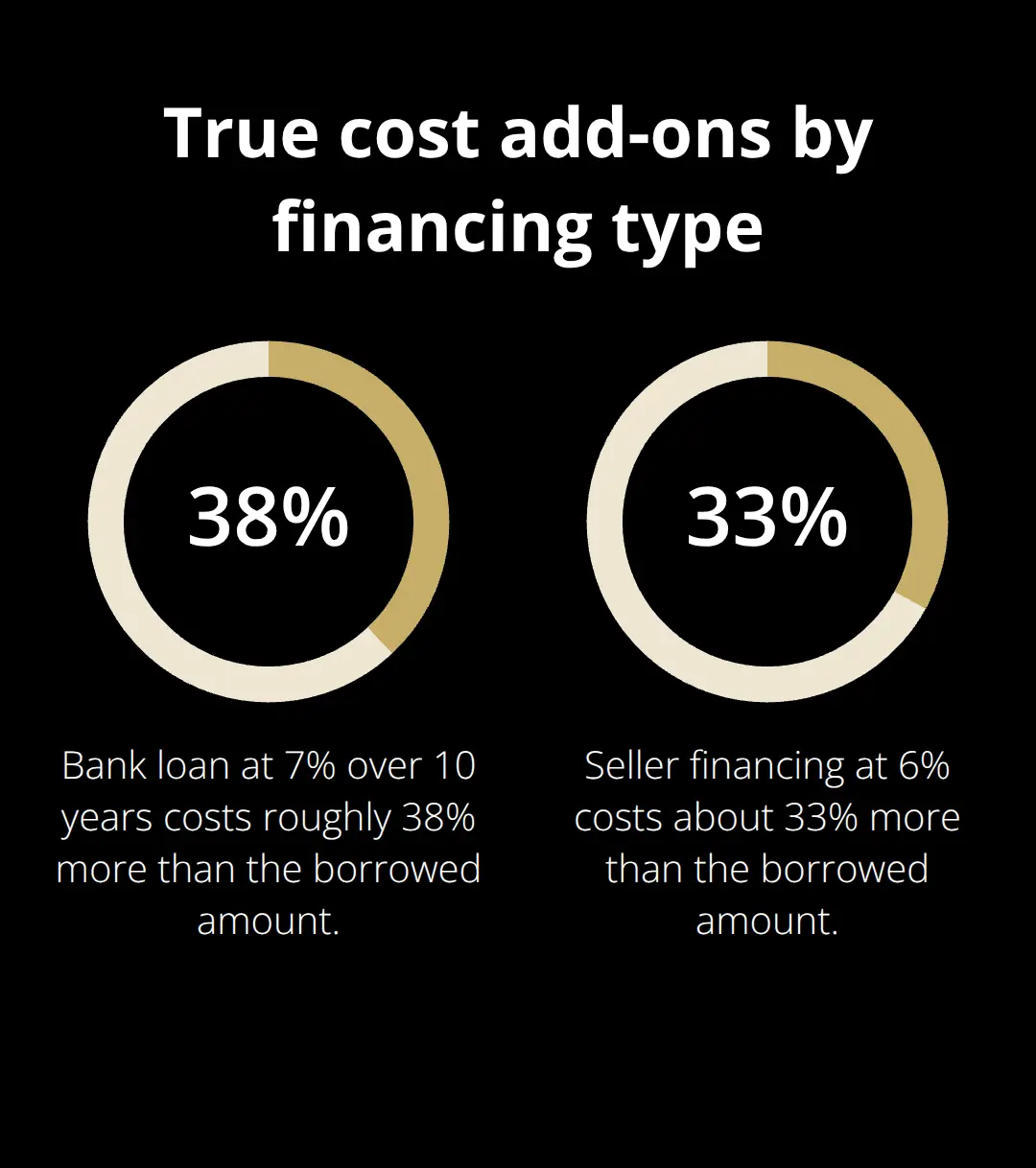
Some buyers layer multiple funding sources together-using their own capital for 20 percent, seller financing for 30 percent, and a bank loan for the remainder-to spread risk and negotiate better terms across each lender. The cost difference between these approaches is substantial. A bank loan at 7 percent interest over 10 years costs roughly 38 percent more than the borrowed amount. Seller financing at 6 percent costs about 33 percent more.
Equity investors typically expect 20 to 30 percent annual returns, which compounds far faster than interest-based debt.
Comparing True Costs Across Options
Understanding which financing path matches your situation-your down payment capacity, timeline, and risk tolerance-separates buyers who get fair deals from those who leave money on the table. Transparent platforms eliminate broker markups that traditionally inflate costs by 3 to 6 percent on financing arrangements, giving you clearer visibility into what each option actually costs. The next section examines how modern sales platforms streamline these financing decisions and reduce your total expenses.
How Modern Sales Platforms Cut Financing Costs
Transparency Replaces Hidden Broker Markups
Brokers traditionally bury financing costs in their fees, adding significant expenses without clear explanation. Modern platforms strip away this opacity entirely by showing you exactly what you pay at each stage. When you see financing options side-by-side with transparent pricing, you stop overpaying for convenience and start making decisions based on real numbers. This shifts power back to you. Instead of accepting whatever terms a broker negotiates behind closed doors, you evaluate multiple financing routes and their exact costs upfront.
M&A broker fees typically run 8-12% of sale price on businesses under about $1M, with the smallest deals sometimes reaching 12-15%. Transparent platforms eliminate that friction entirely by displaying interest rates, origination fees, earnout structures, and payment schedules before you sign anything.
AI-Driven Matching Connects You With Compatible Lenders
You gain access to AI-driven matching systems that connect you with lenders, investors, and sellers whose financing needs align with yours. Instead of cold-calling banks or hoping a broker knows someone interested in your deal structure, algorithms identify compatible parties in real time. This network effect reduces the time spent searching for capital and increases your negotiating leverage because multiple options surface simultaneously.
The matching process works faster than traditional outreach because the platform evaluates compatibility across hundreds of potential partners at once. You no longer wait weeks for a broker to shop your deal around; qualified lenders and investors appear within days, each with clear terms and expectations already defined.
Legal Documents Arrive Ready to Customize
Legal documentation that traditionally required lawyers to draft from scratch now comes pre-built and customizable through the platform. Templates for promissory notes, purchase agreements with seller financing clauses, and earnout schedules arrive ready to use, cutting legal costs by hundreds or thousands of dollars depending on deal complexity. You maintain full control over terms and can involve your attorney for review, but the platform removes the blank-page problem that makes legal processes drag on for weeks.
This acceleration matters because every week of delay costs you money in lost business performance and extended uncertainty. Pre-built templates standardize common deal structures while remaining flexible enough to accommodate your specific situation. Your lawyer reviews and adjusts rather than starting from zero, which compresses timelines and reduces billable hours significantly.
Cost Comparison Happens in Real Time
Modern platforms display the total cost of ownership across different financing methods simultaneously, so you compare a bank loan against seller financing against equity investment without manual calculations. You see not just the interest rate but the full financial impact-how much you’ll pay in total, when payments occur, and what ownership stake you retain. This transparency prevents the common mistake of choosing a financing option based on monthly payment alone while ignoring the true cost over the deal’s lifetime.
The comparison tools often include scenario modeling, letting you adjust down payment amounts, repayment terms, or interest rates to see how each change affects your total expenses. This capability transforms financing from a binary choice into an optimization problem where you find the option that best matches your cash flow and long-term goals.
Network Effects Lower Your Cost of Capital
When multiple lenders compete for your deal simultaneously, interest rates and terms improve in your favor. A platform with thousands of active lenders creates genuine competition, whereas a broker working with a handful of preferred partners has little incentive to negotiate aggressively on your behalf. The platform’s scale means lenders accept lower margins because they process high deal volume, and those savings transfer directly to you through better rates and fewer fees.
This competitive dynamic also encourages lenders to offer creative structures-longer repayment windows, lower down payments, or hybrid approaches-because they know you’ll compare their offer against five others. The result is financing that actually fits your business rather than financing that fits the lender’s standard template. With these cost-cutting mechanisms in place, the next section examines how different purchase methods stack up financially and what truly determines whether you overpay or strike a fair deal.
What You Actually Pay: Broker Fees vs. Direct Platform Costs
Traditional Broker Costs Add Up Fast
Broker-assisted sales operate on commission structures that inflate your total expenses significantly. Traditional brokers charge 8 to 12 percent of the sale price for businesses under $1 million, with smaller deals sometimes reaching 15 percent. These fees cover financing consultation, lender connections, and document preparation that modern platforms now handle automatically. A $500,000 acquisition through a broker costs $40,000 to $75,000 in fees alone, before financing costs even begin.
Direct platforms eliminate these intermediary markups entirely. Unbroker charges a 6% success fee, paid when the business sells. That same $500,000 acquisition costs $30,000 in success fees, leaving you $10,000 to $30,000 more capital for down payments or operational improvements.
Hidden Lender Markups Compound Over Time
Brokers traditionally embed their own markups into lender rates, adding another 1 to 3 percent annually across your repayment term. A 10-year loan at 7 percent with a broker’s hidden markup might actually cost you 8 to 10 percent, whereas a transparent platform displays the true rate upfront. Over a decade, that extra 1 to 3 percent compounds significantly, costing thousands more in interest payments.
Total Cost of Ownership Reveals the Real Difference
A $500,000 acquisition financed through a broker with an 8 percent fee, a lender markup, and a 7.5 percent interest rate over 10 years costs approximately $685,000 when you add principal, interest, and fees combined. The same acquisition through a direct platform with transparent 6.5 percent financing costs roughly $595,000 total, saving $90,000 across the loan term.
This calculation shifts further in your favor when you layer multiple financing sources, because transparent platforms show you exactly how each component affects total cost. A buyer using 25 percent personal capital, 40 percent seller financing at 5 percent, and 35 percent bank financing at 6.5 percent can model the precise cost impact before committing to any option.
Financial Cushion Determines Long-Term Success
Long-term financial impact extends beyond purchase price into operational flexibility and growth capacity. Buyers who overpay on financing costs enter ownership with less cash reserves, forcing them to operate tighter margins and reduce their ability to invest in growth or weather unexpected challenges. A buyer who saves $90,000 in financing costs enters ownership with stronger cash position, enabling faster inventory investment, team expansion, or strategic improvements that drive revenue growth. This financial cushion often determines whether a buyer survives the critical first two years or struggles through them.
Final Thoughts
Financing options for buyers determine whether you build real wealth from your acquisition or watch profits disappear into unnecessary fees. The difference between a smart financing decision and a costly one often exceeds $90,000 on a mid-sized deal, money that could fund growth, build reserves, or strengthen your competitive position. Traditional brokers obscure these costs deliberately, embedding markups into lender rates and presenting financing as a take-it-or-leave-it proposition rather than an optimization problem.
Modern platforms flip this dynamic entirely by showing you exactly what you pay at every stage. Transparent pricing eliminates the opacity that costs you thousands, while AI-driven matching connects you with multiple lenders simultaneously and forces genuine competition that improves rates and terms in your favor. Pre-built legal documents eliminate weeks of lawyer time, and real-time cost comparisons let you model different financing structures to choose the one that actually fits your situation.
The financial impact compounds over years-a buyer who saves $90,000 in upfront and financing costs enters ownership with stronger cash reserves, enabling faster growth investments and better resilience during challenges. Unbroker removes the broker middleman and gives you access to a modern platform designed around your interests, not theirs, with transparent low-cost options that show you exactly what you pay upfront. Stop accepting financing as something brokers impose on you and start treating it as a decision you control.