Selling your business is one of the biggest financial decisions you’ll make. At Unbroker, we’ve helped countless business owners navigate this complex process, and we know that having a clear roadmap makes all the difference.
The exit planning steps you take now will determine whether you walk away with maximum value and minimal stress. This guide walks you through each phase, from assessing your business to closing the deal.
Know Your Business’s Real Value Before You Sell
Getting a realistic picture of what your business is actually worth is where smart exit planning begins. Too many owners either overestimate value based on emotional attachment or underestimate it by relying on outdated financial snapshots. You need three approaches working together: the market approach, the income approach, and the cost approach. The income approach typically matters most because buyers care about future cash flow, not just what’s on your balance sheet.
Pull together three to five years of tax returns and financial statements, but go deeper than that. Normalize your earnings by removing one-time expenses, owner perks that a new owner wouldn’t need, and any unusual revenue spikes. A CPA audit of your financials signals to buyers that you’ve been serious about accuracy, which strengthens your negotiating power significantly.
Timeline Drives Everything
Timing your exit shapes every decision that follows. Most business sales take about a year from serious buyer conversations to closing, so if you want to exit in two years, you’re essentially starting now. That’s exactly why waiting for the perfect moment rarely works.
Instead, assess whether your business runs smoothly right now. If your customer base is stable, your team functions without constant owner involvement, and your revenue trends upward, conditions favor a sale. Rising interest rates and cautious buyer behavior mean well-prepared businesses stand out while unprepared ones struggle. Identify whether you want a quick sale to a strategic buyer, a longer transition that lets you stay involved, or a transfer to employees or family. Each path requires different preparation timelines and changes which potential buyers make sense for your situation.
Know Exactly Who Wants to Buy
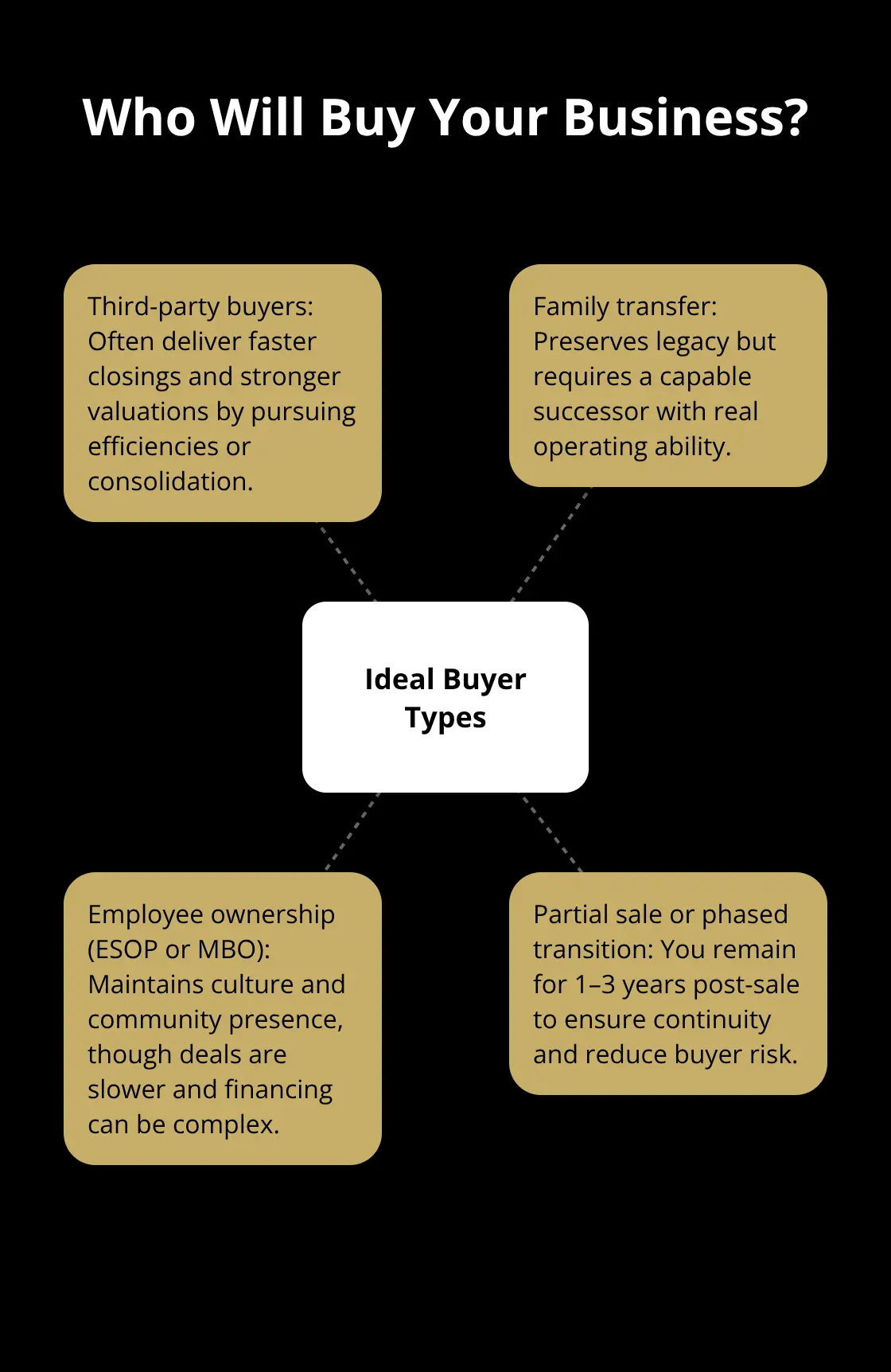
The wrong buyer will either destroy what you built or force you to accept a lower price. Third-party buyers typically offer the fastest sales and highest valuations because they’re betting on operational improvements or market consolidation. Family transfers preserve legacy but require an heir with actual capability to run the company, not just willingness.
Employee ownership through mechanisms like ESOPs or management buyouts keeps your business culture intact and maintains community presence, though these deals move slower and require creative financing. Some owners pursue partial sales or phased transitions where they stay on for one to three years post-sale, which appeals to buyers worried about continuity.
Your ideal buyer profile depends on your personal goals after the sale. If you want zero involvement afterward, a strategic buyer or financial investor makes sense. If you want ongoing involvement or want to preserve your company’s mission, employee ownership or a family transfer aligns better.
The SBA offers counseling through its network of Small Business Development Centers and SCORE mentors who can help you think through buyer profiles specific to your industry.
With your business value clear and your buyer profile defined, you’re ready to prepare your operations for the scrutiny that serious buyers will bring.
Prepare Your Business for Sale
Organize Your Financial Records
Buyers will scrutinize everything once they sign a non-disclosure agreement, so gather tax returns, bank statements, and profit-and-loss statements in one organized location before you list. Buyers expect clean, consistent documentation that tells a story without requiring interpretation. If your bookkeeping has been loose, hire a fractional CFO or experienced bookkeeper immediately to standardize your records and catch discrepancies before a buyer’s accountant does.
A CPA audit costs between $3,000 and $10,000 depending on complexity, but it signals professionalism and removes a major objection during due diligence. The investment pays for itself through stronger negotiating leverage. Compile an owner task list showing what you personally handle versus what your team manages, because buyers worry about businesses that collapse without the founder. Include job descriptions, compensation details, and evidence of management depth. If your business depends heavily on you, buyers will either discount the price significantly or walk away entirely.
Document Your Operations
Your operational systems matter as much as your financials. Document your core processes, customer acquisition methods, supplier relationships, and revenue streams so a new owner can operate independently from day one. Create written procedures for your most important functions-this transforms tacit knowledge into transferable assets that increase buyer confidence and valuation.
If you have customer contracts, review them for change-of-control clauses that might trigger renegotiation or termination when ownership transfers. Check your insurance policies, licensing requirements, and compliance status with state and federal regulations. Unresolved legal issues, pending lawsuits, or tax liens will surface during due diligence and torpedo the deal or slash your valuation. Address these problems now rather than hoping a buyer overlooks them.
Secure Your Intellectual Property
If your business holds intellectual property, trademarks, or proprietary processes, secure documentation of ownership and registration. Buyers want to know exactly what they’re acquiring and whether any assets are encumbered by liens or licensing restrictions. Verify that all patents, copyrights, and domain names transfer cleanly to the new owner without complications or third-party claims.
The months before you list are your chance to eliminate friction and present a business that runs like a machine without you. With your operations documented and your legal house in order, you’re positioned to attract serious buyers and command top dollar when you enter the market.
Market Your Business and Attract Qualified Buyers
Once your business is operationally sound and financially transparent, you must shift focus to marketing. Most owners underestimate the effort required to attract qualified buyers who will actually close. The sales channel you select determines your timeline, buyer quality, and final price.
Choose Your Sales Channel Strategically
A traditional business broker typically charges 10% of the sale price, which means selling a $1 million business costs you $100,000 in fees. We at Unbroker offer a modern alternative with transparent pricing: a 6% success fee, paid only when your business sells, which on that same $1 million sale keeps $40,000 more in your pocket. Whichever path you choose, avoid listing your business on generic marketplaces where unqualified prospects waste your time. Serious buyers come through targeted channels: brokers with industry expertise, M&A advisors who understand your sector, or platforms that use AI to match sellers with vetted purchasers.
Interview at least three brokers before committing. Ask specifically about their recent sales in your industry, average days on market, and whether they co-broker with other firms to expand buyer access. A broker who closed five similar deals in the past year knows your market better than one working generically across multiple industries.
Present Your Business Strategically to Buyers
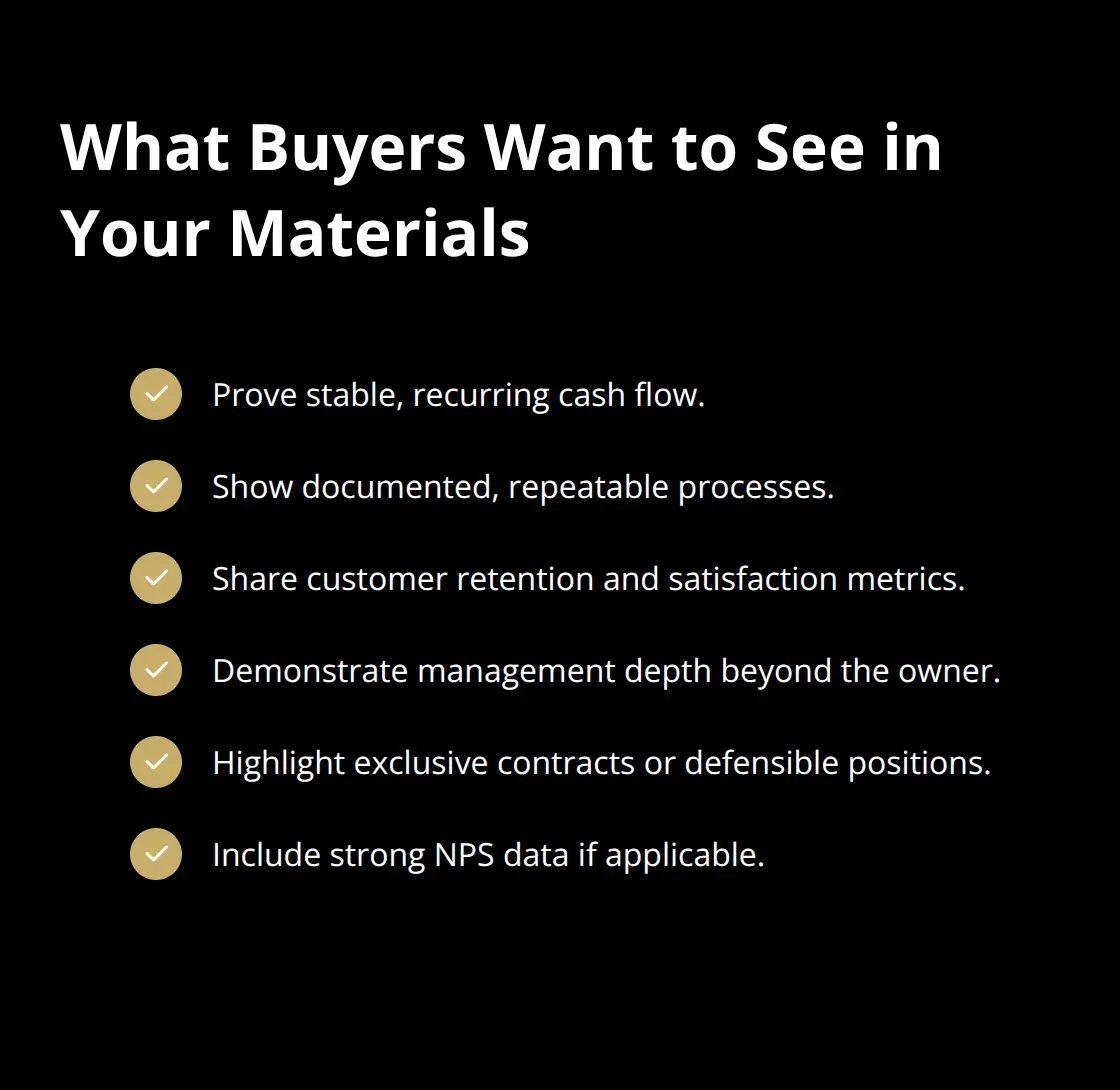
Your marketing materials must address buyer concerns directly, not just highlight what you love about your business. Buyers want proof of stable cash flow, documented processes, customer retention metrics, and management capability independent of you. If your Net Promoter Score or customer satisfaction data is strong, lead with that because it signals low churn risk.
Quantify your competitive advantages plainly with supporting evidence. If you hold exclusive contracts, proprietary technology, or a defensible market position, state it clearly. Buyers evaluate these factors heavily when determining what they’ll pay.
Negotiate with Discipline and Confidence
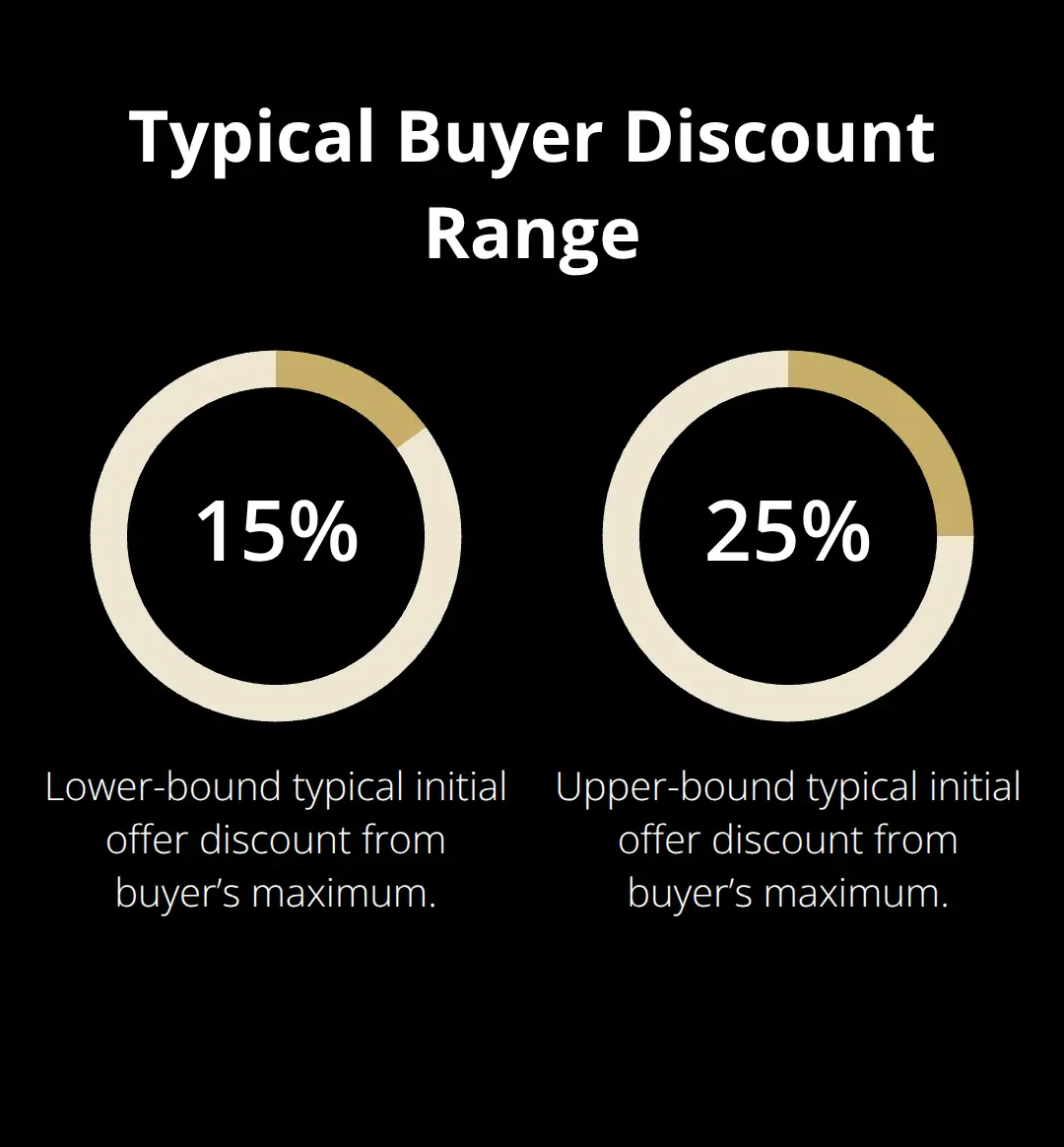
Stay disciplined about your walk-away price during negotiations. Too many owners anchor to an inflated valuation and watch deals collapse rather than compromise. Understand that a buyer’s initial offer typically runs 15–25% below their actual maximum, so legitimate room exists to negotiate.
However, if your asking price exceeds what comparable sales in your industry command by a significant margin, you set yourself up for a failed sale. Use data from recent comparable sales in your sector to calibrate expectations.
When a serious offer arrives, request that the buyer provide proof of financing immediately, because deals die when buyers cannot actually fund the purchase. Negotiate the earnout structure carefully if one is proposed, since earnouts tie you to the business longer and introduce risk that the buyer might deliberately underperform to reduce what they owe you.
Close the Deal Properly
Have an attorney review all purchase agreements, verify that all representations and warranties are accurate, and confirm that any contingencies are truly satisfied before you sign final papers. The margin between a smooth closing and a contentious one often comes down to how thoroughly you prepared your documentation and how clearly you communicated expectations throughout the process.
Final Thoughts
The exit planning steps you’ve completed throughout this guide position you to walk away from your business with maximum value and minimal regret. You’ve assessed your business honestly, prepared your operations for buyer scrutiny, and marketed strategically to qualified purchasers-each action directly determines your financial outcome and peace of mind after closing. The most successful exits share one common thread: owners started their preparation years before they needed to sell, not months before.
After your sale closes, verify that all purchase agreement terms are fulfilled and confirm that earnout schedules are documented clearly if applicable. Many owners underestimate the emotional adjustment required after selling, so plan how you’ll spend your time and energy in your next chapter (some stay involved as consultants for a transition period, while others step away completely). Neither approach is wrong, but clarity about your post-sale role prevents friction with the new owner.
We at Unbroker understand that selling your business deserves a partner who respects your effort and maximizes your proceeds. Our platform offers transparent pricing with no hidden fees, AI-driven buyer matching, and expert support throughout your sale, so explore how we can support your exit with efficiency and integrity.