Most founders build companies to make a difference, not just to cash out. Yet when it comes time to sell, the traditional M&A playbook often forces a choice between financial success and staying true to your mission.
At Unbroker, we’ve seen a shift. More founders are exploring nonprofit-aligned sales as a way to exit on their own terms, protecting their legacy while creating lasting impact.
Why Founders Are Rejecting Traditional M&A
Founders who built mission-driven companies often discover that standard acquisition routes create a fundamental problem: the buyer’s incentives don’t align with yours. When a private equity firm or conventional acquirer takes over, they typically prioritize profit maximization and operational efficiency over the social impact that motivated you to start the business. Acumen and Open Capital Advisors studied exit patterns in off-grid energy companies and found that mission misalignment during acquisitions frequently led to reduced access for underserved customers and compromised service quality. The data shows this isn’t a rare occurrence-it’s the default outcome when financial returns dominate the decision-making process. Nonprofit-aligned acquisitions solve this problem directly.
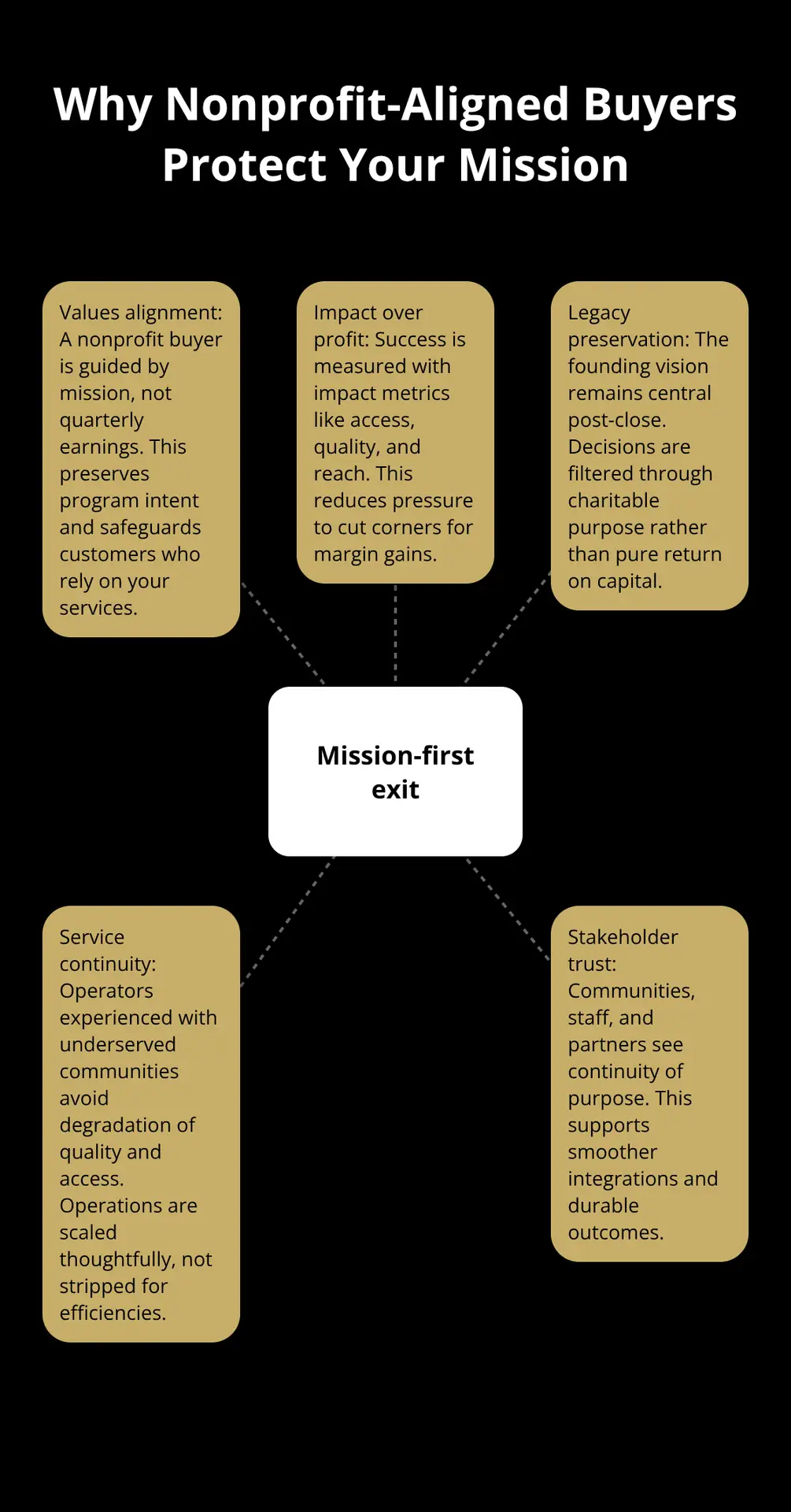
A nonprofit buyer shares your values and measures success through impact metrics, not quarterly earnings. This structural alignment means your legacy stays intact the moment the deal closes.
The Market Shift Toward Mission-First Exits
The market for nonprofit acquisitions and charitable exits has grown noticeably, though exact statistics remain fragmented across sectors. Glick Davis & Associates analyzed 26 nonprofit mergers since the Great Recession and found that most were strategic, not crisis-driven, and explicitly aimed at expanded services and long-term sustainability. The research revealed that cultural alignment, mission fit, and leadership chemistry predicted success far more reliably than balance sheet metrics. This insight flips conventional M&A logic on its head. When founders evaluate potential nonprofit buyers, financial strength matters less than philosophical compatibility.
Assessing Mission Alignment Over Financial Metrics
The practical implication is straightforward: assess whether a nonprofit buyer’s programs, beneficiaries, and operational philosophy match yours, not just whether they have cash. Social enterprises serving as sole providers in their regions face particular pressure to plan exits carefully. If you’re the only reliable source of essential goods or services for your customers, an exit to a misaligned buyer could leave those customers stranded. Planning exit scenarios with your team and stakeholders before you actually fundraise helps prevent this outcome and protects the communities you serve.
Moving Forward With Strategic Planning
The decision to pursue a nonprofit-aligned exit requires more than financial analysis. It demands that you understand what success looks like beyond the sale price and identify buyers whose operational philosophy and mission commitment genuinely match your own. This groundwork-conducted early and with full stakeholder input-positions you to negotiate terms that protect both your legacy and your customers’ access to the services they depend on.
Finding the Right Nonprofit Buyer for Your Mission
Map Your Operations Before You Search
Finding a nonprofit buyer who genuinely aligns with your mission requires more than a surface-level mission statement review. Start by mapping your customer base, service geography, and operational philosophy, then identify nonprofits already working in those exact spaces. If you run a for-profit providing clean water access in rural areas, search for established water nonprofits operating in those regions.
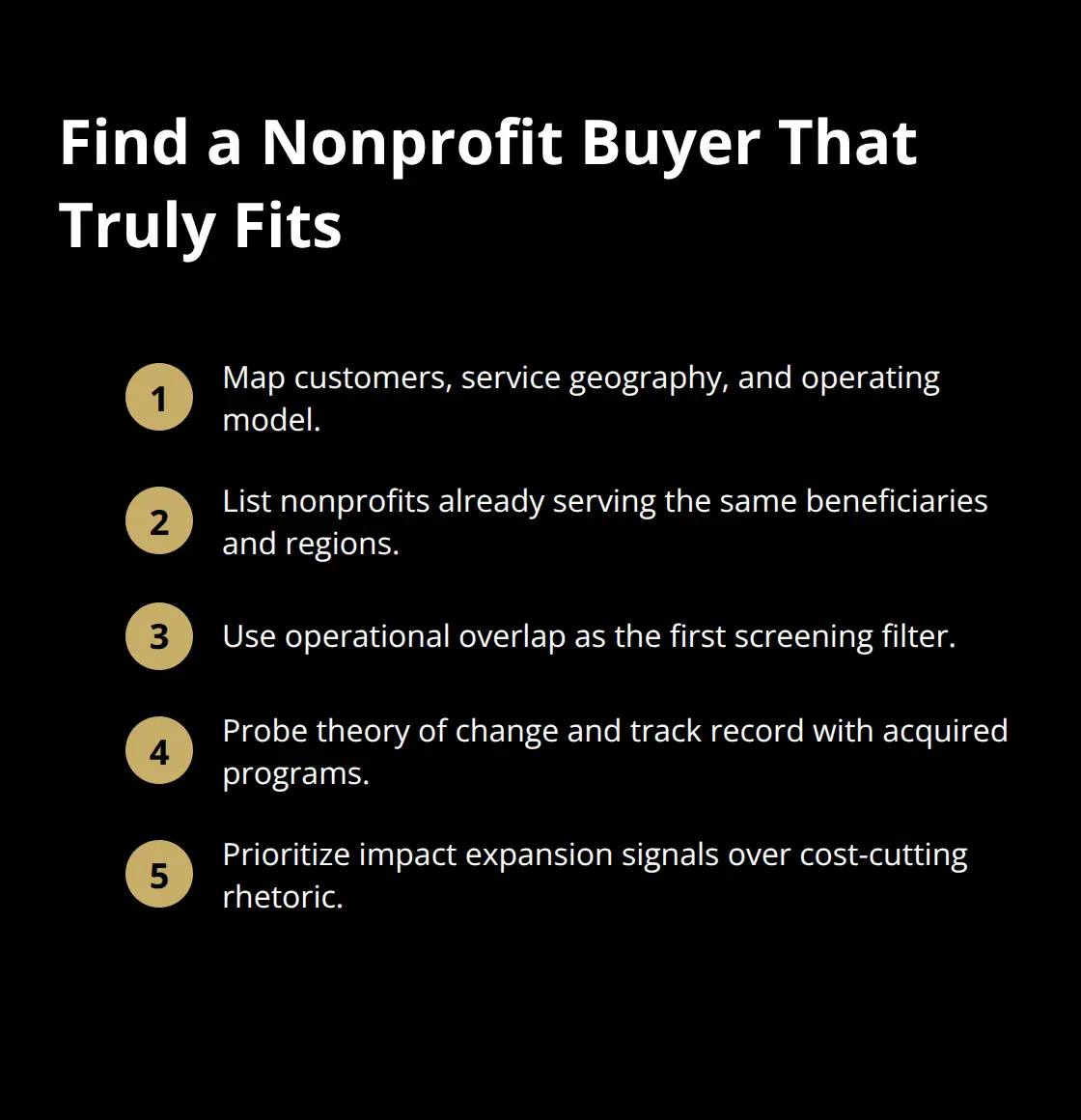
Research on nonprofit consolidations showed that mission fit and leadership chemistry predicted merger success far more reliably than financial strength. This means your first filter should be operational overlap, not balance sheet size.
Conduct competitive analysis to understand how potential buyers differ from similar organizations and what unique value they bring. A nonprofit serving your exact customer base understands the economics of that market and won’t accidentally compromise service quality chasing margin improvements. When you contact prospects, ask about their theory of change, their track record with acquired programs, and whether they’ve ever scaled operations into new geographies. Listen carefully to how they describe success-if they lead with cost reduction rather than impact expansion, they’re not your buyer.
Assess Cultural Fit Through Direct Conversation
Cultural alignment matters more than most founders expect because nonprofit leadership often carries strong convictions about how work should be done. Schedule conversations with their executive team, board members, and program staff to assess whether their day-to-day operations match what they claim publicly. Ask specific questions about staffing decisions, community feedback loops, and how they handle situations where impact and efficiency conflict. These conversations reveal whether a nonprofit’s stated values actually shape their decisions.
Leverage Networks and Specialized Brokers
The nonprofit sector has a substantial number of organizations worldwide using mission-driven platforms, which means your potential buyer pool is substantial but requires genuine vetting. Leverage your industry networks, attend sector conferences, and work with brokers who specialize in mission-aligned transitions rather than traditional M&A firms. Brokers focused on purpose-driven exits understand that valuation depends partly on impact metrics, not just revenue multiples, and they’ll connect you with buyers who see that nuance. They can also facilitate conversations earlier in your process, before you’re forced to sell, giving you time to find the right fit rather than settling for the fastest offer.
With the right buyer identified and vetted, the next challenge emerges: structuring the actual sale in ways that protect both your legacy and your organization’s future.
How to Structure a Nonprofit-Aligned Sale
A nonprofit buyer approaches your sale differently than a traditional acquirer, but that difference creates both opportunities and complexities you must navigate carefully. The legal structure matters enormously because nonprofits operate under different tax rules and governance constraints than for-profit companies. When a nonprofit acquires your business, the transaction often qualifies for favorable tax treatment if structured correctly.
Tax Advantages of Nonprofit Acquisitions
The IRS allows nonprofits to acquire for-profit operations without triggering the same capital gains taxes that would apply in a standard sale, provided the acquisition genuinely advances the nonprofit’s charitable mission. This structural advantage means your proceeds can be significantly larger than in a conventional exit, since less of the sale price disappears into tax obligations. Work with a tax attorney who specializes in nonprofit transactions, not a general M&A lawyer, because they understand how to document the mission alignment in ways that withstand IRS scrutiny.
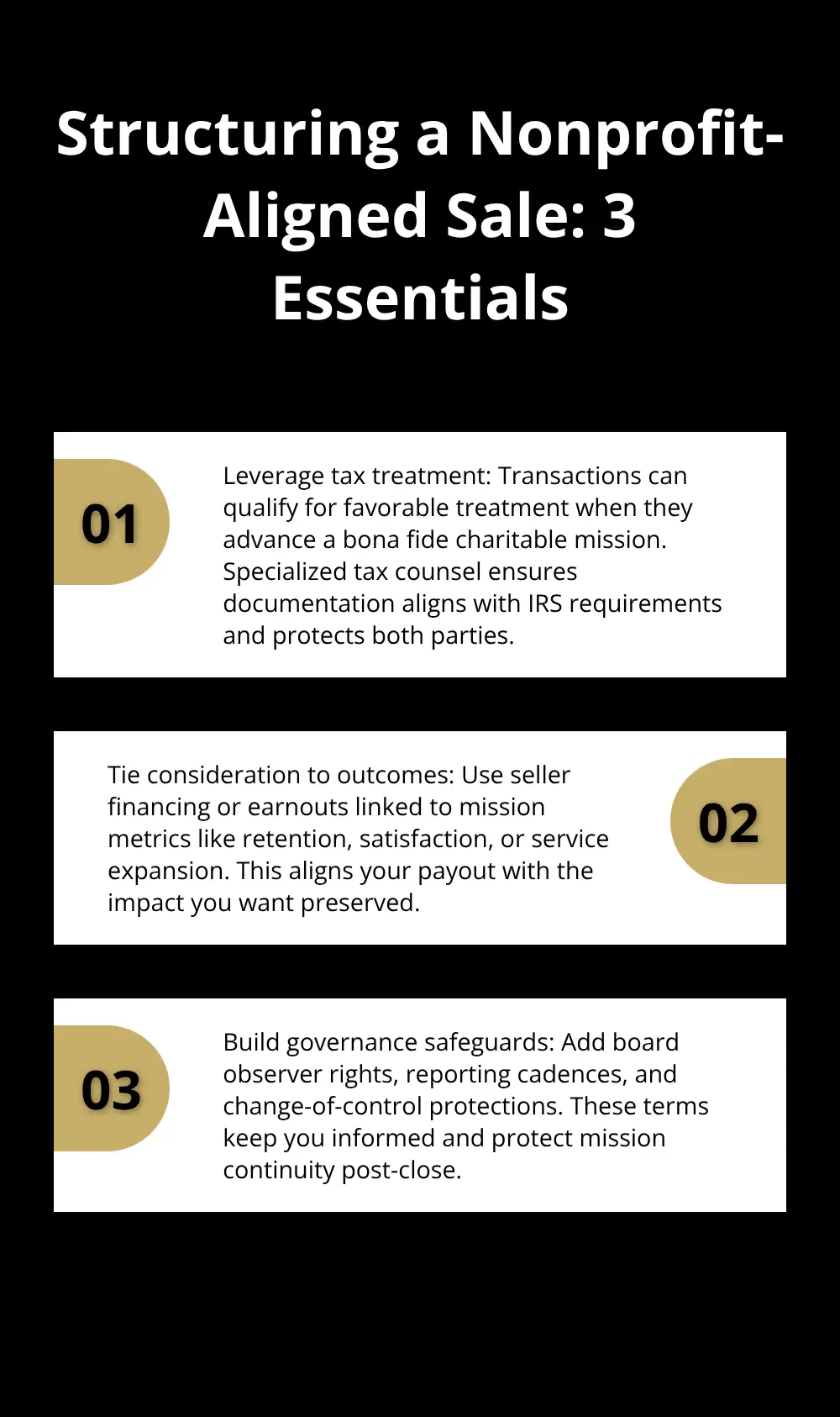
The nonprofit buyer will need written evidence that your business directly supports their charitable purpose. Prepare detailed documentation showing how your operations, customer base, and impact metrics align with their stated mission. This isn’t bureaucratic theater-it’s the foundation that protects both parties from audit risk and ensures the sale structure holds up legally.
Structuring Terms Around Mission Outcomes
Nonprofit buyers have legitimate constraints that for-profit acquirers don’t face. Most nonprofits cannot pay all-cash upfront because their capital is restricted to charitable purposes, which means seller financing or earnout structures often become necessary. Rather than resist this reality, structure it to your advantage by building in performance metrics that actually matter to you.
If your primary concern is that the nonprofit maintains service quality for underserved customers, tie a portion of the purchase price to retention rates, customer satisfaction scores, or service expansion metrics. This approach aligns your financial interests with the mission outcomes you care about, turning what looks like a constraint into genuine protection for your legacy.
Protecting Your Legacy Post-Sale
Negotiate governance provisions that give you visibility into how your business operates after the sale, such as board observer rights or quarterly reporting requirements. This visibility allows you to monitor whether the nonprofit executes on the promises they made during due diligence. Include explicit language about what happens if the nonprofit’s leadership changes or if they attempt to sell the business again-protective provisions like these prevent your exit from becoming a stepping stone to a mission-misaligned buyer down the road.
The earnout period typically runs two to five years, and nonprofits operating on annual budgets often prefer shorter timelines. A three-year structure gives them time to integrate your operations while keeping your financial interest active long enough to matter. This timeline balances their operational realities with your need for meaningful protection.
Final Thoughts
A nonprofit-aligned sale protects your mission in ways traditional M&A cannot match. The founders who succeed in this space understand that the right buyer matters far more than the highest price tag, and they structure their exits around impact metrics rather than financial multiples alone. Mission fit, cultural alignment, and genuine commitment to your customers determine whether your legacy strengthens or weakens after you exit.
The practical path forward requires intentional work at each stage. Map your operations and customer base before you search for buyers, assess potential nonprofit partners through direct conversations with their leadership and staff, and structure your deal around the outcomes that matter most to you. Work with tax specialists who understand nonprofit acquisitions and brokers focused on mission-driven transitions rather than traditional M&A firms that optimize for speed over alignment.
We at Unbroker support mission-driven founders through nonprofit aligned sales at every stage of selling your business. Our platform offers transparent pricing, expert guidance, and access to a network of buyers who understand what you’re trying to accomplish. Visit Unbroker to learn how we can help you sell on your terms while protecting the impact you’ve created.