Selling your business without a broker means keeping more money in your pocket. We at Unbroker believe that with the right roadmap, you can handle this process yourself.
This DIY business sale guide walks you through valuation, marketing, negotiation, and closing. You’ll learn exactly what professional sellers do-and how to avoid costly mistakes.
Getting Your Business Deal-Ready
The foundation of a successful DIY sale starts months before you talk to a single buyer. Most owners underestimate how long preparation takes. Getting Your Business Deal-Ready typically takes one to three months for preparation and planning, followed by two to six months for marketing and buyer search. The first step is obtaining an independent business valuation. This isn’t optional-it’s your market anchor. A credible valuation prevents you from pricing too high and scaring away buyers or too low and leaving hundreds of thousands on the table. For a mid-seven-figure business, the difference between a $2 million and $2.3 million valuation directly impacts your bottom line.
Choosing the Right Valuation Approach
When you evaluate your business, use the Income-Based Approach if your cash flow is stable. This approach applies capitalization methods to your Seller’s Discretionary Earnings or net cash flow. The Market-Based Approach compares your business to similar recent sales in your industry using revenue multiples or P/E ratios. Start with three years of tax returns or CPA-reviewed financial statements, plus your year-to-date P&L and balance sheet. Strip out personal expenses-that luxury vehicle, country club dues, or family travel-and one-time costs like litigation settlements. These adjustments create normalized earnings that buyers actually care about.
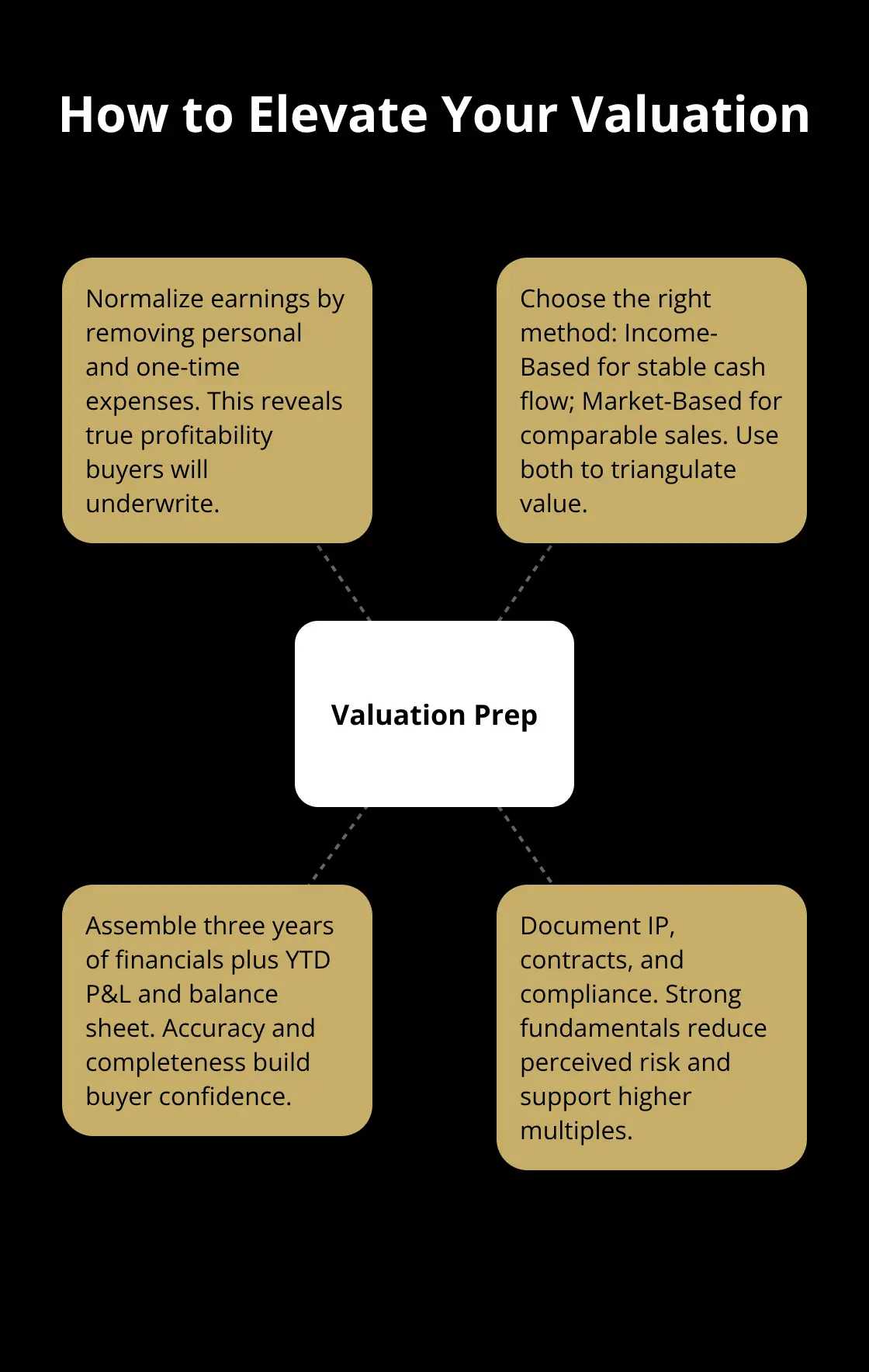
This step alone can shift your valuation significantly upward because it shows true business profitability separate from owner lifestyle choices.
Organizing Your Financial Records
Once you have your valuation, your next priority is organizing a data room with documents buyers will demand. Plan for 100 or more document requests during due diligence. Start with clean, complete financials: monthly P&Ls for the past three years, balance sheets, tax returns, and bank statements. Then add operational documents-customer contracts, vendor agreements, employee records, and any IP or proprietary processes your business relies on. Include lease agreements, insurance policies, and evidence of compliance with industry regulations. A well-organized data room signals professionalism and accelerates negotiations.
Addressing Legal and Compliance Gaps
Next, address any legal and compliance gaps before they become deal-killers. Pay off back taxes, resolve any pending litigation, clean up employment records, and document that you’ve complied with licensing requirements in your industry. A quality of earnings assessment validates your financials and identifies working capital needs that affect the sale price. Many DIY sellers skip this step and regret it when buyers use due diligence to chip away at price. With your business now deal-ready, you can move forward with confidence into the marketing phase, where you’ll position your company to attract qualified buyers who recognize its true value.
How to Position Your Business to Attract Real Buyers
Your deal-ready financials and organized data room mean nothing if qualified buyers never see your business. This is where most DIY sellers falter. They create a generic business listing and hope word-of-mouth carries them to a sale. That approach leaves deals on the table. Instead, you need a focused marketing strategy that reaches actual buyers-not tire-kickers or competitors fishing for intel.
Craft a Professional Marketing Document
Start by drafting a Confidential Information Memorandum, or CIM, a professional marketing document that tells your business story in the language buyers understand. Your CIM should lead with cash flow and growth trajectory, not sentiment. Include your normalized EBITDA or SDE prominently in the first section, along with the key metrics buyers use to value companies: revenue growth rate, customer concentration, recurring revenue percentage, and gross margins. For a mid-seven-figure business, buyers typically evaluate you using revenue multiples between 0.5x and 3x depending on industry and growth profile. Make that math easy for them.
Your CIM should span 15 to 25 pages and include a two-page executive summary, financial highlights with three years of tax returns, customer and vendor breakdowns, and a clear description of your competitive advantage. Avoid hype. Buyers spot inflated claims immediately and use them as leverage to negotiate price down.
Protect Information at Every Step
Confidentiality is your second priority in marketing. You cannot afford a leak to employees, customers, or competitors. Implement a strict NDA process before sharing any sensitive information. Screen potential buyers through financial background checks and require them to sign a non-disclosure agreement before accessing your CIM or data room. Control who knows about the sale. Many DIY sellers make the mistake of telling staff early, and within weeks, top talent starts job hunting. Customers pick up on uncertainty and begin exploring alternatives. Competitors learn you’re vulnerable and poach accounts.
A realistic timeline for a seven-figure revenue business sale is 12 to 18 months, so protect confidentiality for at least the first three to four months while you build a qualified buyer pipeline.
Identify and Reach Qualified Buyers
Target buyers directly: competitors in your space, private equity firms focused on your industry, and strategic acquirers who could integrate your operation into theirs. Use LinkedIn to identify decision-makers at acquisition-stage companies. Reach out with a soft inquiry before sharing the CIM. If you lack the network to find buyers yourself, consider a middle ground between full DIY and traditional broker representation. Services like business brokers platforms provide expert support, marketing tools, and access to a buyer network enhanced by AI-driven processes, letting you maintain control while filling gaps you can’t cover alone. This approach often delivers the best outcome: you keep costs low while avoiding the confidentiality and process mismanagement risks that sink solo sales. With your business positioned and your buyer pipeline building, you’re ready to evaluate offers and structure the terms that protect your interests.
Structuring Your Deal and Managing Negotiations
Once a qualified buyer emerges, your first move is to draft a Letter of Intent before any binding agreement. An LOI outlines purchase price, payment structure, which assets or shares transfer, and the deal timeline. It’s non-binding but signals seriousness and guides what due diligence the buyer will conduct. This document prevents surprises later. Many DIY sellers skip the LOI and jump straight to purchase agreements, then discover the buyer interprets terms completely differently.
Choose Between Asset and Stock Sales
Next, you must decide whether you’re selling assets or shares. An Asset Purchase Agreement versus Stock Purchase Agreement transfers specific business assets but leaves the legal entity with the buyer; a Stock Purchase Agreement transfers ownership of the company itself. Asset sales often favor sellers because they limit liability exposure post-close, but they trigger more complex tax implications. Stock sales are simpler structurally but expose you to longer-tail liabilities. A business lawyer must guide this choice based on your tax situation and risk tolerance. For a mid-seven-figure business, the difference in tax efficiency between these structures can mean $50,000 to $150,000 in your pocket.
Understand the True Cost of Professional Help
Brokers commonly charge about 10% of sale price, translating to roughly $300,000 to $500,000 in commission on a mid-seven-figure deal. Understanding what you actually get for that fee matters. With a DIY or assisted approach, you control costs and know exactly where money goes. Some sellers find that middle-ground options-platforms offering expert support without full broker representation-deliver better value by combining low upfront costs with access to buyer networks and marketing tools.
Prepare for Due Diligence
Due diligence is where deals either accelerate or stall. Expect 100 or more document requests. Buyers want customer contracts, vendor agreements, employee records, IP documentation, lease agreements, insurance policies, litigation history, and tax compliance evidence. Organize everything in a secure data room before the buyer asks. This preparation cuts due diligence timelines from months to weeks. Buyers will use incomplete or disorganized records as leverage to negotiate price downward, so transparency works in your favor.
Protect Yourself with Proper Documentation
Include Disclosure Schedules attached to your purchase agreement listing all contracts, pending litigation, debt obligations, and employee agreements. These schedules protect you post-sale by documenting what you disclosed upfront, limiting exposure to claims the buyer could have discovered. Address working capital adjustments early. Many deals include a working capital peg, meaning if the business closes with less cash or higher liabilities than expected, the purchase price adjusts downward at closing. Understand these mechanics before signing anything. Some sellers also encounter earnouts, where a portion of the purchase price depends on hitting revenue or profit targets post-sale. Earnouts shift risk to you and complicate your exit. Negotiate for as much cash at closing as possible. Finally, involve your attorney at the appropriate stages to avoid post-close disputes. Closing paperwork is extensive, but proper legal guidance prevents costly mistakes that emerge months or years later.
Final Thoughts
Selling your business without a broker demands discipline and preparation, but the payoff justifies the effort. This DIY business sale guide walks you through valuation, marketing, negotiation, and closing-each step builds on the last. Owners who invest time upfront in deal-ready financials, organized data rooms, and professional marketing documents close faster and at better prices than those who skip preparation.
The biggest risks are confidentiality leaks, incorrect pricing, and poor documentation. A single leak to employees or competitors derails months of work, so control information flow ruthlessly and screen all buyers with NDAs before sharing sensitive data. An independent valuation prevents both overpricing that kills buyer interest and underpricing that leaves six figures on the table. Buyers exploit incomplete records as leverage to chip away at price, so organize everything in advance and prepare for 100+ document requests during due diligence. Post-sale, you’ll support transition activities, answer buyer questions, and manage any earnout conditions, so plan for this involvement when structuring your deal.
Full broker representation costs roughly $300,000 to $500,000 on a mid-seven-figure sale, but middle-ground approaches can deliver better value by combining low upfront costs with access to buyer networks and professional tools. We at Unbroker built our platform specifically for DIY sellers who want expert support without traditional broker fees, offering transparent pricing through our Full Service option, which charges a 6% success fee paid only when your business sells, with access to a vast buyer network enhanced by AI-driven processes and premium marketing tools. If your financials are clean and your business performs well, start preparing now-the best time to sell is when you’re strong, not when problems force your hand.