Selling a business shouldn’t cost you 6-10% of the sale price in broker commissions. Yet that’s exactly what traditional brokers charge, eating into profits you’ve spent years building.
We at Unbroker believe there’s a better way. A transparent, success-fee model puts you in control of your costs and keeps more money in your pocket where it belongs.
What Makes Traditional Brokers So Expensive
The Real Cost of Commission-Based Models
Traditional business brokers charge 6-10% of your sale price as commission, but that headline figure masks a far more complex cost structure. A $5 million business sale at 8% costs you $400,000 in broker fees alone. That’s money that could go toward your retirement, reinvestment, or personal goals. Beyond the base commission, you’ll encounter escrow fees, legal document preparation costs, and often an upfront retainer just to list your business. Some brokers also charge success fees on top of commissions or take a percentage of earnout payments over multiple years. These hidden layers transform what appears to be an 8% fee into an effective cost of 10-12% or higher.
Hidden Fees That Add Up Fast
The opacity of traditional broker pricing matters because sellers rarely know the full financial impact until deep into the sales process. You might agree to an 8% commission only to discover that document preparation, escrow administration, and success bonuses add thousands more to your final bill. The upfront fees for required services can range from $2,500 – $25,000+, with broker commissions ranging from 3% to 10% of the total sale price. This fragmented cost structure makes it nearly impossible to compare offers accurately or predict your actual net proceeds. A seller considering a $3 million business sale faces a meaningful difference between paying $300,000 in traditional broker commissions at 10% versus a straightforward 6% success fee—just $180,000—paid only when the business sells. That’s $120,000 more capital you retain.
Why Transparency Changes Everything
Transparent pricing directly impacts your net proceeds and your ability to make informed decisions. When you know exactly what you’ll pay upfront and upon closing, you can accurately calculate your actual sale price and compare realistic offers across platforms. This shift means the broker’s interests align more closely with completing a fair transaction rather than inflating valuations to increase commission payouts. When sellers understand exactly what they’re paying, they also hold brokers accountable for performance. A broker charging $400,000 in commissions has less pressure to market aggressively or negotiate hard on your behalf compared to a platform where your satisfaction directly determines repeat business and referrals.
The Incentive Problem with High Commissions
Traditional brokers profit most when they close deals quickly, not necessarily when they secure the best price for you. A broker earning 8% commission makes the same percentage whether your business sells for $2 million or $3 million, so they lack motivation to push for higher valuations. They also benefit from faster closings since their commission arrives sooner. This creates a misalignment: you want maximum price and favorable terms, while your broker wants speed and volume. Platforms that charge a single, transparent success fee-paid only when your business sells-help reduce this conflict. Your success becomes their success because satisfied sellers generate referrals and repeat business. This alignment matters most when you’re negotiating earnout terms, non-compete agreements, or contingent payments that could affect your long-term wealth.
Moving Beyond Commission-Based Economics
The shift from commission-based to transparent pricing represents a fundamental change in how business sales work. You no longer accept whatever fee structure a broker imposes; instead, you choose a model that matches your needs and budget. Some sellers want full-service support with marketing, buyer outreach, and negotiation assistance. Others prefer to handle marketing themselves but need expert guidance on valuation and legal documents. Modern platforms accommodate both approaches with clear, upfront pricing that doesn’t hide costs in fine print or surprise fees at closing. This flexibility, combined with transparent costs, gives you control over your sale process and your bottom line. The next section explores how to maximize your sale price while minimizing costs on these modern platforms.
How Modern Platforms Are Reshaping Business Sales
The Cost Revolution in Business Sales
Platform-based business sales have fundamentally altered what sellers expect to pay. Where traditional brokers charge commissions between 8-12% of your sale price, transparent, success-fee models like Unbroker’s Full Service offer a lower alternative: a single 6% fee paid only when your business sells. This shift isn’t marginal-it’s a wholesale rejection of the opaque, layered commission structures that dominated for decades. The math is stark: a seller closing a $3 million deal at Unbroker’s 6% fee instead of a traditional 8-12% commission keeps an extra $60,000 to $180,000.
This cost advantage attracts serious sellers who understand that every percentage point saved goes directly to their pocket. Modern platforms leverage AI-driven buyer networks, automated marketing systems, and standardized legal templates to reduce operational overhead. They don’t need massive sales teams or expensive office networks because their model scales through technology rather than headcount.
What You Actually Receive for Lower Costs
The real disruption happens when you compare what you actually receive for those lower costs. Traditional brokers justify high commissions with claims of exclusive buyer access and negotiation expertise. Modern platforms counter with technology-enabled networks that work around the clock, allowing buyers to access information whenever they need it. They provide professional marketing materials, legal document templates, confidentiality agreements, and negotiation guidance-the same services brokers offer, delivered through software rather than personal relationships. Sellers report that transparent platforms hold them accountable differently: when you’re not paying a massive commission, you expect faster responses, better marketing, and genuine advocacy. This accountability matters because the platform’s reputation depends on seller satisfaction and referrals, not on closing volume.
Clarity on Your Actual Net Proceeds
You gain clarity on actual net proceeds before signing anything, eliminating the shock of discovering hidden costs at closing. With Unbroker’s Full Service, a single 6% success fee-paid only when your business sells-means no surprises and no incentive misalignment between your interests and the platform’s interests. The choice between traditional brokers and modern platforms ultimately comes down to whether you want to pay for relationships and hope they deliver, or pay transparently for results and tools that give you control. Understanding these cost structures sets the stage for the next critical decision: how to actually maximize your sale price while keeping those savings intact.
How to Maximize Sale Price While Spending Less on Fees
Align Your Interests With Platform Economics
The real advantage of low-fee platforms isn’t just saving money on commissions-it’s redirecting those savings into strategies that actually increase what buyers will pay for your business. Modern platforms flip this incentive structure, meaning your success directly determines theirs through referrals and reputation. This alignment creates space for smarter, data-driven approaches to valuation and buyer outreach. You gain transparency on demand, allowing you to adjust your asking price or terms based on real market signals rather than a broker’s opinion.
Leverage Technology-Driven Buyer Networks
AI-driven networks now process buyer inquiries 24/7, matching serious purchasers with businesses that fit their criteria far faster than traditional brokers managing spreadsheets and phone calls. Sophisticated matching algorithms prioritize intent and financial capacity, meaning more qualified leads arrive with less manual work. This technology-first approach translates directly into competitive bidding that drives prices up. Platforms provide detailed buyer profiles showing who’s interested, their funding status, and timeline expectations-information that traditional brokers guard closely to maintain control over negotiations.
Choose Your Service Model Based on Complexity
Full-service options handle marketing, buyer qualification, legal document preparation, and negotiation guidance-removing the operational burden entirely while keeping costs predictable and far below traditional commissions. This structure works well if your business has multiple revenue streams, complex earnout terms, or if you lack time to manage the sales process. DIY models with monthly subscriptions suit sellers who understand their business valuation, can handle basic marketing through existing networks, but want expert support on legal terms and negotiation strategy. Unlike one-off sales where revenue spikes unpredictably, subscriptions create a reliable income schedule that matches ongoing expenses better.
Access Professional Tools at Transparent Costs
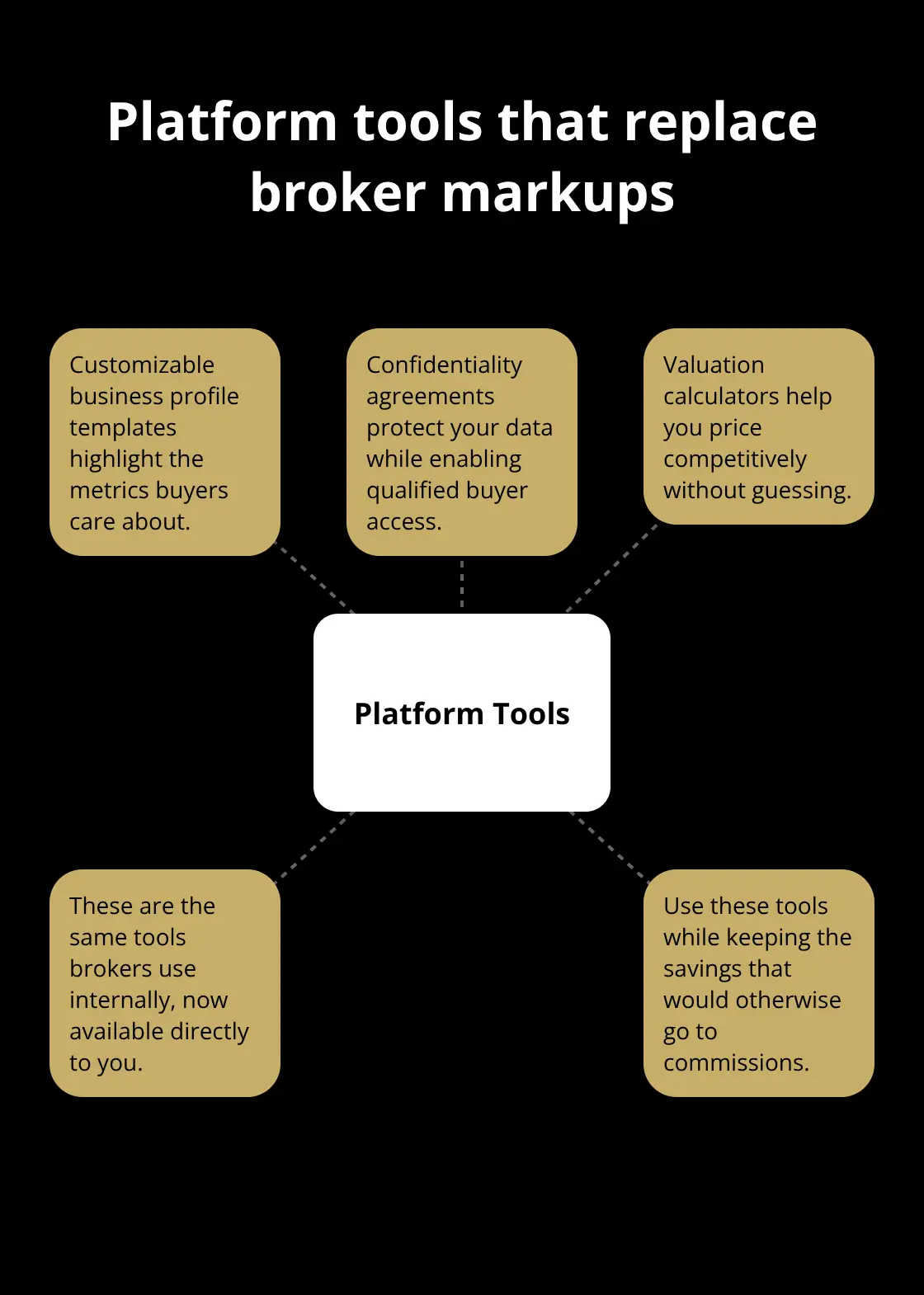
Professional tools available on these platforms include customizable business profile templates that highlight financial metrics buyers actually care about, confidentiality agreements that protect your data while allowing qualified buyers access, and valuation calculators that help you price competitively without guessing. These aren’t stripped-down versions of broker services; they’re the same tools brokers use internally, now available directly to you. Your advantage comes from using these tools while keeping the savings that would otherwise go to broker commissions, essentially paying a single 6% success fee, charged only when your business sells, instead of the layered commissions traditional brokers charge for the same business sale support and buyer access.
Final Thoughts
Selling your business through a transparent, success-fee platform fundamentally changes what happens with your sale proceeds. Traditional brokers have controlled this market for decades by charging percentages that grow with your sale price, creating misaligned incentives where they profit from speed rather than maximizing your outcome. Transparent pricing reduces that conflict, and you know exactly what you’ll pay at closing-a single 6% success fee-allowing you to calculate your actual net proceeds before committing to anything.
Modern platforms deliver access to AI-driven buyer networks that work around the clock, professional marketing materials that highlight what buyers actually care about, and legal templates that protect your interests without requiring expensive attorney involvement at every step. These tools were previously available only through brokers who charged massive commissions to access them. Now they’re available directly to you through Unbroker’s Full Service for a single 6% success fee, paid only when your business sells-a fraction of what traditional brokers extract from your sale.
The right choice depends on your situation and comfort level. If you understand your business valuation, have time to manage marketing, and want expert guidance on negotiation and legal terms, a monthly subscription model gives you flexibility and control. If you prefer hands-off selling with professional handling of buyer outreach, marketing, and deal management, full-service options deliver that support at transparent costs. We at Unbroker built our platform on this principle, offering transparent pricing and AI-enhanced buyer networks that let you choose between Full Service Business Sale or Assisted Business Sale options, both with no hidden fees and confidentiality protections.