The business sale market is shifting. Platforms are emerging as serious competitors to traditional brokers, offering lower costs and faster transactions for sellers tired of paying hefty commissions.
But broker replacement isn’t happening overnight. We at Unbroker see a more nuanced reality: platforms and brokers are carving out different roles based on deal complexity, seller needs, and transaction size.
Why Traditional Brokers Have Dominated Business Sales
For decades, traditional brokers controlled the business sales market because they held the information sellers desperately needed. Before online marketplaces existed, brokers acted as gatekeepers. They maintained private buyer networks, understood valuation methods, and knew how to navigate legal complexities. Sellers had little choice but to work with them.
The Commission Trap
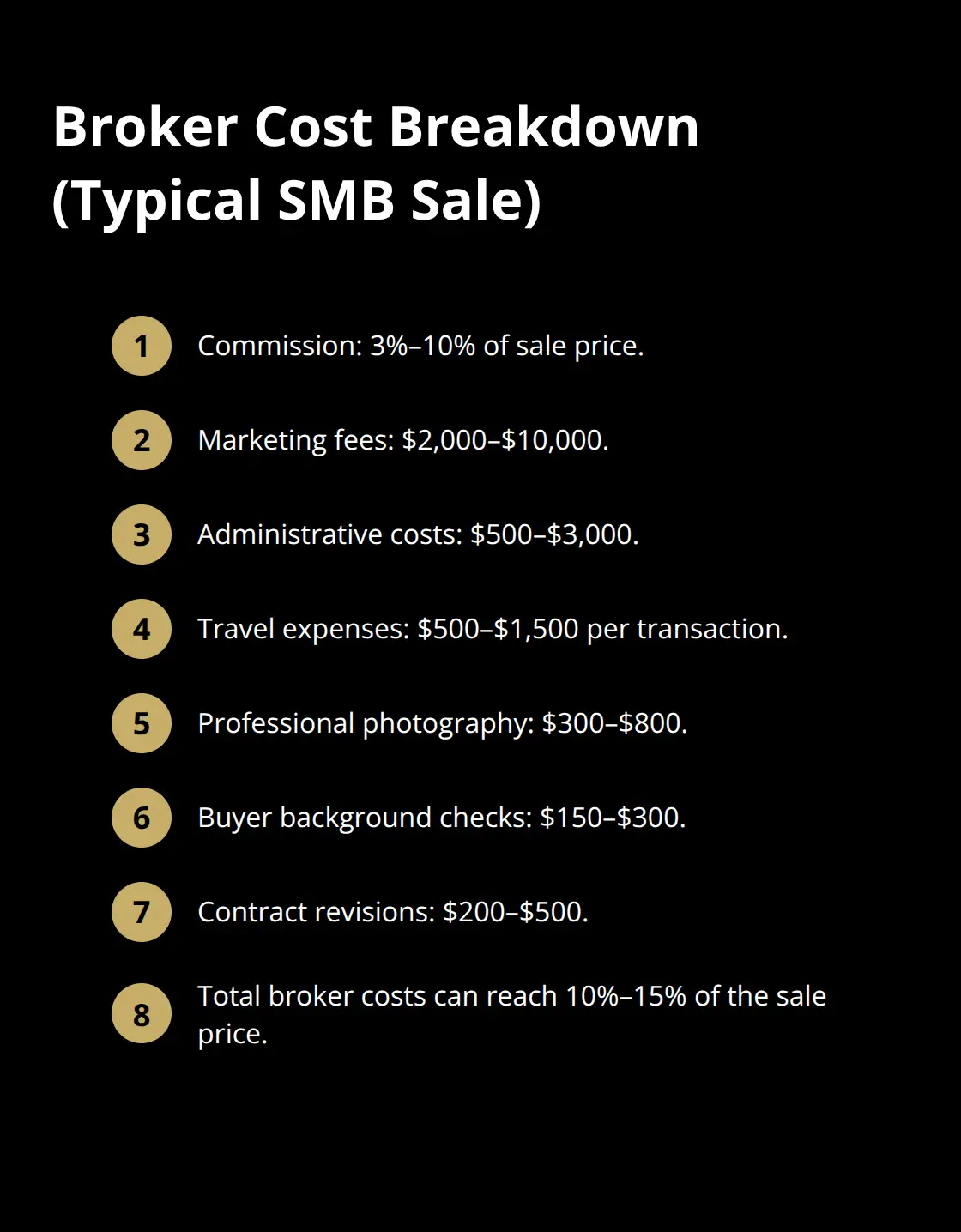
Brokers typically quote commissions between 3% to 10%, though smaller deals often reach higher percentages. On a $1 million sale, this means significant commissions disappear. Marketing fees of $2,000 to $10,000 and administrative costs of $500 to $3,000 add further strain. Total broker expenses can easily consume 10 to 15 percent of your sale price.
Hidden costs compound the damage. Travel expenses ($500 to $1,500 per transaction), professional photography ($300 to $800), buyer background checks ($150 to $300), and contract revisions ($200 to $500) frequently catch sellers off guard at closing. Brokers justified these expenses by claiming they handled everything, reducing seller burden and providing confidentiality through strict non-disclosure agreements.
They positioned themselves as essential negotiators who maximized price and protected sensitive business information.
How the Fee Structure Shaped Market Dynamics
The percentage-based commission model created misaligned incentives. On a $500,000 business, a 10 percent commission generates $50,000 in broker revenue. On a $5 million business, that same 10 percent becomes $500,000. This structure incentivized brokers to focus on higher-value deals while smaller businesses received minimal attention or inflated fee percentages.
Sellers also faced information asymmetry. Brokers controlled who knew about your business, when they knew, and how much information they received. This power dynamic meant brokers could stretch timelines (typically 12 to 18 months) without consequence. A 6-month sale and an 18-month sale both paid the same percentage commission, so brokers had no incentive to accelerate the process. Sellers often felt trapped: exit quickly and lose potential buyers, or wait months while paying carrying costs and managing the stress of a prolonged sale.
The Shift Begins
This broker-dominated model worked because sellers had no alternatives. Information remained scarce, buyer networks stayed private, and the sales process required specialized knowledge that only brokers possessed. Today, that foundation is cracking. Technology now provides sellers with tools that brokers once monopolized-valuation data, buyer access, and transaction management. The question is no longer whether platforms can compete, but which sellers will recognize that their needs have changed.
How Platforms Break the Broker Cost Stranglehold
The math is brutal. On a $1 million sale, traditional brokers extract $80,000 to $120,000 in commissions alone, then layer on $2,000 to $10,000 in marketing fees and $500 to $3,000 in administrative costs. Hidden expenses for photography, background checks, and contract revisions add further strain. Total broker costs consume 10 to 15 percent of your sale price.
Platforms operate on fundamentally different economics. We at Unbroker charge a 6% success fee, paid only when your business actually sells. On a $1 million transaction, that’s $60,000 versus the $100,000 a traditional broker charging 10% would take-keeping $40,000 more in your pocket. For a $1.5 million business, that gap widens to roughly $60,000 in savings.
This structural advantage makes platforms mathematically superior for mid-market sellers.
Transparent Pricing Changes Everything
Assisted options like Unbroker’s lower-cost membership tier cost even less for sellers comfortable managing more of the process themselves. Transparent pricing matters psychologically too. Sellers know exactly what they’ll pay before closing. No surprise invoices appear at closing. No unexpected charges for document revisions or buyer background checks. This clarity lets you plan finances accurately and understand your true net proceeds before signing anything.
Where Buyers Actually Come From
Platforms connect sellers to millions of potential buyers through distributed networks that brokers simply cannot replicate. Listings appear on BizBuySell, The Wall Street Journal, LoopNet, AllBusiness.com, and BizQuest simultaneously, reaching buyers across industries and geographies. Traditional brokers operate within their own networks, which typically means dozens or perhaps hundreds of pre-qualified prospects. A small buyer pool suppresses sale price because limited competition reduces bidding pressure.
Speed Through Technology and Automation
AI-driven buyer matching accelerates the process significantly. Instead of brokers manually screening tire-kickers over weeks, algorithms identify serious purchasers within days. Cloud-based accounting data lets buyers review financials immediately, eliminating the back-and-forth delays that stretch traditional sales to 12 to 18 months. Real-time access to buyer activity, marketing performance, and deal progress through digital platforms keeps momentum intact without constant broker involvement.
Maintaining Deal Velocity
Two-business-day response guarantees from transaction coordinators replace the slow email chains that plague traditional sales. Digital deal rooms provide 24/7 access to due diligence documents, contracts, and financial records, maintaining velocity throughout the process. Sellers no longer depend on broker availability or broker priorities. The platform works around the clock, and buyers access information whenever they need it. This shift from broker-controlled timelines to seller-controlled momentum represents a fundamental change in how business sales operate. The next section examines where traditional brokers still hold advantages despite these platform innovations.
When Brokers Still Win
Platforms excel at democratizing mid-market sales, but they hit real limits with complex transactions and enormous deal values. When a business sale involves multiple legal entities, earn-outs spanning years, or intricate tax structuring, the broker’s deep expertise becomes genuinely valuable. A $50 million acquisition with cross-border components, contingent payments, and regulatory compliance demands specialized knowledge that no platform automates effectively. Brokers who focus on these high-complexity deals maintain relationships with M&A attorneys, tax specialists, and industry insiders who understand how to structure transactions that protect both parties. For sellers navigating deals above $10 million, traditional brokers often justify their fees through structural advice alone. The International Business Brokers Association reports that experienced brokers reduce deal friction by negotiating terms that lower buyer risk, which directly impacts purchase price and earnout certainty. Platforms cannot replicate this level of customization because each large deal requires bespoke legal and financial architecture.
The Trust Premium
Relationship-based selling still drives outcomes in industries where personal reputation matters intensely.
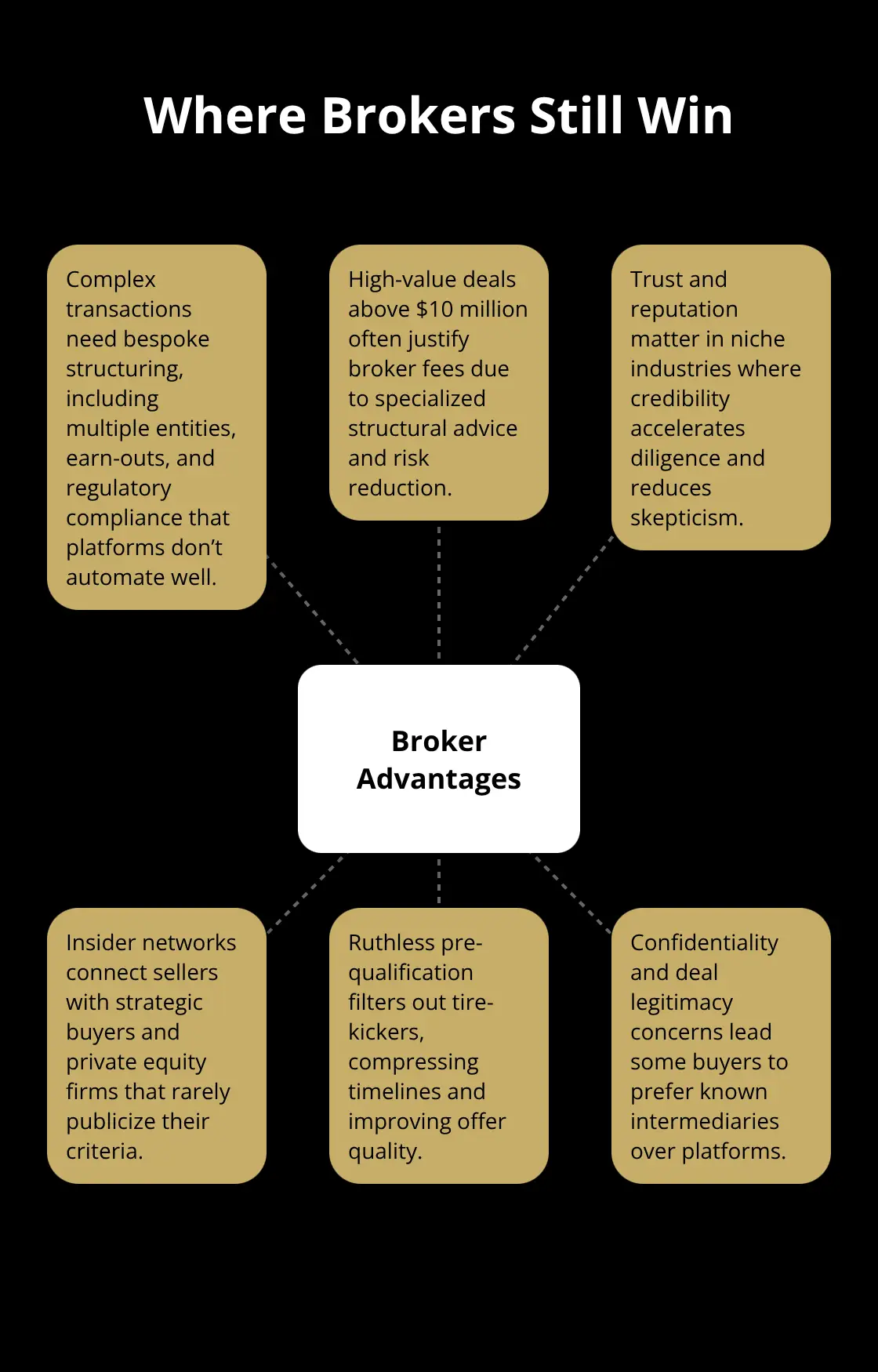
A broker who has closed dozens of transactions in a specific sector carries credibility that algorithms cannot match. Buyers in niche markets-manufacturing, franchises, professional services-often prefer working with established brokers they know rather than faceless platforms. This preference reflects legitimate concerns about confidentiality, deal legitimacy, and post-sale disputes. A broker with 20 years in the restaurant franchise space understands seasonal cash flow patterns, real estate lease complications, and supply chain vulnerabilities that affect valuation. They position deals to minimize buyer skepticism and accelerate due diligence. Platforms reach more buyers but often attract tire-kickers and unqualified prospects who clog the sales pipeline. Brokers pre-qualify ruthlessly, meaning serious buyers enter the process with genuine purchase intent. This selectivity compresses timelines and raises offer quality.
Industry Networks and Insider Access
Specialized brokers maintain networks of strategic buyers, private equity firms, and industry consolidators who never list their acquisition criteria publicly. These relationships exist because brokers have earned trust through repeated successful transactions. A consolidator seeking to acquire 15 regional businesses in a sector will contact their preferred broker directly rather than browsing a platform. This insider access means brokers can match sellers with buyers actively seeking their exact business profile, sometimes before the business reaches the open market. Platforms democratize access but sacrifice exclusivity and buyer targeting precision. For sellers in specialized industries where consolidation activity runs high, working with a broker embedded in that ecosystem often produces better outcomes than platform exposure. The trade-off between broad reach and targeted access favors brokers when buyers are concentrated and known.
Final Thoughts
The broker replacement narrative oversimplifies a market that’s actually fragmenting into distinct segments. Platforms excel for mid-market businesses under $10 million, where transparent pricing eliminates the fee shock that plagues traditional sales-a $1 million business costs roughly $5,000 through a platform versus $100,000+ with a broker. Sellers also gain real-time visibility into buyer activity and deal progress, while AI-driven buyer matching accelerates timelines from 12-18 months to weeks by filtering serious prospects from tire-kickers immediately. Large, complex deals remain broker territory because a $50 million acquisition with earn-outs, multiple entities, and regulatory complications requires specialized expertise that platforms cannot automate.
Brokers embedded in niche industries maintain buyer networks that platforms simply cannot replicate, and these relationships exist because brokers have earned trust through repeated transactions in specific sectors. A business owner with a straightforward operation and clear financials benefits from platform efficiency and cost savings, while an owner navigating complex structuring or selling in a consolidation-heavy industry still gains value from broker expertise and insider access. The practical reality is that sellers now have genuine choice based on deal complexity, timeline, and industry dynamics.
We at Unbroker believe sellers deserve both options, and our Full Service option, which charges a 6% success fee paid only when your business sells, provides professional guidance without broker markups for those wanting hands-off support. Our Assisted option offers legal templates and negotiation assistance for DIY sellers who want to keep more control. The future isn’t about broker replacement-it’s about matching the right tool to your situation.