Selling a business fast requires more than hope-it demands strategy. At Unbroker, we’ve seen owners leave money on the table or wait months longer than necessary because they skipped critical preparation steps.
The difference between a quick exit and a stalled sale comes down to three things: realistic pricing, organized financials, and reaching the right buyers. This guide shows you exactly how to execute each one.
Price Your Business Competitively From Day One
Most business owners overprice their exit by 30-50% on the first listing. This single mistake kills deals before they start. Sellers typically target 6-7x net profit while buyers expect to pay 2-3x. That gap isn’t a negotiation waiting to happen-it’s a signal that your asking price is out of touch with market reality. Getting the price right from day one separates owners who sell in months from those who wait years or walk away empty-handed.
Research what similar businesses actually sold for
Don’t guess at valuation. Find actual transaction data from your industry in the last 12-24 months. If you sell software-as-a-service, look at SaaS exits. If you run an e-commerce store, track retail tech acquisitions. Industry databases, M&A reports, and business brokers publish real sale prices tied to revenue multiples. These aren’t theoretical ranges-they’re what buyers paid last quarter. Talk to brokers who handle deals in your space. Many will share anonymized comparable sales if you ask directly. This data becomes your anchor. When you walk into a conversation with a buyer backed by three recent similar sales at 3.5x EBITDA, the conversation shifts from opinion to evidence. Without this research, you price based on emotion or what you think your business is worth, not what the market actually pays.
Factor in your actual financial health, not potential
Buyers pay for what exists today, not what might happen next year. They examine your last three years of tax returns and financial statements-not projections. A business with $500,000 in consistent annual profit sells faster than one with $300,000 in profit plus promises of 50% growth. Stable, documented revenue commands 4-5x profit. Speculative growth barely moves the needle. Calculate your EBITDA accurately: take net profit, add back owner salary (if inflated), depreciation, and non-recurring expenses. This is the number buyers use. Many owners pad their financials with one-time gains, owner perks, or family member salaries. Buyers see through this immediately and adjust downward, reducing your price. Start with clean, three-year average financials. If your profit fluctuates wildly, expect a lower multiple. If your revenue depends on one customer or one contract, that reduces value significantly-sometimes by 20-30%. These factors matter more than your growth hopes.
Avoid the overpricing trap that stalls everything
Setting a high price hoping to negotiate down sounds logical. It doesn’t work. Overpriced listings sit. Serious buyers ignore them.
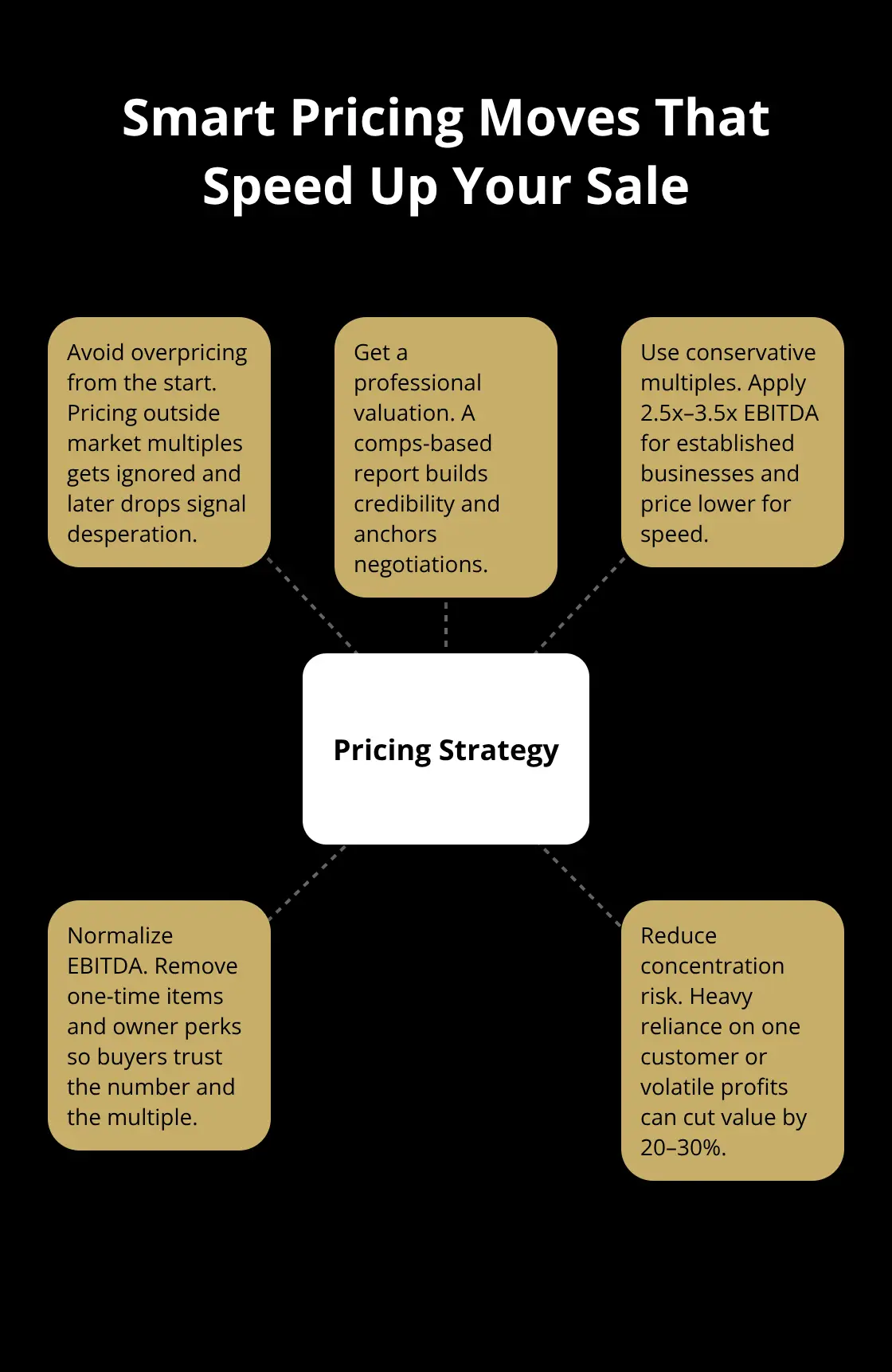
You’ll eventually lower the price anyway, but now you’ve wasted three months and signaled desperation. Poor pricing can reduce your sale price by 10-20% or prevent a sale entirely. The damage compounds. Buyers who see your price drop assume something is wrong with the business. Momentum dies. Professional valuations cost $8,000 to $50,000+ but prevent this disaster. An appraiser delivers a detailed report grounded in comparable sales, not feelings. This report gives you credibility with buyers and anchors negotiations. If you can’t afford a professional valuation, use industry-standard multiples conservatively. Apply 2.5x to 3.5x EBITDA for most established businesses-not 6x or 7x. Price at the lower end of your range if you want speed. You’ll close faster, and buyer satisfaction increases the odds they’ll refer others or close without complications.
Organize your financials before buyers ask
Clean financial records separate fast sales from stalled ones. Buyers request three to four years of tax returns, bank statements, and profit-and-loss statements within the first conversation. If you scramble to find receipts or reconstruct numbers, you signal disorganization. That hesitation costs you. Prepare these documents now, before you list. Have your accountant review them for accuracy and consistency. If you’ve mixed personal and business expenses, separate them. If you’ve claimed inflated deductions, document what’s legitimate. Buyers will verify everything anyway-transparency speeds the process. This preparation also reveals whether your business qualifies for the price you’re asking. If your records show lower profit than you thought, you adjust your asking price now, not after a buyer walks away mid-due diligence.
With realistic pricing anchored in market data and clean financials ready to share, you move to the next critical step: preparing your entire business for the scrutiny that serious buyers bring.
Prepare Your Business for Buyer Due Diligence
Buyers don’t take your word for anything. They verify every claim, examine every contract, and scrutinize every financial detail. Over half of all deals die during due diligence because sellers haven’t prepared. You can’t afford to be one of them. The goal is simple: make the buyer’s investigation frictionless. When a buyer requests documents, you deliver them organized and within 24 hours, not scattered across three email threads a week later. This speed signals confidence and keeps momentum alive. Start now by treating your business like it’s already under a microscope.
Get your financial records audit-ready today
Your accountant should review your tax returns and reconstruct your financials into a clean, normalized format that buyers actually understand. This means separating owner compensation from business profit, removing one-time expenses, and documenting every adjustment. Financial records audit-ready typically includes clean financial statements, normalized EBITDA, tax records, debt schedules, and KPI reporting. Buyers will ask for bank statements, credit card statements, and customer invoices to verify your reported numbers. If your books show $500,000 in annual profit but your bank deposits average $350,000, that discrepancy kills credibility instantly.
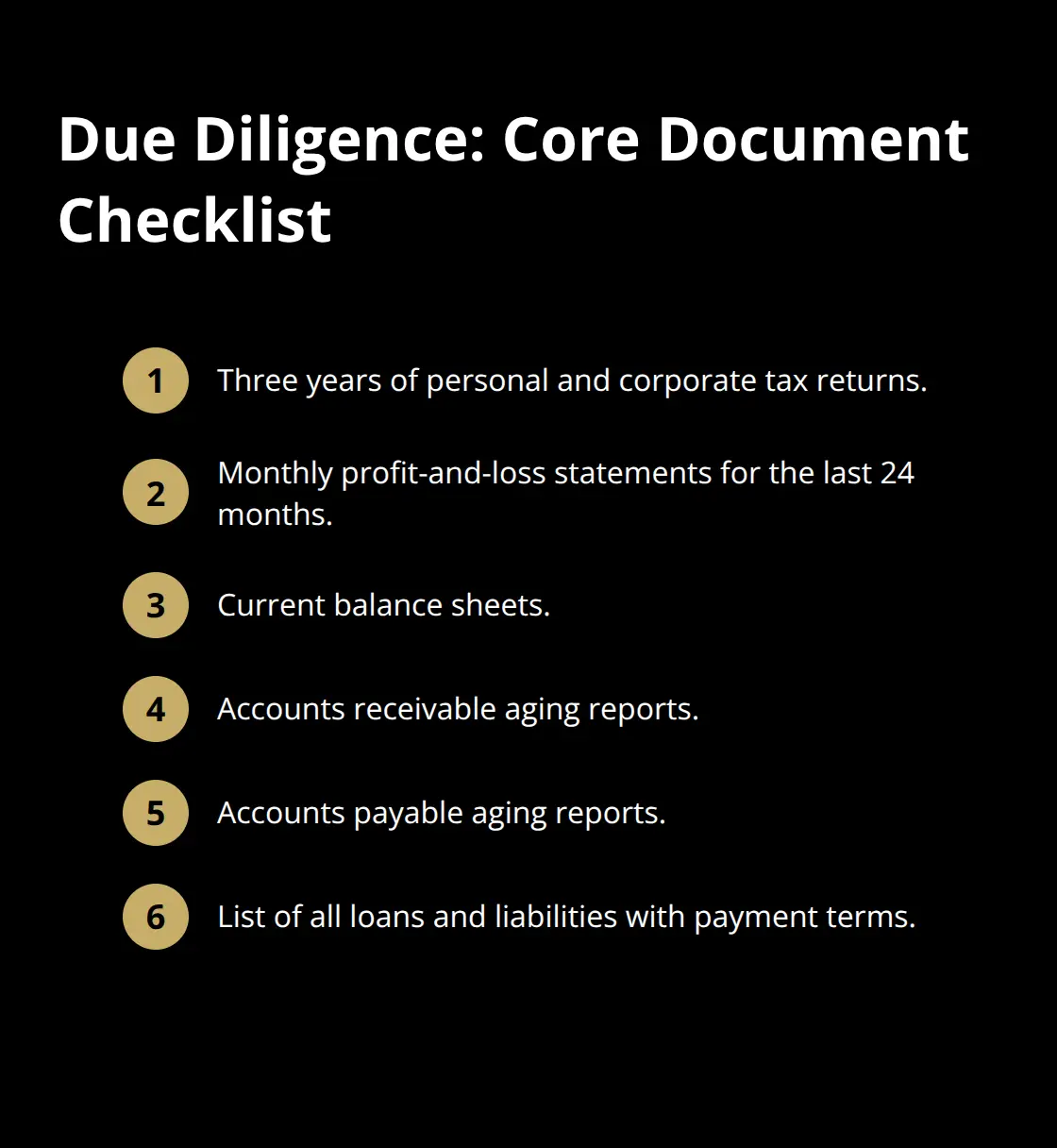
Create a document checklist now: three years of personal and corporate tax returns, monthly profit-and-loss statements for the last 24 months, balance sheets, accounts receivable aging reports, accounts payable aging reports, and a list of all outstanding loans or liabilities with payment terms. Store everything in one organized folder, either digital or physical.
When a serious buyer appears, you hand them a complete package immediately. Delays here extend the timeline by weeks. Buyers interpret slow document delivery as a red flag that something is hidden.
Document exactly how your business operates without you
Buyers purchase a business, not a job. If your business depends entirely on your presence, your reputation, or your customer relationships, the buyer assumes revenue will drop after you leave. That fear reduces their offer significantly or kills the deal. Write down every critical process: how you acquire customers, how you fulfill orders, how you handle customer service, how you manage finances, how you hire and train staff. Use simple language, not complex jargon. Include decision-making authority for each process. If you’re the only person who approves refunds, that’s a bottleneck the new owner needs to fix immediately.
Standard operating procedures should cover your top 10 revenue-generating or cost-controlling activities. Include templates, checklists, and access credentials where relevant. If you use software tools, document login information and workflows. Buyers want proof that your business runs on systems, not on you. This documentation also reveals whether your business is truly ready to sell. If you can’t document a process because it only exists in your head, you have a serious problem that will tank your valuation. The businesses that sell fastest are the ones where the owner could disappear for a month and operations would continue smoothly.
Resolve legal and contractual issues before they become deal-killers
Buyers conduct legal due diligence. They review your articles of incorporation, all contracts with customers and suppliers, lease agreements, employment agreements, and any pending litigation. Unresolved issues don’t just slow down the sale-they reduce your price or kill the deal entirely. Review your contracts now. Do you have non-compete agreements with key employees? Are customer contracts assignable to a new owner, or do they terminate if ownership changes? What happens to your lease if you sell? Some landlords require buyer approval or charge transfer fees. Clarify this with your landlord now, not during due diligence.
If you have pending lawsuits, settle them or get a legal opinion on the likely outcome and cost. Buyers will assume worst-case scenarios if issues remain unresolved. If you have intellectual property, document ownership clearly. If you’ve licensed technology from third parties, confirm the license transfers to a new owner. If you have patents or trademarks, ensure they’re properly registered. Any ambiguity here reduces buyer confidence and price. Hire a business attorney for two to three hours to review your core contracts and identify issues. This investment costs $500 to $1,500 but prevents surprises that could cost you $50,000 or more in reduced price or failed negotiations. Clean contracts signal a professionally run business. Messy legal situations signal risk that buyers avoid.
With your financials organized, operations documented, and legal issues resolved, you’ve eliminated the friction that kills deals. Now you need to reach the right buyers-the ones who will actually close.
Market Your Business to the Right Buyers
Most business owners list their business in one place and wait. That approach guarantees a slow sale. The businesses that sell fastest reach qualified buyers through three distinct channels at once: direct outreach to targeted buyers who fit your profile, confidential marketing through industry publications and trade networks, and broad sale portals where serious buyers actively search. Spreading your listing across all three channels increases exposure while maintaining confidentiality.
Contact potential buyers directly with a targeted pitch
Direct outreach works best for niche businesses. If you sell specialized software to dental practices, contact five to ten dental software companies and private equity firms that focus on healthcare tech. Email them directly with a confidential summary, not a full pitch. Keep it to three paragraphs: what your business does, annual revenue and profit, and why you’re open to a sale. Most buyer inquiries arrive via email, so respond within 24 hours with a non-disclosure agreement. Serious buyers sign it immediately. Those who hesitate aren’t worth your time.
Industry publications reach warm prospects effectively. Trade journals, newsletters, and association publications let you place confidential listings without broadcasting your sale across the internet. A dental software publication reaches practice management companies and consolidators actively acquiring in that space. These buyers already understand your market and move faster than cold prospects.
Post on multiple sale portals simultaneously
Broad portals like BizBuySell and WebsiteClosers cast the widest net. While these attract more tire-kickers, they also surface unexpected buyers with real capital. Post on at least two major portals simultaneously. Your listing should emphasize what makes your business different, not generic descriptions of what you do.
Highlight specific revenue streams and competitive advantages
Vague language like “growth potential” or “loyal customers” fails to separate your listing from dozens of others. Instead, state facts: 65% of revenue comes from recurring monthly subscriptions with 92% annual retention, or your top ten customers represent 40% of revenue but no single customer exceeds 8% of total sales. These specifics tell a buyer the business is stable and not dependent on one account.

If you’ve built proprietary technology, document it clearly. If you hold valuable contracts or long-term customer agreements, mention the contract terms and renewal dates. If your business operates in a growing market segment, cite the market growth rate from a credible source. Buyers want proof your revenue isn’t dependent on your personal hustle. The fastest sales happen when a buyer sees documented, repeatable revenue with systems in place to maintain it.
Include your customer acquisition cost and lifetime value if those numbers are strong. If you’ve achieved 40% gross margins while competitors average 25%, that’s a competitive advantage worth highlighting. Buyers respond to concrete evidence, not promises.
Activate your professional network for warm introductions
Email former business partners, suppliers, and industry contacts directly. Many acquisitions happen through warm introductions, not cold listings. If you know a competitor who’s been acquiring smaller businesses, reach out to them. If you have investors or advisors, ask them to introduce you to potential buyers. Personal introductions move faster than portal listings because they come with credibility.
Consider hiring a business broker if speed matters more than saving the commission. Brokers maintain buyer databases and make calls constantly. For businesses under $1 million, brokers typically charge 10% commission. A broker who closes your deal three months faster has paid for themselves through faster cash access and reduced carrying costs. The choice depends on whether your time is worth more than the commission.
Final Thoughts
Selling a business fast requires three deliberate actions executed in sequence: price competitively from day one, prepare your financials and operations for scrutiny, and reach qualified buyers through multiple channels simultaneously. Skip any one of these steps and your timeline extends by months. Execute all three and you create momentum that closes deals. Owners who research comparable sales and price within market reality receive offers faster, businesses with organized financial records and documented operations pass due diligence without friction, and direct outreach combined with portal listings surfaces serious buyers who move quickly.
Professional support accelerates this timeline significantly. A business broker with an active buyer network can close deals months faster than solo efforts, an accountant who normalizes your financials prevents the credibility gaps that kill momentum, and a business attorney who reviews your contracts identifies deal-killers before they emerge during due diligence. These professionals cost money upfront but save far more through faster closing and higher final price. At Unbroker, we’ve built a platform specifically to eliminate the friction that slows business sales and help you sell a business fast without the traditional broker markup.
The time to start is now. Price your business competitively, organize your documents, document your operations, and activate your buyer channels. Every week you delay extends your exit timeline and costs you money in carrying costs and opportunity cost.