Selling your business is one of the biggest financial decisions you’ll make. Most owners underestimate how much planning it takes to maximize value and avoid costly mistakes.
Exit planning for owners isn’t something you handle in the final months before a sale. At Unbroker, we’ve seen firsthand how early preparation separates owners who walk away satisfied from those who leave money on the table.
This guide walks you through the concrete steps to build a transition plan that works.
Why Exit Planning Matters
The difference between a successful exit and a regrettable one often comes down to timing and preparation. According to the Exit Planning Institute, 73% of privately held U.S. companies plan to transition ownership within the next decade, representing a $14 trillion opportunity. Yet most owners wait too long to start planning.

Data from ideas42 shows that 63% of business owners say exit planning is too early and 45% claim they’re too busy-the exact mindset that leaves money on the table. Owners who begin planning at least 3 to 5 years before their intended exit maximize value significantly. Those who rush face buyer skepticism, lower valuations, and operational disruptions that tank final prices.
Your Business Value Depends on Readiness
Buyers don’t just evaluate financials; they assess how well your business runs without you. A comprehensive business valuation forms your first concrete step. Only 60% of owners had their business formally valued within the last two years, according to the Exit Planning Institute, yet this number jumped from just 18% in 2013. That trend matters because formal valuation identifies which specific elements drive your company’s worth-recurring revenue streams, customer diversity, scalable processes, and clean financial controls. When you know your real value, you negotiate from strength. Profitability matters here: the Exit Planning Institute found that 54% of owners say profitability is key to a successful exit. Employers planning to sell or transfer their business report median profits of $100,000, while those planning to shut down report median profits around $20,000. The gap is stark. Your operational weaknesses (outdated systems, key-person dependencies, poor documentation, customer concentration) become negotiating leverage against you. Buyers will discover these issues and discount your asking price accordingly. Address them now, not during due diligence when you have no leverage.
Mistakes That Cost Real Money
Common exit mistakes follow predictable patterns. Owners often fail to organize financial records properly, making due diligence painful and raising red flags for serious buyers. Others neglect to build a management team independent of themselves, which signals to buyers that the business depends entirely on the owner-a massive valuation killer.
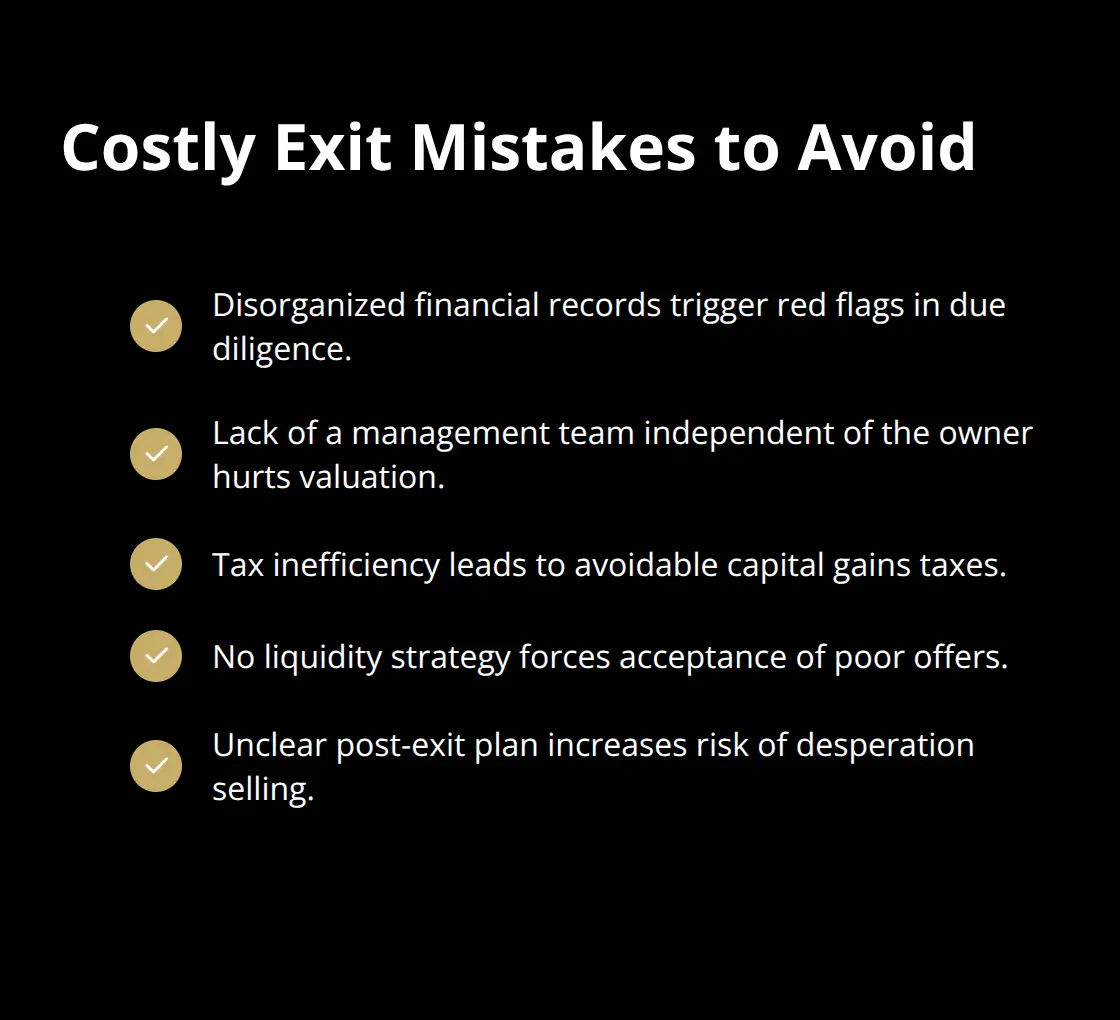
Tax inefficiency costs more owners than any other mistake. Without early guidance from a tax advisor, you’ll overpay capital gains taxes and miss legitimate structuring opportunities. Additionally, 70% of business owners rely on income from their business to maintain their lifestyle after exit, yet many don’t build a clear liquidity strategy beforehand. This means they accept the first offer without calculating whether it actually funds their retirement or post-exit plans. One-third of surveyed owners either don’t have a long-term plan or are unsure about what happens after they leave, according to Gallup. That uncertainty leads to desperation selling and suboptimal outcomes.
What Separates Prepared Owners from the Rest
The owners who succeed share one trait: they treat exit planning as a strategic business decision, not a last-minute scramble. They work with tax advisors, attorneys, and valuation experts early (not weeks before closing). They document their processes, build leadership depth, and strengthen their financial controls. They calculate their actual cash needs post-exit and structure deals accordingly. These steps take time, but they compound into significantly higher sale prices and smoother transitions. The owners who skip this work often regret it. Now that you understand why preparation matters, the next step is building your actual exit strategy-assessing your market value, identifying the right timing, and choosing the sales channel that fits your goals.
Building Your Exit Strategy
Get a Professional Valuation First
A formal valuation forms the foundation for every decision that follows. You need a professional assessment of what your business is worth before you can negotiate effectively or even decide if selling makes sense right now. A valuation specialist examines your revenue streams, profit margins, customer concentration, growth trajectory, and operational dependencies to arrive at a defensible number. This isn’t theoretical-it’s concrete data that shapes your entire exit approach.
The Exit Planning Institute reports that 60% of owners had their business formally valued within the last two years. This shift shows more owners recognize that valuation matters. When you know your actual value, you avoid anchoring to an inflated number or accepting an offer that undershoots your business’s real worth. Valuation also reveals which specific drivers create value in your business. If recurring revenue represents 70% of your income, that’s a major selling point. If your business depends entirely on you, that’s a liability buyers will price into their offer as a discount.
Understanding these dynamics lets you either address weaknesses before sale or adjust your exit timeline accordingly. You gain clarity on what actually moves the needle for potential buyers.
Assess Market Conditions and Your Readiness
Timing your exit requires honest assessment of both market conditions and your personal readiness. The Exit Planning Institute found that 45% of owners consider themselves best-in-class or better regarding readiness to transition to a potential buyer, but this self-assessment often overstates actual preparedness. Market conditions shift constantly-recessions depress valuations, interest rate hikes make financing harder for buyers, and industry disruption can accelerate or delay your window.
You cannot control markets, but you can control your business’s operational strength going into them. If your financials are clean, your processes are documented, your management team functions without you, and your customer base is diversified, you have leverage in any market. Owners with weak operations face buyer skepticism regardless of market conditions. Your operational readiness matters more than timing the perfect market moment.
Choose Your Sales Channel Based on Your Goals
Your sales channel choice should align with your goals, not just speed. The Exit Planning Institute data shows that 70% of business owners prefer internal transfers, 17% prefer external sales to outside buyers, and 13% remain undecided. This preference for internal transfers reflects the reality that family succession and employee buyouts preserve company culture and owner legacy-values that matter more to many owners than maximizing sale price.
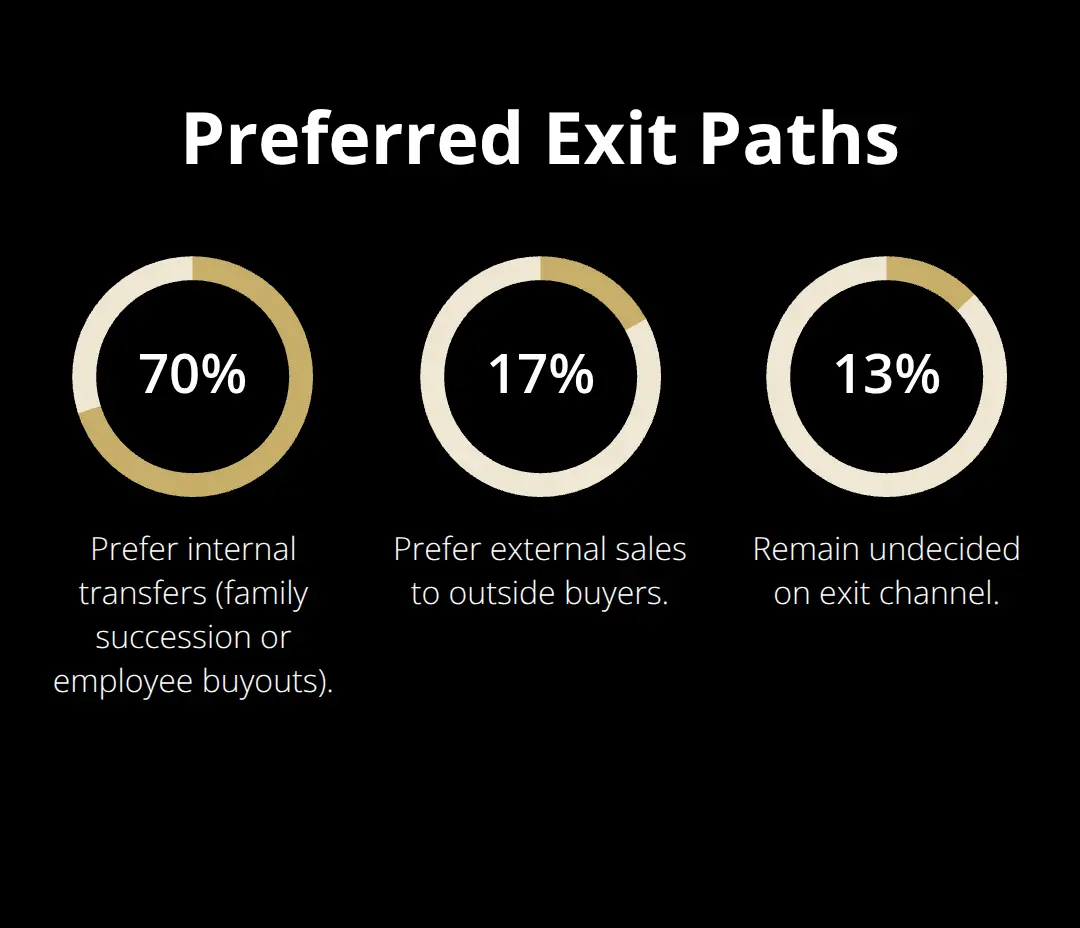
External sales to strategic buyers or financial investors typically generate higher valuations but involve loss of control and potential cultural shifts. A management buyout keeps your team in place but depends on their ability to secure financing and their willingness to take on ownership risk. Each path carries real trade-offs. Your decision should align with what matters most after you exit-whether that’s financial maximization, legacy preservation, or employee welfare.
Build Your Advisory Team Now
Whatever path you choose, start conversations with advisors now rather than waiting until you’re ready to sell. The top-advised professionals for exit planning according to the Exit Planning Institute are financial advisors first, followed by attorneys, accountants, your spouse, and bankers. These professionals identify value drivers you might miss, structure deals for tax efficiency, and navigate legal complexities that kill unprepared deals.
Your next step is preparing your business for sale-organizing the financial records and documentation that buyers scrutinize, addressing the operational weaknesses they notice immediately, and creating a compelling business profile that attracts serious offers.
Prepare Your Business for Sale
Buyers scrutinize three areas immediately: your financial records, your operational dependencies, and your competitive position. Getting these right determines whether you attract serious offers or waste months on tire-kickers who disappear during due diligence.
Organize Financial Records That Withstand Scrutiny
Clean financials matter most because they’re non-negotiable. If your books are disorganized, inconsistent, or show unexplained gaps, buyers assume you’re hiding problems. They’ll either walk away or demand a steep discount as insurance against undisclosed liabilities.
Start with an audit of your last three years of tax returns, profit-and-loss statements, balance sheets, and bank reconciliations. If your accountant prepared these documents, they carry credibility. If you’ve managed finances informally, hire a CPA now to reconstruct accurate records. This costs money upfront but prevents far costlier valuation hits later.
Document every material transaction, expense category, and revenue stream. Buyers want to understand exactly how you make money, not guess. If you’ve deducted personal expenses through the business (vehicle, meals, travel), separate those out now so buyers see true operating profitability. The Exit Planning Institute found that 54% of owners cite profitability as key to successful exits-but only if that profitability is clearly documented and defensible.
Address Operational Weaknesses Before Due Diligence
Buyers immediately notice if your business depends entirely on you, your customer base relies on a handful of accounts, your systems are outdated, or your team lacks documented processes. If you’re the only person who knows how to service your largest clients, that signals business continuity risk.
Start cross-training team members now and document standard operating procedures for critical functions. If three customers represent 60% of revenue, spend the next year diversifying your client base or at minimum securing long-term contracts with those key accounts. If your IT infrastructure is aging or your data security is weak, fix these before buyers conduct technical due diligence. These operational fixes take time, which is exactly why you need 3-5 years before your intended exit.
Position Your Business as Attractive to Buyers
Create a compelling business profile that positions your company for serious interest. This means articulating your competitive advantage clearly, highlighting your recurring revenue or subscription model if you have one, showcasing customer retention rates, and demonstrating consistent margin improvement.
Buyers respond to narrative-a story about why your business matters, why customers stick around, and why it will thrive under new ownership. If you can show that your business generates predictable, recurring revenue from a diversified customer base with documented processes and a capable management team, you’ve addressed the core concerns that depress valuations.
Final Thoughts
Exit planning for owners requires three concrete actions: start early, build the right team, and address weaknesses before buyers discover them. Owners who succeed spend 3 to 5 years strengthening their business, organizing their finances, and documenting their operations-this timeline compounds into significantly higher valuations and smoother transitions. Your first step is obtaining a professional valuation that clarifies what your business is actually worth and reveals which specific elements drive value.
Assess your operational readiness honestly by asking whether your business runs without you, your financials withstand scrutiny, and your customer base remains diversified. These factors matter more than market timing because operational strength gives you leverage in any economic environment. Decide which exit path aligns with your goals: internal transfers preserve legacy and culture, external sales to strategic buyers typically generate higher valuations, and management buyouts keep your team in place.
Build your advisory team now rather than waiting until you’re ready to sell. Financial advisors, attorneys, accountants, and tax specialists identify value drivers you’ll miss alone and structure deals for tax efficiency. Unbroker connects you with transparent, low-cost exit options when you’re ready, with no hidden fees and access to a vast buyer network.