Most small business owners have no idea what their company is actually worth. We at Unbroker see this constantly-business owners either wildly overestimate their value or underestimate it by thousands of dollars.
Getting your small business valuation right matters. Whether you’re selling, seeking investment, or planning for the future, an accurate number changes everything.
How to Calculate Your Business Valuation
The Three Methods That Matter
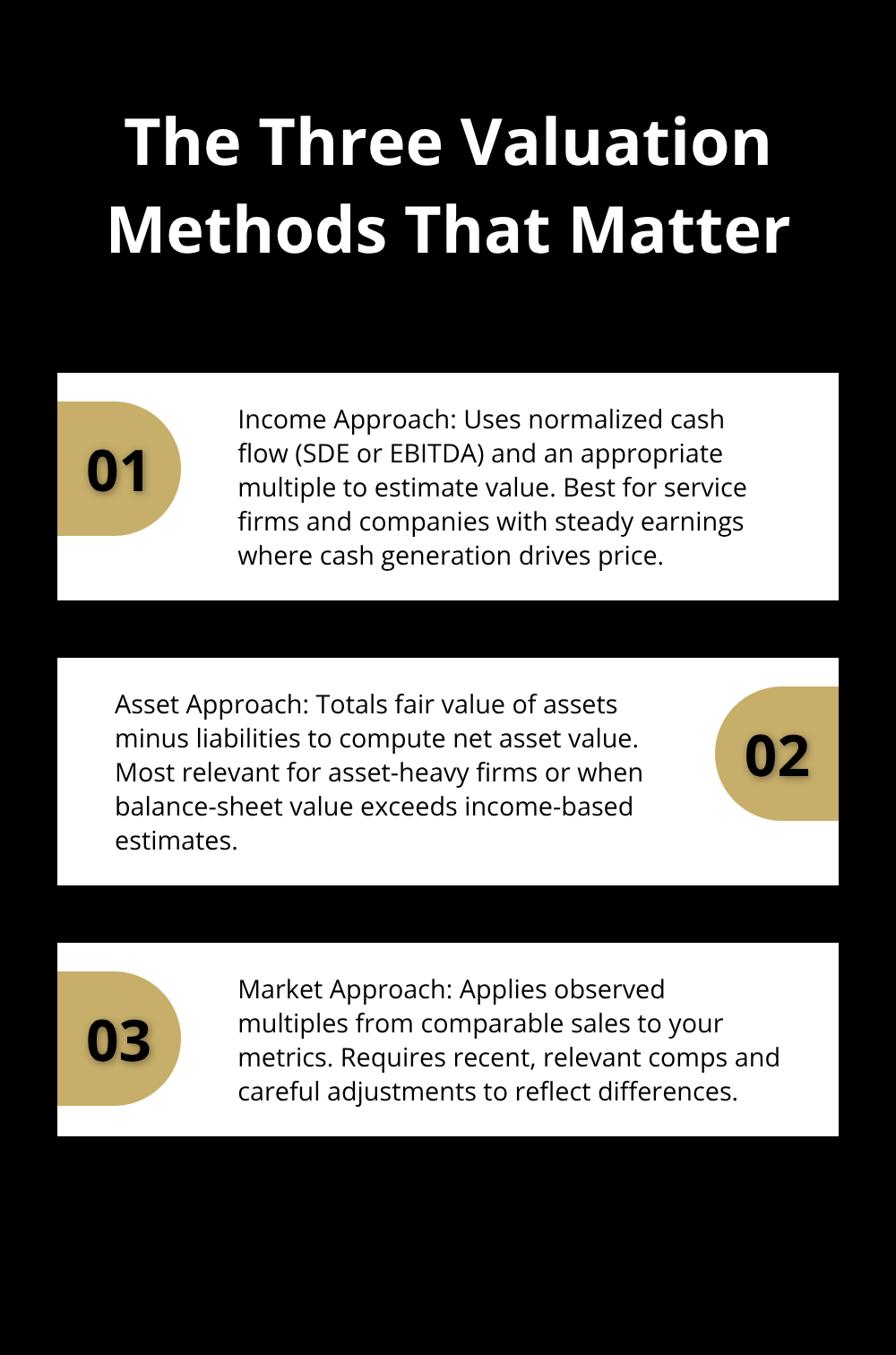
Three core methods dominate small business valuation, and your job is selecting the right one for your situation. The Income Approach uses your cash flow to calculate value, the Asset Approach totals what your business owns minus what it owes, and the Market Approach compares your business to similar companies that sold recently. Most small business owners ignore this framework and pick a number they like instead. That’s a mistake.
Income Approach: Cash Flow Tells the Real Story
The Income Approach works best for service businesses and companies with steady earnings because it captures what your business actually generates in cash. If you make $300,000 in annual Seller’s Discretionary Earnings (SDE)-that’s your net income plus owner compensation, benefits, depreciation, and personal expenses-and your industry typically sells at a 5x multiple, your business is worth roughly $1.5 million. The American Society of Appraisers and AICPA-certified valuators rely on this method because it reflects reality: buyers care about cash flow, not your feelings about the business.
Asset Approach: When Balance Sheet Value Matters
The Asset Approach works differently. You add up everything your business owns-equipment, inventory, real estate, intellectual property-then subtract all liabilities. A manufacturing company with $800,000 in equipment, $200,000 in inventory, and $300,000 in debt has a net asset value of $700,000. This method matters most when your balance sheet value exceeds what your cash flow suggests.
It’s less common for typical small businesses, but it’s essential if you’re asset-heavy.
Market Approach: Real Data Beats Guesses
The Market Approach compares your business to actual sales. If similar businesses in your industry sold for 3x revenue or 8x EBITDA, you apply those multiples to your numbers. This requires real data from recent transactions, not assumptions. The challenge: finding comparable sales is hard. Your industry might not have transparent pricing data, and no two businesses are identical.
Triangulate for a Defensible Range
When you triangulate all three methods together, you get a defensible range instead of a single inflated number. A professional valuation typically weighs each method based on your business type and data quality. If your financials are clean and your industry has good comparable data, the Market Approach carries more weight. If your earnings are volatile but your assets are solid, the Asset Approach matters more.
Most small business owners focus only on revenue multiples and ignore profitability. That’s backwards. A business generating $2 million in revenue but only $50,000 in profit is worth far less than a $1 million revenue business with $300,000 in profit. Buyers invest in earnings, not sales.
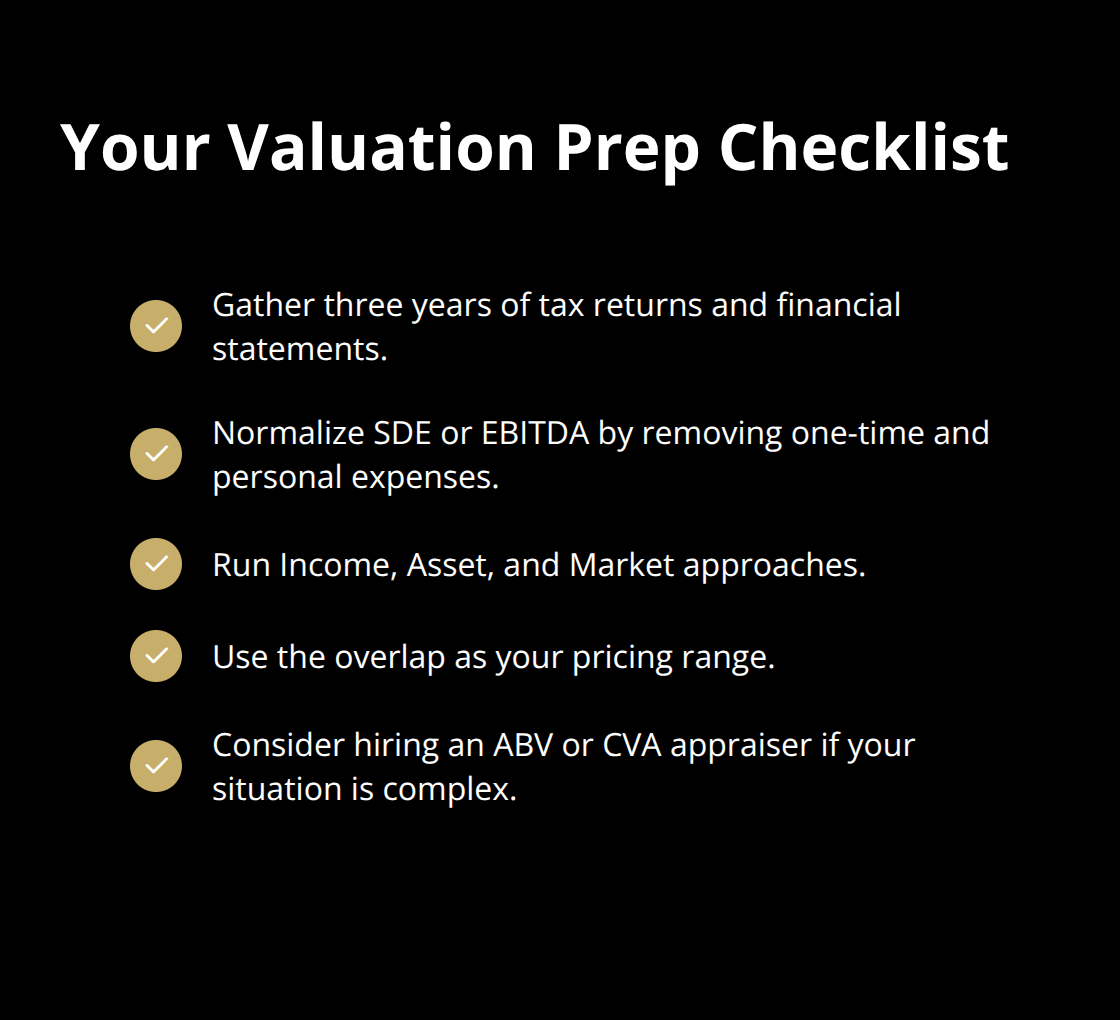
When you’re ready to price your business, you need three years of tax returns and financial statements. Calculate your normalized SDE or EBITDA by removing one-time expenses, then run all three methods. Don’t pick the highest number. Pick the middle range where at least two methods overlap. This foundation sets you up to understand what actually drives your value-and that’s where the real work begins.
What Really Drives Your Business Value
Profitability Trumps Revenue Every Time
Profitability matters infinitely more than revenue, and most small business owners get this backwards. A business generating $5 million in annual revenue but keeping only $200,000 in profit gets valued far lower than a $2 million revenue business that generates $400,000 in profit. Buyers don’t pay for sales-they pay for cash they can pocket. This is why the Income Approach works: it focuses on what’s left after all expenses.
When you calculate your SDE or EBITDA, strip out every one-time cost, personal expense, and non-recurring item. The cleaner your normalized earnings, the higher your valuation multiple. A business with consistent, predictable profits attracts multiples of 5x to 8x earnings, while volatile or declining earnings get hammered with multiples of 2x to 3x.
If your profit margins have been flat or shrinking over the past three years, you’re already worth less than you think. Conversely, if you’ve grown profits year-over-year, you’ve built real value. This is why clean financials matter so much-they let buyers trust your numbers and justify paying higher multiples.
Customer Concentration and Revenue Stability
Your competitive position and customer concentration directly impact what someone will pay. A business dependent on three major clients is riskier than one with 200 diversified customers, and buyers adjust their offer accordingly. Recurring revenue businesses-those with subscriptions or long-term contracts-sell for premiums over one-time transaction businesses because cash flow is predictable.
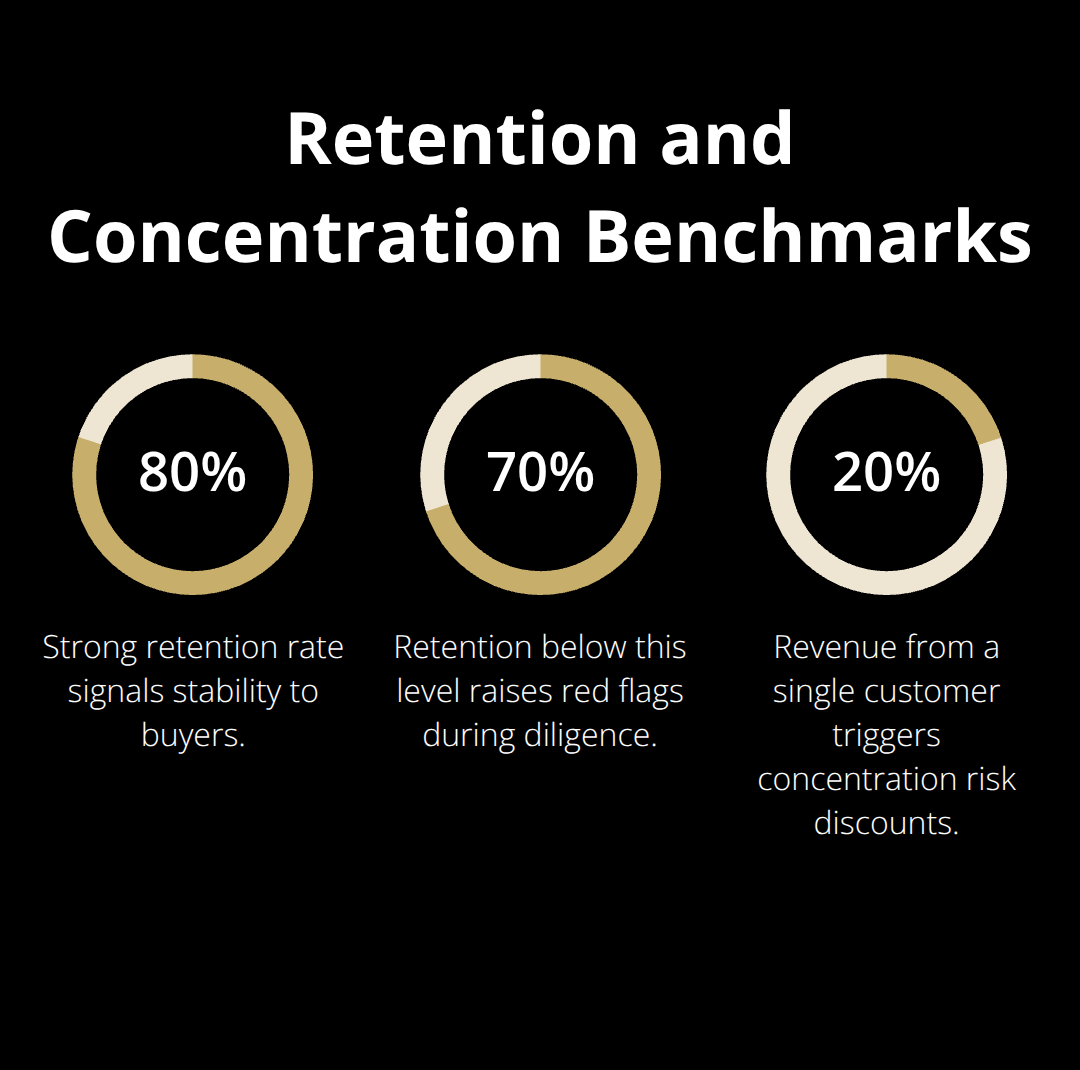
A customer retention rate above 80% signals strength; anything below 70% raises red flags. Diversified revenue streams protect your valuation from sudden loss. When one customer represents more than 20% of your revenue, buyers immediately discount your price because they see concentration risk.
Industry Trends and Competitive Position
Industry trends reshape valuation overnight. A software-as-a-service company in a growing sector commands higher multiples than a declining industry, regardless of current profitability. If your industry is consolidating or facing disruption, your valuation gets discounted. Market position matters because it determines whether you can maintain or grow those profits buyers care about.
Your brand recognition, proprietary processes, or intellectual property also factor in, but only if they genuinely drive customer loyalty or prevent competition. Most owners overstate their brand value. What matters is whether customers would choose you again, not whether you like your logo. Tangible competitive advantages-patents, exclusive contracts, or unique technology-carry real weight. Intangible feelings about your brand do not.
These three factors work together to shape what buyers will actually pay. A business with strong profitability, diversified customers, and favorable industry tailwinds commands premium multiples. A business with the same profit level but concentrated customers in a declining sector gets valued at a steep discount. Understanding which factors work for you and which work against you sets the stage for the next critical step: identifying and fixing the mistakes that tank valuations.
Where Small Business Owners Lose Thousands in Valuation
Projecting Growth That Never Happens
Small business owners project growth that doesn’t materialize, and this mistake costs thousands in lost value. Owners assume their business will grow 20% annually for the next five years, then use those inflated projections to justify a higher valuation today. Buyers ignore your optimistic forecast and focus on what you’ve actually delivered. If your business grew 5% last year and 3% the year before, a buyer assumes similar performance ahead, not acceleration. When you projecting growth that never happens, you price yourself out of the market.
Professional appraisers weight historical performance heavily because it’s real data. A business that has grown consistently at 8% annually gets valued differently than one claiming it will suddenly hit 15% growth with no evidence supporting that jump. Financial projections matter for discounted cash flow valuations, but overestimating them invites litigation and kills deals. The AICPA emphasizes this risk: unrealistic projections undermine credibility with lenders and buyers alike.
Ignoring Industry Headwinds and Market Shifts
The second critical mistake is ignoring what’s happening in your industry right now. A business in a growing sector with tailwinds commands multiples 30% to 50% higher than the same business in a declining industry. If you operate in software-as-a-service and the sector is expanding, your 5x multiple on earnings makes sense. If you operate in print media facing digital disruption, that same 5x multiple is fantasy. Market conditions shift valuation faster than anything else.
Downturns may reduce revenue expectations, increase discount rates, and lower market multiples, which can decrease business value. Ignoring these trends means you price your business wrong and wonder why qualified buyers never show up. Industry consolidation, new regulations, or technological disruption reshape what buyers will pay overnight.
Tangling Personal and Business Finances
The third mistake-mixing personal and business finances-tanks valuations instantly. Owners run personal expenses through the business: vehicle payments for their family car, home office deductions that exceed actual workspace, travel that’s partly personal, insurance that covers personal liability. When your accountant sees this, they normalize those expenses to calculate real Seller’s Discretionary Earnings (SDE).
A business claiming $400,000 in profit but running $80,000 in personal expenses through the books actually generates $320,000 in real discretionary earnings. Buyers see this adjustment immediately. If your records are messy and your personal expenses are tangled with business costs, appraisers discount your valuation because they can’t trust your numbers. Clean financial records command higher multiples because buyers have confidence in what they’re actually purchasing.
Separating these takes discipline: your business credit card only covers business expenses, your personal vehicle isn’t deducted against business income, and your home office is documented precisely. When you walk into a valuation conversation with three years of clean, separated financials, you’ve already won half the battle. The opposite-showing up with commingled expenses and unclear records-signals that you don’t take your business seriously, and buyers price that risk into their offer.
Final Thoughts
You now understand what actually drives small business valuation and where most owners stumble. The three methods-Income, Asset, and Market approaches-provide a framework to calculate a defensible number instead of guessing. Profitability matters infinitely more than revenue, customer concentration directly impacts what buyers will pay, and industry trends reshape value overnight. The mistakes are equally clear: projecting growth that never materializes, ignoring market headwinds, and tangling personal expenses with business finances all tank your valuation.
An accurate valuation gives you negotiating power because you’re not defending a number pulled from thin air-you’re backed by real financial data and comparable market sales. Gather three years of tax returns and financial statements, calculate your normalized SDE or EBITDA by removing one-time expenses, and run all three valuation methods. Find where at least two methods overlap and use that range as your starting point, or hire a professional appraiser with ABV or CVA credentials (costs typically run $5,000 to $20,000) if your financials are messy or your business is complex.
We at Unbroker offer a modern platform for selling your business with transparent pricing and access to a vast buyer network. Whether you choose full-service support or assisted selling, you’ll have the tools and guidance to price your business right and close the deal confidently.