Selling a business means negotiating with buyers who have very different goals than you do. Most sellers go into these conversations without professional support, which puts them at a disadvantage from day one.
At Unbroker, we’ve seen how the right negotiation support tools can shift the balance in your favor. The difference between walking away with a fair price and leaving money on the table often comes down to having the right resources at your fingertips.
What Separates Buyers and Sellers at the Negotiation Table
Buyers in M&A deals operate with a fundamentally different playbook than sellers. A buyer’s goal is to acquire your business at the lowest possible price while minimizing their risk exposure. They arrive with teams of accountants, lawyers, and due diligence specialists whose job is to find problems, uncover hidden liabilities, and justify price reductions. Sellers, by contrast, typically show up alone or with a single advisor, armed mainly with emotion and hope.
The Buyer’s Coordinated Advantage
According to Dentsu’s B2B Superpowers Index 2024, 77% of all buying processes now use AI.

Buyers coordinate across finance, legal, operations, and executive leadership to apply pressure from multiple angles simultaneously. They use specific tactics to shift momentum: they anchor artificially low opening offers, introduce surprise due diligence findings late in negotiations, create artificial urgency by threatening to walk away, and fragment your focus by raising separate objections through different stakeholders.
Common Buyer Tactics That Reduce Your Price
One common tactic is the holdback strategy, where buyers propose keeping a percentage of the purchase price in escrow or trust to cover potential post-closing liabilities they discover during due diligence. This isn’t a negotiation-it’s a calculated risk transfer that protects them while you absorb the uncertainty. Another frequent move is the working capital adjustment, where buyers claim your business needs more cash to operate than you documented, reducing the final payout.
Why Sellers Negotiate Without Professional Support
Most sellers lack professional negotiation support because they assume selling a business is straightforward. They believe their accountant or a general business advisor can handle it, or worse, they think they can manage buyer conversations themselves. This assumption costs them significantly. Research shows that without negotiation training, sellers concede too quickly, causing value erosion that compounds throughout the deal. A 1% price reduction might seem minor, but it translates to roughly an 11% change in operating profits.
The gap widens further when you consider that final deal value depends not only on headline price but on structure: milestone payments, earnouts, and holdbacks can substantially reduce net proceeds compared to cash-at-close. Sellers also lack visibility into what buyers actually need versus what they claim to need. Buyers are trained to separate wants from needs and exploit information asymmetries. They’ll demand extensive customer lists, operational manuals, and financial records during due diligence, then use any gap or inconsistency as justification to renegotiate downward.
The Due Diligence Phase: Where Leverage Shifts
Without structured support, sellers respond emotionally or defensively, weakening their position further. The reality is that a typical middle-market M&A process timeline often takes six to nine months from pre-marketing through closing. Sellers who enter this phase unprepared face a choice: accept whatever offer emerges or walk away empty-handed after months of work. This imbalance is exactly why negotiation support tools exist-they equip you with the visibility, documentation, and strategic framework that buyers already possess, transforming a one-sided conversation into a genuine negotiation where both parties operate from comparable positions.
Tools That Keep You in Control During Negotiations
Negotiation support tools solve a specific problem: they eliminate the information gap that buyers exploit. When a buyer’s team coordinates across multiple departments while you manage everything alone, you operate blind.
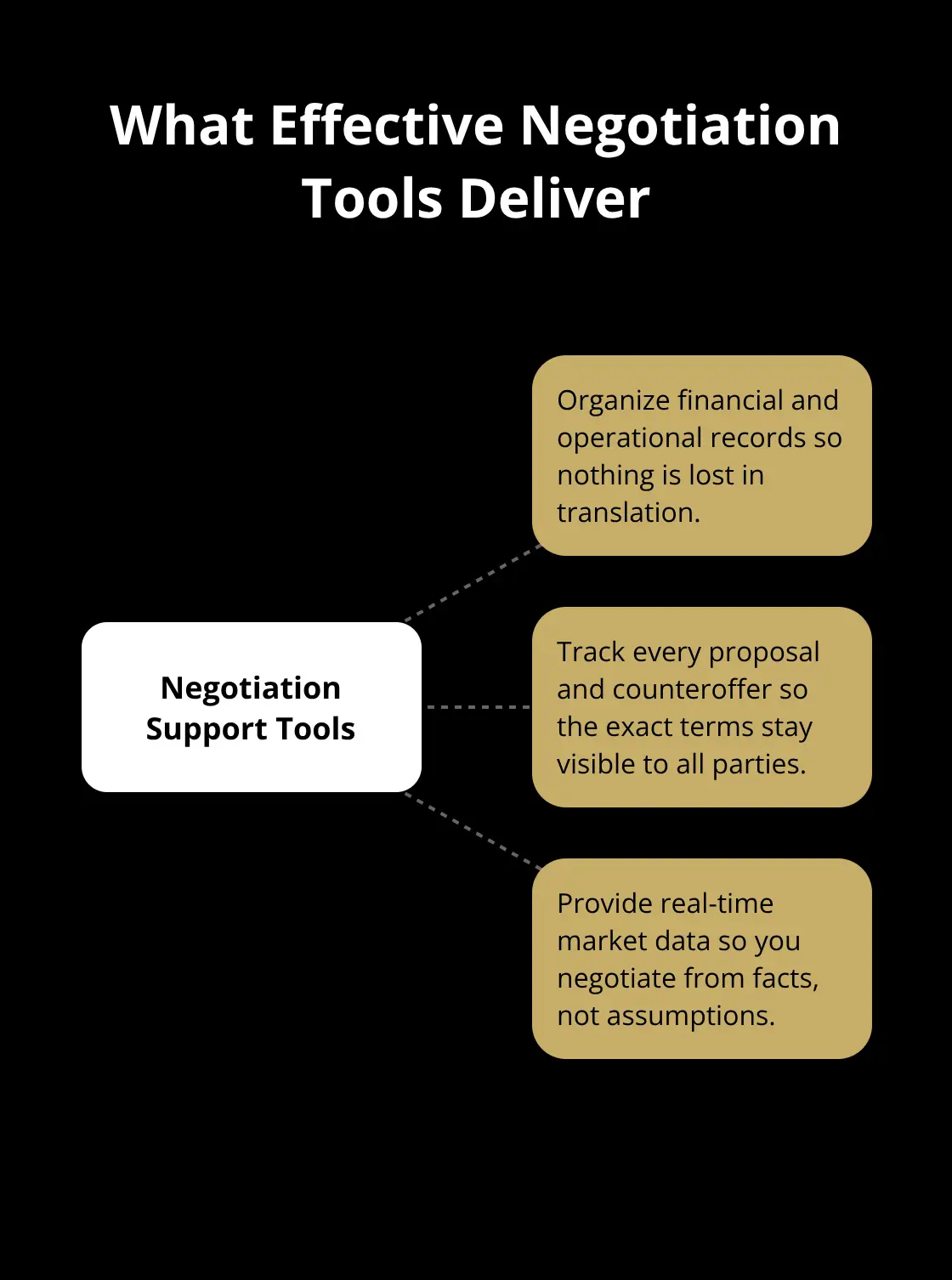
Modern negotiation assistance tools give you the visibility, documentation standards, and communication infrastructure that level this imbalance. The most effective tools accomplish three things simultaneously: they organize your financial and operational records so nothing gets lost in translation, they track every proposal and counteroffer so you never lose sight of what sits on the table, and they provide real-time market data so you negotiate from facts rather than assumptions.
Document Management: Your First Line of Defense
Buyers request hundreds of items during due diligence-customer contracts, employee agreements, tax returns, equipment lists, insurance policies, lease agreements, and more. Without a centralized system, these documents scatter across email, cloud storage, and physical files. When a buyer questions a number or finds a discrepancy, you waste days locating the supporting documentation. Gaps in your records signal weakness to the other side.
Centralized platforms handle this by organizing all materials in one location with version control, so every stakeholder accesses the current document and you maintain an audit trail of what was shared and when. This matters because the due diligence phase is where most price adjustments happen. Price reductions during due diligence average 5–15% below the initial offer, and many of those reductions stem from missing documentation or inconsistent records.
Template libraries within these platforms accelerate preparation further. Instead of drafting representations, warranties, and indemnification language from scratch, you pull pre-built frameworks that legal counsel has already vetted. This speeds up the process and prevents costly omissions that buyers exploit later.
Proposal Tracking: Preventing Contradictions
B2B deals typically involve around 13 stakeholders across multiple departments, making it easy for conversations to contradict each other. One buyer representative might agree to a price adjustment in a phone call while another requests it in writing, leaving you uncertain about what actually stands. Platforms with proposal tracking and version control prevent this confusion.
Every offer, counteroffer, and conditional term appears in a single record that all parties reference. When a buyer claims they never agreed to a certain earnout structure or payment schedule, you pull the exact proposal from the system with timestamps. This shifts the conversation from he-said-she-said to documented fact, which strengthens your negotiating position considerably.
Valuation Tools: Anchoring Your Position
Most sellers rely on a single valuation from their accountant or advisor, then negotiate against a buyer’s valuation without independent verification. Market-comparable analysis tools pull recent comparable sales data, EBITDA multiples for your industry, and adjusted earnings benchmarks so you enter negotiations with multiple independent valuation approaches rather than one.
This matters because buyer opening offers are often anchored artificially low-they expect you to counter. If your valuation rests on a single number and theirs rests on market data showing your business should trade at a higher multiple, you lose credibility in the negotiation. Tools that aggregate real transaction data from your industry sector give you the anchor instead, transforming what could be a one-sided conversation into a discussion grounded in evidence.
These features transform negotiations from emotional exchanges into structured conversations where documentation, market evidence, and transparent communication trails replace guesswork. With this foundation in place, you’re ready to move beyond defensive positioning and into the strategies that actually shift deal outcomes in your favor.
How to Structure Offers That Buyers Can’t Refuse
The structure of your offer matters more than most sellers realize. A $5 million all-cash deal at closing is fundamentally different from $4.5 million cash plus $500,000 in earnouts over two years, even though both claim the same headline number. Buyers understand this distinction intimately. They negotiate price aggressively because they control the conversation around terms. Your job is to flip that dynamic by proposing structures that protect your interests while appearing flexible to the buyer.
Separate Your Needs From Your Negotiating Room
Start by identifying what you actually need versus what you’re willing to negotiate. You need certainty and liquidity at closing. You should not accept terms that push risk onto you after the sale concludes. Earnouts and holdbacks sound reasonable until you realize the buyer controls whether those conditions are met. If the buyer’s management team underperforms post-acquisition, they’ll claim your business didn’t hit its targets and withhold your earnout. Holdbacks create the same problem-the buyer sits on your money for twelve to twenty-four months while you chase documentation requests to prove liabilities don’t exist.
This is why structuring your initial offer around maximum cash-at-close strengthens your position immediately. When you propose an offer with 90% cash at closing and only 10% contingent on standard reps and warranties, you signal confidence in your business. Buyers respond to confidence. They interpret it as a business that’s clean, well-documented, and unlikely to harbor surprises. That confidence shifts their negotiating tone from aggressive to collaborative.
Use Evidence to Counter Demands for Risk Protection
If a buyer pushes back and demands higher earnouts or larger holdbacks, you’ve learned something valuable: they’re uncertain about your business quality or your ability to transition smoothly. That uncertainty is precisely what documentation helps you address. You should document your customer retention rates, employee stability, and operational consistency with hard evidence. Pull industry benchmarks customer churn sits below sector averages. Reference your EBITDA stability over the past three years. This evidence transforms an abstract negotiation into a fact-based conversation where the buyer’s demands for risk protection lose credibility.
Coordinate Across Multiple Buyer Conversations
Managing multiple buyer conversations simultaneously is where most sellers lose control entirely. You’re fielding calls from the buyer’s CFO about working capital, their operations team about staffing plans, their legal counsel about representations and warranties, and their integration lead about customer transition timelines. Without a system tracking these conversations, you’ll contradict yourself. One representative hears you say customer contracts can transfer immediately. Another hears you say they require thirty days’ notice. The buyer’s team compiles these contradictions into a list of discrepancies, then uses them to justify price reductions during due diligence.
Centralized communication platforms eliminate this vulnerability. Every conversation, every agreement, every conditional statement gets recorded in one place that all parties reference. When the buyer’s CFO claims you promised a working capital adjustment and their legal team disputes it, you pull the exact communication thread showing what was actually agreed. This shifts power back to you because documentation beats memory.
The secondary benefit is momentum control. If buyer conversations stretch across three weeks with no documented progress, momentum dies and the deal enters limbo. Platforms that track proposals, responses, and outstanding items keep conversations moving forward. When you can see that the buyer’s finance team hasn’t responded to your working capital documentation in eight days, you send a targeted follow-up that references the specific request and proposed timeline. This professionalism keeps the deal alive and signals you’re organized and serious about closing.
Know Your Walk-Away Number and Defend It
Knowing when to walk away separates experienced sellers from those who leave money on the table. Most sellers develop emotional attachment to a deal after months of negotiation. They’ve imagined the sale, planned what they’ll do with proceeds, and mentally moved on from the business. This emotional investment clouds judgment.
A buyer who starts at $4 million and slowly negotiates to $3.6 million feels like progress. In reality, that $400,000 reduction represents roughly 10% of your enterprise value. If your business generates $500,000 in EBITDA, a 10% price reduction equals twenty months of profit. That’s not a minor negotiating move. It’s a massive value transfer.
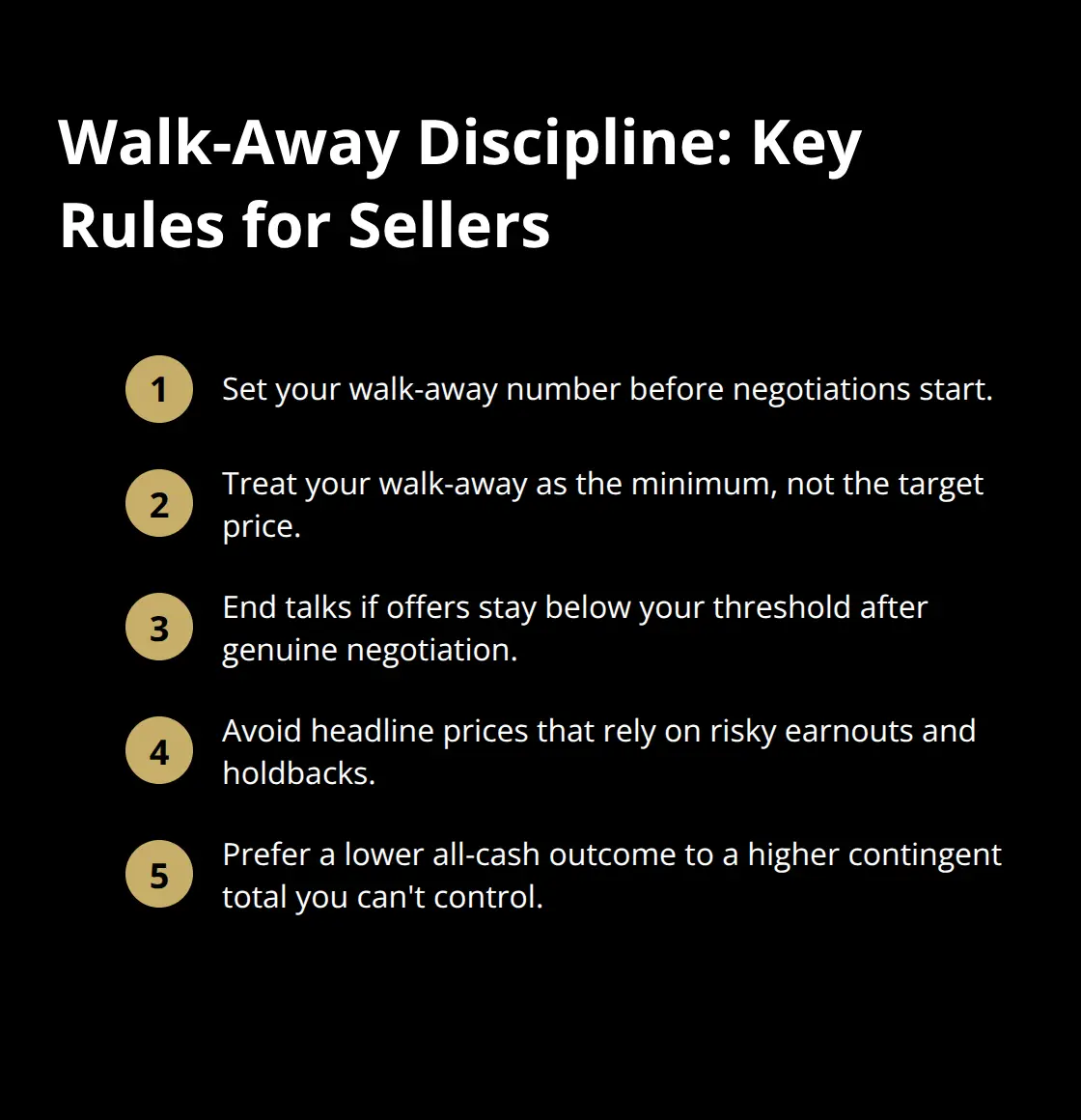
Set your walk-away number before negotiations start and stick to it. Your walk-away isn’t your target price. It’s the absolute minimum below which you’ll stop negotiating and pursue other buyers or hold the business longer. If you establish your walk-away at $3.8 million and a buyer won’t move past $3.6 million after genuine negotiation, you walk. This isn’t failure. It’s discipline. The buyer knows you’re serious because you demonstrated it. That seriousness often triggers movement. Buyers who believe you’ll accept any price keep squeezing. Buyers who see you’re willing to end the conversation often find additional budget or adjust their structure to meet your minimum.
The walk-away also protects you from bad deals disguised as victories. A buyer might offer $4.2 million headline price but structure it as $3 million cash at close plus $1.2 million in earnouts dependent on hitting aggressive growth targets you can’t control. Your business grows 5% annually, not 20%. The earnout never pays. You accepted a deal that looks good on paper but delivers $3 million in actual proceeds. Walking away from that deal and finding a buyer willing to pay $3.8 million all-cash is the better outcome, even though the headline number is lower.
Final Thoughts
Selling your business without negotiation support tools puts you at a structural disadvantage from the moment conversations begin. Buyers arrive with coordinated teams, documented strategies, and systems designed to extract maximum value, while you arrive alone. That imbalance compounds through every phase of the sale, from initial offers through due diligence and into final closing.
Negotiation support tools eliminate the information gap that buyers exploit by organizing your documentation, tracking every proposal, and providing market data so you negotiate from evidence rather than emotion. Sellers who use structured negotiation support typically preserve 5 to 15 percent more value during due diligence compared to those who negotiate without documentation systems or market validation. These capabilities shift the conversation from one-sided pressure into genuine negotiation where both parties operate from comparable positions.
At Unbroker, we’ve built negotiation support directly into our platform because we believe sellers deserve the same professional infrastructure that buyers take for granted. Explore how Unbroker can support your business sale and take control of the process that determines your financial future.