Most business owners spend years building value but never plan how to capture it. At Unbroker, we’ve seen sellers leave hundreds of thousands on the table simply because they started too late.
Exit planning basics aren’t complicated, but they do require strategy. The difference between a rushed sale and a profitable one often comes down to preparation.
Why Exit Planning Actually Matters
Most business owners underestimate what poor exit planning costs them. Research shows that 30% of family businesses make it to the second generation, and only about 10-15% reach a third generation. These failures rarely stem from bad operations-they stem from owners who never developed a clear exit strategy. Without planning, you’re essentially hoping for the best while competitors with structured exits capture significantly higher valuations. The gap between a planned exit and an unplanned one often reaches hundreds of thousands of dollars, sometimes millions depending on business size. Starting your exit plan now, even if you’re 5-10 years away from selling, fundamentally changes what your business is worth and who will want to buy it.
What Happens When You Wait Too Long
Waiting until you’re ready to sell is the most expensive mistake a business owner makes. Most business brokers recommend starting your exit plan 5-7 years before your target exit date. That timeline isn’t arbitrary-it’s how long it takes to fix the operational and financial weaknesses that buyers scrutinize. If you start planning just 1-2 years before selling, you’ll face compressed timelines, limited buyer interest, and severely reduced negotiating power. Buyers will notice that your financial records are disorganized, your key employees lack documentation of their roles, or your systems depend entirely on you. These red flags tank valuations.
One common mistake is failing to separate yourself from daily operations. Buyers want to purchase a business they can run without you, not a job where they’re dependent on the owner. If your business can’t function without your personal involvement, expect a valuation discount. Another costly error is ignoring your balance sheet. Clean, audited financials backed by 3-5 years of solid records signal professionalism and stability. Sloppy bookkeeping or inconsistent reporting forces buyers to discount heavily for risk and hidden liabilities.
The Eight Value Drivers That Require Time
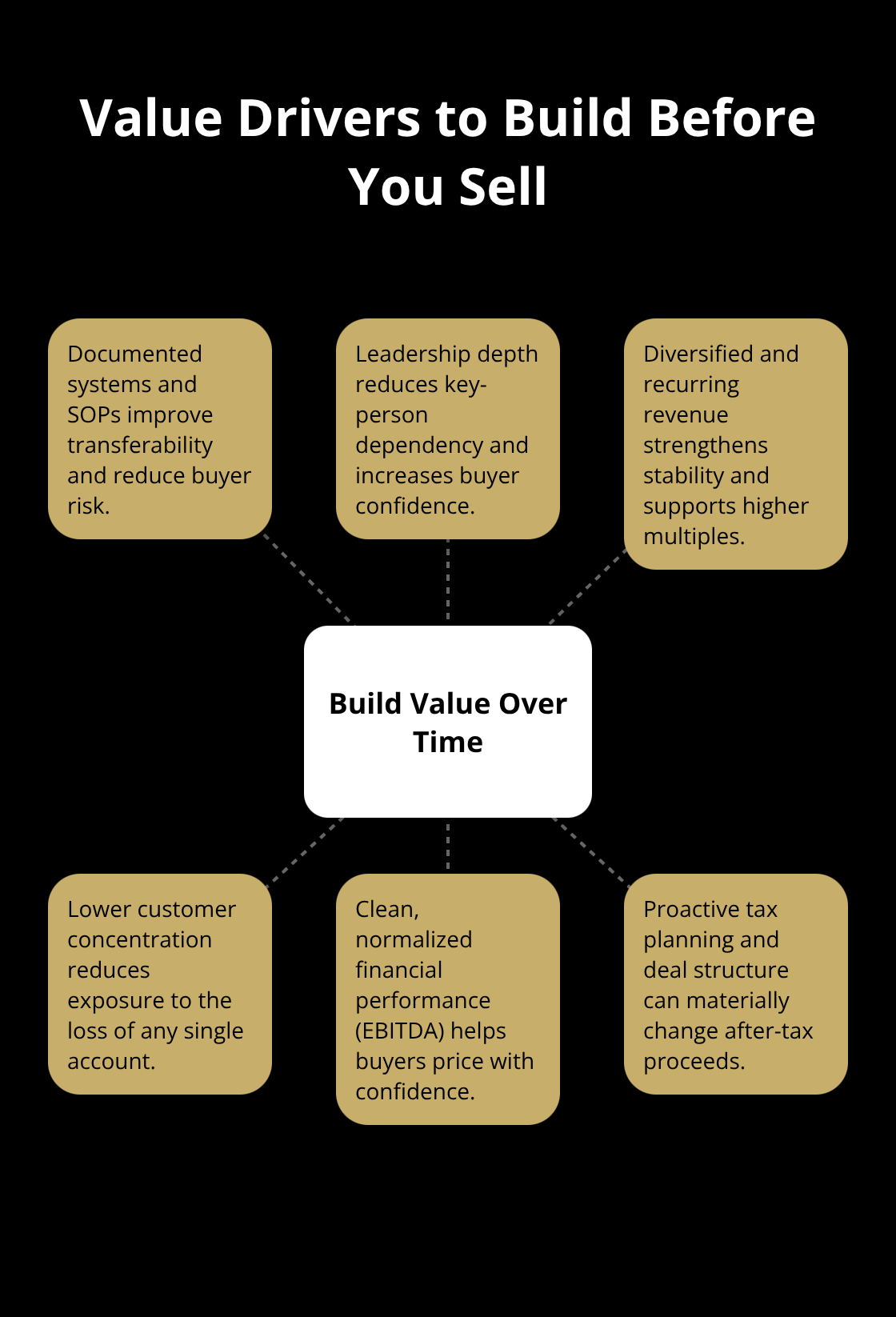
Businesses with documented systems and processes sell for measurably higher prices. The eight key drivers of business value include management, customer base, competition, financial performance, and sales and marketing distribution. You can’t build management depth in six months. You can’t prove recurring revenue patterns without years of data. You can’t show independence from a single customer if that customer represents 40% of your revenue.
Early planning gives you time to diversify revenue, develop your leadership team, and eliminate operational bottlenecks. Sellers who invest time in these areas consistently achieve valuations 15-25% higher than those who rush. Additionally, tax planning tied to your exit structure matters enormously. The difference between an asset sale and a stock sale, for example, can swing your after-tax proceeds by tens of thousands of dollars. These decisions require months of professional guidance from accountants and tax advisors, not weeks.
How Your Financial Structure Shapes Your Exit
Your financial records form the foundation of every buyer conversation. Clean, organized financials backed by 3-5 years of audited statements signal that you’ve run a professional operation. Buyers scrutinize your balance sheet, income statement, and cash flow statements to identify hidden liabilities or inconsistencies. Disorganized records force them to assume the worst and discount your valuation accordingly. The work you do now-normalizing your EBITDA, documenting unusual expenses, and explaining revenue fluctuations-directly impacts what a buyer will pay. This preparation takes months, not days. Your next step involves getting your financial house in order and identifying the operational weaknesses that buyers will target during due diligence.
Getting Your Business Sale-Ready
Organize Financial Records That Buyers Will Trust
The gap between having financial records and having sale-ready financial records is enormous. Most business owners keep books for tax purposes, not for buyer scrutiny. Buyers request 3-5 years of audited or reviewed financial statements, tax returns, and bank statements. They comb through every line item looking for inconsistencies, one-time expenses, or inflated costs that shouldn’t exist post-sale.
You need to normalize your EBITDA now, which means identifying expenses that a new owner won’t actually incur-your personal vehicle, inflated salary, or family members on payroll doing minimal work. When you normalize these items, you show buyers what the business actually earns under standard operating conditions. Hire a CPA or accountant experienced in business sales to audit your last three years of financials. Don’t wait until a buyer asks for them. The cost upfront saves you tens of thousands in negotiation leverage.
Document Everything That Proves Stability
Beyond financials, organize your contracts, customer agreements, lease terms, and any intellectual property documentation. Buyers want proof that your revenue is stable and not dependent on relationships that evaporate once you leave. Organize every process-how you onboard clients, handle customer service, manage inventory, or fulfill orders. Create standard operating procedures for critical functions so a new owner can hand them to an employee and have operations continue smoothly. This documentation typically takes 2-4 months depending on business complexity, so start now.
Eliminate Key Person Dependencies
Operational weaknesses kill deals faster than anything else. Buyers immediately discount valuations when they discover that your business can’t function without you, that your top three customers represent 60% of revenue, or that your systems exist only in your head. Identify your key person dependencies and begin solving them now. If your business relies on one salesperson, one technician, or one relationship, that’s a valuation killer. Develop backup personnel, cross-train employees, or document how you’d replace that function if needed. Buyers specifically assess whether the business can operate independently from you. If it can’t, expect a significant valuation reduction.
Reduce Customer Concentration Risk
Clean up your customer concentration immediately. If one customer represents more than 15% of revenue, buyers will heavily discount the risk that this customer leaves post-sale. Work now to diversify your revenue base or secure long-term contracts with major customers that extend beyond your ownership transition. These steps take months to execute properly, and buyers will scrutinize them during due diligence. The strength of your customer relationships and the stability of your revenue streams directly determine how aggressively a buyer will bid for your company.
Choosing Your Sales Partner
The decision between handling your sale yourself or hiring professional support often comes down to two factors: how much time you can invest and whether you can afford to make costly mistakes. Most business owners underestimate both. Business broker commission structure typically ranges between 5% and 10% of the final sale price, plus potential retainer fees. That fee structure incentivizes brokers to close quickly rather than maximize your value. Modern platforms have disrupted this model entirely. Instead of high double-digit commissions, a much lower success fee lets you keep substantially more of what you earn. The trade-off is clear: lower costs demand more of your time and decision-making ability. If you have 10-15 hours per week to manage buyer communications, negotiate terms, and coordinate due diligence over 6-12 months, a DIY or assisted approach works. If your schedule doesn’t allow that commitment, full-service support becomes necessary despite the higher cost.
Traditional Brokers: Speed Over Value
Traditional brokers handle everything from marketing your business to closing the deal. They maintain exclusive buyer networks, conduct valuation assessments, manage confidentiality, and negotiate on your behalf. The advantage is straightforward: you stay focused on running your business while professionals handle the sale. The disadvantage is equally clear. That commission structure means brokers earn more when they close faster, not when they maximize your price. Additionally, exclusive agreements lock you into one broker for 6-12 months, which eliminates your ability to shop for better terms or take advantage of multiple interested buyers simultaneously. When you evaluate brokers, transparency and cost-efficiency matter more than the false comfort of traditional brokerage. Full-service options make sense only if you genuinely cannot dedicate time to the process or if your business is complex enough to require extensive hand-holding. For most owners, the commission cost far outweighs the convenience benefit.
Modern Platforms: Control and Lower Costs
Modern platforms offer two distinct advantages: dramatically lower costs and genuine control over the process. A DIY approach means you list your business, manage inquiries, conduct initial conversations, and negotiate directly with buyers. You handle marketing, screening, and deal structure decisions. This requires significant time investment, typically 10-15 hours weekly for several months, but you retain complete control and avoid hefty commissions. Assisted platforms split the difference. These services provide the infrastructure, buyer access, and expert guidance while keeping costs low. Unbroker’s Full Service Business Sale charges a 6% success fee, paid only when your business sells. Both include legal templates, negotiation support, and access to a vetted buyer network enhanced by AI-driven matching. This structure aligns incentives correctly: the platform succeeds when you succeed, not when you rush.
The Financial Reality of Your Choice
Research on business sales shows that owners who maintain control over the process and work with platforms charging a lower success fee typically retain more of the sale price compared to traditional brokerage arrangements, which charge 8-12% commissions. With Unbroker’s 6% success fee, that difference can mean $20,000-$60,000 staying in your pocket on a $1 million sale. The time investment required for DIY or assisted selling (10-15 hours weekly) translates to real money saved. If you value your time at $100 per hour, that’s $1,000-$1,500 weekly, but you still come out ahead financially compared to paying a commission between 5% and 10%. Assisted platforms offer a middle ground: you invest moderate time while professionals handle complex negotiations and buyer screening. Unbroker’s 6% success fee, paid only when your business sells, represents a fraction of what traditional brokers extract.
Matching Your Situation to the Right Approach
Your choice depends on three factors: available time, business complexity, and your comfort with negotiations. If you have limited availability and your business involves intricate contracts or multiple revenue streams, full-service support may be necessary. If you can dedicate 10-15 hours weekly and your business is relatively straightforward, DIY or assisted platforms deliver superior financial outcomes. If you want expert guidance without the full-service price tag, assisted platforms bridge that gap. The wrong choice costs you tens of thousands of dollars. The right choice keeps that money in your account.
Final Thoughts
Exit planning basics come down to three decisions: when you sell, how you prepare, and who executes the sale. Waiting costs money-sometimes hundreds of thousands of dollars. Starting 5-7 years before your target exit date gives you time to clean up financials, document systems, reduce key person dependencies, and diversify revenue. These steps aren’t optional if you want maximum value.
If you’re 5-10 years from selling, start organizing your financial records immediately and identify operational weaknesses. Hire a CPA to normalize your EBITDA and audit your last three years of statements. Document your processes, cross-train employees, and work to reduce customer concentration. These actions take months, and you can’t compress them into weeks without sacrificing value.
Once your business is sale-ready, choose your sales partner carefully. Traditional brokers extract 5-10% commissions and prioritize speed over price. Modern platforms offer dramatically lower costs and align incentives with your success. At Unbroker, we’ve built a platform with a simple, aligned fee structure-our Full Service Business Sale charges a 6% success fee, paid only when your business sells. This includes legal templates, negotiation support, and access to a buyer network enhanced by AI-driven matching. Owners who work with a lower success-fee platform like Unbroker can keep significantly more of the sale price compared to traditional brokerage; on a $1 million business, a 6% fee versus a 10% commission means $40,000 more stays in your account. Start your exit planning with Unbroker and keep more of what you’ve built.